
Custom Cleaning Brush
Dust Collector Filter Element Cleaning Brush
Dust collector filter element cleaning brush with soft nylon filaments for pleated cartridge and bag filters, matched to pleat spacing, depth, and media.
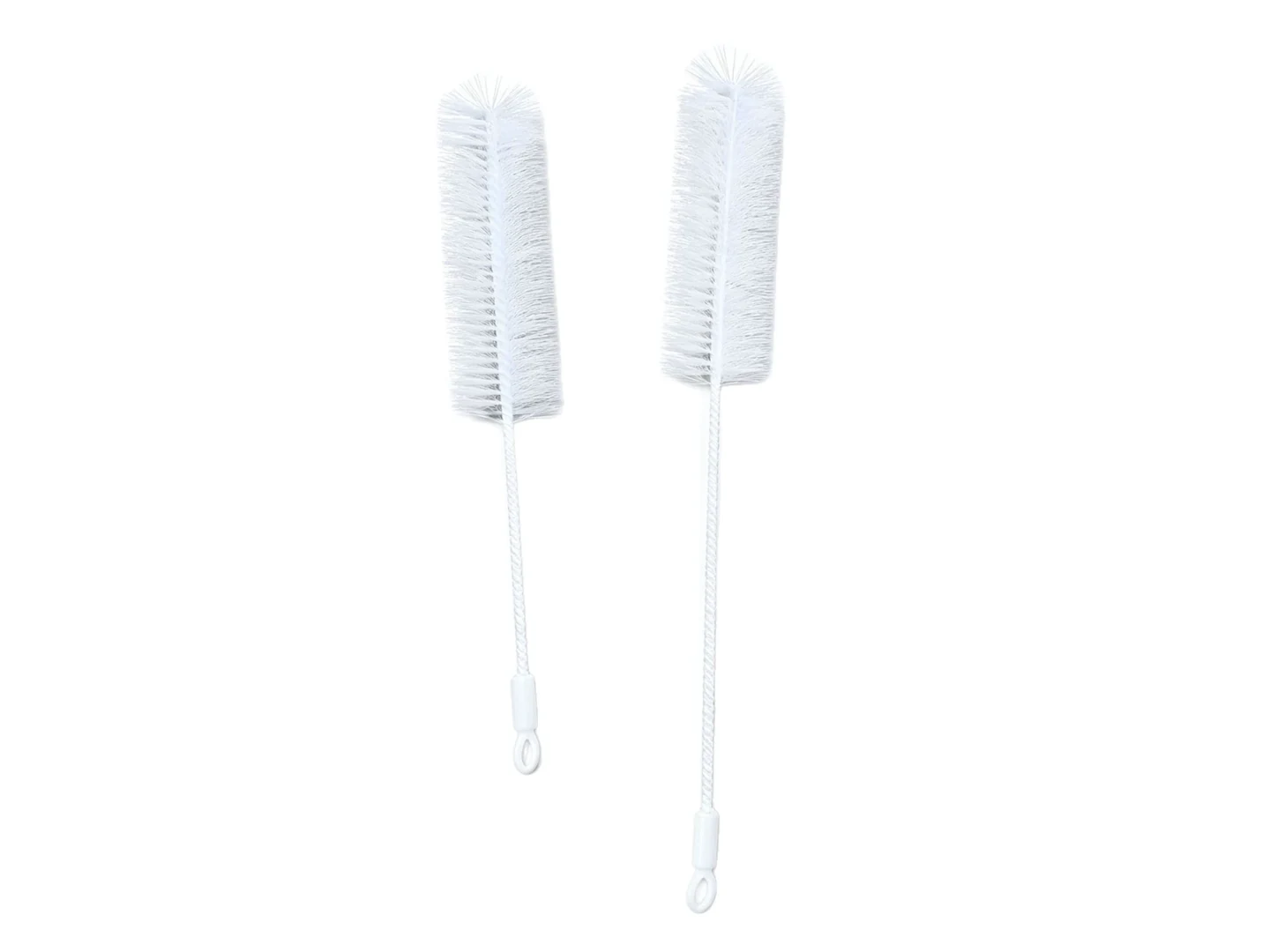
Small brush
500 pcs
Minimum order
Held in one hand: tube, bottle, detail and swab brushes — including long-handled ones with a small head.
Production lead time, once the specification is confirmed
- Up to 500 pcsWithin 7 days
- 501–50,000 pcsWithin 14 days
- Over 50,000 pcsWithin 21 days
Peak season can extend these times; the shipping date is confirmed in writing with your quotation. Sampling and shipping are quoted separately.
A long-reach, soft-filament maintenance brush for cleaning pleated cartridge elements and bag filters in dust collection systems. Head profile, filament trim, and stiffness are matched to pleat spacing, pleat depth, and filter media so operators can remove caked dust without tearing, gouging, or embedding particles into the media.
What can this brush do for you?
Cleans the Full Depth of Pleated Valleys, Not Just the Tips
Pleated filter media only releases dust when the brush actually reaches the valley floor between folds. A head width matched to the pleat gap and a filament trim that extends to the base of the valley let each stroke contact both sidewalls without flattening or pinching the pleats together. Flat, one-size brushes stop at the outer pleat tips and leave the heaviest deposit untouched.
Breaks Up Dust Cake Without Forcing It Deeper Into the Media
Fine powder that compacts on a filter surface needs shear, not stabbing. Rounded or flagged nylon filament tips lift the cake at the media interface and let loosened dust fall toward collection or vacuum extraction. Stiff wire or sharp-cut synthetic tips tend to push particles into the pores and can permanently raise pressure drop.
Protects Coated and Membrane Filter Media
PTFE membranes, nanofiber layers, and base cellulose/polyester blends fail quickly under metal bristles or heavy scraping. Nylon PA6/PA6.6 fill in a diameter range selected for the media type gives enough agitation to remove dry residue while staying below the abrasion threshold that lifts fibers, smears coatings, or opens pinholes in the membrane.
Keeps the Operator Out of the Dirty Air Stream
Long fixed handles or threaded extension sections are sized to the element height so maintenance technicians can work from the floor or platform without leaning into the collector housing. The result is better stroke control along the full element length and less exposure to respirable dust during offline cleaning.
Reduces Static Re-Deposition in Powder-Handling Systems
For fine organic, polymer, or combustible powders, an antistatic or conductive nylon filament option dissipates surface charge generated by dry brushing. Dust releases more cleanly instead of immediately re-attaching to the media or surroundings. The filament choice is made at the time of specification, not added later as a coating that wears off.
What is a Dust Collector Filter Element Cleaning Brush?
A dust collector filter element cleaning brush is a hand-guided maintenance tool built for periodic, offline cleaning of the dirty side of pleated cartridge elements, baghouse filter bags, and similar cylindrical filter media. It combines a narrow or flat brush face, soft nylon filament fill, and a long handle or extension system so a technician can sweep across the media face without damaging the filter structure.
In use, the operator works along the pleat direction from end cap to end cap, using pull strokes with light to moderate pressure. On cartridge elements, the element is normally supported on a stand, sawhorse, or rotating fixture; on bag filters, the brush moves down the outside surface while a vacuum nozzle captures loosened dust. The head may be single-face for one-sided contact or double-face to sweep two adjacent pleats in one pass.
The tool is not an online cleaning device and it is not a replacement for the dust collector’s reverse-pulse, shaker, or sonic cleaning system. It is used during scheduled maintenance when surface dust cake remains after normal cleaning cycles, or when a filter has been removed for inspection and needs manual recovery before it is returned to service.
Because every filter element has a specific pleat depth, pleat spacing, media type, and length, the brush is configured around those dimensions rather than sold as a universal item. That is the key difference between a functional filter cleaning brush and a general-purpose brush that happens to be soft.
Technical Specifications
The values below are typical for dust collector service. Final dimensions, filament grade, and handle reach are matched to your filter element.
| Parameter | Typical range / options | Selection note |
|---|---|---|
| Brush form | Handheld maintenance brush; single-face or double-face head | Head can be flat, tapered, or angled to reach end caps and pleat roots |
| Fill material | Nylon PA6 or PA6.6, straight or crimped; antistatic/conductive nylon option | Non-metallic, filter-safe; no wire against media |
| Filament diameter | 0.15–0.40 mm for soft grades; 0.40–0.60 mm for medium grades | Softer diameters for membrane/coated media; medium for woven synthetics |
| Filament trim length | 30–60 mm | Matched to pleat depth so tips reach valley floor without bottoming on core |
| Filament tip finish | Rounded, flagged, or fused | Reduces scratching and fiber shedding on media |
| Head length | 200–450 mm | Selected to cover several pleats per stroke; longer for bag cleaning |
| Head width / depth | 20–50 mm | Sized to enter pleat gap without forcing sidewalls apart |
| Overall length | 500–1000 mm fixed; telescopic/extension up to 1800 mm | Based on element height and required reach from safe position |
| Handle | Polypropylene, fiberglass, or aluminum with polymer grip; threaded joints | D-grip or straight; replaceable head with locking sleeve |
| Operating temperature | -20°C to 80°C continuous for nylon fill | Higher temperatures require material review before specification |
| Chemical exposure | Good resistance to dry powders, mild alkalis, light oils; not for strong acids, hot solvents, or wet adhesive residues | Always test on a small area if detergent is used |
| Fitting / interface | Threaded sleeve, quick-connect, or fixed base | Replaceable head option for multi-element service |
| Brush type | Custom Handheld Detail Brushes | |
| How it is driven | Hand-guided | |
| Cleaning target | pleated cellulose and polyester cartridge filter, baghouse filter bag, and cylindrical and oval filter element cleaning | |
| Surface or part | filters, pleats, profiles, drums, gaps, dosing wheels, transfer points, and nozzles | |
| Residue or debris | dust, dust cake, powder, particles, fine powder, and fine dust | |
| Mounting / connection | Threaded sleeve, quick-connect, or fixed base |
Where does this brush work best?
- Pleated cellulose and polyester cartridge filters in cartridge dust collectors, powder coating booths, fume and smoke extractors, and industrial vacuum systems.
- Baghouse filter bags with surface dust cake or localized blinding, when the bag supplier confirms brushing is acceptable for the fabric.
- Cylindrical and oval filter elements with high pleat counts where the gap between pleats traps fine dust.
- Drum and bin vent filter elements exposed to fine powders from mixers, mills, silos, and transfer points.
- Static-charged powder systems when the brush is configured with antistatic or conductive nylon filaments.
- Adjacent powder-contact surfaces maintained during the same downtime window, such as hopper screens, dosing wheel pockets, and enclosure rails.
How do I choose the right one?
Start with the filter element geometry
Measure pleat spacing at both tip and base, pleat depth, element or bag diameter, and overall length. Use these numbers to set head width, trim length, and handle reach. A head that is too wide spreads pleats and folds media; a head that is too narrow requires many extra strokes and slows the maintenance window.
Match filament stiffness to the media
| Filter media type | Recommended filament | Typical diameter |
|---|---|---|
| ePTFE membrane, nanofiber, coated cellulose | Soft nylon, rounded or flagged tips | 0.15–0.25 mm |
| Cellulose / polyester blend pleated media | Soft to medium nylon | 0.20–0.35 mm |
| Woven synthetic filter bags, rigid mesh | Medium nylon, crimped | 0.35–0.60 mm |
| Metal support structures only | Wire or heavy scrub brush (never on media) | Not applicable to filter face |
Do not use wire, brass, or steel bristles on filter media. Metal fills tear pleats, puncture membranes, and leave conductive fragments that can migrate into product or damage downstream equipment. Keep wire brushes for metal support frames and housings, and only when those parts are removed or isolated from media.
Choose the working face
Single-face head for one side of a pleat or a flat bag area. Double-face head for sweeping two facing pleat walls in one stroke. Angled or tapered head for end-cap shoulders, pleat roots, and transition areas. If you need to reach inside the element core, specify a separate core brush; do not reverse a head through the media.
Set the reach from a safe working position
Handle length should allow full vertical coverage without the operator leaning into the collector. For elements above 1 m, use threaded or telescopic extensions. A D-grip or T-grip improves wrist control during long pull strokes. The head should arrive at the far end cap without the operator stretching.
Decide between antistatic and standard nylon
Use antistatic or conductive nylon when the dust is combustible, aggressively hygroscopic, or static charge makes it re-attach after brushing. Standard nylon is sufficient for coarse mineral dust and non-critical maintenance. The plant’s hazardous-area classification determines additional procedures; brush material selection supports that program rather than replacing it.
When a different tool is the right choice
If the visible deposit is loose and sits only on the surface, a HEPA vacuum nozzle may remove it without brushing. If the filter media is already wet, oil-saturated, or torn, do not brush it; replace the element. If the pleats are collapsed or permanently compressed, the element needs replacement, not manual cleaning. And if the pressure drop stays near the alarm point after pulse cleaning and manual brushing, the media is likely blinded and should be changed.
Can I customize this brush?
This brush is built around the filter element, so nearly every dimension and material can be adapted. To start, provide the filter make and model if available, plus pleat spacing tip/base, pleat depth, media type, element length, diameter, access clearances, residue characteristics, and the available cleaning station layout. A photo or drawing of the element shortens the process.
- Head geometry – length, width, taper, angle, curved profile for drum elements, single- or double-face, detachable or fixed head.
- Filament – nylon PA6/PA6.6, antistatic or conductive nylon, diameter, trim length, tip finish, straight or crimped, color coding by zone.
- Head base / block – polypropylene, nylon, ESD-safe polymer, or replaceable filament strips; metal-free options to avoid media contamination.
- Handle and extension – fixed or telescopic, fiberglass or aluminum with insulated grip, D-grip/T-grip, threaded locking joint, hanging loop, total reach.
- Accessories – filter-rotation stand adapter, vacuum port integration, scraper edge for heavy cake around the end cap (not on media).
- Marking and packaging – color coding, permanent marking of part number or zone, bulk cartons, individual poly bags, or maintenance-kit packaging.
For regulated or demanding sites, we can help coordinate material declarations, third-party testing, inspection reports, and documentation as part of the project specification. Compliance with site-level standards is handled per order, not assumed as a stock product attribute.
Which filament survives the cleaning chemicals a dust collector filter element cleaning brush meets?
How can I tell whether the brush is too aggressive for my filter media?
Clean a small marked section and then inspect the media under good light. Look for lifted fibers, fuzz, visible scratches on the membrane, or dust appearing on the clean-air side. Wipe the clean side with a white cloth; if particulate transfers through, the filament diameter, pressure, or stroke direction is too aggressive. Switch to softer filaments, reduce force, or brush only in the pleat direction before proceeding.
Should I brush the dirty side or the clean side of the element?
Always brush the dirty side, which is the outside of a pleated cartridge or the outside of a standard pulse-jet bag. Brushing the clean side can force captured particles back through the media and contaminate the clean-air side. If the clean side or interior core needs attention, use a separate approved method and do not scrub through the filter wall.
Can this brush be used while the dust collector is online?
No. Isolate the collector, lock out and tag out the system, verify that airflow has stopped, and follow your confined space and dust-control procedures before using the brush. Brushing releases dust into the air; perform the work in a ventilated maintenance area or with a downdraft bench and HEPA-filtration vacuum, and wear the PPE required by your plant.
Does manual brushing restore a heavily blinded filter?
Only partially. If the differential pressure remains high after normal reverse-pulse or shaker cleaning, brushing can remove accessible surface cake but will not recover media that is deeply loaded, wet, oil-impregnated, or structurally damaged. If brushing improves pressure only briefly and the reading climbs back, replace the element. Brushing is a recovery step, not a cure for exhausted media.
What should I inspect on the brush before each maintenance shift?
Check that the handle and extension joints are tight, the head is secure, and no metal fastener or wear surface is exposed near the filament face. Look for bent, broken, or shedding filaments that could embed in the media. If the head has been used on a different filter element or powder, clean it before reuse to avoid cross-contamination between product lines.
When should I use the antistatic filament option?
Select antistatic or conductive nylon whenever the dust is combustible, electrostatically chargeable, or so fine that it re-attaches to the media after each stroke. The filament reduces charge generation and helps dust release cleanly. The brush itself does not make the process intrinsically safe; grounding, bonding, and hazardous-area procedures must still be managed by the site.
Guides that go deeper on this
Custom Manufacturing RFQ
Describe Your Application
Please share the brush dimensions, working area, residue type, material direction, quantity, and a drawing or photo for quotation.
Drawing or photo optional — it speeds things up, it does not gate the enquiry.
Custom Brush RFQ
Send Your Brush Project
Upload a drawing, product photo, or sample photo and provide the core dimensions and cleaning conditions.
“We need a brush to remove wet residue from a stainless steel conveyor, about 800mm wide. The current brush wears quickly. We can send photos.”
“We sell drinkware and need a cleaning brush to include with the product. Quantity around 5,000 pieces.”