
Custom Cleaning Brush
Anti-Static Dust Removal Brush
Precision anti-static dust removal brush with conductive nylon, carbon fiber, and conductive acrylic filaments for boards, connectors, optics.
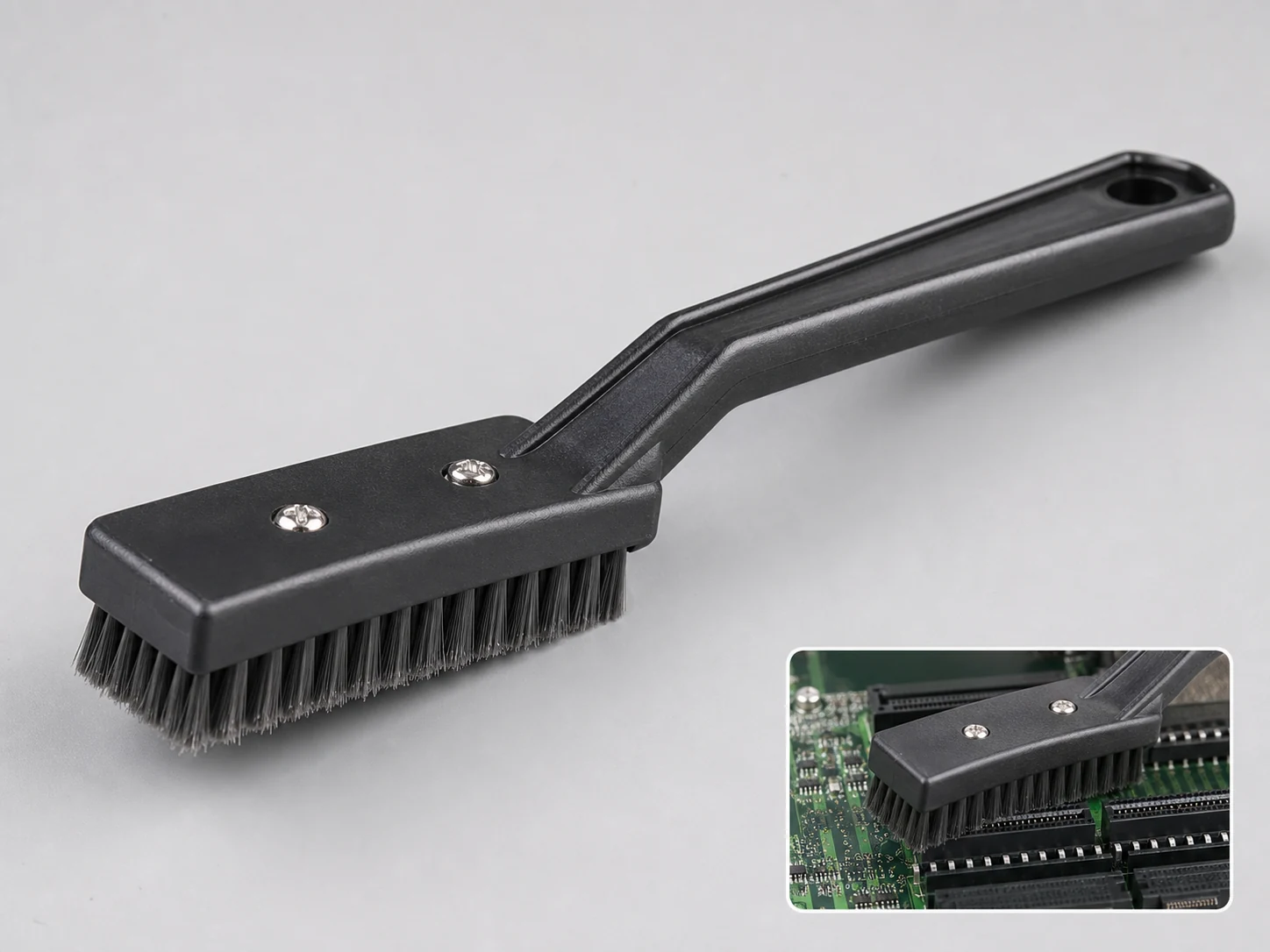
Small brush
500 pcs
Minimum order
Held in one hand: tube, bottle, detail and swab brushes — including long-handled ones with a small head.
Production lead time, once the specification is confirmed
- Up to 500 pcsWithin 7 days
- 501–50,000 pcsWithin 14 days
- Over 50,000 pcsWithin 21 days
Peak season can extend these times; the shipping date is confirmed in writing with your quotation. Sampling and shipping are quoted separately.
This precision anti-static dust removal brush is built for static-sensitive assembly and inspection areas where loose particles such as lint, flux powder, oxide debris, polishing fines, and static-attracted dust must be lifted from boards, connectors, sockets, terminals, optical end faces, films, and carriers without charging the part or re-depositing contamination. The brush uses electrically dissipative or conductive filament plus a groundable handle assembly to control charge generation at the contact point while the tip profile reaches narrow slots, rows, and edge zones.
What can this brush do for you?
Keeps the cleaning pass from re-attracting dust
The conductive or static-dissipative filament fill gives surface charge a controlled path away from the work surface. Conventional nylon bristles tribocharge as they wipe; this brush reduces charge generation at the tip-to-surface interface and, when the handle and ferrule are tied to an ESD ground, drains whatever charge is present. The result is that loose particles lift on the first pass instead of clinging and settling back after the brush moves away.
Reaches slots, rows, and edge zones without losing tip contact
Flat, slanted, feather, notched, pointed, and custom trim profiles place filament tips exactly where the contamination sits. Long fine tips enter connector bodies, card slots, socket rows, and optical ferrule recesses; shorter or stiffer trims hold shape on flat board surfaces and edge contacts.
Removes debris without scratching plated contacts, glass, or coated films
Filament hardness and tip diameter control contact pressure. Soft conductive acrylic or fine conductive nylon removes loose contamination from gold-plated pads, optical end faces, film surfaces, and carrier trays. When the job requires more pressure, carbon fiber or a stiffer blended fill gives firmer contact while the filament property still prevents charge build-up.
Grounds from the bristle to the workstation
Conductive handle and ferrule materials with a ground terminal, lanyard loop, or bench-holder continuity path let the brush become part of the ESD-protected area rather than a floating charge source. In hand use, a conductive handle connected to a wrist strap or cord drains charge; at a station, a grounded holder or machine mount maintains the same path without relying on the operator.
Supports contamination-control routines with low-shed construction
Filament selection, trimming, and packaging can be ordered for particle-controlled workstations so the tool itself does not become a lint source. Cleaned, inspected, and packed for the area where it will be used, the brush supports dry particle control between cleaning and inspection steps.
What is an Anti-Static Dust Removal Brush?
An Anti-Static Dust Removal Brush is a hand-guided precision cleaning tool in which the filament fill is electrically dissipative or conductive rather than insulative. It removes dry particulate from surfaces that must stay within static-control limits, typically in electronics assembly, PCB rework, optical assembly, semiconductor handling, and similar clean or ESD-protected work areas.
During use, the operator makes short sweeping strokes across the targeted contacts, board zones, connector rows, or optical end faces. The filament tips pick up and carry away lint, powder, dust, and loose particles. Because the fill material and handle path maintain controlled resistance, the brushing action does not build up a harmful static charge on the part, and when properly grounded, the assembly also drains existing surface charge.
This brush is a dry particulate removal tool. It is not a substitute for defluxing, degreasing, mechanical scrubbing, or chemical cleaning. Cured flux, grease, heavy oxides, solder bridges, and bonded films need their own process; the anti-static brush is used before, after, or between those steps to keep surfaces free of loose contamination.
Technical Specifications
Values below represent typical production options. Final dimensions, filament composition, and grounding interface are selected for the specific surface, access space, and ESD ground connection.
| Parameter | Typical options |
|---|---|
| Filament fill | Conductive nylon, carbon fiber, conductive acrylic, or blended fill by stiffness and particle requirement |
| Surface resistivity | 10^6–10^9 Ω/sq static-dissipative class; lower-resistance conductive options available for the project |
| Filament tip diameter | 0.03–0.30 mm, set by surface sensitivity and particle size |
| Bristle trim length | 5–45 mm, matched to slot depth or the contact area to be covered |
| Active head width | 5–150 mm, matched to connector row, board zone, carrier lane, or web width |
| Trim profile | Flat, slanted/feather, notched, pointed, multi-row, or custom geometry |
| Handle | Conductive PP, conductive acrylic, stainless steel, or ESD-safe handle with molded ground terminal, lanyard loop, or cord outlet |
| Ferrule / retainer | Brass, stainless steel, aluminum, or conductive polymer, electrically connected to the handle ground path |
| Overall length | 120–600 mm, adjusted to operator reach and enclosure access |
| Ground interface | Threaded ground jack, banana/crimp socket, snap, wrist-strap loop, or machine-holder continuity |
| Operating environment | Dry or lightly damp particulate; no sustained liquid immersion unless the handle and bond are specified for it |
| Contamination-control option | Low-shed filament, edge-dressed tips, particle-controlled cleaning and packaging for clean workstations |
| Brush type | Custom Handheld Detail Brushes |
| How it is driven | Hand-guided |
| Cleaning target | pcb assembly and rework station, edge connector, and optical end face and ferrule cleaning |
| Surface or part | optical end faces, slots, connectors, edges, carriers, boards, terminals, and profiles |
| Residue or debris | dust, particles, lint, flux, powder, oxide, loose particles, and fiber |
| Mounting / connection | Threaded ground jack, banana/crimp socket, snap, wrist-strap loop, or machine-holder continuity |
Where does this brush work best?
- PCB assembly and rework stations: removes loose flux powder, depanelization debris, fiberglass dust, and conductive particles from pads, edge contacts, and test points before inspection or conformal coating.
- Edge connectors, card slots, and socket rows: feather or multi-row trims reach between contact rows where wipes, swabs, and vacuum tools leave residue behind.
- Optical end faces and ferrules: fine soft conductive filament lifts lint and dust from polished end faces before mating, without scratching the optical surface.
- Semiconductor trays, cassettes, and carriers: removes static-attracted particles from tray pockets and carrier rails before wafer, die, or component loading.
- Display films, cover glass, and coated lenses: dry dust removal on optical and film surfaces before lamination, bonding, or final inspection.
- Terminals, relays, and switch contacts: clears loose oxide particles, dust, and fiber contamination from contact areas during final assembly.
How do I choose the right one?
Start with the surface, the gap, and the reach
Measure the narrowest slot or recess the tips must enter, the contact length to be cleaned, and the distance from the operator’s hand to the target. Bristle trim and head width must let the tips bottom out in the slot without the ferrule or handle edge scraping adjacent surfaces. If access is deep or angled, a thinner ferrule or longer trim may be needed even if the part itself is small.
Then select the filament for the residue and the surface sensitivity
| Condition | Recommended fill |
|---|---|
| General board dust, flux powder, lint; plated contacts and PCB surfaces | Conductive nylon — flexible, low-abrasion, balances control and cleaning |
| Adherent dry particles, small-area work, or firmer tip control | Carbon fiber — stiffer, more conductive, but use only where the surface allows firmer contact |
| Optical end faces, films, coated glass, sensitive finishes | Conductive acrylic — soft fine tips for low-pressure dust removal |
Tip diameter follows the same logic: finer filaments spread contact over a larger area for delicate surfaces, while thicker or stiffer filaments transmit more movement into the particle. If a residue needs scraping force, the brush is the wrong tool.
Match the trim and contact pattern to the geometry
Use a flat trim for broad board and web surfaces, a feathered or pointed trim for edge connectors and recesses, a notched profile when cleaning multiple parallel rows in one pass, and a multi-row head when a wider contact zone must be covered without overlapping strokes. Ask for a sample trim test if the slot spacing is tight.
Confirm the ground path before signing off the design
The brush should be ordered with the ground interface that matches your bench, cart, or machine. For hand use, that may be a conductive handle connected to a wrist strap or coiled cord. For machine use, the holder or mount must have electrical continuity to equipment ground. Do not rely on dissipative filament alone if the part or web already carries a charge; the ground path must be complete.
Know when a different tool or process fits better
This brush removes dry, loose particles. Cured flux, adhesives, grease, heavy oxidation, solder bridges, and scale require solvent cleaning, defluxing, ultrasonic processing, or a different mechanical method before the final anti-static pass. For continuous web and roller surfaces, a mounted anti-static roller brush assembly is often more consistent than a hand brush. For very small bores or inside fittings, a point-style anti-static probe brush or swab is the more practical choice.
Can I customize this brush?
The configuration that matters is defined by the surface zone and the grounding interface, so a sketch, photo, or sample part moves the process faster than a list of part numbers. Tell us what needs to be reached, what must not be damaged, and how the brush will be grounded.
- Filament and resistance: conductive nylon, carbon fiber, conductive acrylic, or blended fills with the resistance range required for your process
- Tip construction: filament diameter, packing density, waviness, trim length, and multi-material zones
- Head geometry and trim: width, flat/feather/pointed/notched/multi-row profile, row spacing, and custom contact patterns
- Ferrule and handle: material, shape, diameter, overall length, ergonomic grip, and ground connection type
- Ground interface: threaded jack, banana socket, snap, strap loop, cord outlet, or machine-holder continuity point
- Identification and marking: handle color, part number marking, laser mark, or project color coding
- Packaging: bulk, ESD-safe bags, individual packs or kits, particle-controlled cleaning and packaging for cleanroom entry
We will need the contact surface dimensions, slot widths and depths, row spacing, surface material and finish, particle or residue type, required overall reach, grounding interface, cleaning solvent exposure, and any work-area particle-control requirements. If your qualification program requires resistivity measurement data, material declarations, inspection records, or third-party test support, we can assist with that documentation during the project — include the requirement in your inquiry rather than assuming a standard data sheet covers it.
Which filament survives the cleaning chemicals an anti-static dust removal brush meets?
How do I know the brush still has valid anti-static performance?
Measure resistance from the filament tips to the ground terminal on the handle with a megohmmeter at the same test voltage used in your ESD program. If the path is open, out of the specified range, or intermittent, clean and dry the brush and retest. If the reading still does not recover, replace the brush.
Can I clean the bristles with compressed air or IPA?
Use ionized air if available. Ordinary compressed air can charge the bristles and defeat the purpose of the brush. Isopropyl alcohol or another approved solvent can be applied to the filament tips as long as the handle, ferrule, and bond are compatible and the brush is fully dried before it returns to the ESD area. Retest resistance after cleaning.
Does this brush remove flux residues or oxide films?
No. It removes dry particulate — lint, dust, powder, polishing debris, and loose particles. It will not dissolve or remove cured flux, grease, heavy oxides, adhesives, or bonded films. Use the appropriate chemical or defluxing process first, then the anti-static brush for final dry particle removal.
Should I use the same brush for optical end faces and PCB surfaces?
No. Optical surfaces need softer, finer filament tips, and cross-contamination between optical and electronic work areas creates a real quality risk. Keep separate brushes, store them in labeled ESD-safe containers, and do not swap them between stations.
What if the brush seems to move dust around instead of removing it?
Check three things: whether the ground path from bristle to ground terminal is continuous, whether the part or work surface itself remains charged, and whether the filament tips are matted, clogged, or loaded with particles. Replace the ground connection as needed, neutralize the work surface charge, or clean/replace the brush head before continuing.
How should the brush be stored between uses?
Keep it in an ESD-safe container or grounded holder with the bristles uncompressed. Store away from oil, solvent vapor, heat, and high-humidity swings. Do not lay tools or parts on the bristle tips, and inspect the trim before each shift if the brush is part of a controlled operation.
Guides that go deeper on this
Custom Manufacturing RFQ
Describe Your Application
To quote this brush accurately, send the size, material, cleaning target, residue, quantity, and any available drawing or sample photo.
Drawing or photo optional — it speeds things up, it does not gate the enquiry.
Custom Brush RFQ
Send Your Brush Project
Upload a drawing, product photo, or sample photo and provide the core dimensions and cleaning conditions.
“We need a brush to remove wet residue from a stainless steel conveyor, about 800mm wide. The current brush wears quickly. We can send photos.”
“We sell drinkware and need a cleaning brush to include with the product. Quantity around 5,000 pieces.”