What Is a Beer Keg Cleaning Brush?
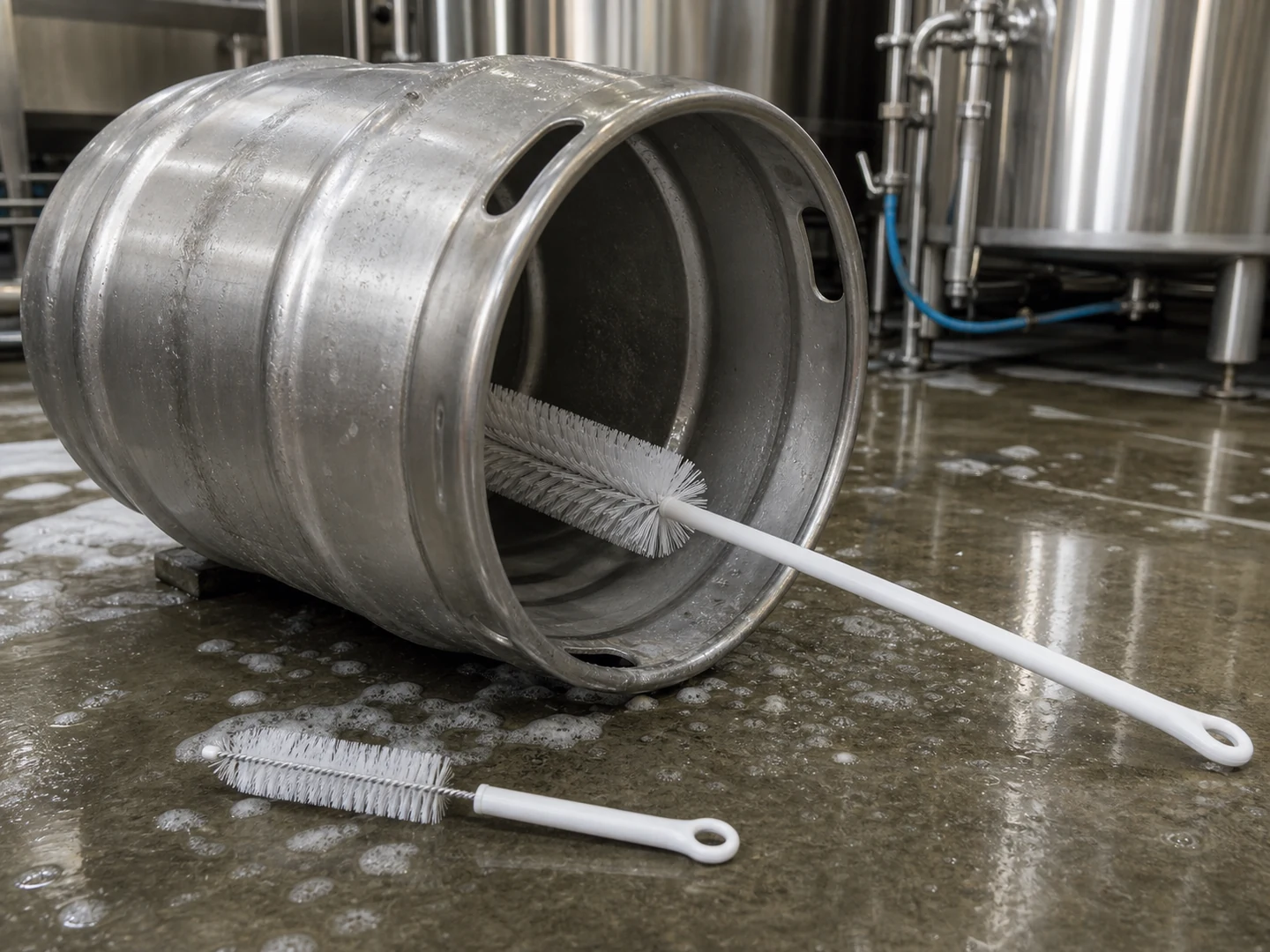
A beer keg cleaning brush is a long-handled or drill-mounted brush with bristles engineered to safely scrub the interior walls, bottom corners, and spear shaft openings of stainless steel beer kegs. Unlike general-purpose bottle brushes or floor brushes, a keg brush must match the keg’s neck opening (usually 2″ Sanke or ball-lock) and extend deep enough to clean the entire interior surface without scratching the passivated stainless steel layer. Quality brushes use chemical-resistant fibers, a stiff but flexible core, and a secure handle or shank that works with manual or automated cleaning routines.
Key Features That Affect Cleaning Performance
| Feature | Typical Options | Why It Matters |
|---|---|---|
| Bristle Material | Nylon, polypropylene, polyester, natural fiber, stainless steel, brass | Chemical resistance, surface safety, scrubbing power |
| Brush Diameter | 1.5″ to 4″ diameter; often tapered | Must fit through keg neck and fill interior space for full contact |
| Overall Length | 12″ to 36″; usually 20–30″ for standard half-barrel kegs | Needs to reach the bottom of the keg without straining |
| Bristle Stiffness/Trim | Soft, medium, stiff, extra stiff; flagged tips, straight trim, spiral fill | Matches residue type; stiffer bristles risk scratching soft surfaces |
| Handle / Core | Galvanized steel wire, stainless steel, polypropylene rod, flexible shaft | Must withstand chemicals, frequent sanitation cycles, and drilling torque |
| Mounting Style | Fixed plastic handle, T-handle, hex shank for drill, ring loop | Works with your cleaning method: manual, drill-powered, or machine-mounted |
Material Selection for Beer Keg Brushes
For food-manufacturing equipment and wet food zones, eCFR — 21 CFR Part 117 Human Food CGMP and Preventive Controls is the production-side CGMP and preventive-controls reference.
When the article mentions sanitizing food-contact articles, eCFR — 21 CFR 178.1010 Sanitizing Solutions provides the regulatory context for sanitizing solutions.
For food-service sanitation language, the FDA — Food Code is the reference point for food safety terminology rather than a brush manufacturer’s preference.
For the material or regulatory boundary in this section, the supporting reference is eCFR — 21 CFR 177.1500 Nylon Resins.
For the material or regulatory boundary in this section, the supporting reference is eCFR — 21 CFR 177.1520 Olefin Polymers.
For the material or regulatory boundary in this section, the supporting reference is eCFR — 21 CFR 177.1630 Polyethylene Phthalate Polymers.
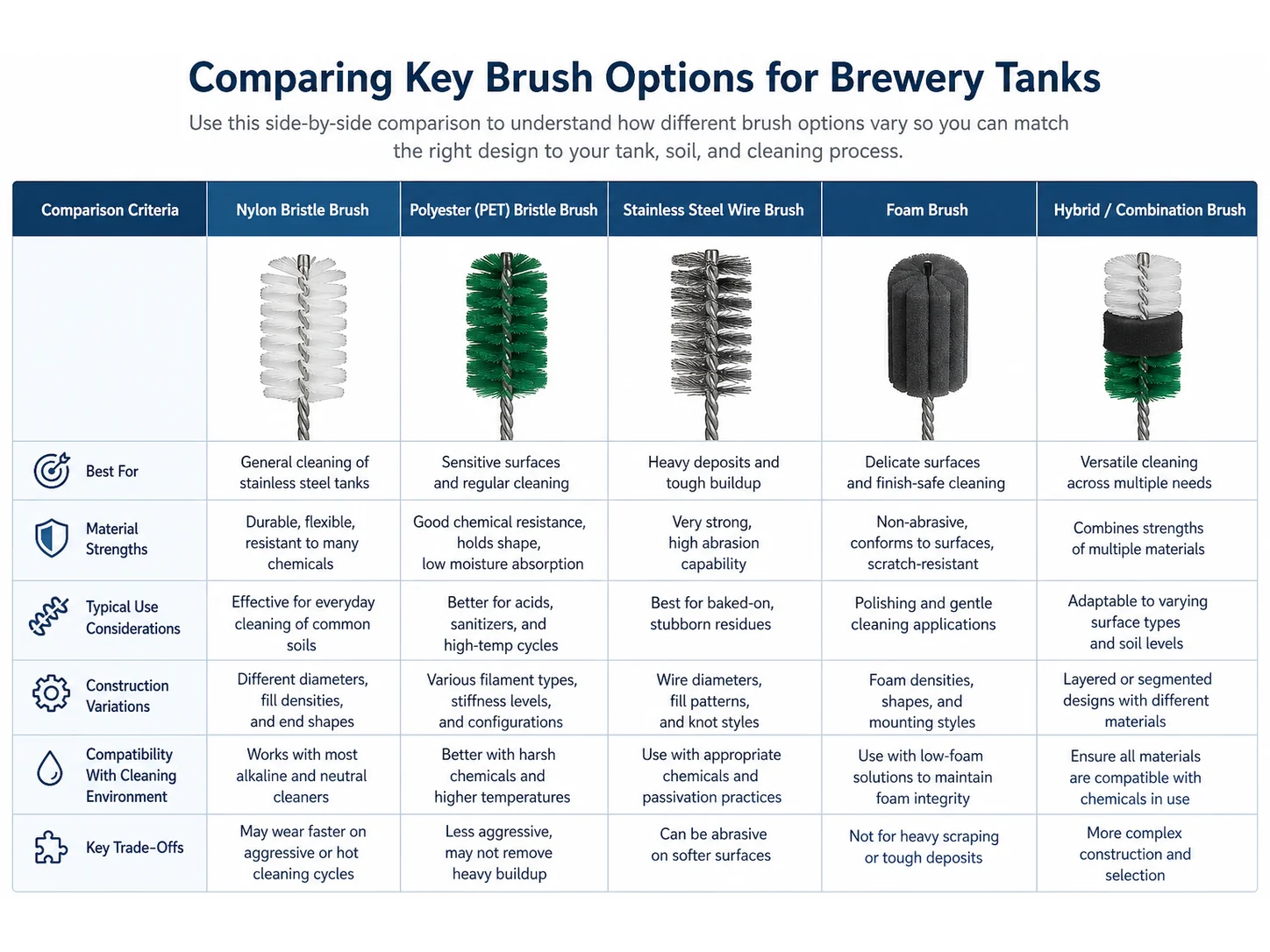
Bristle material is the most critical factor because it directly touches stainless steel and must remove residues without scratching or degrading. The table below summarizes common materials.
| Material | Best For | Avoid When | Notes |
|---|---|---|---|
| Nylon (standard or abrasive-impregnated) | General keg cleaning, mild beer stone, yeast removal | High pH (>12) chemicals or temperatures above 200°F | Good balance of stiffness and surface safety; widely available |
| Polypropylene | Light-duty washing, pre-rinse, sensitive linings | Heavy beer stone or baked-on soil | Soft, resists most chemicals; low water absorption; not aggressive |
| Polyester | Acidic or alkaline CIP solutions, high heat | Pure abrasive removal; too soft for thick scale | Excellent chemical resistance; often used in sanitary brush fills |
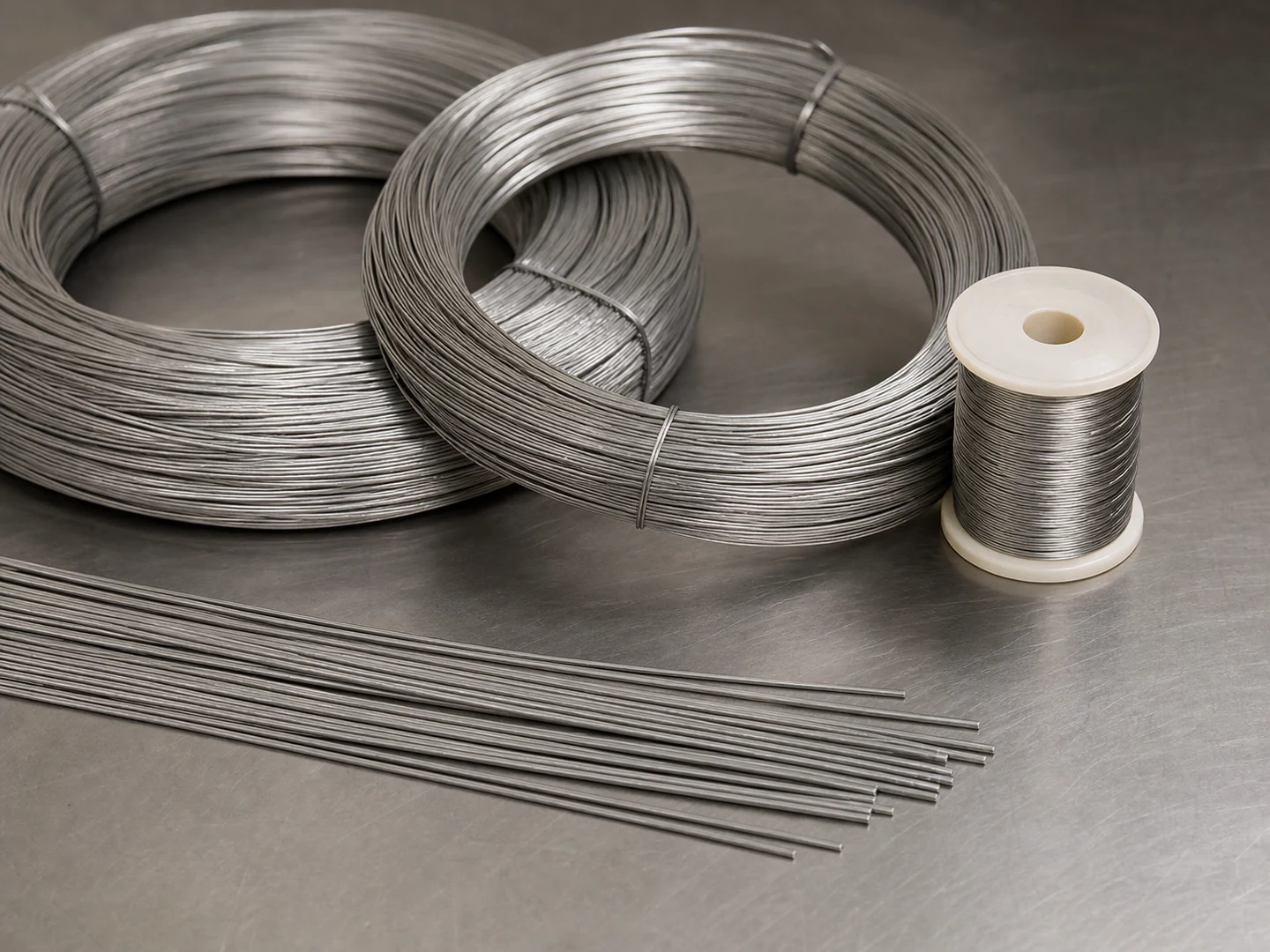
| Stainless Steel Wire | Stubborn beer stone removal, extreme buildup | Everyday cleaning or thin-walled kegs; high risk of scratching | Use only local stubborn deposits; must be fully passivated after |
| Brass Wire | Non-sparking environments (rare in brewing) | Standard keg cleaning; can leave brass residue and scratch | Not recommended for stainless steel; risk of galvanic corrosion |
| Natural Fiber (tampico, palmyra) | Manual scrubbing, organic deposits | Caustic cleaners, soaking in harsh chemicals | Degrades in strong chemicals; can absorb moisture and harbor bacteria |
For most small beverage channels, a medium-stiff nylon or polyester brush with a stainless steel core is the practical default. Always verify chemical compatibility with your cleaning agents and sanitizers.
Brush Diameter, Length, and Stiffness: Matching Keg Dimensions
Choosing the correct size prevents wasted time and possible damage. Follow these steps:
- Measure keg neck opening: Standard Sanke D-type neck inner diameter is about 1.97″ (50 mm). Your brush diameter at the tip must be slightly smaller to fit through, but the widest section should fill the keg body to scrub walls.
- Check keg depth: A half-barrel (15.5 gal) keg is roughly 23″ tall. Allow an extra 2–4″ of handle above the neck for comfortable grip or drill attachment. Total brush length of 24–30″ works for most.
- Match stiffness to residue: After rinsing, if a soft cloth wipes away the residue, a medium stiffness brush is enough. If a fingernail test can’t scrape off beer stone, you need a stiff nylon or a targeted stainless steel brush.
- Tapered designs: Many keg brushes have a narrower front to enter the neck and a wider middle section to contact walls. Specify both tip diameter and body diameter when ordering.
Handle/Core and Mounting Options
The core material and handle determine how the brush will be used day-to-day:
- Stainless steel core: Ideal for caustic chemicals, high-temperature washdown, and long service life. Often paired with a T-handle or loop end for manual use.
- Galvanized wire core: Lower cost but may corrode over time in acidic cycles. Suitable for low-volume use.
- Plastic rod or flexible shaft: Good for drill operation; the shaft connects directly to a drill chuck. Ensure the rod is chemical-resistant and won’t snap under torque.
- Mounting tips: A hex shank (e.g., 1/4″) fits most cordless drills. A loop end allows hanging for drying and storage. Some brushes are designed to fit into semi-automatic keg washers—check the machine chuck specifications.
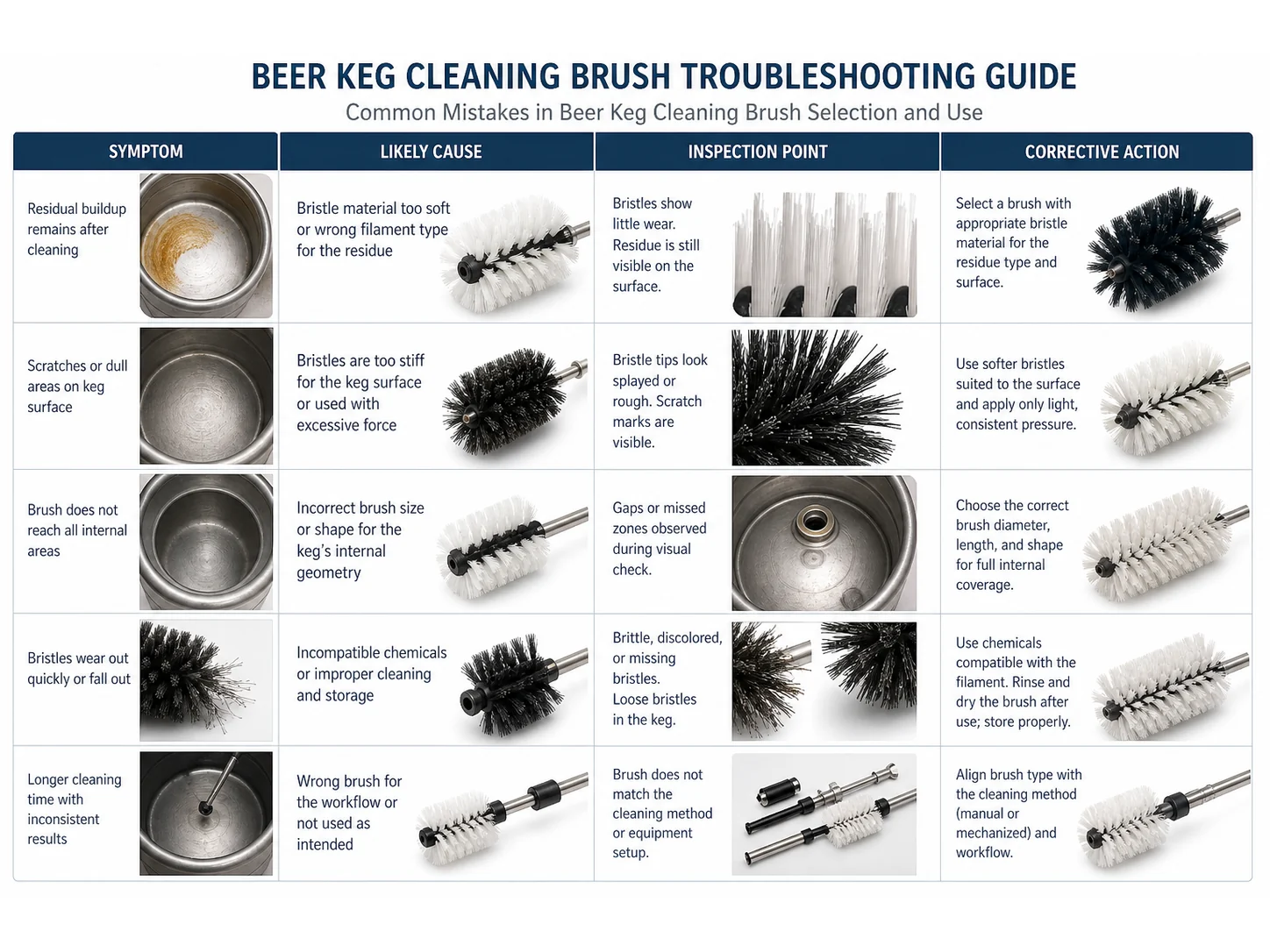
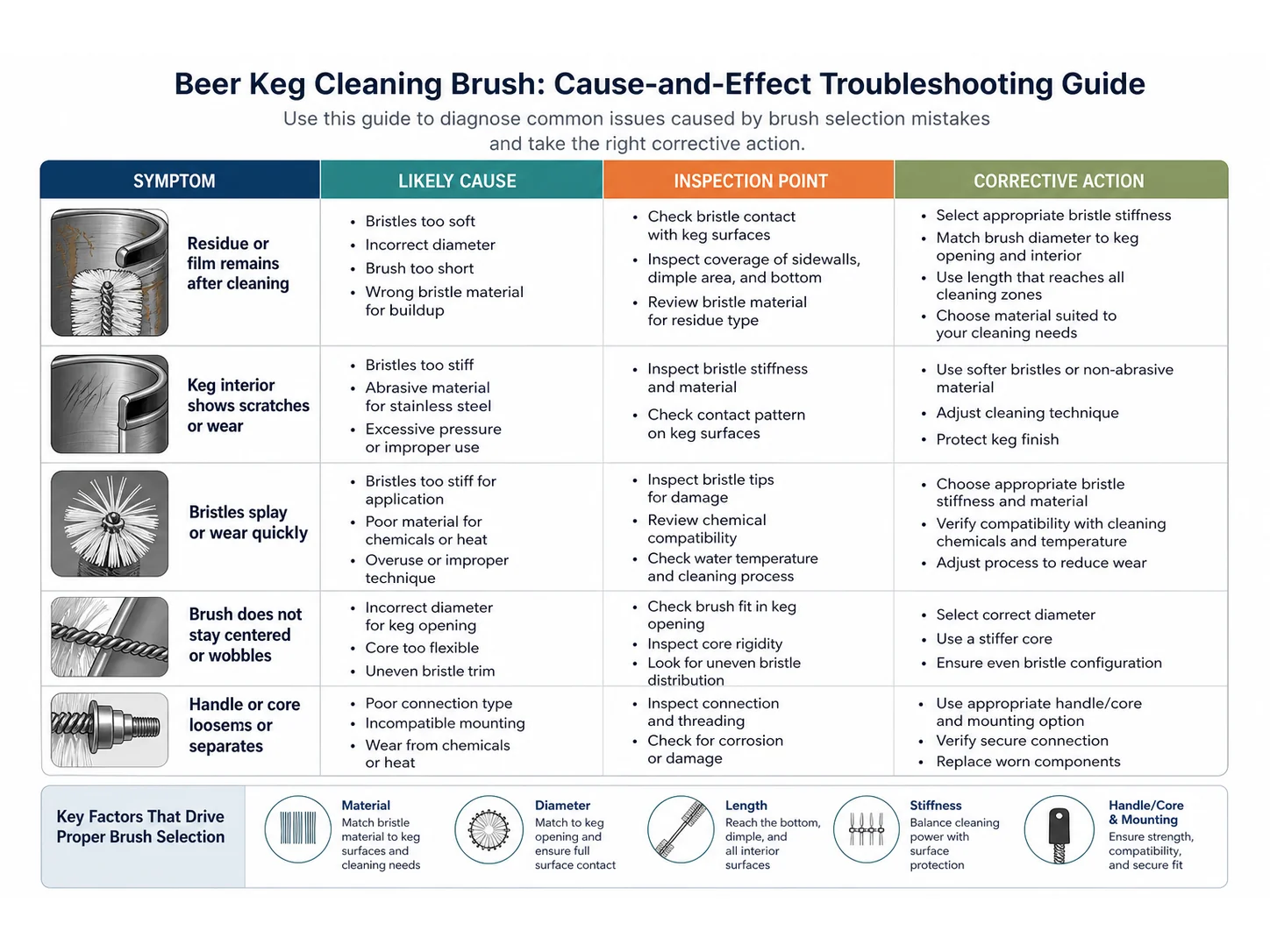
Common Mistakes When Selecting a Beer Keg Cleaning Brush
Even experienced operators can make these avoidable errors:
- Focusing only on cost drivers: A low-cost brush that falls apart, rusts, or scratches kegs costs more in ruined batches and downtime.
- Ignoring bristle chemical compatibility: Using nylon brushes in strong caustic solutions at high temperatures causes bristle softening and early failure.
- Choosing the wrong stiffness: Overly stiff bristles scratch stainless steel, creating micro-crevices for bacteria. Too soft leaves beer stone behind.
- Overlooking brush dimensions: A brush that is too wide can get stuck in the neck; one that is too narrow misses sidewall contact.
- Skipping maintenance: Brushes must be rinsed, sanitized, and hung to dry after each use. Trapped moisture leads to bacterial growth.
- Assuming all kegs are the same: European Sankey kegs, Corney kegs, and disposable one-way kegs have different neck dimensions. Always verify.
- Not having a sample/test routine: Speculative bulk orders without field testing often lead to mismatched fit or performance issues.
When a Basic Beer Keg Cleaning Brush Is Not Enough
A manual or drill-powered brush can handle everyday keg maintenance, but in these situations, you may need a different approach:
- High-volume production: For dozens or hundreds of kegs daily, a fully automatic keg washer with spray balls and chemical CIP cycles is more consistent and labor-efficient.
- Hard, thick beer stone layers: If a stiff nylon brush won’t remove the scale, consider a professional acid wash service or a specialized passivation process followed by stainless steel wire spot cleaning. A regular brush alone won’t solve chronic mineral buildup.
- Specialty kegs or linings: Corny kegs with narrow posts and tight threads require smaller-diameter, post-specific brushes. A full-size keg brush cannot fit these openings.
- Custom or non-standard containers: If your beverage channel uses tanks, totes, or custom fermentation vessels, a standard keg brush may be too short or the wrong shape. In these cases, request a CAD drawing or 3D model from a brush manufacturer and validate physical samples before bulk ordering.
- Hygiene validation: When third-party lab testing or ATP monitoring shows persistent contamination, the brush may be a symptom, not the solution. Investigate the entire CIP system, brush replacement frequency, and staff training.
Final Takeaway: A Practical Decision Checklist
When choosing a beer keg cleaning brush, verify these points:
- [ ] Keg type and neck opening measured
- [ ] Brush diameter fits through neck and covers walls
- [ ] Bristle material matches your cleaning chemicals and water temperature
- [ ] Stiffness tested on your typical residue
- [ ] Core and handle compatible with manual or drill use
- [ ] Supplier can provide samples or dimensioned drawings
- [ ] Spare brushes planned into your maintenance inventory
By focusing on material, size, and fit—and avoiding common specification mistakes—you protect your product quality, reduce downtime, and extend the life of your keg fleet.
Frequently Asked Questions
Can I use the same brush for beer kegs and soda kegs (Corny kegs)?
No. Beer kegs usually have a 2″ Sanke neck, while Corny kegs have narrow (~15–20 mm) opening posts. Using a full-size keg brush in a Corney keg will not fit. Dedicated small-diameter brushes are needed for ball-lock and pin-lock kegs.
How often should I replace a beer keg cleaning brush?
Replace when bristles show signs of matting, permanent deformation, or if the core begins to rust or crack. In a weekly-use environment, inspect monthly and plan to replace every 3–6 months depending on chemical exposure and care.
Is nylon the only material I should consider?
Nylon is the most common for general use because it balances chemical resistance, stiffness, and cost. However, polyester offers better high-temperature and chemical tolerance for aggressive CIP cycles. Polypropylene is suitable only for light-duty or pre-wash. Always match material to your cleaning chemicals.
Can I attach a keg brush to a cordless drill?
Yes, if the brush has a hex shank or round shank that fits your drill chuck. Check the shank size (typically 1/4″ hex). Always run the drill at low to medium speed to prevent splashing and excessive wear on the brush core.
What diameter do I need for a standard half-barrel keg?
Most half-barrel kegs have an internal diameter around 15.5″. A brush with a maximum body diameter of 3.5–4.0″ will contact the walls effectively, provided the neck opening allows it to pass through. Measure before ordering.
Does a stiffer brush always clean better?
Not necessarily. Stiff bristles can scratch stainless steel surfaces, creating bacteria-harboring grooves. Use the softest bristle that effectively removes your typical residue. If you need stiffer for beer stone, spot-treat only the affected areas and re-passivate if needed.
How do I clean and sanitize the brush itself?
After each use, rinse the brush thoroughly with hot water to remove organic debris. Soak in a compatible sanitizer (e.g., peracetic acid or quaternary ammonium solution) per your brewery’s SOP. Rinse again, shake off excess water, and hang to air dry completely. Never store a wet brush in a closed container.
Can I order a custom-sized brush for non-standard containers?
Yes, many brush manufacturers produce custom brushes to match specific dimensions, bristle materials, and mounting options. Provide a detailed drawing or sample part, specify the wet/dry environment, and always test with a prototype before a full production run.