
What Is a Beer Keg Cleaning Brush?
A beer keg cleaning brush is a long-handled, often narrow cleaning tool with bristles arranged to reach inside small openings and convoluted tank interiors. Unlike generic bottle brushes or pipe brushes, it must withstand repeated exposure to hot water (up to 85 °C/185 °F), alkaline cleaners (pH 11-13), and acid sanitizers (pH 1.5-2.5) without shedding bristles, corroding the core, or scratching passivated stainless steel surfaces. In breweries, it supplements automated CIP by targeting difficult-to-clean zones such as the keg neck, spear tube, and bottom chimes, as well as manway covers and gasket grooves on larger tanks.
Common Material and Construction Options
Before comparing specific models or requesting custom quotes, you need to understand the material and build choices that determine a brush’s safety, durability, and cleaning performance. The three most important variables are bristle material, core/handle material, and overall construction method.
- Bristle material: Nylon (6.6 or 6.12), polypropylene, polyester, PTFE, and specialty blends. Nylon is the most common food-grade choice for brewery use because it resists caustic and acid cleaners, retains stiffness when wet, and won’t scratch stainless steel when properly trimmed. Polyester and polypropylene are softer and may be chosen for delicate polished surfaces. PTFE bristles offer extreme chemical resistance and high-temperature capability but cost significantly more.
- Core and handle: Stainless steel (304 or 316) wire, galvanized steel, or plastic cores. Stainless steel wire cores and handles are essential for brewery environments to prevent rust contamination. Plastic cores and handles (e.g., polypropylene, nylon) eliminate metal-to-metal contact and are lighter, but may warp under prolonged exposure to very hot CIP fluids.
- Construction: Twisted-in-wire (the most common for keg brushes), staple-set in a solid block, or molded-in-place. Twisted-in-wire construction holds bristles securely and allows the brush to flex around bends. Staple-set brushes hold bristles in a wooden or plastic block and are better for flat surfaces like tank walls. Molded brushes are custom-made with bristles embedded into a plastic hub and can be designed for specific keg neck profiles.
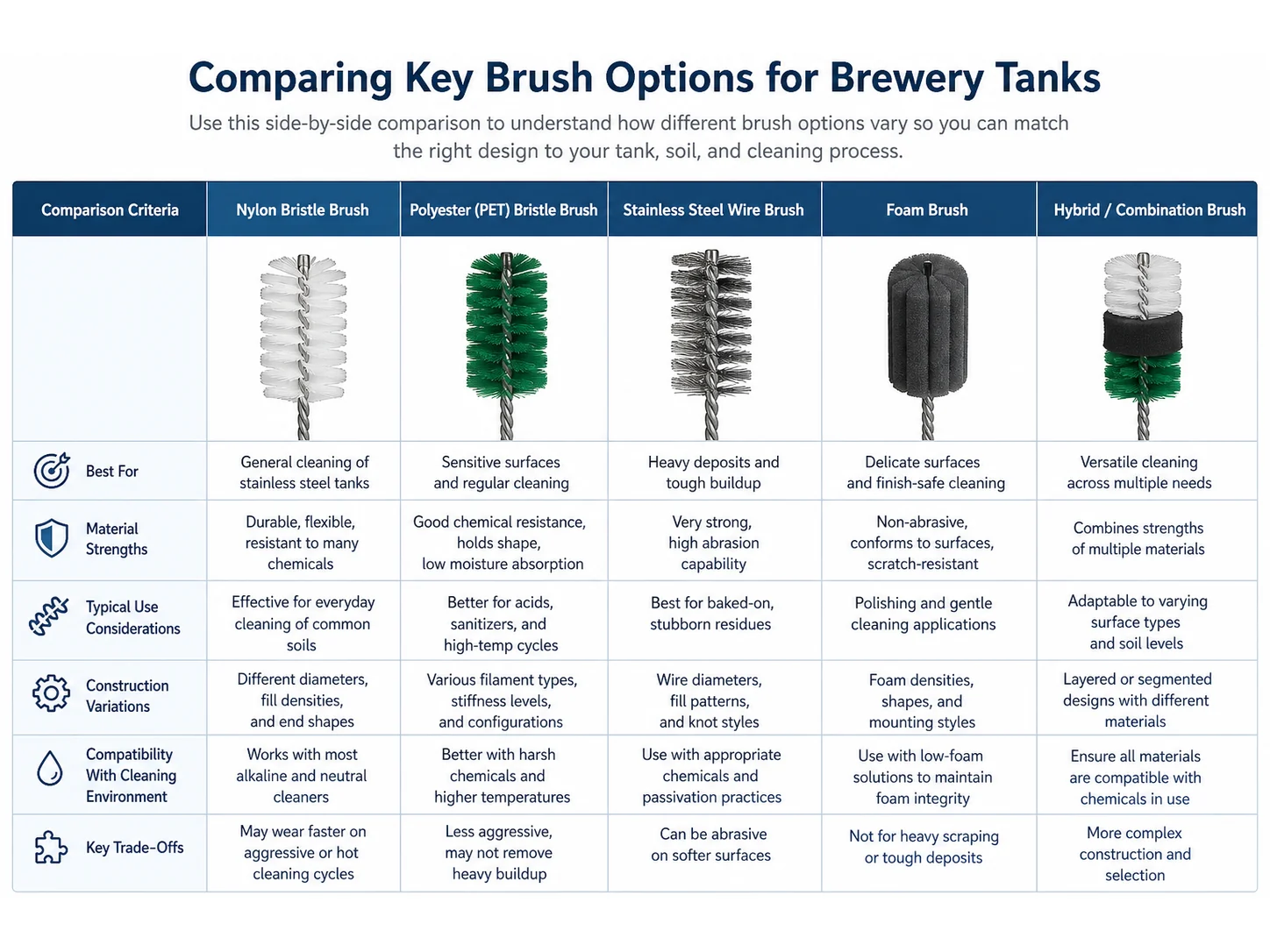
Comparing Key Brush Options for Brewery Tanks
The table below compares four common brush configurations used in breweries based on their typical application, strengths, and limits. This is a starting point for conversations with a brush manufacturer or supplier before you request a sample.
| Brush Type | Best Use Case | Typical Diameter (in) | Stiffness | Handle / Core | Chemical Compatibility | Customization Notes |
|---|---|---|---|---|---|---|
| Twisted-in-wire keg brush | Keg neck, spear tube, small ports | 1.5 – 2.5 | Medium to firm | Galvanized or stainless steel wire extended handle | Good with caustic and acid; avoid long exposure to strong acids if core is not 316 | Diameter, length, bristle trim profile can be adjusted |
| Staple-set tank brush | Large tank walls, manway covers, racking arms | 3 – 6 (block width) | Soft to medium | Plastic or stainless steel backing with threaded handle | Depends on block material; nylon bristles cover most brewery chemicals | Block size, bristle pattern, mounting thread can be specified |
| Molded silicone or nylon keg brush | Delicate polished interiors, glass carboys, small fermenters | 2 – 4 (molded head) | Soft | Integrated nylon or polypropylene handle | Excellent for hot water and mild chemicals; avoid ketone solvents | Head shape, bristle length, color-coding for zones |
| Long-handle bottle brush style | Bottom chimes, hard-to-reach corners in open fermenters | 2 – 4 | Medium | Stainless steel wire with dipped plastic handle | Good all-around; check handle coating for long-term hot caustic exposure | Length and handle coating can be customized |
How to Choose Based on Your Cleaning Conditions
Selecting the right brush is less about picking a “best” model and more about matching the tool to your actual cleaning environment. Consider these factors:
- Residue type and tenacity: Beer stone (calcium oxalate) requires firm but non-metallic bristles that can scrub without embedding metal particles. Soft yeast trub can be removed with medium bristles. If you frequently clean sticky hop resin deposits, choose a brush with chemical-resistant nylon and a design that doesn’t trap material in the bristle base.
- Surface sensitivity: Most brewery stainless steel is passivated 304 or 316 with a 2B or #4 finish. Never use steel wire or abrasive brushes—they can cause micro-scratches that harbor bacteria. If your tanks have an electropolished interior (Ra < 0.5 µm), you may need a softer polyester or PTFE bristle to avoid creating scratches visible only under inspection.
- Equipment interface: How will the brush be used? By hand through a manway? On an extension pole for deep tanks? Attached to a cordless drill for the keg neck? The handle must fit the mounting method and withstand the torque or pressure applied. A brush designed for hand use may snap if attached to a drill without proper core reinforcement.
- Wet and chemical exposure: The brush will spend much of its life wet or submerged in cleaning solutions. Bristles that absorb water (e.g., natural fibers, low-grade nylon) swell and lose stiffness, while stainless steel cores can corrode at the cut ends. Ask about end-sealing and whether the bristle material is pre-shrunk to maintain diameter after first use.
- Hygiene expectations: In a brewery following HACCP principles, brushes must be easy to inspect and sanitize. No bristle shedding allowed. A brush that breaks down with heat and chemicals after a few cycles becomes a foreign material risk. Specify food-grade, FDA-compliant materials (e.g., nylon that meets 21 CFR 177.1500) and request documentation.
- Maintenance frequency and replacement cost: Some brushes are disposable items replaced every few weeks; others are semi-permanent tools. If the brush is used daily on hundreds of kegs, prioritize durability and chemical resistance over initial cost drivers. Custom brushes with replaceable heads can lower long-term cost but must be designed with a secure, hygienic coupling.
Setup and Usage Factors That Change the Right Choice
Even the best brush can fail if it doesn’t fit your workflow. Consider these real-world factors:
- Keg type and opening size: A Sankey keg neck (standard in North America) has a specific diameter and internal profile. A brush head must pass through the neck (usually about 1.25 in ID) but then expand inside the keg body (up to 2.5 in or more). A twisted-in-wire brush can be compressed and then released, but if the wire diameter is too large, it won’t fit through the valve opening. Custom brushes can be built with a fold-back bristle design or a segmented head that assembles inside the keg.
- Automated vs. manual cleaning: If you attach the brush to a keg washer drive, the brush must have a precise shank diameter and length to avoid damaging the machine. Manual brushes need an ergonomic handle with a non-slip grip for wet hands.
- Temperature cycles: Some brushes are rated for intermittent heat (e.g., 15 minutes at 85 °C) while others withstand continuous immersion. In a keg cleaning cycle, the brush may be dipped in hot cleaning solution repeatedly. Ask for temperature resistance data and a max exposure time recommendation.
Common Mistakes When Selecting a Keg Cleaning Brush
Avoid these pitfalls that often lead to reordering, downtime, or tank damage:
- Choosing by diameter alone: “It says 2-inch brush, so it must fit.” The brush diameter is usually measured at the bristle tips. A stiff brush with zero-tolerance trimming may be exactly 2 inches, but if the bristles are flared, the effective diameter under pressure might be much larger. Always ask for the core diameter and the bristle length setting.
- Ignoring the core material: A galvanized steel core might look strong but will rust after a few hot caustic cycles, contaminating your cleaning solution and potentially your beer. For brewery use, specify stainless steel 304 or 316 core and handle materials.
- Assuming all nylon is the same: Nylon 6.6 and 6.12 have different melt points, moisture absorption rates, and chemical resistance. Nylon 6.6 softens at lower temperatures and absorbs more water than 6.12. If your cleaning cycle exceeds 80 °C, nylon 6.12 or a polyester blend is safer.
- Overlooking bristle trim style: A flat trim cleans flat surfaces well but may miss the corners of a keg’s bottom chime. An uneven or spiral trim profile can reach curved radii but may not provide uniform scrubbing. Discuss the exact geometry you need with a supplier and request a drawing before sampling.
- Not testing with actual cleaning chemicals: A brush that looks intact after water testing might swell, discolor, or shed when soaked in your specific caustic/acid blend for 30 minutes. Always request a sample and test it in a beaker with your chemicals before committing to a production run.
When a Standard Beer Keg Cleaning Brush Is the Wrong Choice
A dedicated keg cleaning brush solves many problems, but there are limits. Consider these boundaries:
- Severe beer stone buildup: If a standard nylon brush won’t remove thick beer stone even after multiple passes, you may need a multi-step approach: a chemical soak with a chelating agent followed by a brush with a more aggressive (but still non-metallic) bristle, perhaps silicon carbide-impregnated nylon. However, always verify that such abrasive filaments are safe for your tank surface finish.
- Deep, narrow tank necks: Brushes with flexible wire cores work well for moderate bends, but if your tank has a very narrow, S-shaped neck (like some European-style serving tanks), a standard twisted-in-wire brush may kink or not pass through. In this case, a custom molded brush with a flexible, kink-resistant plastic core may be required.
- Automated CIP brush integration: If you plan to attach the brush to a mechanical CIP arm for repeated cycles, a hand brush design will likely fail. You need a brush engineered for machine use, with a standardized machine-mounting end (e.g., a 1/2-inch shaft) and sealed bearings if rotating parts are involved.
- When a brush isn’t the right tool: For pitted or heavily damaged stainless steel with embedded contaminants, no brush will restore a sanitary surface. Passivation, electropolishing, or tank reconditioning may be necessary first. Brushes clean by physical contact; they cannot replace chemical passivation or descaling treatments.
Final Takeaway
Choosing a beer keg cleaning brush for brewery tanks isn’t a one-size-fits-all decision. Start by measuring your tank openings and the soil you need to remove, then match a bristle material and core that survive your chemical and temperature cycles without shedding or corroding. Ask for a sample and test it in your real conditions before customizing a large order. The right brush will improve cleaning consistency, reduce manual labor, and help maintain the sanitary state of your tanks—without risking metal contamination or bacteria harborage.
Frequently Asked Questions
How do I measure my keg opening for a custom brush?
Measure the smallest internal diameter the brush must pass through (often the keg neck valve opening). Then determine the maximum internal diameter of the area you need to clean. The brush core must fit through the small opening, and the bristle length should be enough to contact the tank wall but not so long that the brush jams. Provide both dimensions to a supplier when asking for a quote.
What bristle material is safest for my stainless steel tanks?
Nylon (6.6 or 6.12) is widely considered safe for passivated stainless steel because it is non-abrasive if trimmed properly. Avoid any metal wire bristles, even stainless steel, because they can scratch the surface and create niches for bacteria. If you have an electropolished interior, consider reducing stiffness with a softer polyester or PTFE brush.
Can I use a standard bottle brush for cleaning kegs?
Standard consumer bottle brushes often have galvanized or painted wire cores that can rust and contaminate your brewery. They are also not sized or trimmed for sankey keg internals. It’s better to source a brush specifically designed for brewery use with food-grade materials.
How often should I replace a keg cleaning brush?
There’s no universal schedule. Inspect brushes after each use for loose bristles, bend deformation, or core corrosion. Replace any brush that shows shedding or rust immediately. In a high-volume keg line, some breweries swap brushes weekly, while others may get months of use from a well-made custom brush. Record replacement dates and adjust based on visual wear and cleaning efficacy.
Do I need a different brush for alkaline and acid cleaning?
Generally no, if the brush is made of chemical-resistant materials like nylon with a stainless steel core. However, you should verify with the supplier that the specific caustic concentration, temperature, and acid pH do not exceed the brush’s limits. If you alternate between strong acid and caustic without a rinse, some nylon grades may experience accelerated degradation.
Can I attach a keg brush to a power drill?
Many twisted-in-wire keg brushes can be chucked into a drill, but the handle must be a straight wire shank of consistent diameter, and the brush core must withstand the torque without unwinding. Not all hand brushes are designed for powered use—confirm with the manufacturer and test at low speed first. Over-speed can cause bristle loss or wire fatigue.
What does “custom brush” mean in a brewery context?
A custom brush is built to your specifications rather than sold off the shelf. This may include a non-standard diameter, specific bristle trim profile, a 316 stainless steel core, a certain overall length, or a handle adapted to fit a keg washer machine. Suppliers typically require a drawing or detailed specifications and may ask for a small batch trial before full production.
Is there a brush that can clean the outside of a keg and the inside with one tool?
Usually not. The internal and external cleaning brushes have different shapes and stiffness requirements. Using an internal brush on the outside risks embedding contaminants from the exterior into the brush bristles that could then be transferred inside another keg. It’s best to maintain separate brushes for external surfaces and tank interiors, and color-code them to prevent cross-contamination.
Technical References
- eCFR — 21 CFR 178.1010 Sanitizing Solutions
- FDA — Food Code
- eCFR — 21 CFR 177.1500 Nylon Resins
- eCFR — 21 CFR 177.1520 Olefin Polymers
- eCFR — 21 CFR 177.1630 Polyethylene Phthalate Polymers
- eCFR — 21 CFR Part 117 Human Food CGMP and Preventive Controls
Which bristle material fits this job — Nylon PA, AISI 304 Stainless Steel Wire or Silicone?
| Material | Continuous temperature (°C) | Peak temperature (°C) | Water absorption | Hardness |
|---|---|---|---|---|
| Nylon PA | 93 | 121 | 0.3–9% by PA grade and conditioning | Medium to firm; filament diameter and trim length control bending force. |
| AISI 304 Stainless Steel Wire | 400 | 500 | 0% | Rockwell B 70–95 depending on temper and cold work |
| Silicone | 200–250 | 280–300 | 0.1–1.0% | Shore A 20–80 |
| Polypropylene PP | 80–100 | 120–140 | ≤0.03% | Shore D 65–75 |
Figures as published by Brushtec / DuPont; Alleima; Perlon. Confirm the exact grade against the supplier datasheet before ordering.
What should replace Bottle & Container Brushes for beer keg cleaning brush?
- Bottle & Container Brushes — Bottle and container brushes are selected around an opening plus a larger vessel body and bottom geometry; tube and bore brushes are selected mainly around a long diameter-controlled passage. Closest alternative: Tube & Pipe Bore Brushes.
- Nylon PA — Compare Nylon PA with PP, PBT, PET. Change material when wet stiffness, temperature, chemical resistance, conductivity, particle shedding, or surface marking becomes the limiting factor.
- AISI 304 Stainless Steel Wire — Use AISI 316 stainless steel wire for chloride, marine, dairy, beverage, chemical washdown, or higher pitting-resistance requirements. Use carbon steel for dry aggressive cutting and brass or abrasive nylon for lower marking risk.
- Silicone — Compare Silicone with PP, TPE, Nylon. Change material when wet stiffness, temperature, chemical resistance, conductivity, particle shedding, or surface marking becomes the limiting factor.