
Custom Cleaning Brush
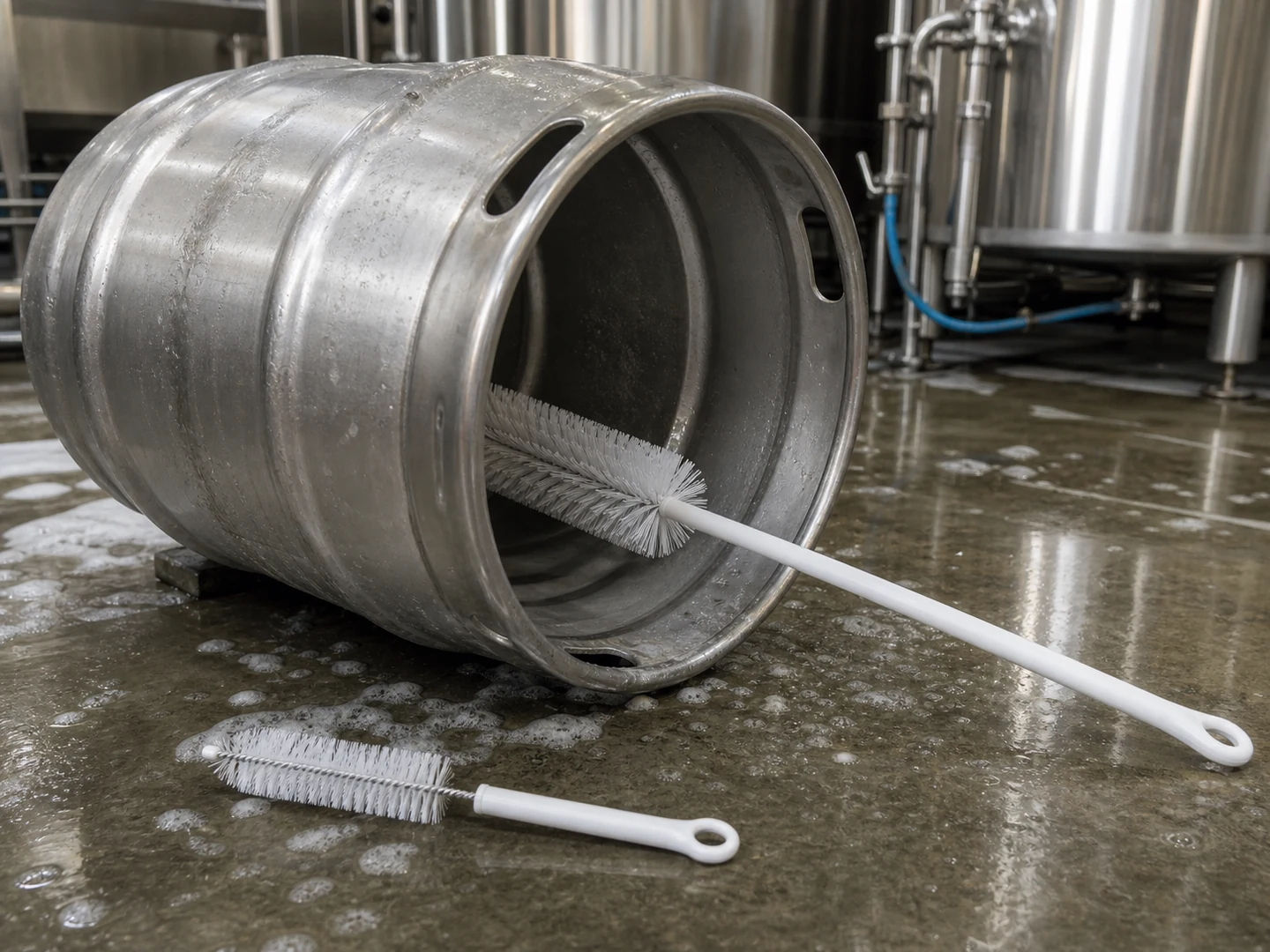
Beer Keg Cleaning Brush
Custom beer keg cleaning brushes for breweries and beverage plants. PP or nylon fill, 130–250 mm heads, threaded or fixed handles, reach up to 2000 mm.
Medium brush
100 pcs
Minimum order
Worked with two hands or on a pole: chimney, gutter and pond-filter brushes, discs, cups and tank brushes.
Production lead time, once the specification is confirmed
- Up to 100 pcsWithin 7 days
- 101–5,000 pcsWithin 14 days
- 5,001–50,000 pcsWithin 21 days
- Over 50,000 pcsConfirmed with your quotation
Peak season can extend these times; the shipping date is confirmed in writing with your quotation. Sampling and shipping are quoted separately.
Designed for interior cleaning of beer kegs, this long-reach brush removes beer film, biofilm, and soft deposits from sidewalls, shoulders, and bases through the keg neck. Its stiff polypropylene or nylon fill works with standard keg cleaning chemicals while the extended handle keeps operators clear of the opening.
What can this brush do for you?
Reaches the Full Keg Depth Through a Narrow Neck
The brush head is sized to pass through standard keg neck openings and then contact the full internal diameter. The long shaft, configurable up to 2000 mm, lets an operator scrub from the shoulder to the bottom without inverting the keg or reaching inside. No matter the keg height, the brush keeps the cleaning action where the residue collects.
Cuts Through Beer Film and Biofilm Without Scratching Stainless
Dense polypropylene or nylon bristles provide the mechanical action that detaches sticky beer residue, yeast film, and odor-causing biofilm. Nylon fill delivers higher abrasion resistance and stiffness for stubborn films, while polypropylene offers a softer, more flexible contact for regular maintenance cleaning. Both materials are safe on stainless steel keg surfaces.
Connects to Manual Handles or Powered Cleaning Shafts
Choose a European thread, ACME, M10, or a fixed handle. Threaded heads attach to drill extensions, manual T-handles, or semi-automated keg cleaning shafts, so the same brush can move between different cleaning stations without changing the whole tool.
Stands Up to Brewery Cleaning Chemistry
Polypropylene resists alkaline and acid solutions, while nylon performs well in alkaline cleaners and neutral sanitizers. The brush can stay in the keg during chemical cleaning steps, providing scrubbing action while the chemicals do their work.
Replaceable Head Reduces Downtime and Consumable Cost
When configured with a threaded head, worn bristles can be replaced in minutes without discarding the entire handle. Scheduled brush changes become a simple swap at the keg washing station.
What is a Beer Keg Cleaning Brush?
A Beer Keg Cleaning Brush is a radially filled, long-handled cleaning tool built for manual or semi-automated interior cleaning of beverage kegs. It consists of a cylindrical or tapered brush head with bristles extending outward from a central shaft, connected to a long stem that allows the operator to scrub the keg from outside the neck.
In use, the brush is inserted through the keg opening (usually with the spear removed) and worked up and down or rotated against the internal walls. The bristles contact the sidewall, shoulder, and bottom areas, loosening beer film, yeast residue, and biofilm so that rinsing and sanitizing chemicals can remove them completely.
This is a wet-cleaning tool. It works as part of a keg washing sequence that includes flushing, caustic or acid cleaning, rinsing, and sanitizing. The brush provides the mechanical action that chemicals alone cannot deliver on vertical or curved surfaces.
The brush is not designed to remove heavy beer stone or mineral scale on its own. Those deposits require chemical descaling or a more aggressive mechanical treatment. The keg brush handles organic residues and soft films efficiently.
Technical Specifications
The table below shows standard ranges for our beer keg cleaning brushes. All dimensions, materials, and connections can be adjusted to your keg model and cleaning process.
| Parameter | Standard Range / Options |
|---|---|
| Head diameter | 130–250 mm (selected to match keg internal diameter) |
| Head length | 170–300 mm |
| Bristle trim length | 35–80 mm (shorter for stiffer contact, longer for more flexibility) |
| Overall reach | 400–2000 mm (from handle end to brush tip) |
| Thread or handle | European thread, ACME, M10, or fixed handle |
| Filament diameter | 0.30–0.80 mm (thicker for aggressive cleaning, thinner for gentler contact) |
| Fill material | Polypropylene (PP) or Nylon (PA) |
| Shaft material | 304 stainless steel (316 available for high-corrosion environments) |
| Operating temperature | PP: up to 80°C continuous in water; Nylon: up to 120°C continuous in water |
| Chemical compatibility | PP: good alkaline and acid resistance; Nylon: good alkaline resistance, limited acid resistance |
| Brush type | Custom Bottle & Container Brushes |
| How it is driven | Hand-guided |
| Cleaning target | breweries cleaning standard sanke keg, cold-brew producers removing sticky residue and biofilm, and keg rental and logistics companies performing routine cleaning |
| Surface or part | necks, shoulders, sidewalls, thread, tubes, narrow necks, bases, and stone |
| Residue or debris | biofilm, soft deposits, yeast, and mineral scale |
| Mounting / connection | European thread, ACME, M10, or fixed handle |
Where does this brush work best?
- Breweries cleaning standard sanke kegs (20L, 30L, 50L) during keg washing cycles between fills.
- Wineries and cideries using stainless kegs with narrow necks and internal sidewalls that need consistent scrubbing.
- Kombucha, soda, and cold-brew producers removing sticky residue and biofilm before refilling kegs.
- Keg rental and logistics companies performing routine maintenance cleaning on returned kegs before inspection and reuse.
- Distilleries cleaning transfer or aging kegs before introducing new product.
The brush contacts the keg interior sidewall, bottom, shoulder, and neck threads. For cleaning the spear tube itself, a smaller diameter tube brush is usually required separately.
How do I choose the right one?
Start with three measurements: the keg neck inside diameter, the keg internal body diameter, and the keg internal depth. These determine the maximum head size that can enter the keg and the required reach.
Head diameter: Select a head that is 60–80% of the keg internal diameter. A smaller head passes easily through the neck but may not scrub the sidewall effectively; a larger head gives better contact but might bend or bind at the opening. We can confirm fit using your neck ID and keg drawing.
Fill material and stiffness: Use the following decision table to match the brush to your typical residue.
| Condition | Recommended Fill | Reason |
|---|---|---|
| Light beer film, daily cleaning | PP, 0.30–0.50 mm filament | Soft, flexible, safe on all stainless finishes |
| Stubborn biofilm or yeast deposits | Nylon, 0.50–0.80 mm filament | Stiffer, more abrasion resistant, higher scrubbing force |
| High chemical exposure (strong acids) | PP | Nylon degrades in prolonged strong acid contact |
| High wash temperature (>80°C) | Nylon | PP softens above 80°C; nylon handles up to 120°C |
Bristle trim length: Shorter trim (35–50 mm) makes the fill stiffer and more aggressive; longer trim (60–80 mm) conforms better to curved shoulders but applies less direct pressure. Choose based on whether you need more scrubbing or more surface following.
Connection type: If you plan to use a manual T-handle, a fixed handle is simplest. If you have a drill adapter or automated keg washer, specify the existing thread (European, ACME, M10) so the brush head mounts directly.
When this brush is not the right tool: If your kegs accumulate heavy beer stone or mineral scale, this brush alone will not remove it. Combine brushing with an acid descaling step, or consider a brush with abrasive filament for certain surfaces. For very narrow-neck kegs (opening below 40 mm), a flexible tube brush or a spray ball system may be more practical.
Can I customize this brush?
Beer keg brushes are configured to match your keg model and cleaning line. We can adjust the following:
- Head geometry – diameter, length, taper, or custom profile for specific keg shapes.
- Bristle fill – filament material (PP, Nylon, PET, PBT, or blends), diameter, trim length, and density.
- Shaft – length, diameter, 304 or 316 stainless steel, coated steel, or other project-suitable material.
- Connection – European thread, ACME, M10, quick-connect, fixed T-handle, loop handle, or drill adapter.
- Color coding – custom bristle or handle colors to separate cleaning agents or production lines.
- Packaging and marking – bulk packing, individual bags, laser marking, pad printing, or custom labels.
To define the correct brush, please provide the keg neck ID, internal body diameter, internal depth, cleaning chemicals used, maximum wash temperature, manual or powered operation, and preferred connection. A keg drawing or sample photo helps us verify the fit before production.
If your project requires material declarations, inspection reports, or third-party testing support, we can assist during the customization process.
Which filament survives the cleaning and still lasts on a beer keg cleaning brush?
What is the real difference between polypropylene and nylon fill in a keg brush?
Polypropylene is softer and more chemically resistant, especially to acids. It works well for routine cleaning of light films. Nylon is stiffer and more abrasion resistant, which helps lift stubborn biofilm and yeast deposits, but it can degrade with prolonged exposure to strong acids. Choose nylon when you need more scrubbing force; choose PP when chemical resistance or surface gentleness is the priority.
How do I know when to replace the brush head?
Inspect the bristles for flattening, excessive bending, or loss of fill. A simple check: after cleaning, the keg sidewall should feel smooth and show no visible residue. If you notice that cleaning time has increased, or the bristles no longer spring back to their original shape, replace the head. Threaded heads can be swapped without replacing the handle.
Can I use this brush with a cordless drill?
Yes, if the brush head has a threaded connection compatible with your drill adapter (European, ACME, or M10). A low-speed cordless drill with a suitable extension shaft works well for smaller kegs. For larger or automated keg washing lines, a fixed handle or machinery shaft is more common.
Will this brush remove beer stone by itself?
No. Beer stone is a mineral deposit that requires chemical descaling (typically an acid wash) before or during brushing. The brush removes the organic layer above and around the scale, but the scale itself must be dissolved or softened chemically. Use the brush as part of the chemical cleaning sequence, not as a replacement for it.
How should I clean and store the keg brush between uses?
Rinse the bristles thoroughly with clean water after each use to remove loosened residue and chemical residues. Hang the brush vertically or store it in a dry, ventilated area away from direct sunlight or strong oxidizing agents. Periodically inspect the shaft for corrosion or bending, especially if you use acidic cleaning agents.
How can I verify that the keg has been properly cleaned after brushing?
After the full cleaning cycle (brush + chemicals + rinse), inspect the keg interior with a flashlight or borescope through the neck. The sidewall, shoulder, and bottom should be free of visible film or residue. You can also wipe a white cloth or swab across the bottom and shoulder to check for discoloration or odor. If residue remains, adjust the head diameter, bristle stiffness, or cleaning time.
Guides that go deeper on this
Beer Keg Brush for Brewery Tanks: What to Compare
Read this guideGuideBeer Keg Brush Mistakes in Small Beverage Channels
Read this guideGuideBeer Keg Brush vs Standard Brushes in Brewery Tanks
Read this guideGuideBeer Keg Brush: Material, Size and Common Mistakes
Read this guideGuideBeer Keg Cleaning Brush: Does It Handle Milk Residue?
Read this guideCustom Manufacturing RFQ
Describe Your Application
Please include the main sizes, application, residue, preferred material, interface, quantity, and any drawing or sample available.
Drawing or photo optional — it speeds things up, it does not gate the enquiry.
Custom Brush RFQ
Send Your Brush Project
Upload a drawing, product photo, or sample photo and provide the core dimensions and cleaning conditions.
“We need a brush to remove wet residue from a stainless steel conveyor, about 800mm wide. The current brush wears quickly. We can send photos.”
“We sell drinkware and need a cleaning brush to include with the product. Quantity around 5,000 pieces.”