
What Is a Beer Keg Cleaning Brush?
A beer keg cleaning brush is a purpose-built cleaning tool featuring a curved or angled brush head, a long rigid handle, and chemical-resistant bristles. Its design allows it to pass through the small keg opening and scrub the entire interior surface, including the top dome and chime area, where residue tends to accumulate. Unlike generic brushes, it is engineered to deliver consistent contact pressure without scratching stainless steel surfaces or trapping moisture that could lead to corrosion.
Common Types and Options
Beer keg cleaning brushes are available in several configurations, though the core purpose remains the same:
- Handle type: Fixed rigid shaft for manual scrubbing, or a hex shank for drill-powered rotation.
- Bristle material: Nylon (standard), polyester (higher chemical resistance), or natural fiber blends for gentle scrubbing.
- Brush head shape: Curved or angled heads to follow the keg contour; some have a tufted tip for dome cleaning.
- Diameter range: Typically sized to fit standard half-barrel kegs; custom diameters available for Cornelius kegs or oversized tanks.
Standard cleaning brushes include bottle brushes, straight-handle tank brushes, and general-purpose scrub brushes, none of which are optimized for the keg geometry.
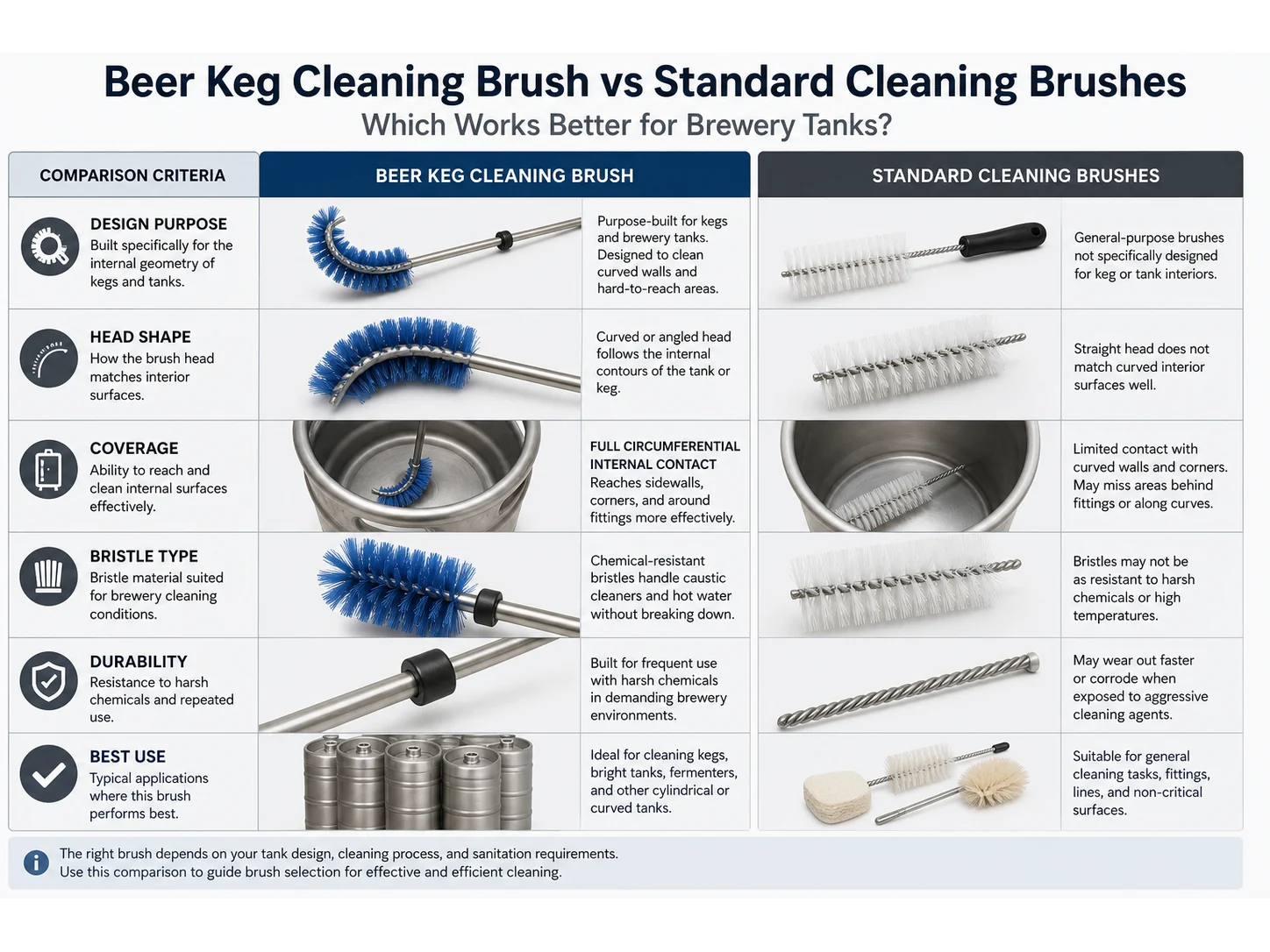
Beer Keg Cleaning Brush vs Standard Cleaning Brushes
| Feature | Beer Keg Cleaning Brush | Standard Cleaning Brushes |
|---|---|---|
| Head shape | Curved or angled to match keg interior profile | Usually straight or simple loop; cannot reach all keg surfaces |
| Handle length | Sufficient to reach the bottom of a full-size keg (18–24 in) | Often too short for keg depth; requires extended reach or awkward grip |
| Bristle stiffness | Firm enough to remove beer stone and biofilm without scratching | May be too soft (ineffective) or too abrasive (risk of scratching stainless steel) |
| Chemical resistance | Materials selected for caustic and acid cleaning cycles (nylon, polyester) | Varies widely; many common materials degrade with brewery chemicals |
| Drill compatibility | Often includes a hex shank for powered cleaning | Typically round shaft, not designed for drill use |
| Contact coverage | Engineered to scrub the entire interior, including the top dome | Leaves blind spots, especially the upper shoulder and chime ring |
| Hygiene outcome | More consistent removal of biofilm, reducing microbial hideouts | Inconsistent cleaning raises cross-contamination risk between batches |
How to Choose the Right Brush for Brewery Tanks
Your selection should be based on the specific cleaning challenge, not just brush availability. Consider these factors:
- Residue type: Light yeast sediment may clean up with a medium-stiffness nylon brush; stubborn beer stone requires a stiffer polyester brush designed for chemical-assisted cycles.
- Surface sensitivity: Keg interiors are typically 304 stainless steel. Avoid steel wire bristles unless the manufacturer explicitly approves them for your keg type.
- Equipment interface: If using a drill, verify that the brush has a properly machined hex shank that fits your drill chuck and won’t slip under torque.
- Wet or chemical exposure: In automated cleaning loops or soak tanks, choose a brush with a sealed ferrule and chemical-resistant bristles to prevent degradation.
- Keg size and neck diameter: Measure the keg opening and depth. Cornelius kegs often need a smaller brush diameter (e.g., 3–4 in) compared to standard half-barrel brushes.
- Cleaning frequency: High-volume breweries benefit from drill-powered brushes with replaceable heads to reduce labor time and maintain consistency.
Common Mistakes When Selecting a Keg Cleaning Brush
Even experienced brewery operators can overlook critical details. Avoid these pitfalls:
- Assuming any brush that fits will clean effectively. A straight bottle brush may enter the keg but leave the top dome untouched, harboring biofilm.
- Ignoring bristle stiffness rating. Too soft means longer scrubbing time; too stiff can compromise the keg’s passivation layer over many cycles.
- Choosing by cost drivers alone. Low-cost brushes often use adhesives that fail in hot caustic tanks, leading to bristle shedding and foreign material in your kegs.
- Mixing brush types without sanitation protocols. Using the same brush for fermentation tank exteriors and keg interiors can introduce wild yeast into the keg.
- Neglecting handle-to-head connection. A weak ferrule may bend or break during powered use, making the brush unusable mid-cleaning cycle.
When a Beer Keg Cleaning Brush Is the Wrong Choice
A dedicated keg brush handles routine cleaning well, but there are limits. If you notice persistent pitting, deep scratches, or beer stone that recurs immediately after cleaning, a manual brush alone may be insufficient. Consider these situations where a different approach is needed:
- Heavy beer stone deposits: Acid recirculation cleaning or a specialized rotating jet keg washer may be required before brush use.
- Unusual keg geometries: Some European slim kegs or disposable kegs with narrow plastic liners can catch loose bristles. A sample test with a supplier-provided drawing ensures fit and bristle retention.
- Surface restoration: If the passivation layer is already damaged, abrasive brushing can worsen the problem. Electrochemical repassivation may be needed first.
- Automated cleaning lines: When you are scaling up, fixed brush assemblies or spray-ball systems often replace manual brushes to ensure consistency and traceability.
In these cases, ask your brush supplier for a drawing or sample to validate the brush design against your exact keg specification before committing to a large order. A quick fit-and-function test with water or cleaning chemical can prevent damage and downtime.
Final Takeaway
A beer keg cleaning brush is the superior choice for maintaining brewery tank hygiene because it matches the keg’s internal geometry and chemical exposure profile. Standard brushes may seem like a quick fix, but they often leave behind residue, increase labor time, or risk damaging the keg surface. Match the brush bristle material, stiffness, and handle configuration to your specific cleaning regimen, and always verify fit through a sample test if you are cleaning a non-standard keg model.
Frequently Asked Questions
Can I use a regular bottle brush to clean my beer kegs?
Bottle brushes are too short and often lack the stiffness to scrub the top dome of a keg effectively. They can be a temporary substitute for quick yeast slurry removal, but they don’t provide reliable biofilm control for beer-contact surfaces.
What bristle material is safest for stainless steel kegs?
Nylon and polyester are the safest common materials. Nylon is sufficient for most daily cleaning; polyester handles higher temperatures and harsh chemicals better. Always avoid steel wire unless the keg manufacturer specifically recommends it for your model.
How do I know if a brush fits my Cornelius keg?
Measure the keg neck’s inner diameter, then select a brush head that is slightly smaller so it can be inserted without forcing. Many brushes list compatibility with common keg types; always confirm with a physical sample if possible.
Should I use a drill-powered brush or a manual handle?
Drill-powered brushes reduce labor and provide consistent rotational speed, which helps remove heavy beer stone. Manual handles offer more control for delicate kegs or when you want to feel the surface resistance. The choice depends on your cleaning volume and residue severity.
How often should I replace a beer keg cleaning brush?
Inspect the brush after each cleaning cycle. Replace when bristles become permanently bent, show signs of abrasive wear, or if the ferrule loosens. A degraded brush can shed bristles or scratch the keg interior.
Can I use the same brush for different chemical cleaners?
Yes, if the bristle material is rated for both caustic and acid solutions. Rinse the brush thoroughly between cycles to avoid chemical mixing. Some facilities keep separate brushes for acid and caustic to extend brush life.
What should I do if bristles start shedding into the keg?
Stop using the brush immediately. The adhesive or mechanical fastening may be failing. Replace the brush and inspect the keg interior for any trapped bristles before the next fill.
Technical References
- eCFR — 21 CFR 178.1010 Sanitizing Solutions
- CDC — Preventing Food Poisoning
- eCFR — 21 CFR 177.1500 Nylon Resins
- eCFR — 21 CFR 177.1630 Polyethylene Phthalate Polymers
- eCFR — 21 CFR Part 117 Human Food CGMP and Preventive Controls
- FDA — Food Safety in Your Kitchen
Which bristle material fits this job — Nylon PA, AISI 304 Stainless Steel Wire or Polypropylene PP?
| Material | Continuous temperature (°C) | Peak temperature (°C) | Water absorption | Hardness |
|---|---|---|---|---|
| Nylon PA | 93 | 121 | 0.3–9% by PA grade and conditioning | Medium to firm; filament diameter and trim length control bending force. |
| AISI 304 Stainless Steel Wire | 400 | 500 | 0% | Rockwell B 70–95 depending on temper and cold work |
| Polypropylene PP | 80–100 | 120–140 | ≤0.03% | Shore D 65–75 |
Figures as published by Brushtec / DuPont; Alleima; Perlon. Confirm the exact grade against the supplier datasheet before ordering.
What should replace Bottle & Container Brushes for beer keg cleaning brush?
- Bottle & Container Brushes — Bottle and container brushes are selected around an opening plus a larger vessel body and bottom geometry; tube and bore brushes are selected mainly around a long diameter-controlled passage. Closest alternative: Tube & Pipe Bore Brushes.
- Nylon PA — Compare Nylon PA with PP, PBT, PET. Change material when wet stiffness, temperature, chemical resistance, conductivity, particle shedding, or surface marking becomes the limiting factor.
- AISI 304 Stainless Steel Wire — Use AISI 316 stainless steel wire for chloride, marine, dairy, beverage, chemical washdown, or higher pitting-resistance requirements. Use carbon steel for dry aggressive cutting and brass or abrasive nylon for lower marking risk.
- Polypropylene PP — Compare Polypropylene PP with Nylon, PBT, PET. Change material when wet stiffness, temperature, chemical resistance, conductivity, particle shedding, or surface marking becomes the limiting factor.