
What Is a Beer Keg Cleaning Brush?
A beer keg cleaning brush is a narrow, long-bristled brush engineered for cleaning the interior of keg components. Unlike a general bottle brush or test tube brush, it must withstand repeated exposure to caustic cleaners, hot water, and sanitizers while reaching into restricted spaces. Typically, these brushes feature a twisted wire core, a loop or stopper handle, and filament choices such as nylon, polypropylene, stainless steel, or natural fibers like tampico. Their primary purpose is to remove beer stone, yeast residues, and biofilm that can harbor off-flavors or spoilage organisms.
Common Types of Beer Keg Cleaning Brushes
While a single brush cannot cover every cleaning task, most small beverage operations encounter a few essential types:
- Tube brushes: Straight, uniform-diameter brushes for dip tubes and beer lines. Available in various diameters and lengths.
- Tapered brushes: Wider at the base, narrowing toward the tip, ideal for faucet bodies and shanks where the bore changes shape.
- Twisted-in-wire brushes: Bristles are captured between twisted wires, offering aggressive scrubbing action; often used for heavy beer stone.
- Sponge or foam swabs: Soft, absorbent heads for wiping sensitive surfaces; less common but useful when scratching must be avoided.
- Extendable handle brushes: Feature telescoping or modular handles for reaching deep keg interiors.
Common Mistakes in Beer Keg Cleaning Brush Selection and Use
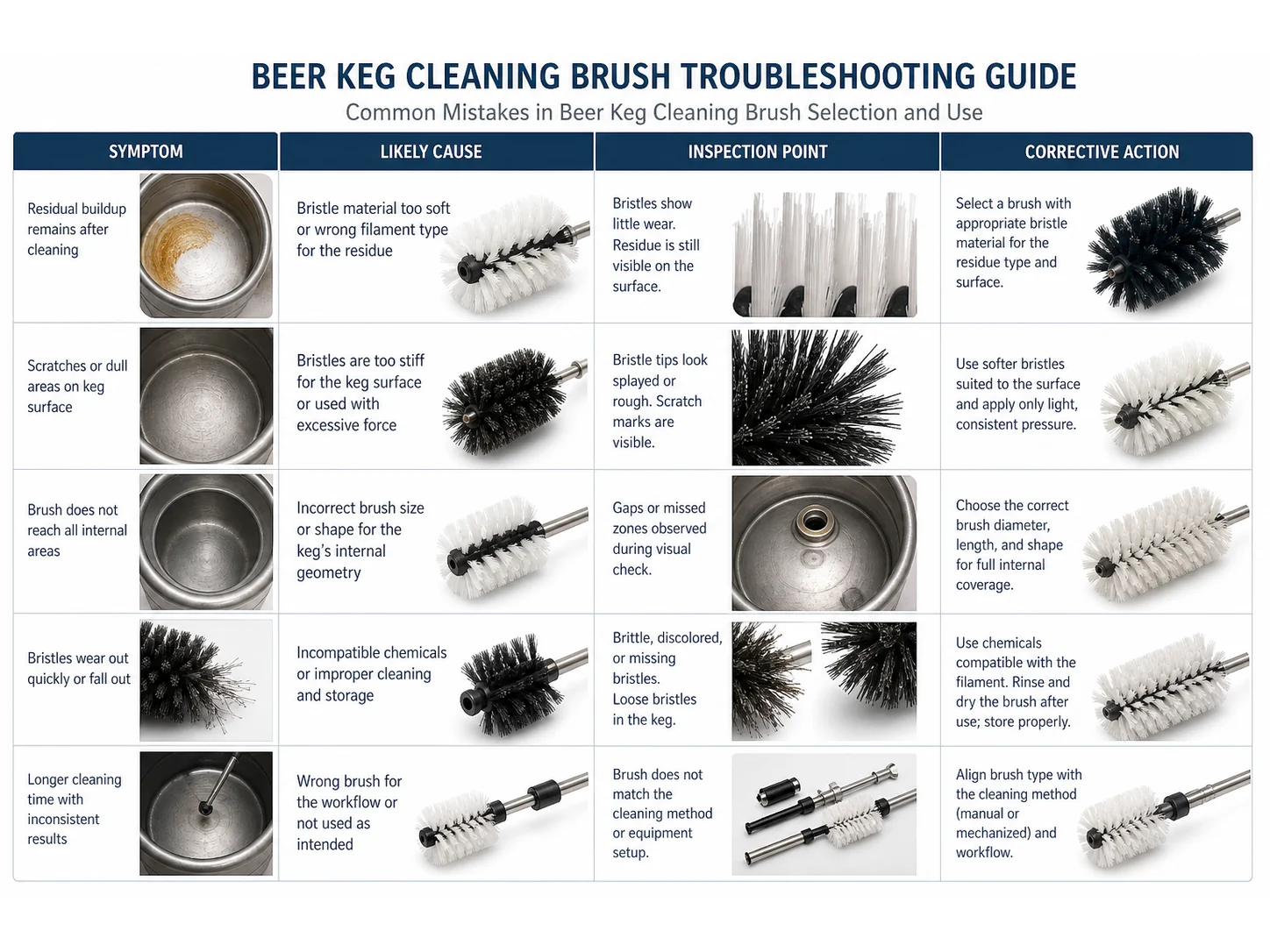
Mistakes in choosing or handling a beer keg cleaning brush can compromise both safety and cleaning effectiveness. The following table summarizes the most prevalent errors and their consequences.
| Mistake | Why It Happens | Potential Consequence | How to Avoid |
|---|---|---|---|
| Using wrong bristle material for chemicals | Assuming all nylon or plastic handles caustic | Brush degradation, contaminated beer | Check chemical compatibility chart before purchase |
| Incorrect brush diameter | Estimating size visually or reusing same brush for all tasks | Incomplete cleaning or surface scratching | Measure internal diameter and choose brush with a slight clearance (approx. 0.5–1 mm smaller than the bore) |
| Ignoring handle/core material | Wood handles appear inexpensive or traditional | Splintering, mold growth, core failure | Specify stainless steel or FDA-compliant plastic cores |
| Assuming one brush fits all components | Lack of awareness of different geometries | Missed residues in tight bends or varying diameters | Map each cleaning point and procure purpose-matched brushes |
| Excessive force and bending | Trying to scrub aggressively or force into tight curves | Wire core deformation, bristle loss | Use gentle, back-and-forth motion; if resistance, check sizing |
| Neglecting brush maintenance | Leaving brush wet or in chemical solution | Brush itself becomes contamination source | Rinse, dry, and store in a clean, dry place; replace when worn |
How to Choose the Right Brush Based on Residue and Surface Sensitivity
Different residues require different scrubbing power, and surface materials constrain your bristle choice. Use the following table to align your brush selection with the cleaning task.
| Residue Type | Recommended Bristle Material | Surface Compatibility | Notes |
|---|---|---|---|
| Light beer film / daily rinse | Soft nylon or sponge | All surfaces, including plastic | Lowest risk of scratching |
| Beer stone (calcium oxalate) | Stiff nylon or stainless steel | Stainless steel only (risk of scratching plastic) | Stainless bristles can scratch softer stainless grades |
| Heavy yeast or hop debris | Polypropylene or medium nylon | Stainless, plastic lines | Good chemical resistance |
| Delicate chrome-plated faucets | Tampico (natural fiber) or ultra-soft nylon | Chrome, brass | Avoid metal bristles; test in inconspicuous area |
| Mixed residues with caustic cleaner | Polypropylene (PP) | Stainless, most plastics | Excellent chemical resistance; verify temperature limits |
Setup and Usage Factors That Influence Brush Performance
Even the correct brush can perform poorly if used under suboptimal conditions. Consider the following:
- Wet vs. dry: Always use brushes in conjunction with a cleaning solution; dry brushing can generate static or embed residues.
- Manual or drill-driven: Drill speeds increase risk of overheating or scratching; manual operation allows better feel and control.
- Frequency: Brushes used multiple times per day will wear faster; invest in higher filament density and chemical-resistant cores.
- Custom fit: If standard brushes leave gaps, request a supplier drawing review; a small batch of custom brushes may prevent long-term cleaning failures.
When a Beer Keg Cleaning Brush Is the Wrong Choice
Brushes are essential but have limitations. Recognize these boundaries to maintain hygiene standards:
- Complex pipe bends: If a brush cannot follow the bend, consider a clean-in-place (CIP) system that circulates cleaning solution under pressure.
- Severe pitting or corrosion: A brush will not repair damaged surfaces; replace the keg or component and investigate root cause (e.g., improper passivation).
- High-volume, automated lines: In continuous production, manual brush cleaning may be impractical; automated CIP or ultrasonic cleaning may be more efficient.
- Cross-contamination concerns: When switching between product lines (e.g., different beer styles or non-beer beverages), a dedicated or disposable brush/swab minimizes carryover.
- Rapid brush failure: If brushes wear out within days, recheck chemical concentration, temperature, and exposure time; the cleaning protocol may be damaging the brush rather than the brush being inadequate.
Final Takeaway
Avoiding common beer keg cleaning brush mistakes is about precision in selection, not just grabbing the nearest brush. Define your residue profile, measure internal diameters, confirm chemical compatibility, and establish a maintenance schedule. When standard solutions fall short, involve a brush manufacturer early with a drawing or sample. By aligning the brush to the actual cleaning challenge, small beverage channels can protect both product quality and equipment investment.
Frequently Asked Questions
Can I use a regular bottle brush for cleaning keg dip tubes?
In many cases, no. Standard bottle brushes often lack the necessary diameter precision, chemical resistance, and length for internal keg components. Using them may lead to incomplete cleaning or contamination from bristle shedding.
How often should I replace my beer keg cleaning brush?
Replace the brush when you notice bristle splaying, wire core rust or deformation, or reduced cleaning efficacy. In high-use environments, a monthly inspection is reasonable; for heavy beer stone removal, replacement may be needed every few weeks.
Is stainless steel bristle safe for all stainless steel keg surfaces?
Not necessarily. Stainless steel bristles can scratch the surface, especially if the brush and keg are made of similar hardness stainless. This can create crevices that harbor bacteria. Use stainless bristles only when absolutely necessary and test on a sample surface first.
What’s the best way to clean and store the brush between uses?
After each use, rinse thoroughly with clean water to remove chemical residue and loosened debris. Hang vertically to air dry completely before storing in a clean, dry, dust-free container. Avoid leaving the brush submerged in sanitizer for extended periods.
Do I need different brushes for cleaning beer lines vs. keg spears?
Yes, typically. Beer lines have a smaller, consistent inner diameter, while keg spears and couplers have varying internal geometries and often require a combination of tube and tapered brushes. Mapping each component’s cleaning point is the best practice.
How do I confirm a brush material is compatible with my cleaning chemical?
Request a chemical resistance chart from the brush supplier that lists the specific chemical, concentration, and temperature. Common materials like polypropylene and stainless steel resist most brewery chemicals, but nylon can degrade in hot caustic solutions above certain concentrations.
What information should I include in an RFQ for a custom beer keg cleaning brush?
Provide the exact internal diameter and length of the channel, the type of residue (beer stone, yeast, etc.), the base material of the equipment (304 SS, 316 SS, chrome-plated brass), the cleaning chemicals and temperatures used, and any special hygiene standards (e.g., FDA, 3-A).
Can I bend a straight brush to clean a curved dip tube?
Only if the brush is designed with a flexible core; standard twisted wire cores may permanently deform or break if forced. If curved cleaning is necessary, consider a brush with a pre-shaped bent stem or a more aggressive chemical cleaning step instead.
Technical References
- eCFR — 21 CFR 178.1010 Sanitizing Solutions
- CDC — Preventing Food Poisoning
- eCFR — 21 CFR 177.1500 Nylon Resins
- eCFR — 21 CFR 177.1520 Olefin Polymers
- eCFR — 21 CFR Part 117 Human Food CGMP and Preventive Controls
- FDA — Food Safety in Your Kitchen
Which bristle material fits this job — AISI 304 Stainless Steel Wire, Nylon PA or Polypropylene PP?
| Material | Continuous temperature (°C) | Peak temperature (°C) | Water absorption | Hardness |
|---|---|---|---|---|
| AISI 304 Stainless Steel Wire | 400 | 500 | 0% | Rockwell B 70–95 depending on temper and cold work |
| Nylon PA | 93 | 121 | 0.3–9% by PA grade and conditioning | Medium to firm; filament diameter and trim length control bending force. |
| Polypropylene PP | 80–100 | 120–140 | ≤0.03% | Shore D 65–75 |
Figures as published by Alleima; Brushtec / DuPont; Perlon. Confirm the exact grade against the supplier datasheet before ordering.
What should replace Bottle & Container Brushes for beer keg cleaning brush?
- Bottle & Container Brushes — Bottle and container brushes are selected around an opening plus a larger vessel body and bottom geometry; tube and bore brushes are selected mainly around a long diameter-controlled passage. Closest alternative: Tube & Pipe Bore Brushes.
- AISI 304 Stainless Steel Wire — Use AISI 316 stainless steel wire for chloride, marine, dairy, beverage, chemical washdown, or higher pitting-resistance requirements. Use carbon steel for dry aggressive cutting and brass or abrasive nylon for lower marking risk.
- Nylon PA — Compare Nylon PA with PP, PBT, PET. Change material when wet stiffness, temperature, chemical resistance, conductivity, particle shedding, or surface marking becomes the limiting factor.
- Polypropylene PP — Compare Polypropylene PP with Nylon, PBT, PET. Change material when wet stiffness, temperature, chemical resistance, conductivity, particle shedding, or surface marking becomes the limiting factor.