What Is an MLCC Carrier Cleaning Brush?
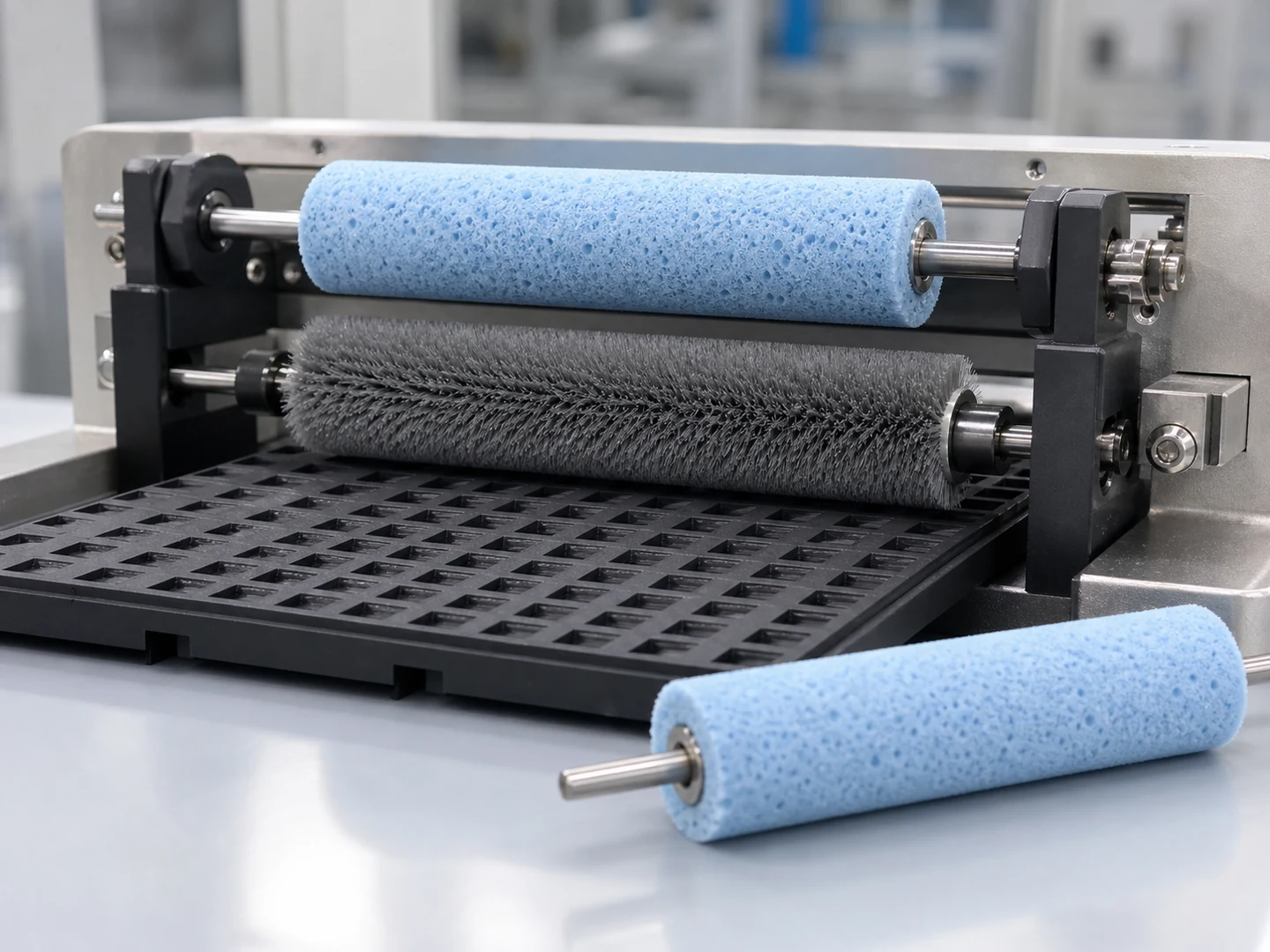
An MLCC carrier cleaning brush is a cylindrical or wheel-shaped brush engineered to clean the internal surfaces of wheel barrels that hold MLCC components during tumbling, coating, or drying processes. Unlike general-purpose wheel brushes or car detailing tools, these brushes must balance effective residue removal with zero damage to delicate ceramic parts and carrier surfaces.
For electrostatic discharge fundamentals, this article references EOS/ESD Association — ESD Fundamentals.
For ESD control principles and protected area practices, this article references EOS/ESD Association — Principles of ESD Control.
For semiconductor contamination and precision metrology context, this article references NISTIR 4653 — Metrology for the Semiconductor Industry.
For cleanroom classification standard page, this article references ISO 14644-1 Cleanrooms and Associated Controlled Environments.
For brush construction terminology, filament/backing/stem terms, this article references American Brush Manufacturers Association — Brush Lingo.
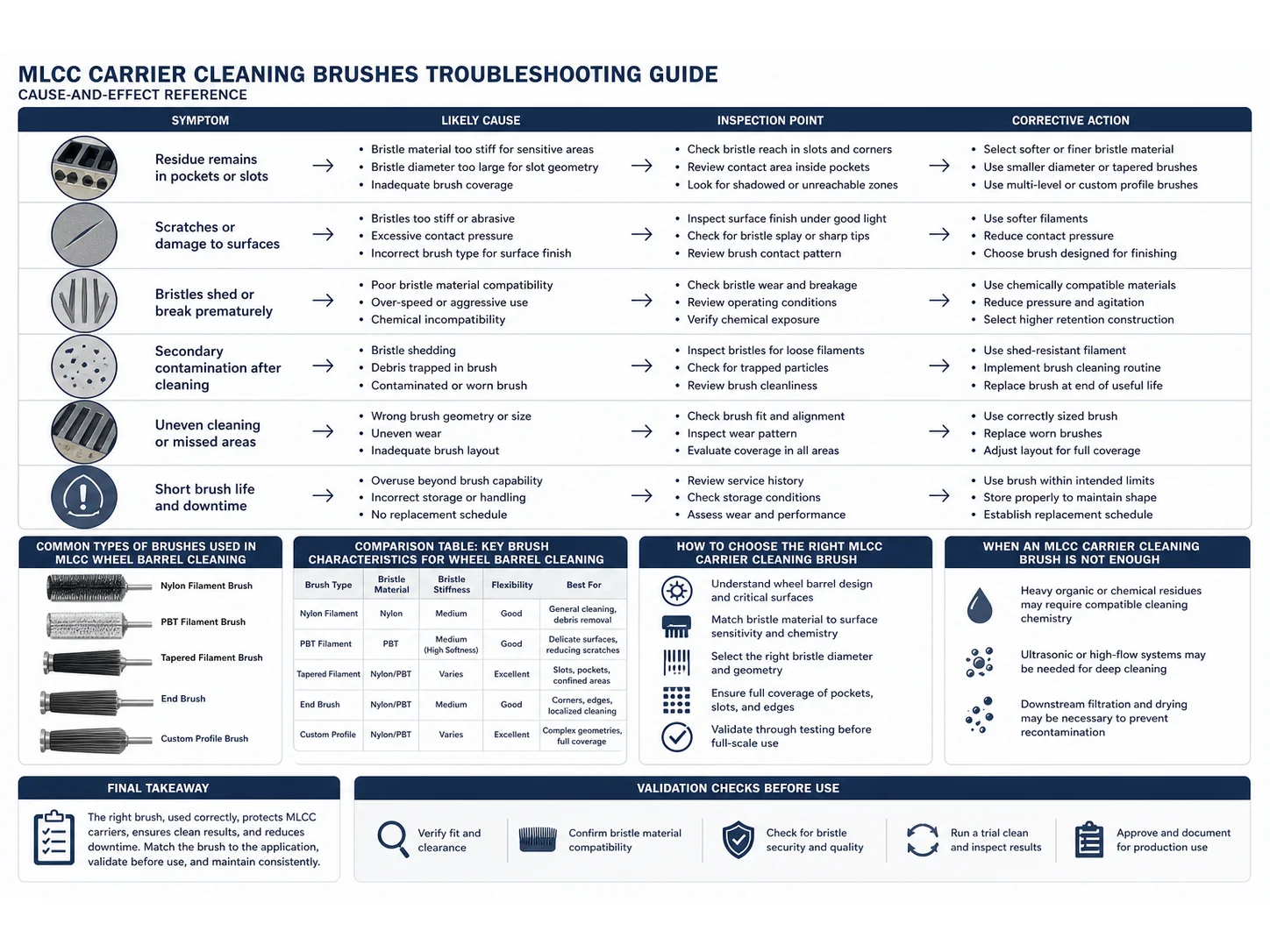
Common Types of Brushes Used in MLCC Wheel Barrel Cleaning
While many facilities use off-the-shelf industrial brushes, the most common styles adapted for this application include:
- Nylon filament brushes: Non-abrasive, chemically resistant, good for light powder removal.
- Abrasive nylon brushes: Impregnated with silicon carbide or aluminum oxide, used for moderate baked-on residues.
- Natural fiber brushes: Tampico or horsehair, extremely soft, used in final polishing or sensitive carrier materials.
- Wire brushes: Brass or stainless steel, aggressive cleaning but high risk of scratching or particle shedding.
- Channel-mount or twist-in wire brushes: Used in automated cleaning heads or rotary equipment.
Comparison Table: Key Brush Characteristics for Wheel Barrel Cleaning
| Characteristic | Soft Nylon | Abrasive Nylon | Brass Wire | Stainless Steel Wire |
|---|---|---|---|---|
| Surface Damage Risk | Very low | Low–moderate | Moderate | High |
| Residue Removal Power | Light dust | Baked-on films | Moderate caking | Heavy rust/scale |
| Wet/Dry Use | Both | Both | Dry preferred | Dry preferred |
| Chemical Resistance | Good | Good | Fair (corrosion risk) | Good but may discolor |
| Bristle Shedding | Very low | Low | Moderate | Low |
| Typical Working Life | Moderate | Long | Moderate | Long |
| MLCC Suitability | Excellent for carriers | Good for barrels (not carriers) | Not recommended | Not recommended |
Note: Always confirm material compatibility with your specific process chemicals and carrier substrate.
How to Choose the Right MLCC Carrier Cleaning Brush
Use these decision factors instead of guessing based on diameter or cost drivers:
- Residue type: Is it loose powder, sticky paste, or hard baked-on layer? Match abrasive level accordingly.
- Surface sensitivity: MLCC carriers are often ceramic or coated – avoid metal bristles that can create micro-scratches.
- Equipment interface: Check shank diameter, overall length, or quick-connect style. A brush that does not fit the shaft will stall the cleaning station.
- Wet or chemical exposure: If using solvents or ultrasonic baths, choose a filament that will not swell, degrade, or leach.
- Hygiene expectations: For high-purity environments, select brushes with sealed core hubs and minimal binder materials.
- Maintenance frequency: Higher brush density and crimped wire cores can extend life if throughput is high.
- Custom size requirements: Most wheel barrels are not standard pipe sizes; custom OD, ID, and fill density may be necessary.
Common Mistakes When Selecting and Using MLCC Carrier Cleaning Brushes
- Using a wire brush on a ceramic carrier: This is the most expensive mistake. Tiny scratches become defect nucleation sites, leading to capacitor failure.
- Choosing diameter by guesswork: A brush too small misses residue at the barrel walls; too large jams the mechanism and damages bristles.
- Ignoring chemical compatibility: Some nylon grades soften in strong solvents, causing the brush to collapse mid-cycle.
- Ordering without sampling: A CAD drawing may not capture real-world fill density, core balance, or fraying behavior.
- Skipping a test run with actual residue: A brush that cleans test coupons perfectly may fail with production residues due to adhesion differences.
- Mixing metal brushes with acoustic or optical sensors: Shed brass or steel particles can trigger false readings or damage nearby sensors.
- Overlooking mounting hardware: A twist-knot wire wheel may need a specific arbor adapter not included; confirm before ordering.
- Failing to set a replacement schedule: Even non-abrasive brushes wear down and lose cleaning efficiency, leading to gradual residue buildup.
When an MLCC Carrier Cleaning Brush Is Not Enough
Even the best brush cannot solve every cleaning problem. Consider alternate or supplementary steps when:
- Residue is carbonized or chemically bonded and requires a soak tank or chemical pre-treatment before brushing.
- The wheel barrel has complex geometry (grooves, undercuts) that a radial brush cannot reach – a custom-formed brush or nozzle-based cleaning may be needed.
- Particle counts after brush cleaning are still above specification; downstream high-pressure rinsing or ultrasonic cleaning should be added.
- The brush itself introduces contamination; verify via swab testing and consider a different material or a cleanroom-grade version.
- The process requires a validated cleaning protocol; a single brush choice may not be enough without documented qualification runs.
Final Takeaway
Avoid costly MLCC carrier contamination by matching the brush material, diameter, and stiffness to your exact residue and surface. Test with real samples, inspect for bristle shedding, and never default to a metal brush just because it is cheaper. A well-chosen nylon or abrasive nylon brush, properly sized and chemically compatible, will protect your carriers and maintain consistent cleaning performance.
Practical Use Note
In daily use, the practical test is simple: check whether the brush reaches the full contact area, removes the target residue, and leaves the surface in the required condition. Record what changes when ESD control, slot access, particle type, contact pressure, and component sensitivity changes, because many brush failures are caused by the working condition shifting rather than by the brush body alone.
Frequently Asked Questions
What is the best material for an MLCC carrier cleaning brush?
For most ceramic MLCC carriers, soft nylon or abrasive nylon with fine grit is safest. They remove light to moderate residues without scratching. Avoid wire brushes unless cleaning a sturdy metal barrel component and no carrier contact occurs.
Can I use a wire brush on MLCC wheel barrels?
Not directly on carriers. Wire brushes can be used on the barrel housing itself if it is stainless steel and carriers are removed, but the risk of particle shedding into the cleanroom environment is high. Most facilities prohibit metal brushes near ceramic components.
How often should I replace the cleaning brush?
Replacement frequency depends on production volume and residue hardness. Inspect bristle length and shape weekly. When bristles shorten by 30% or become permanently deformed, cleaning efficiency drops and replacement is due. Some lines schedule changes every 200–500 cycles.
Can I get a custom diameter brush for my wheel barrel?
Yes. Many industrial brush manufacturers can produce custom outside diameters, arbor holes, and fill densities based on a drawing or sample barrel. Send exact measurements and residue description for an accurate recommendation.
What bristle stiffness is safest for sensitive MLCC processes?
Soft to medium nylon is typical. If more cleaning power is needed, move to a fine-grit abrasive nylon rather than increasing bristle diameter or switching to metal, because abrasive nylon is embedded with grit and cuts residue without deep scratching.
Is it necessary to test a cleaning brush sample before bulk ordering?
Strongly recommended. Even brushes with the same nominal specification can perform differently due to filament source, crimp style, or core design. A short trial with actual production residue avoids surprises and justifies the final selection.
Does the brush mounting type matter for automated cleaning stations?
Yes. Confirm whether your station uses a square drive, hex shank, or round shank with set screws. An incompatible mount can cause slippage, imbalance, or damage to the brush core and the cleaning machine.