What Is an MLCC Carrier Cleaning Brush?
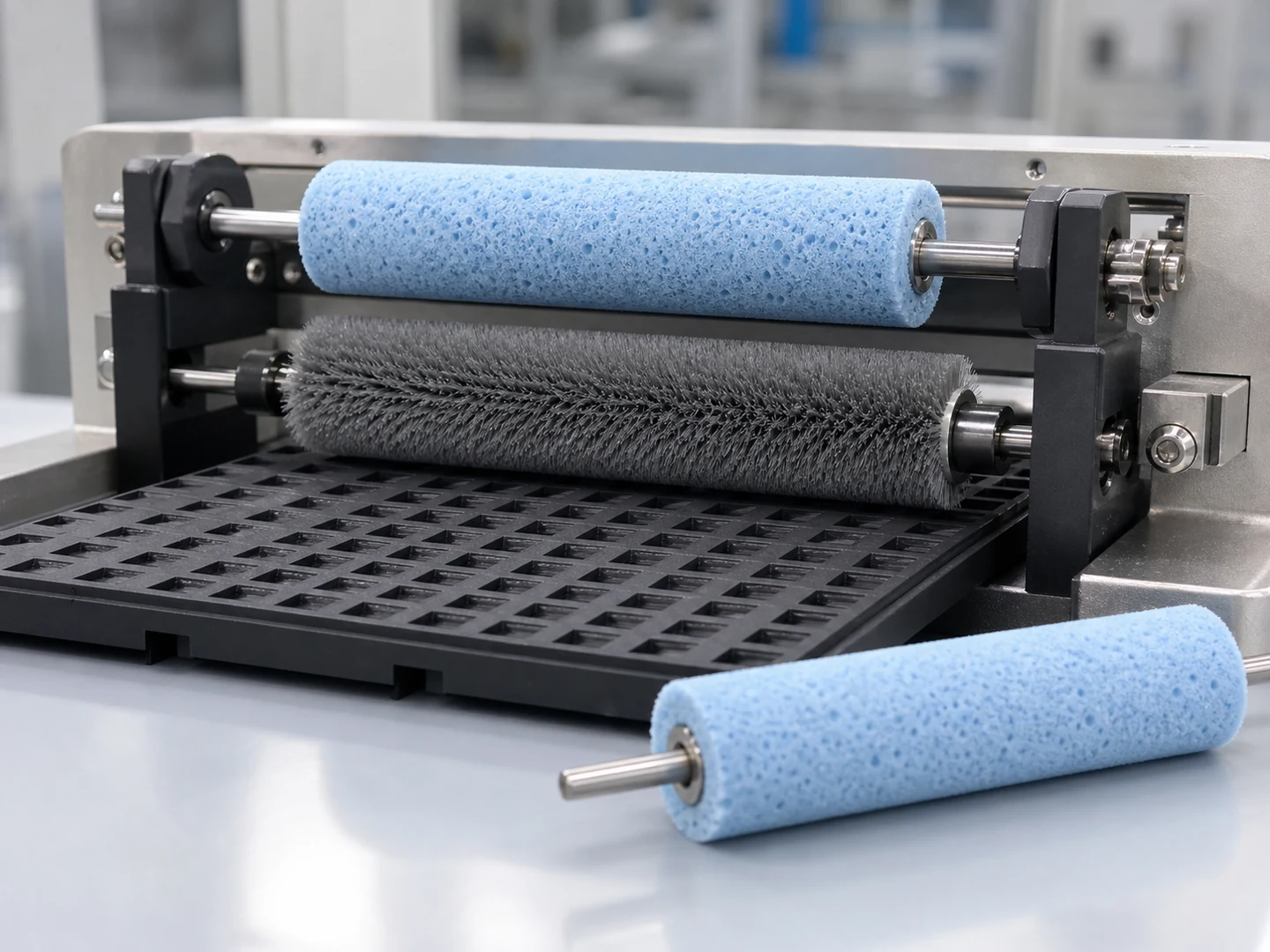
An MLCC carrier cleaning brush is a precision cleaning tool designed to safely remove contaminants from the cavities, pockets, and surfaces of carriers used to transport or store MLCCs. Unlike general-purpose brushes, these must be non-abrasive enough to prevent scratching ceramic carriers or damaging delicate capacitor terminations, yet effective against stubborn residues like baked-on flux or oil films. They are often used in automotive engine bay environments where MLCC carriers are handled during module assembly or repair, exposing them to higher levels of dirt and chemical contamination.
Common Brush Types and Material Options
For static-control claims, this article uses EOS/ESD Association — ESD Fundamentals as the ESD reference.
For static-control claims, this article uses EOS/ESD Association — Principles of ESD Control as the ESD reference.
For semiconductor and wafer-cleaning context, NISTIR 4653 — Metrology for the Semiconductor Industry is used as the precision-cleaning and contamination-control reference.
For cleanroom-classification language, this article points to the official ISO 14644-1 Cleanrooms and Associated Controlled Environments standard page rather than inventing cleanliness claims.
For the safety point in this section, the relevant OSHA reference is OSHA — Electrical.
For dimension and measurement language, NIST — Metric SI supports the use of consistent SI/metric specifications.
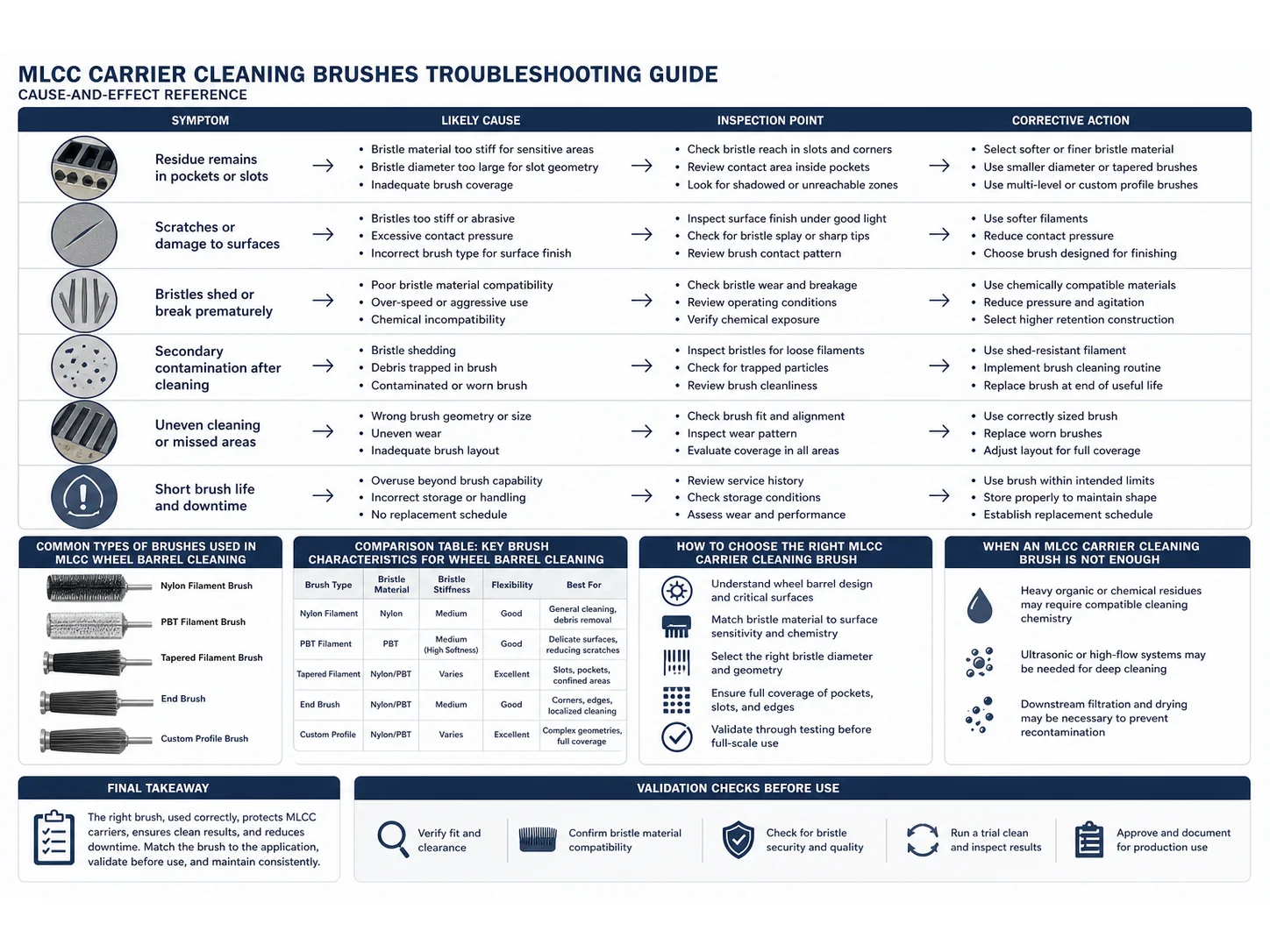
MLCC carrier cleaning brushes come in several constructions, each suited to different cleaning needs:
- Twisted-in-wire brushes – bristles are held between twisted wire stems; available in various diameters and bristle lengths. Good for cleaning holes and narrow pockets.
- Strip or channel brushes – bristles set in a metal or plastic channel; ideal for wiping larger flat areas of carriers.
- Hand-held detail brushes – with plastic or wooden handles and bristle tufts; suitable for manual spot cleaning.
- Rotary brushes for automated cleaning – designed to mount on spindles or rotary tools; used in semi-automated cleaning stations.
Bristle material is the most critical choice. Common options include:
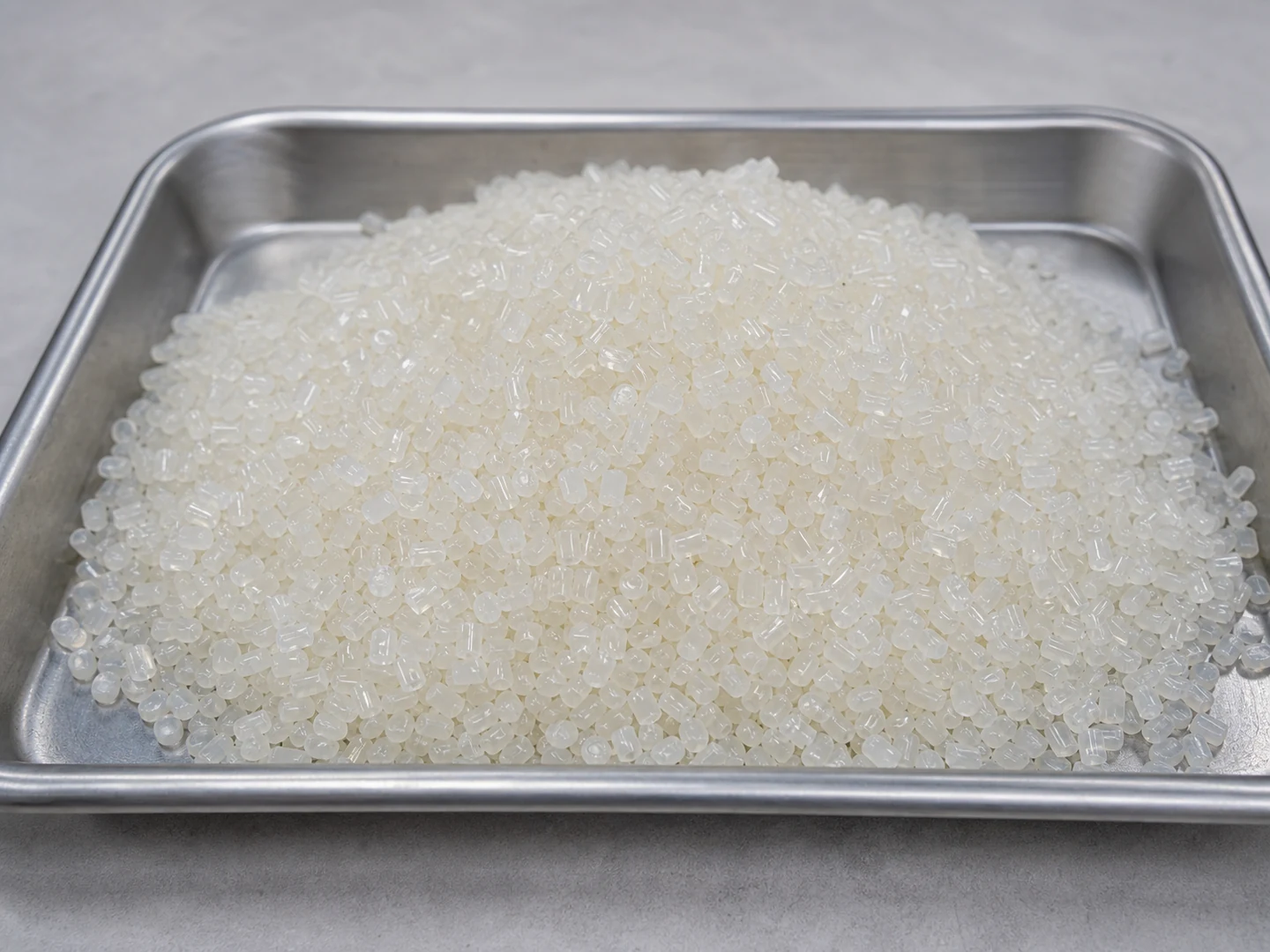
- Nylon (6.6 or 6.12) – durable, chemical-resistant, and available in abrasive or non-abrasive grades. Good for general cleaning with solvents.
- Conductive nylon or ESD-safe fibers – carbon-filled nylon prevents static buildup; essential when cleaning static-sensitive carriers.
- Natural animal hair (horsehair, Tampico) – very soft, absorbent, and non-abrasive; ideal for dust removal and delicate surfaces.
- Polypropylene – resistant to acids and alkalis, but less temperature-resistant than nylon.
Comparison of Brush Materials for MLCC Carrier Cleaning
| Material | Stiffness | Chemical Resistance | ESD Safety | Best For |
|---|---|---|---|---|
| Standard Nylon | Medium to high | Good (hydrocarbons, solvents) | No (insulative) | Stubborn grease, flux; non-ESD sensitive carriers |
| Conductive Nylon | Medium | Good | Yes (surface resistance 10³–10⁹ Ω) | Static-sensitive carriers, cleanroom environments |
| Horsehair | Soft | Limited (degrades in strong solvents) | No | Dust, light residue; scratch-sensitive surfaces |
| Tampico | Medium-soft | Good (alkaline cleaners) | No | Water-based cleaning, polishing |
| Abrasive Nylon (silicon carbide coated) | High | Excellent | No | Stubborn baked-on carbon; only if carrier material allows |
How to Choose the Right MLCC Carrier Cleaning Brush
Selecting a brush requires matching the brush characteristics to the specific cleaning challenge and carrier design:
- Residue type – heavy oils and flux residues need medium-stiff nylon with good solvent compatibility; dry dust may need soft horsehair to avoid scratching.
- Surface sensitivity – ceramic carriers can be brittle; avoid overly stiff bristles or metallic core wires that could scratch. Use plastic-coated wire stems or all-plastic core brushes.
- Equipment interface – is the brush used manually, in a rotary tool, or mounted in an automated cleaning machine? Ensure the brush shank or arbor fits the machine spindle.
- Wet or chemical exposure – check material compatibility with the cleaning fluid. Nylon resists most solvents; polypropylene is better for aggressive acids. Natural fibers may swell.
- Hygiene and contamination control – for ESD-safe areas, use conductive filaments; in cleanrooms, lint-free synthetic brushes are preferred.
- Maintenance frequency – high-volume use may require durable nylon; soft natural bristles wear faster but are gentler.
- Custom size requirements – carrier pockets may require specific diameters, lengths, or trim lengths. Many suppliers offer made-to-order brush sizes.
Common Specification Mistakes and How to Avoid Them
Even experienced buyers can make errors that lead to poor cleaning or damaged carriers. Avoid these pitfalls:
- Choosing by size alone – a brush that fits the pocket may still have the wrong stiffness or chemical resistance.
- Ignoring electrostatic discharge (ESD) – using non-conductive brushes on ESD-sensitive carriers can induce voltages that zap MLCCs. Always specify conductive materials when required.
- Overlooking chemical compatibility – a brush that dissolves or swells in the cleaning solvent will fail quickly. Check material resistance charts.
- Using metal wire brushes – a wire brush for engine cleaning is too abrasive and can scratch ceramic carriers or short circuit nearby electronics. Stick to soft or synthetic bristles.
- Assuming one brush fits all carriers – different carrier designs (pocket depth, shape) may require custom brush diameters or trim lengths.
- Neglecting brush construction – a poorly secured twisted-wire stem can shed bristles or injure the operator. Look for quality crimps or sealed ends.
When an MLCC Carrier Cleaning Brush Is Not Enough
There are cleaning scenarios where a standard brush will not solve the problem, and other approaches are needed:
- Baked-on carbon or heavy scale – manual brushing may be insufficient. Ultrasonic cleaning or chemical soaking may be required before final brush cleaning.
- Deep, multi-cavity carriers – standard brushes may not reach all areas. A custom brush shape or a brushless cleaning method (e.g., high-pressure spray, CO₂ cleaning) might be more effective.
- High-precision cleaning for medical or aerospace – if carrier cleanliness must meet ISO or MIL specs, a simple brush may not provide consistent results; consider automated brush systems with controlled parameters.
- Verifying brush suitability – if you are unsure about the brush’s effect on carrier surfaces, request a sample for testing or ask the supplier for a drawing review against your carrier specifications.
Final Takeaway
An effective MLCC carrier cleaning brush balances material, size, and construction to match the contamination, carrier material, and ESD requirements of your engine bay environment. Start by defining the residue type and surface sensitivity, then choose a brush material and configuration that avoids scratches and static damage. Always test on a sample carrier before bulk ordering, and don’t hesitate to request custom sizes when standard brushes fall short. A well-chosen brush protects your MLCC carriers and the components they hold, reducing defects and downtime.
Practical Use Note
In daily use, the practical test is simple: check whether the brush reaches the full contact area, removes the target residue, and leaves the surface in the required condition. Record what changes when ESD control, slot access, particle type, contact pressure, and component sensitivity changes, because many brush failures are caused by the working condition shifting rather than by the brush body alone.
Frequently Asked Questions
What is the best bristle material for cleaning MLCC carriers?
It depends on the residue and ESD sensitivity. For general grease and flux, standard nylon offers good solvent resistance and durability. If static discharge is a concern, opt for conductive nylon or carbon-filled fibers. Soft horsehair is best for light dust on very delicate carriers.
Can I use a wire brush for engine cleaning on MLCC carriers?
No. Wire brushes are too abrasive and can scratch ceramic surfaces or damage metal terminations. They also pose a short-circuit risk if bristles break off near electronics. Use only soft or synthetic-bristle brushes designed for electronics.
How do I determine the correct brush size for my carrier?
Measure the pocket diameter, depth, and any narrow passages. The brush should be slightly smaller than the pocket to allow bristle flex, but large enough to make contact with all surfaces. For unusual shapes, provide the carrier drawing to a brush manufacturer for a custom fit.
Are anti-static brushes always necessary for MLCC carrier cleaning?
If the carriers hold or will hold sensitive components, and your process is within an ESD-protected area, yes. Using a non-conductive brush can generate and hold a charge that may damage MLCCs upon contact. Conductive brushes safely dissipate static.
How often should I replace an MLCC carrier cleaning brush?
Replace the brush when bristles become bent, matted, or start shedding. In high-volume cleaning, this may be weekly; in light use, monthly. A worn brush not only cleans poorly but may also leave bristle debris.
Can I use the same brush with different cleaning chemicals?
Check the bristle material’s chemical resistance chart. Nylon tolerates most common solvents (isopropyl alcohol, degreasers), but avoid strong acids or alkalis unless the brush is specifically rated. Natural fibers may degrade quickly with strong chemicals.
What if my carrier has very tight holes or blind pockets?
Standard brushes may not reach. Consider a custom brush with a narrower diameter, longer trim length, or a twisted-wire design that can bend into tight spaces. In some cases, a brushless cleaning method like ultrasonic agitation works better.
Is it possible to get a sample before a large order?
Reputable industrial brush manufacturers typically offer sample or prototype brushes for testing. Provide your carrier specifications and cleaning requirements; they can recommend a trial brush to validate fit and performance before production.