What Is an MLCC Carrier Cleaning Brush?
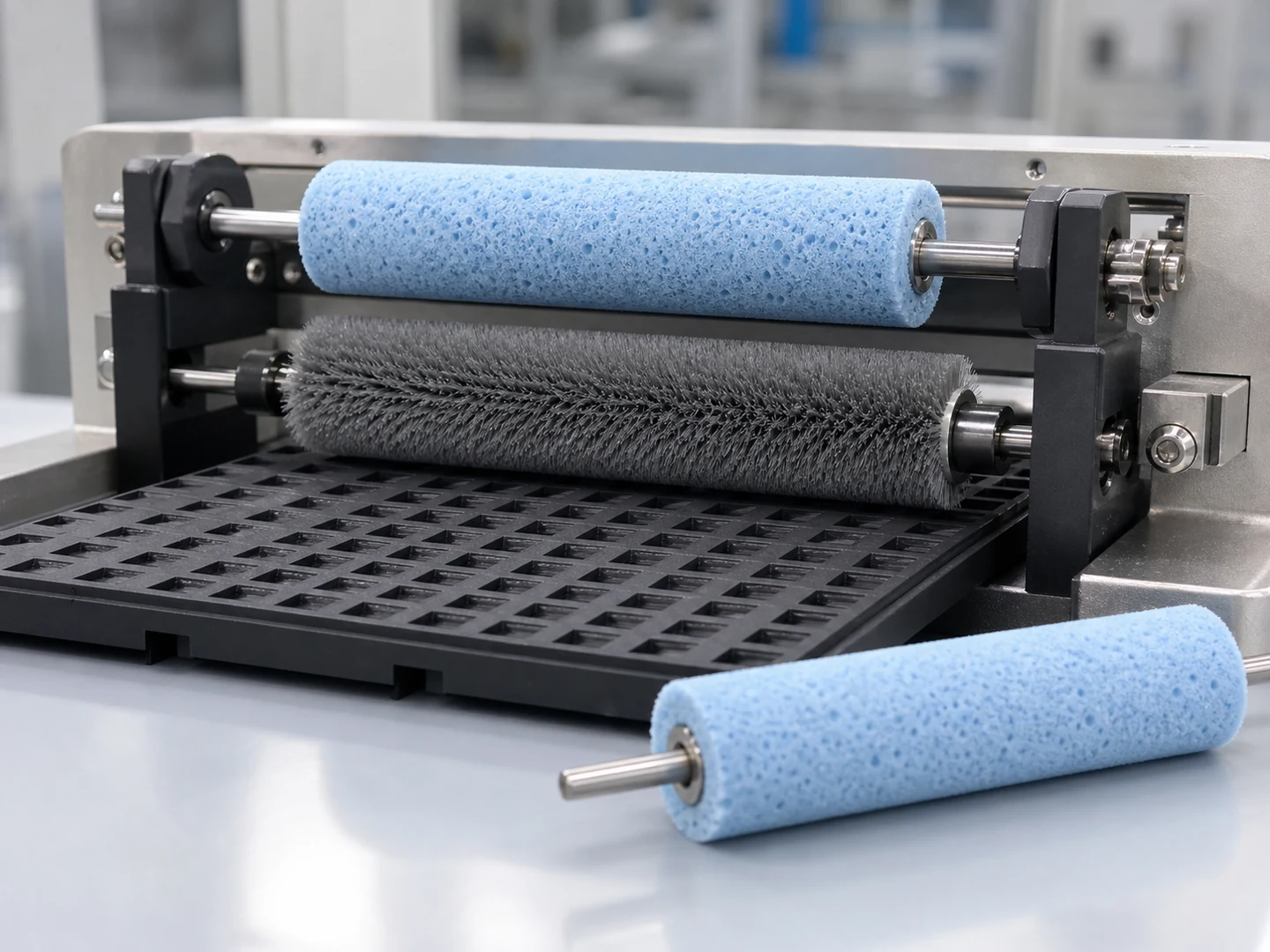
An MLCC carrier cleaning brush is a precision brush engineered to access and clean the internal ventilation channels of MLCC carrier plates. These carriers hold ceramic green sheets during printing, stacking, and cutting; the interior vents help maintain process conditions, but quickly accumulate debris that can cause misalignment, contamination, or carrier damage. The brush typically features a slender profile, chemically resistant filaments, and a mounting configuration compatible with automated or manual cleaning stations.
The Cleaning Challenge of Interior Vents
For static-control claims, this article uses EOS/ESD Association — ESD Fundamentals as the ESD reference.
For static-control claims, this article uses EOS/ESD Association — Principles of ESD Control as the ESD reference.
For semiconductor and wafer-cleaning context, NISTIR 4653 — Metrology for the Semiconductor Industry is used as the precision-cleaning and contamination-control reference.
For cleanroom-classification language, this article points to the official ISO 14644-1 Cleanrooms and Associated Controlled Environments standard page rather than inventing cleanliness claims.
For brush terminology and construction language, this section references American Brush Manufacturers Association — Brush Lingo.
Interior vents in MLCC carriers are small, deep, and often rectangular or slotted. Residue inside them – fine ceramic powder, binder residue, or airborne particulates – can bake into hard deposits after drying or firing steps. Standard pipe brushes or generic cleaning tools are either too large to fit, too stiff and risk scratching the carrier, or shed bristles that become new contaminants. The right brush must match the vent geometry, remove residue without abrasion, and withstand the cleaning chemicals or heat used in the process.
Common Types of MLCC Carrier Cleaning Brushes
Although the term “MLCC carrier cleaning brush” does not refer to a single standardized product, most options fall into a few categories based on filament material, core design, and mounting style:
- Anti‑static nylon brushes – soft, non‑abrasive, dissipate static charges; ideal for dry or low‑humidity environments where ESD protection matters.
- Abrasive‑loaded nylon brushes – nylon embedded with silicon carbide or aluminum oxide grit; used when baked‑on residue requires gentle scrubbing without metal filaments.
- Brass wire brushes – more aggressive; reserved for robust carrier materials where surface scratching is acceptable and residue is heavily caked.
- Stainless steel wire brushes – aggressive and conductive; rarely used on ceramic carriers but may be considered for metal carrier parts.
- Soft natural‑hair brushes – goat or horsehair; very gentle, suitable for final dusting or wiping after primary cleaning.
Comparison of Brush Types for Interior Vent Cleaning
| Brush Type | Typical Filament | Stiffness | Best for Residue | Surface Risk | Static Control | Chemical Resistance |
|---|---|---|---|---|---|---|
| Anti‑static nylon | Nylon + carbon | Soft | Loose dust, light powder | Very low | Yes | Good |
| Abrasive nylon | Nylon + grit | Medium | Baked‑on ceramic powder | Low | No (unless carbon‑filled) | Good (check binder) |
| Brass wire | Brass | Medium‑High | Hard, caked residues | Medium (potential scratching) | Conductive; may help static bleed | Good; avoid acids |
| Stainless steel | SS 304/316 | High | Very stubborn deposits | High (scratches likely) | Conductive | Excellent |
| Natural hair | Goat/horsehair | Very soft | Light dust only | Nearly none | Not conductive | Poor (absorbs moisture) |
How to Choose the Right Brush for Your Interior Vents
Selecting the correct brush involves more than picking a size. Evaluate these five factors:
- Residue type and adhesion – Is it loose powder, lightly caked, or hard‑baked? Abrasive nylon handles baked‑on ceramic; anti‑static nylon suffices for loose dust.
- Surface sensitivity – Carrier material and surface finish matter. An anodized aluminum carrier may tolerate brass, but a precision ground ceramic carrier demands non‑scratching nylon.
- Equipment interface – Does the cleaning station accept twist‑lock, threaded, or magnetic mounting? Confirm the brush’s back‑end geometry before ordering.
- Wet or dry process – If solvents, detergents, or ultrasonic baths are used, the filament and core material must resist swelling, degradation, or corrosion.
- Hygiene and contamination control – In cleanroom environments, look for low‑particle‑shedding filaments, sealed core designs, and materials that do not outgas.
Setup and Usage Factors
Once you have the right brush, installation and operation influence how well it works:
- Brush–vent alignment – Off‑center insertion can break filaments or miss residue along vent walls. Guide bushings or fixtures improve repeatability.
- Stroke speed and pressure – Automated systems should follow the carrier manufacturer’s recommendation; excessive speed heats filaments and may cause melting or premature wear.
- Cleaning frequency – Define preventive maintenance schedules based on carrier usage counts rather than waiting for visible buildup that may require more aggressive cleaning.
- Brush replacement – Worn filaments lose effectiveness and can shed. Incorporate brush inspection into routine line checks.
Common Mistakes to Avoid
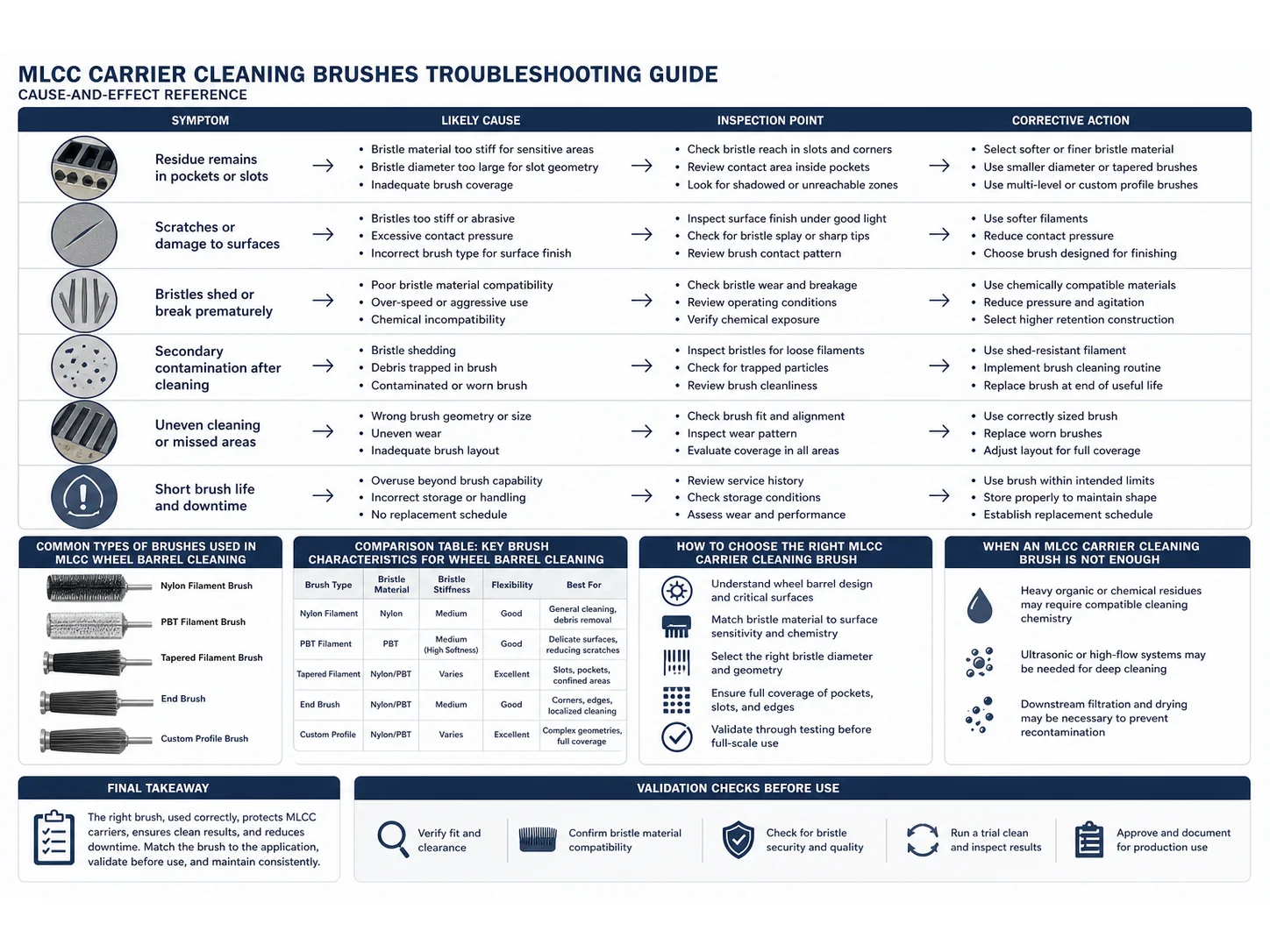
- Choosing by size alone – A 2.0 mm diameter brush that fits the vent may have too stiff a filament and scratch the channel. Diameter must be paired with the right material and filament length.
- Ignoring static dissipation – In dry manufacturing areas, a non‑conductive brush can generate static that attracts more dust after cleaning.
- Overlooking chemical compatibility – Certain nylon grades swell in alcohol‑based solvents, changing fit and effectiveness. Always verify filament‑chemical compatibility.
- Using worn‑out brushes too long – Misshapen filaments lose contact with the vent walls, leaving residue behind. Replace before visible deformation increases product risk.
- One‑brush‑for‑all mentality – A single brush style cannot handle both dry‑wipe dusting and baked‑residue scrubbing without compromise. Keep separate brush sets for different cleaning tasks.
When an MLCC Carrier Cleaning Brush Is Not Enough
Even the best brush has limits. Consider alternative or supplemental cleaning methods if:
- The vent geometry is extremely small (sub‑1.0 mm) with sharp 90‑degree turns where bristles cannot reach; custom miniature brushes with ultra‑fine filaments may still work, but a supplier drawing review and sample test are essential.
- Residue is chemically bonded or carbonized, requiring a solvent soak or ultrasonic cleaning step before brushing.
- Production volumes demand a fully automated, high‑speed cleaning process where robotic manipulation of a brush would be too slow; check if a combination of spray‑wash and brush is needed.
- Surface roughness or coating integrity is critical; a brush test coupon should be evaluated by quality engineering before introducing the brush to production carriers.
Final Takeaway
A purpose‑built MLCC carrier cleaning brush becomes the right choice when the vent cannot be cleaned effectively with airflow or flushing alone, residue is physically adhered but not fused to the surface, and the carrier material tolerates the mechanical action of the filament. Match the brush material and construction to the residue hardness, chemical environment, and static control requirements. When in doubt, request a sample brush, perform a test on a sacrificial carrier, and review the results with your cleaning equipment supplier before scaling to full production.
Practical Use Note
In daily use, the practical test is simple: check whether the brush reaches the full contact area, removes the target residue, and leaves the surface in the required condition. Record what changes when ESD control, slot access, particle type, contact pressure, and component sensitivity changes, because many brush failures are caused by the working condition shifting rather than by the brush body alone.
Frequently Asked Questions
Can I use a regular pipe cleaning brush instead of a specialized MLCC carrier cleaning brush?
Regular pipe brushes are often too large in diameter or too aggressive in filament material, and they may shed bristles that contaminate the carrier. If the vent dimensions and material sensitivity align exactly, a small nylon brush might work, but a brush designed for electronics manufacturing will offer better material purity, static control, and dimensional consistency.
How do I determine the correct bristle length for interior vent cleaning?
Bristle length should be slightly longer than half the narrowest vent dimension so that bristles from opposite sides overlap and scrub the entire surface without bottoming out or bending excessively. A common starting point is vent depth + 0.2–0.5 mm, but a sample test is necessary to verify performance on actual residue.
What mounting style works best with automated cleaning equipment?
Many automated stations accept threaded or quick‑change twist‑lock brush holders. Before ordering, check your equipment manual for the required shank diameter, locking feature, and overall brush length. Custom mounting adapters can be designed if the standard interface does not match.
How often should MLCC carrier cleaning brushes be replaced?
There is no universal schedule; replacement depends on bristle wear, loss of stiffness, or filament breakage. As a rule of thumb, replace when bristle tips no longer reach the vent walls under normal pressure, or after a set number of cleaning cycles established during validation. Visual inspection under magnification helps catch early wear.
Are anti‑static brushes always necessary for MLCC carrier vent cleaning?
Not always, but they become important in low‑humidity cleanrooms where electrostatic charge can attract airborne particles and create a “dirty after cleaning” effect. If your process regularly measures ESD events, or if you handle small‑signal components, anti‑static nylon is a safer choice.
Can I use the same brush for dry and wet cleaning processes?
It is not recommended unless the brush material is rated for both environments. Dry‑dedicated brushes may have lubricants or coatings that wash off; wet‑exposed brushes may corrode internally if not dried properly. Split the inventory or select a chemically resistant all‑purpose filament only after testing.
What is the smallest vent size a custom brush can clean?
Brush manufacturers can produce filament diameters as small as 0.03 mm, allowing effective cleaning of vents down to about 0.5 mm in width. However, at very small sizes, bristle retention and flex become significant challenges. Work closely with your brush supplier’s engineering team, provide a drawing of the vent cross‑section, and request a feasibility study before committing to a purchase order.