
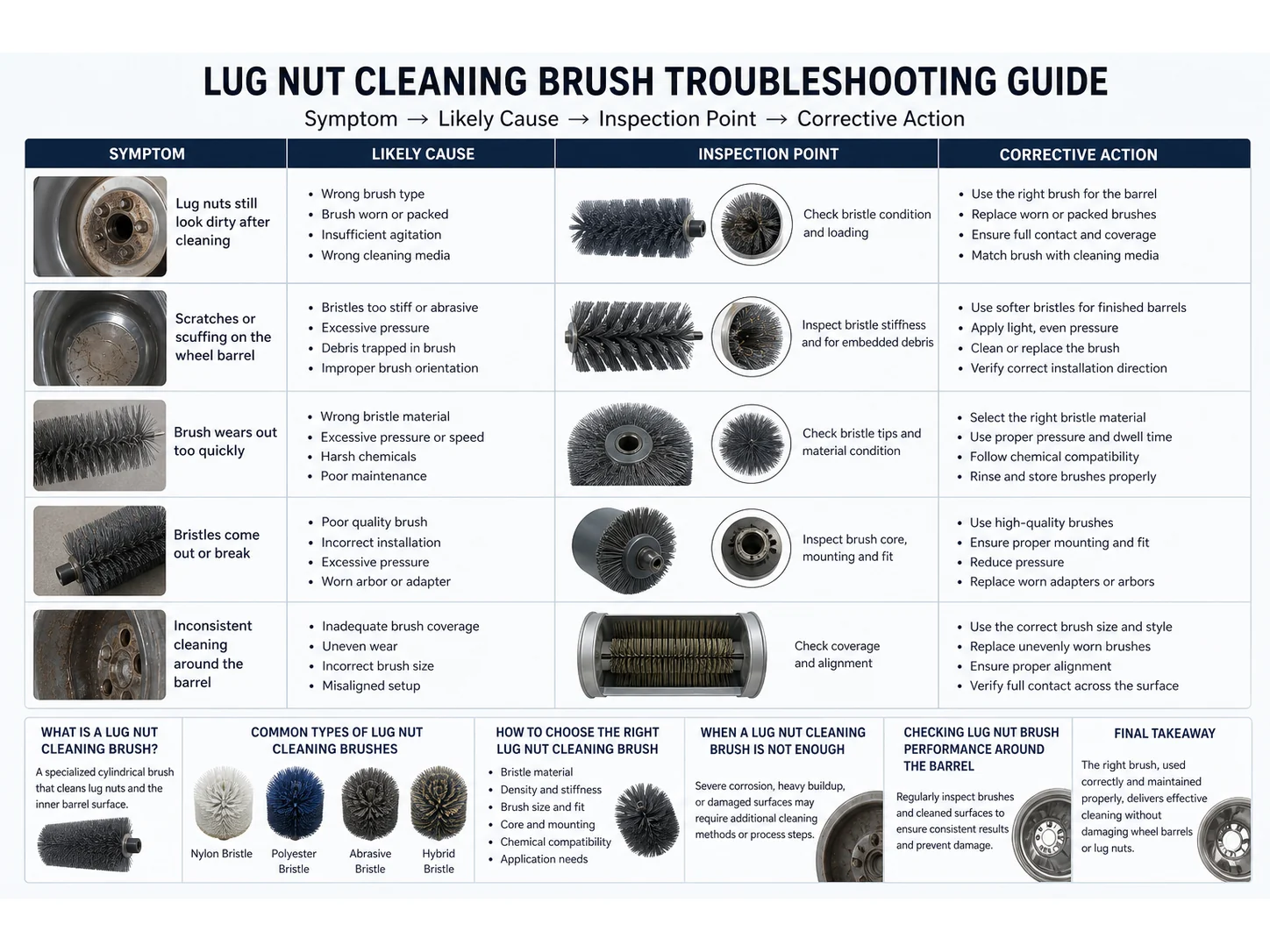
What Is a Lug Nut Cleaning Brush?
A lug nut cleaning brush is a small-diameter, typically long-handled brush engineered to access the narrow wells and curved surfaces surrounding wheel lug nuts and the deeper barrel areas behind spokes. Unlike general-purpose wheel brushes, these tools combine a slim head, durable bristles, and a shape that conforms to wheel contours, allowing effective removal of stubborn deposits without scratching clear coats or polished surfaces. They are widely used in detailing shops, car washes, and fleet maintenance settings where wheel appearance and corrosion prevention matter.
Common Types of Lug Nut Cleaning Brushes
Not all lug nut cleaning brushes are alike. Differences in materials, diameter, stiffness, and handle mounting influence performance across wheel types, residue conditions, and cleaning equipment. The table below compares four typical configurations to help you match the brush to the task.
| Brush Type | Bristle Material | Typical Diameter (in) | Stiffness | Handle/Mount | Best For |
|---|---|---|---|---|---|
| Soft Flagged Nylon | Flagged nylon | 0.5–1 | Soft to medium | Straight wire handle, drill‑adaptable | Sensitive clear‑coated wheels, light dust |
| Boar’s Hair / Tampico | Natural boar bristle | 0.75–1.25 | Medium | Twisted wire core, manual use | Moderate brake dust, gentle scrubbing |
| Crimped Wire (Stainless/Brass) | Stainless steel or brass wire | 0.25–0.75 | Firm | Hardwood or plastic handle, shank mount | Heavy rust, baked‑on deposits, uncoated metal |
| Micro‑Fiber or Wool Blend | Wool/synthetic blend | 1–1.5 | Soft, absorbent | Quick‑connect shaft for rotary tools | Final polishing, water spot removal |
How to Choose the Right Lug Nut Cleaning Brush
Selection should start with the real-world conditions the brush will face, not just cost drivers or brand familiarity. Evaluate these factors:
- Residue Type: Light brake dust needs soft flagged bristles; heavy, caked grease or corrosion demands firmer wire blends. If you regularly deal with iron fallout or rail dust, consider brushes safe for use with decontamination chemicals.
- Surface Sensitivity: Clear‑coated, painted, or anodized wheels require non‑abrasive nylon, boar’s hair, or microfiber. Uncoated steel or commercial truck wheels can tolerate brass or stainless wire.
- Equipment Interface: Determine whether the brush will be used by hand, on a rotary tool, or attached to a cleaning stick. Drill‑compatible shanks speed up high‑volume work, while wire‑twisted handles offer better manual control.
- Wet or Chemical Exposure: If brushes are soaked in wheel cleaners or degreasers, choose bristles that resist chemical degradation (e.g., nylon over natural hair). Consider a sealed ferrule to prevent handle rot.
- Hygiene Expectations: In environments where cross‑contamination matters—such as detailing multiple vehicles—opt for brushes that are easy to sanitize or dedicate brush sets to specific wheel types.
- Maintenance Frequency: High‑frequency commercial use favors durable, quick‑drying materials and replaceable heads. Occasional hobbyist use may allow for simpler, lower‑cost natural bristles.
- Custom Size Requirements: If off‑the‑shelf diameters don’t fit unusually deep lug wells or tight barrel gaps, a custom brush size or a modular system with interchangeable heads may be necessary. Always verify minimum bore clearance before ordering.
Common Mistakes When Using Lug Nut Cleaning Brushes
Even with the right brush, errors in application, handling, or sourcing can undermine results. Avoid these frequent pitfalls:
- Choosing wire where nylon would suffice: A wire brush can scratch or haze clear‑coated wheels. Always match bristle aggressiveness to the wheel finish.
- Ignoring brush diameter fit: A brush too thick won’t reach the lug nut walls; too thin won’t scrub effectively. Measure the recess before purchase.
- Over‑relying on a single brush for all wheel areas: Lug nut brushes are not replacements for wheel face or tire‑cleaning tools. Using them on broad surfaces slows workflow and wears out the brush prematurely.
- Using the same brush for acidic and alkaline cleaners interchangeably: Strong pH extremes can damage natural bristles. Check bristle‑chemical compatibility charts or conduct a sample test.
- Skipping a test patch on high‑end finishes: Even soft brushes can mar sensitive coatings if debris is trapped in bristles. Always test in an inconspicuous area first.
- Neglecting brush maintenance: Failing to rinse bristles after use allows dried chemical residues and grit to embed, turning the brush into an abrasive pad for the next job.
- Ordering without verifying handle mounting: Some brushes have a plain shank; others require a quick‑change adapter. Purchasing the wrong interface leads to downtime and extra costs.
When a Lug Nut Cleaning Brush Is the Wrong Choice
A lug nut cleaning brush is designed for accessible recessed areas, but it has limits. If the wheel barrel has deep, narrow channels that trap hard‑baked carbon deposits, a standard brush may not provide enough mechanical action. In such cases, consider steam cleaning, ultrasonic immersion (for removable wheel parts), or chemical decontamination with a dwell time, followed by agitation with a more flexible bristle tool. Additionally, when wheels exhibit pitting corrosion or require metal restoration, a brush alone won’t suffice—abrasive blasting or professional refinishing may be necessary. If you are specifying brushes for a custom manufacturer instructions wheel line, always request supplier drawings or a sample test against your exact wheel geometry to avoid ordering mismatches.
Final Takeaway
Choosing and using a lug nut cleaning brush correctly comes down to matching bristle aggressiveness, diameter, and handle interface to the wheel finish, residue type, and cleaning environment. Avoid the mistake of treating all brushes as interchangeable; a systematic evaluation of the factors above will save time, prevent damage, and deliver consistent cleaning outcomes. When in doubt, test a small batch or consult with a brush supplier for application‑specific configurations.
Frequently Asked Questions
What is the ideal bristle material for cleaning clear-coated alloy wheels?
Flagged nylon or boar’s hair are excellent choices. They are abrasive enough to remove brake dust but soft enough to avoid scratching the clear coat.
Can I use a lug nut cleaning brush with a cordless drill?
Yes, many brushes feature a ¼‑inch hex shank compatible with cordless drills. However, use low RPM and light pressure to prevent heat buildup and potential marring of the wheel surface.
How do I clean and store a lug nut cleaning brush between uses?
Rinse the bristles thoroughly with clean water after each use. Briefly soak in a mild detergent if chemicals were used, then shake off excess water and hang the brush bristles‑down to dry. Store in a ventilated area away from direct sunlight to prevent bristle degradation.
What diameter brush should I order for recessed lug nut channels?
Measure the narrowest point of the channel. Choose a brush with a bristle diameter at least ¼ inch smaller than that measurement to allow free movement without binding. For extremely tight spaces, a custom diameter may be required.
Is a lug nut cleaning brush suitable for chrome wheels?
A soft- to medium‑stiffness brush, such as boar’s hair or flagged nylon, is safe for chrome. Avoid wire brushes, as they can scratch the chrome surface and lead to rust spots.
How often should I replace a lug nut cleaning brush in a commercial detailing shop?
Replacement frequency depends on volume and bristle wear. Inspect brushes weekly; replace when bristles become flattened, splayed, or embedded with hard debris that cannot be rinsed out. For a high‑volume shop, professional‑grade brushes may last 2–3 months with proper care.
Can I use a lug nut cleaning brush to apply wheel sealant or coating?
It’s not recommended. The brush design is optimized for cleaning, not even product application. Use a dedicated applicator pad or sponge for coatings to ensure a uniform layer.
Technical References
Which bristle material fits this job — Nylon PA, Wool or AISI 304 Stainless Steel Wire?
| Material | Continuous temperature (°C) | Peak temperature (°C) | Water absorption | Hardness |
|---|---|---|---|---|
| Nylon PA | 93 | 121 | 0.3–9% by PA grade and conditioning | Medium to firm; filament diameter and trim length control bending force. |
| Wool | 100 | 130 | 5–20% | Soft and springy; compaction into felt or a dense wheel increases firmness and pressure transfer. |
| AISI 304 Stainless Steel Wire | 400 | 500 | 0% | Rockwell B 70–95 depending on temper and cold work |
| Abrasive Nylon | 120 | 150 | 0.1–1.0% | Abrasive filament; stiffness and cutting level is controlled by PA base, grit type, grit size, filament diameter and trim height. |
Figures as published by Brushtec / DuPont; Alleima; Perlon. Confirm the exact grade against the supplier datasheet before ordering.
What should replace Nylon PA when it stops working?
- Nylon PA — Compare Nylon PA with PP, PBT, PET. Change material when wet stiffness, temperature, chemical resistance, conductivity, particle shedding, or surface marking becomes the limiting factor.
- Wool — Compare Wool with Felt, cotton yarn, microfiber, sisal. Change material when wet stiffness, temperature, chemical resistance, conductivity, particle shedding, or surface marking becomes the limiting factor.
- AISI 304 Stainless Steel Wire — Use AISI 316 stainless steel wire for chloride, marine, dairy, beverage, chemical washdown, or higher pitting-resistance requirements. Use carbon steel for dry aggressive cutting and brass or abrasive nylon for lower marking risk.
- Abrasive Nylon — Compare Abrasive Nylon with PP, PBT, PET. Change material when wet stiffness, temperature, chemical resistance, conductivity, particle shedding, or surface marking becomes the limiting factor.