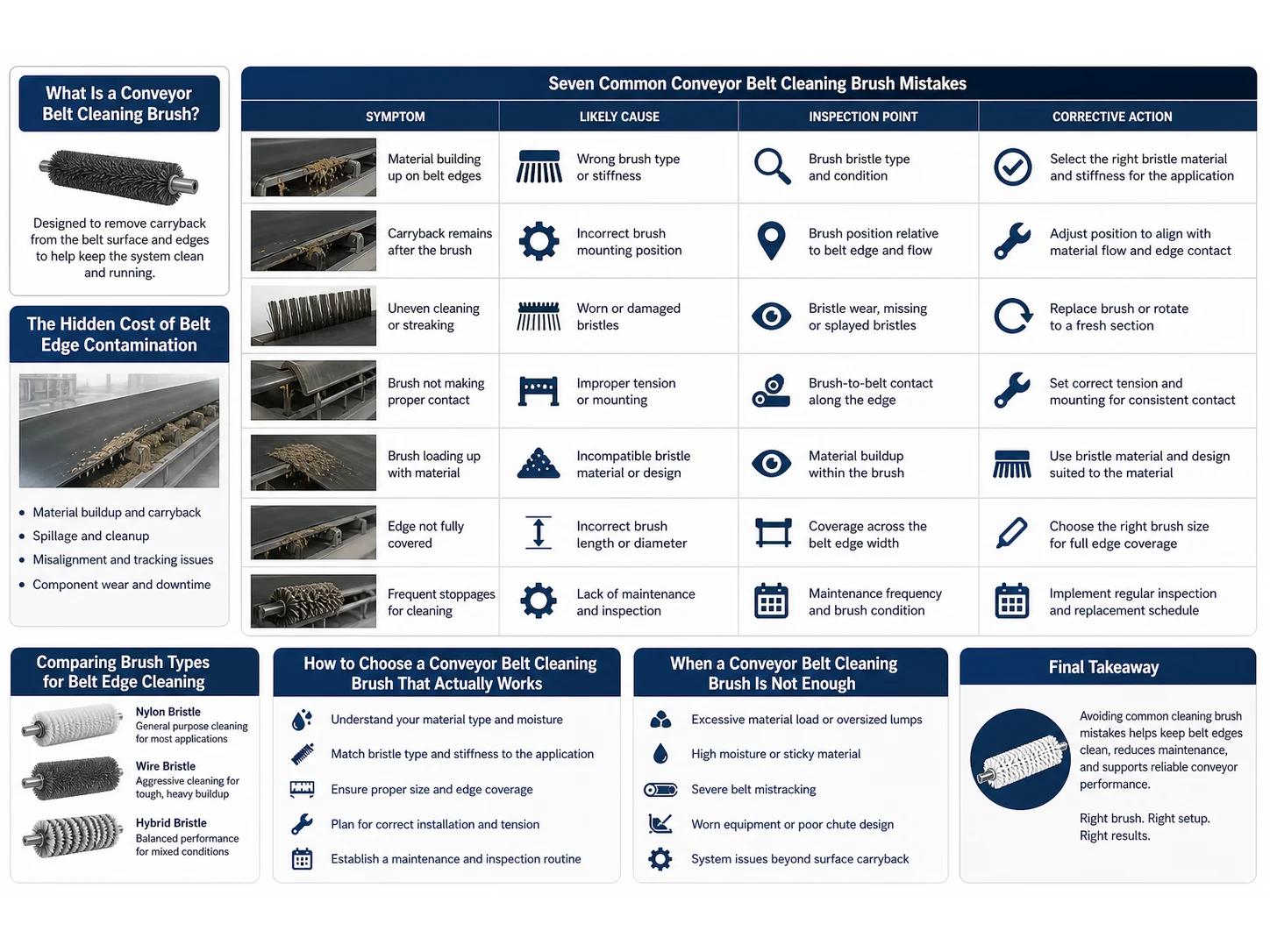
What Is a Return Belt Cleaning Brush?
A return belt cleaning brush is a rotating or fixed brush designed to contact the non-carrying (return) side of a conveyor belt, dislodging material that sticks after the discharge point. Unlike primary and secondary scrapers that remove bulk carryback, a return brush targets finer particles that can compact along the belt edge and into the belt fabric, often in dry or semi-dry applications.
Understanding Belt Edge Contamination
For the safety point in this section, the relevant OSHA reference is OSHA — Machine Guarding.
For the safety point in this section, the relevant OSHA reference is OSHA — Control of Hazardous Energy.
For the safety point in this section, the relevant OSHA reference is OSHA — Combustible Dust.
For the environmental or chemical-safety point in this section, the supporting reference is EPA — Particulate Matter Basics.
For brush terminology and construction language, this section references American Brush Manufacturers Association — Brush Lingo.
Belt edge contamination occurs when fine powders, dust, or sticky residues migrate to the outer edges of the belt during conveying. On the return run, this material can build up on the belt edges and inside the belt carcass, leading to several problems:
- Premature belt tracking and alignment issues
- Increased wear on idlers and pulleys
- Dust emissions and housekeeping burdens
- Material buildup on shafting and bearings
- Safety hazards from spillage around walkways
Return belt cleaning brushes are specifically positioned to address edge contamination that escapes primary and secondary cleaners.
Common Types of Conveyor Belt Cleaning Brushes
Before comparing return belt brushes with standard brushes, it helps to recognize the broad categories of conveyor cleaning brushes:
- Rotary brushes: Powered by an electric or hydraulic motor; aggressive and consistent.
- Fixed tension brushes: Stationary with adjustable pressure; simple and low-cost.
- Vee or chevron brushes: Angled filaments that push material away from the belt center.
- Spiral-wound brushes: A continuous strip of brush wound on a core; easy to replace.
- Roller brushes: Full-coverage rotating cylinders; often used as secondary or return cleaners.
A “return belt cleaning brush” is not a separate category but rather a brush placed on the return run, often a roller or spiral brush, specifically targeting belt edges and the return side surface.
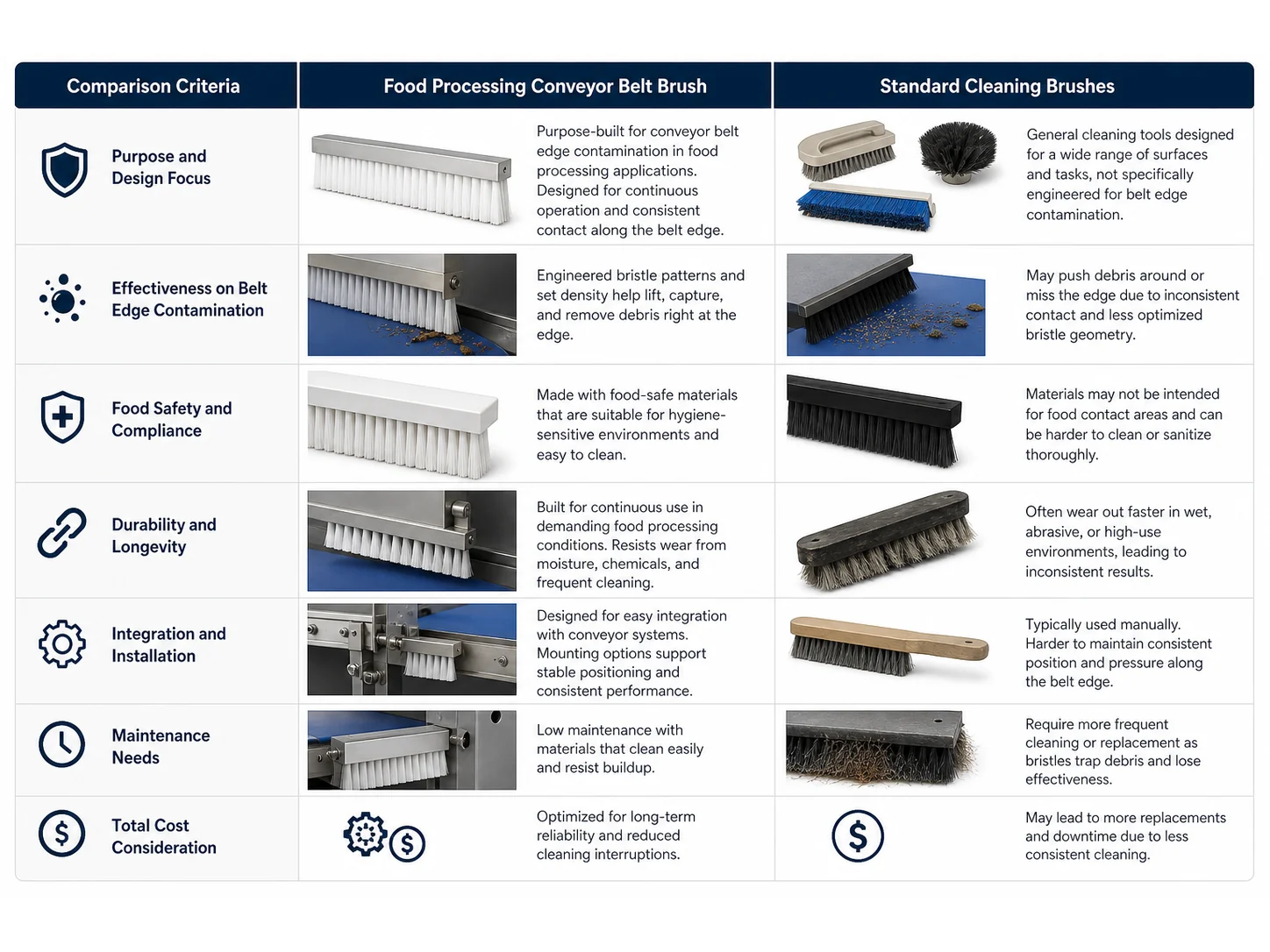
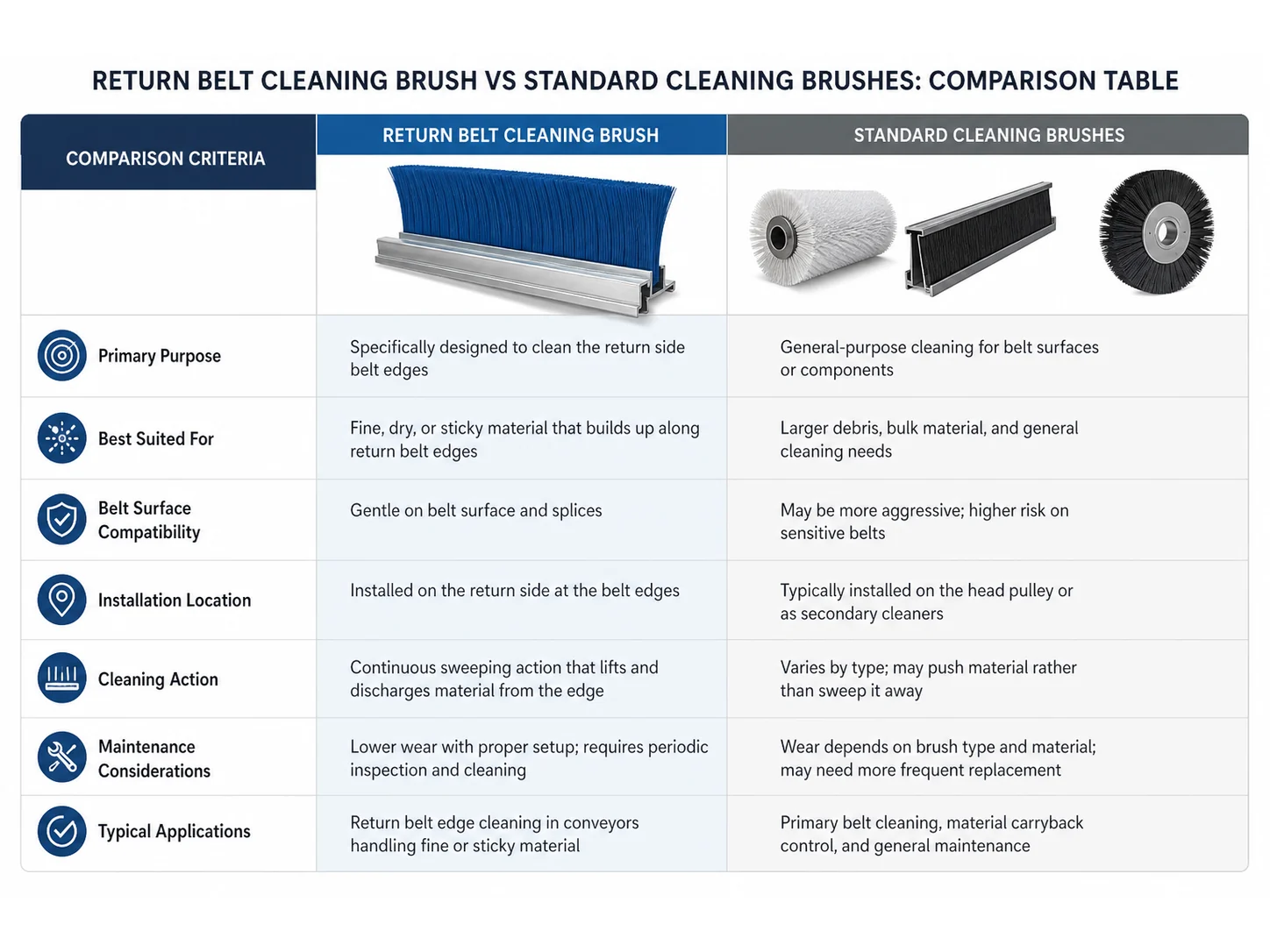
Return Belt Cleaning Brush vs Standard Cleaning Brushes: Comparison Table
| Factor | Return Belt Cleaning Brush | Standard Cleaning Brush (e.g., fixed or head pulley brush) |
|---|---|---|
| Mounting location | Return side, typically after the snub roller or before the tail pulley | Head pulley, discharge chute, or anywhere along the carry side |
| Primary target | Fine dust and stubborn edge buildup on the non-carrying side | Primary carryback, larger chunks, and surface debris |
| Filament stiffness | Moderate to firm; needs to reach into belt fabric without damaging the carcass | Varies widely; can be soft for light dusting to very stiff for scrapers |
| Cleaning action | Often lighter, sweeping motion; can be combined with a tensioner to maintain contact | May be more aggressive; sometimes used with a scraper blade |
| Edge contamination control | Excellent when designed with angled or profiled filaments that focus on the belt edge | Limited; standard designs often miss the outer 1-2 inches unless custom-built |
| Maintenance complexity | Moderate; requires periodic filament height adjustment and cleaning of the brush itself | Low to moderate; may need more frequent replacement if used aggressively |
| Cost (relative) | Higher initial cost due to custom shaft and bearing arrangement, but reduces other maintenance | Generally lower initial cost, but can be less effective at preventing long-term edge wear |
Key Factors for Choosing the Right Brush
Selecting between a return belt cleaning brush and a standard brush depends on several operating factors:
- Residue type: Fine, dry dust may be adequately handled by a standard brush with medium filaments. Sticky, hygroscopic, or abrasive residues usually require a return brush with a more aggressive filament and continuous rotation.
- Surface sensitivity: If the belt cover is delicate or textured, a return brush with softer filaments (e.g., nylon 6.6) and adjustable pressure prevents cover damage.
- Equipment interface: Check space constraints on the return side. A return brush may need mounting brackets, a take-up frame, and motor clearance.
- Wet or chemical exposure: In washdown environments, brushes need stainless steel cores and chemically resistant filaments (e.g., polypropylene).
- Hygiene expectations: Food-grade applications require FDA-compliant filament materials and open-frame designs for easy cleaning.
- Maintenance frequency: Self-cleaning brush designs reduce manual intervention; gear-driven rotary brushes usually need less tension adjustment than fixed brushes.
- Custom size requirements: Belt width, edge profile, and pulley diameters often dictate a custom brush length, core diameter, and shaft fitment.
Common Mistakes When Selecting a Belt Edge Cleaning Brush
- Choosing by cost drivers alone: A low-cost standard brush that misses edge contamination can lead to expensive belt damage and downtime.
- Ignoring belt speed: High-speed belts may fling standard brush filaments outward; a return brush with a robust core and high-density fill is needed.
- Overlooking filament material compatibility: Using nylon in a high-temperature or wet application can cause premature wear or softening.
- Not accounting for belt splice thickness: Thick mechanical splices can catch on fixed brushes; a rotary brush with flexible filaments is often safer.
- Assuming one brush fits all residue types: Sticky residues may load up a standard brush quickly; a return brush with a staggered or open-face pattern sheds debris better.
- Neglecting tension adjustment: Even a well-designed return brush will lose effectiveness if not periodically adjusted for filament wear.
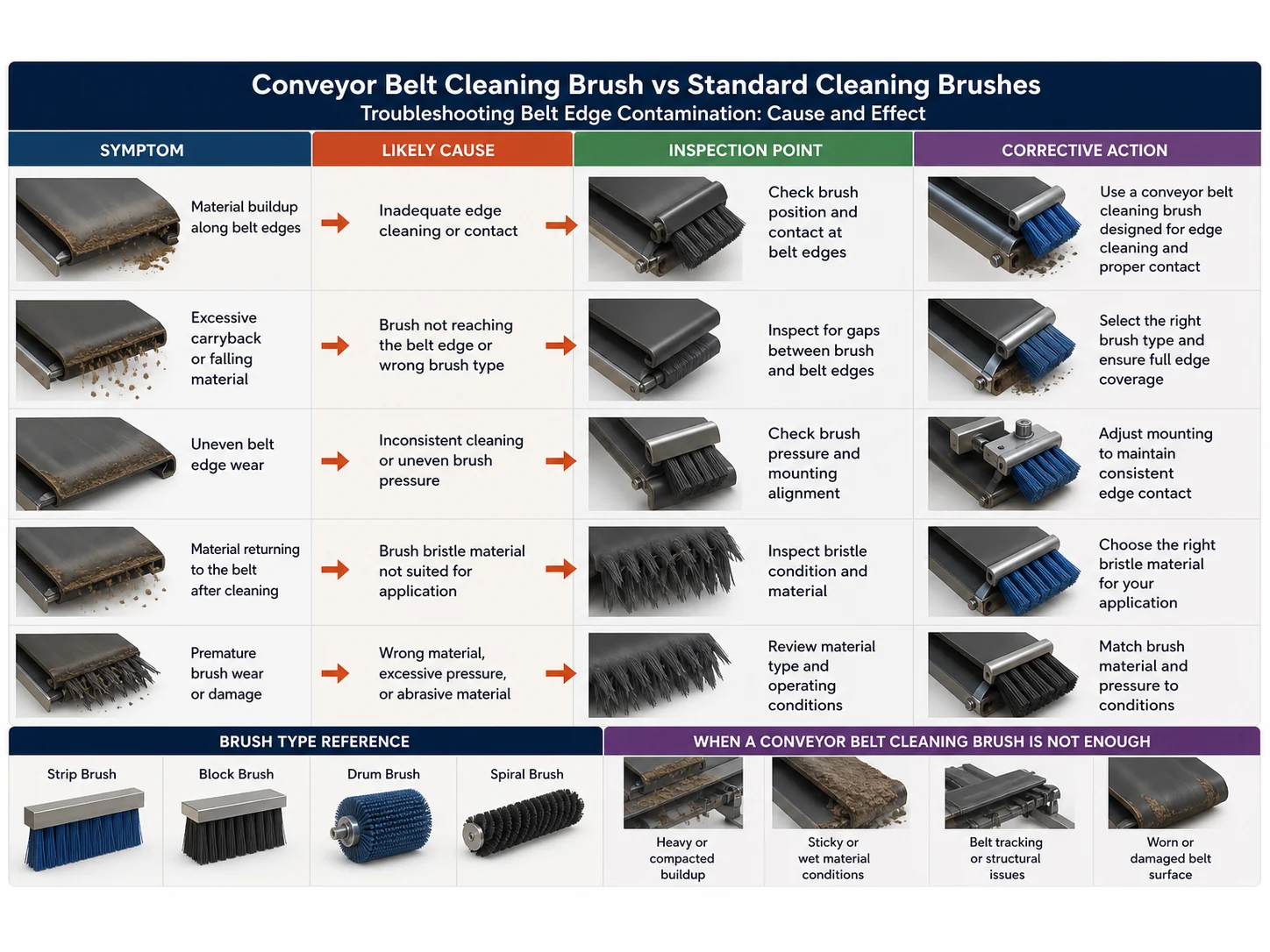
When a Return Belt Cleaning Brush Is Not Enough
A return belt cleaning brush is an effective tool, but it has limits:
- Extreme sticky or large-scale carryback: When the residue is heavy, pasty, or large in volume, a brush alone may not provide enough cleaning force. A secondary scraper or wash box may be needed alongside the brush.
- Severe belt damage or mis-tracking: If the belt is already grooved or tracking off-center, a brush can worsen wear. The belt condition and alignment must be corrected first.
- Limited access for maintenance: If the return area is congested, a simple fixed brush may be impractical; a more complex rotary brush may require additional inspection and cleaning access.
- Applications requiring zero contamination: In pharmaceutical or ultra-clean food processes, brushes alone may not meet sanitary design standards; enclosed vacuum systems or belt wash stations are often required.
In these cases, consult with an experienced brush supplier and request a sample test or drawing review to confirm the brush will meet performance expectations.
Final Takeaway
For belt edge contamination, a return belt cleaning brush offers a targeted and often more complete solution than a standard cleaning brush. Standard brushes work well for general carryback on the top side but frequently leave edges unprotected. The right choice depends on your residue type, belt condition, maintenance resources, and long-term cost of ownership. When edge buildup is a persistent problem, investing in a properly sized return brush with the right filament material and mounting configuration pays for itself through reduced belt wear and cleanup time.
Frequently Asked Questions
What is the difference between a return belt cleaning brush and a roller brush for conveyor belt cleaning?
A return belt cleaning brush is a type of roller brush specifically mounted on the return side to clean the non-carrying surface and edges. A “roller brush for conveyor belt cleaning” can be installed at various locations, not just the return side. The return brush is optimized for edge contamination, while a general roller brush may target the belt center or full width.
How do I know if my belt needs a return cleaning brush instead of just a scraper?
If you see fine dust accumulating on return idlers or material building up along the edge of the belt after the discharge point, a scraper alone is likely insufficient. A return brush can reach into fabric impressions and remove this fine debris.
Can I use the same brush on wet and dry applications?
Not always. Some filaments swell or soften when wet, reducing cleaning effectiveness. For wet applications, choose hydrophobic filaments like polypropylene or abrasive-resistant nylon blends with a stainless steel core.
How often should a return belt cleaning brush be adjusted or replaced?
Adjustment frequency depends on brush design and usage. Rotary brushes with spring-loaded tensioners may need checking weekly; fixed brushes may need monthly filament height inspection. Filament replacement is usually needed after 6-12 months, but this varies widely with abrasive conditions.
Does brush density affect edge cleaning performance?
Yes. A higher fill density provides more contact points and better cleaning of fine dust. For edge-specific cleaning, some brushes have a variable density pattern—higher at the edges, lower in the center—to focus cleaning where it’s needed.
Are return belt cleaning brushes suitable for food-grade conveyors?
They can be, provided the filaments, core, and bearings meet FDA and hygienic design standards. Look for brushes with FDA-listed nylon or polypropylene filaments and easy-to-clean housings that avoid crevices where debris can harbor.
What is the ideal brush diameter for a return belt cleaning brush?
The diameter depends on belt width, speed, and available mounting space. Common ranges are 6-10 inches, but wider belts or high-speed applications may need larger diameters to maintain sufficient contact without excessive RPM.
Can a return belt cleaning brush replace a secondary conveyor belt cleaning system?
Not usually. A return brush is meant to handle what scrapers miss—especially edge fines. It should supplement, not replace, primary and secondary cleaners. The combination yields the best overall belt cleanliness.