
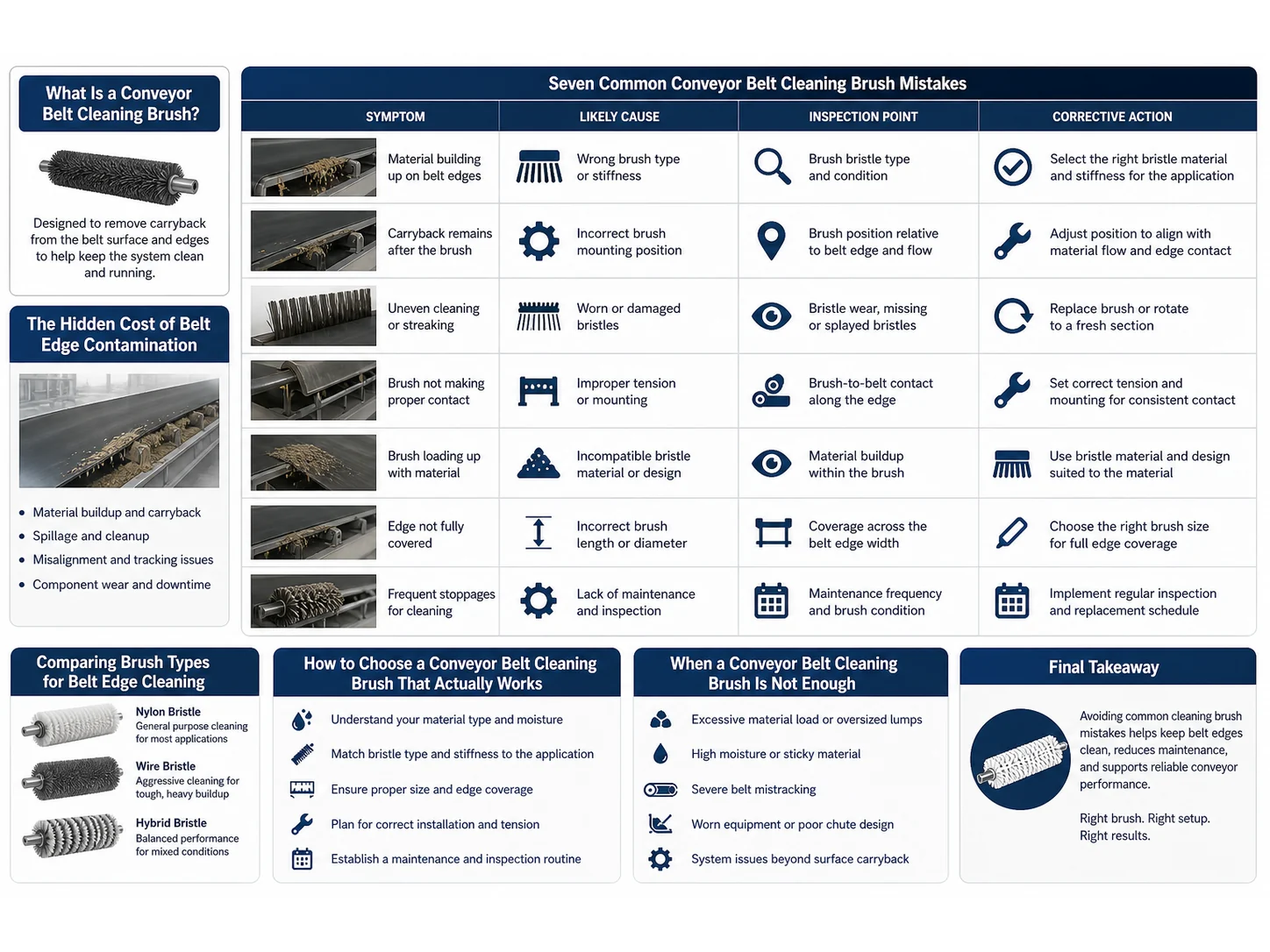
What Is a Conveyor Belt Cleaning Brush?
A conveyor belt cleaning brush is a tool that uses bristle contact to mechanically dislodge material from a moving belt. It can be a standalone rotary brush driven by a motor, a fixed strip brush, or part of a larger belt cleaner system. The brush may feature bristles made of nylon, polypropylene, abrasive‑impregnated polymers, stainless steel, or natural fibers, mounted on a core such as a steel shaft, plastic tube, or molded hub. Its primary job is to keep the belt surface — including the often‑neglected edges — clean, reducing carryback and prolonging belt life.
The Hidden Cost of Belt Edge Contamination
Most belt cleaner attention focuses on the center carrying surface. Yet material accumulation along the edges can cause:
- Belt mistracking due to uneven friction or built‑up lumps that steer the belt on idler rolls.
- Uneven tension and edge fraying, shortening belt replacement intervals.
- Cleanup labor, manual scraping, and increased housekeeping costs.
- Risk of material falling into idler bearings, causing premature idler failure.
Edge contamination is often harder to clean because the belt’s edge is unsupported, bristle contact can be irregular, and standard full‑width brushes may lose pressure at the extremes.
Seven Common Conveyor Belt Cleaning Brush Mistakes
- Using the wrong bristle material for the residue. A nylon brush may be too soft for sticky clay, while a steel wire brush can score a rubber belt. Match bristle material to the residue’s abrasiveness and belt surface sensitivity.
- Ignoring brush diameter and stiffness. A small‑diameter brush with flexible bristles may fail to reach the edge. A stiff brush set too aggressively can cut into the belt. Choose diameter and fill density based on the cleaning force required without damaging the belt.
- Poor mounting or lack of edge support. Brushes that are mounted too far from the edge, or on a frame that flexes, create uneven pressure. Edge cleaning requires a rigid mount or a cantilevered brush design that maintains consistent contact.
- Selecting a brush without considering speed differential. Rotary brushes work best at a surface speed 10–30% different from the belt speed. Running at the same speed reduces the scrubbing effect. Neglecting the drive ratio can leave edges dirty.
- Overlooking wet, chemical, or washdown environments. Standard brush cores may rust, or bristles may absorb moisture and soften. Stainless steel cores and inert bristle materials (polypropylene, nylon) are needed for food, chemical, or high‑humidity applications.
- Treating all conveyor belts as identical. A brush that works on a flat rubber belt may fail on a chevron profile, a plastic modular belt, or a high‑temperature application. Edge geometry and belt composition matter.
- Skipping maintenance and wear monitoring. Even the best brush loses effectiveness as bristles wear. Without regular inspection and adjustment, edge contamination returns. Set a PM schedule and check for bristle length loss and uneven wear patterns.
Comparing Brush Types for Belt Edge Cleaning
The table below highlights common brush configurations and how they perform on belt edge contamination.
| Brush Type | Typical Bristle Material | Stiffness | Best For | Limitations at Belt Edge |
|---|---|---|---|---|
| Rotary shaft‑mounted brush | Nylon, polypropylene, abrasive nylon | Medium to firm | General carryback, dry fines | Flexing shaft may lose end contact; requires sturdy end bearings. |
| Strip brush (fixed) | Polypropylene, horsehair, Tampico | Soft to medium | Light dust, polishing, thin film removal | No active scrubbing; edge pressure inconsistent on crowned pulleys. |
| Cantilevered rotary brush | Abrasive nylon, steel wire | Firm to aggressive | Stubborn sticky residues, edges of chevron belts | Requires precise alignment; risk of gouging if too aggressive. |
| Spiral‑wound roller brush | Nylon, polypropylene, Tampico | Medium | Modular plastic belts, delicate surfaces | Brush segments can trap material; limited edge‑specific design. |
| Custom‑formed edge brush | Custom blend, often abrasive nylon | Tailored | Severe edge buildup, specialty belts | Long lead time; requires accurate belt profile data. |
How to Choose a Conveyor Belt Cleaning Brush That Actually Works
Use these decision factors to specify a brush that will not leave edges dirty:
- Residue type: Dry dust? Sticky sludge? Oily film? Abrasive particles? Match bristle material and stiffness to the residue. Sticky residues often need abrasive‑filled nylon or a combination brush with steel wire for a pre‑scrape.
- Surface sensitivity: What damage is acceptable? For FDA belts or thin‑gauge rubber, use soft, non‑abrasive bristles. For heavy‑duty mining belts, more aggressive materials are acceptable.
- Equipment interface: How will the brush be mounted? Does the conveyor have a pulley or flat run at the edge? Cantilevered brushes need a rigid frame. Ensure the brush core length extends beyond the belt edge by at least 1–2 inches.
- Wet or chemical exposure: Washdown areas require stainless steel cores, sealed bearings, and moisture‑resistant bristles. Check chemical compatibility for cleaning agents.
- Hygiene expectations: Food, pharma, or cleanroom environments demand easy‑to‑clean brush designs, often with quick‑release cores and FDA‑compliant bristle materials.
- Maintenance frequency: In hard‑to‑access locations, choose longer‑wearing bristle materials and self‑adjusting tensioners to reduce maintenance trips.
- Custom size requirements: When standard brush diameters or lengths don’t fit, work with the supplier to confirm core size, shaft diameter, keyway, and overall length. Provide accurate belt‑to‑frame dimensions.
When a Conveyor Belt Cleaning Brush Is the Wrong Choice
A brush alone cannot solve every belt edge problem. You may need additional or alternative systems when:
- Extremely sticky or high‑volume carryback persists despite proper brush setup — consider adding a primary polyurethane scraper before the brush, or an air knife to blow material away.
- Belt edge wear or damage is caused by hardened lumps rather than loose residue — improve material containment and install a belt trainer before investing in heavier brushes.
- Sanitary or high‑risk applications require validated cleaning — a brush may need to be part of a wet CIP (clean‑in‑place) system with chemical sprays.
- Custom belt profiles (deep cleats, sidewalls, extreme camber) make standard brush contact impossible — a supplier drawing review or an on‑site sample test with a custom‑built edge brush is necessary.
In these cases, request a brush sample trial or consult with the brush manufacturer early to review engineering drawings and material compatibility charts.
Final Takeaway
Preventing belt edge contamination starts with specifying the right conveyor belt cleaning brush and avoiding the mistakes outlined above. Check bristle material against your residue, ensure robust mounting, account for wet or harsh conditions, and schedule proactive wear checks. When edges stay clean, belt tracking improves, downtime drops, and overall conveyor reliability increases.
Frequently Asked Questions
What is the best bristle material for a conveyor belt cleaning brush?
It depends on the residue and belt surface. Nylon and polypropylene work well for dry, non‑abrasive materials on rubber belts. Abrasive‑impregnated nylon (grit‑filled) is good for sticky residues. Stainless steel wire is used for heavy‑duty, abrasive materials but can damage softer belts. Always test a small section first.
How often should I check or replace my conveyor belt cleaning brush?
Inspect every 200–500 operating hours or as part of your preventive maintenance routine. Replace when bristles are worn to less than 50% of original length, or when the brush no longer contacts the belt evenly across the entire width, especially at the edges.
Can I use one brush for both the belt center and the edges?
A full‑width brush can clean edges if it is long enough and the mounting supports consistent pressure at the ends. However, because edges often collect more material and receive less support from the belt, a dedicated edge brush (cantilevered design) or an extended brush with stiffer end sections may give better results.
What happens if I set the brush too aggressively against the belt?
Excessive pressure can cause bristle matting, rapid wear, increased motor load, and surface damage to the belt such as scuffing, grooving, or even delamination. Always follow the manufacturer’s recommended interference — typically 1–3 mm for nylon brushes on rubber belts.
Is a rotary brush always better than a fixed strip brush for edge cleaning?
Not necessarily. A rotary brush provides active scrubbing, which is better for stuck‑on material. A fixed strip brush can be effective for light dusting and is simpler to install, but it may not clean edges thoroughly because it lacks the rotational scrubbing action and often has less consistent contact force.
What should I include in an RFQ for a custom conveyor belt cleaning brush?
Provide belt width, belt speed, belt thickness, belt material (rubber, PVC, etc.), residue description (dry, sticky, abrasive), operating environment (wet, dry, temperature, chemical exposure), desired brush diameter, core type and shaft diameter, mounting space available, and any preferred bristle material. Include a dimensional sketch if possible.
Can a conveyor belt cleaning brush run dry, or does it need water?
Many brushes run dry successfully for general carryback and dust. However, for sticky materials or where secondary dust control is needed, water spray or a wet brush system can improve cleaning and reduce airborne particles. Wet operation also affects bristle material choice and requires corrosion‑resistant components.
Technical References
- OSHA — Machine Guarding
- OSHA — Control of Hazardous Energy
- OSHA — Combustible Dust
- EPA — Particulate Matter Basics
Which bristle material fits this job — Nylon PA, Rubber or AISI 304 Stainless Steel Wire?
| Material | Continuous temperature (°C) | Peak temperature (°C) | Water absorption | Hardness |
|---|---|---|---|---|
| Nylon PA | 93 | 121 | 0.3–9% by PA grade and conditioning | Medium to firm; filament diameter and trim length control bending force. |
| Rubber | 100 | 130 | very low | Specified by compound and Shore hardness; published TPE families can span roughly 50–80 Shore A, but that is a product-family example rather than a universal rubber range. |
| AISI 304 Stainless Steel Wire | 400 | 500 | 0% | Rockwell B 70–95 depending on temper and cold work |
| Abrasive Nylon | 120 | 150 | 0.1–1.0% | Abrasive filament; stiffness and cutting level is controlled by PA base, grit type, grit size, filament diameter and trim height. |
| AISI 316 Stainless Steel Wire | 400 | 500 | 0% | Rockwell B 70–95 depending on temper and cold work |
Figures as published by Brushtec / DuPont; Alleima; Perlon. Confirm the exact grade against the supplier datasheet before ordering.
What should replace Roller and Conveyor Brushes for conveyor belt cleaning?
- Roller and Conveyor Brushes — Roller and conveyor brushes hold cylindrical line contact across a working width, including helix-wound builds where the filament path is set to move loosened material toward one side; a strip brush holds the same line without rotating, so it seals or wipes but cannot carry residue along the width.
- Nylon PA — Compare Nylon PA with PP, PBT, PET. Change material when wet stiffness, temperature, chemical resistance, conductivity, particle shedding, or surface marking becomes the limiting factor.
- Rubber — Compare Rubber with Silicone elastomer, TPE, PVC profile, PVA sponge. Change material when wet stiffness, temperature, chemical resistance, conductivity, particle shedding, or surface marking becomes the limiting factor.
- AISI 304 Stainless Steel Wire — Use AISI 316 stainless steel wire for chloride, marine, dairy, beverage, chemical washdown, or higher pitting-resistance requirements. Use carbon steel for dry aggressive cutting and brass or abrasive nylon for lower marking risk.