What Is a Reusable Endoscope Cleaning Brush?
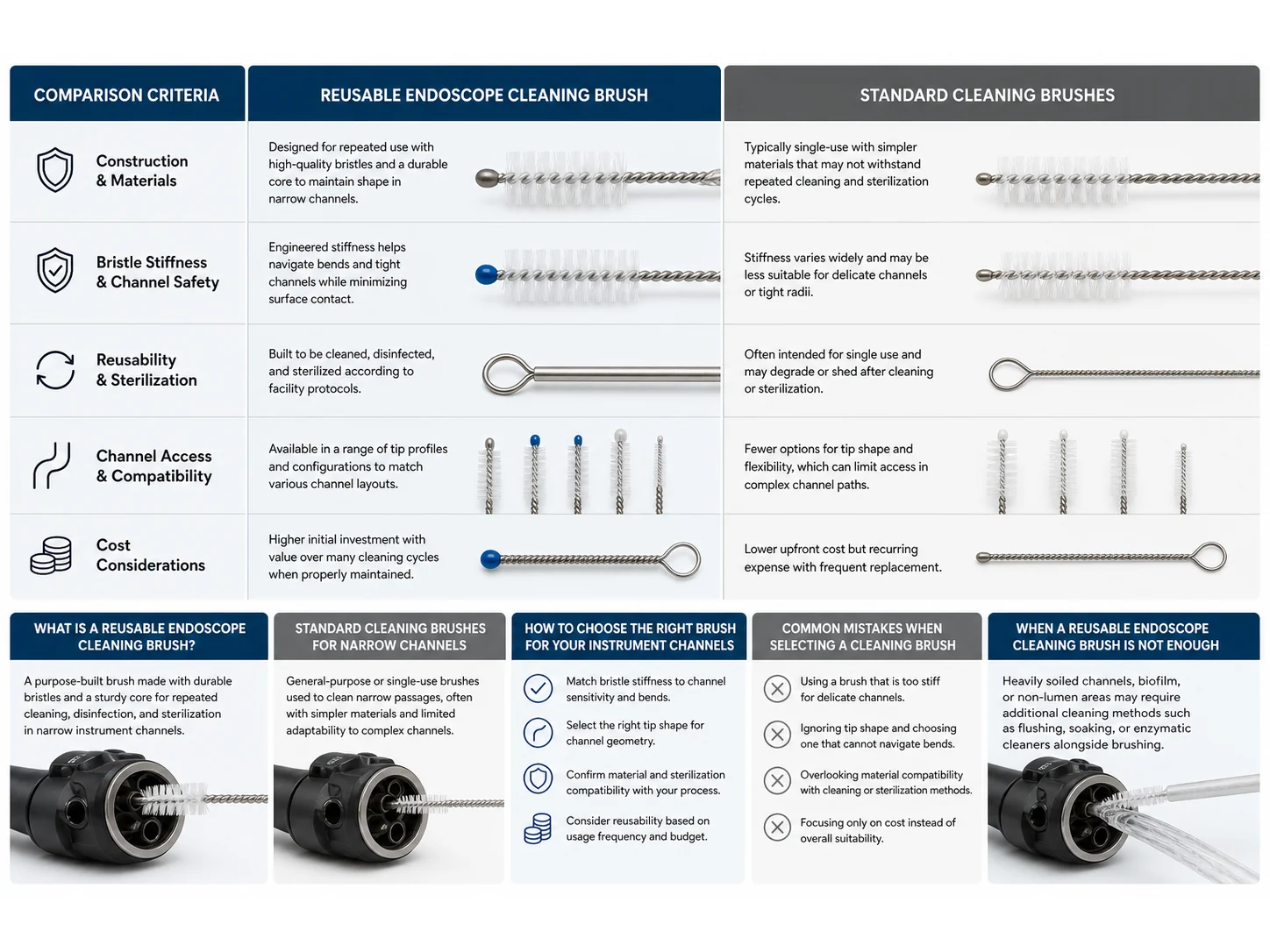
It is a long, flexible brush engineered for repeated use in medical instrument reprocessing. Unlike disposable brushes, a reusable cleaning brush is built with a durable core—often twisted wire or reinforced polymer—and bristles that withstand multiple sterilization cycles. The main challenge it solves is reaching the full length of the biopsy channel (often 1.2–4.2 mm in diameter) and removing tenacious soils without scratching the channel wall or leaving fibers behind.
Common Brush Materials, Sizes, and Configurations
For reusable medical-device cleaning claims, the practical boundary is the device maker’s validated instructions and the FDA — Reprocessing Medical Devices in Health Care Settings rather than a brush-only rule.
For healthcare cleaning language, this article keeps its claims within the general boundary of the CDC — Disinfection and Sterilization Guideline, which is written for disinfection and sterilization in healthcare facilities.
Where the article discusses healthcare settings rather than ordinary cleaning, the CDC — Core Infection Prevention and Control Practices is used as the general infection-control frame.
For dimension and measurement language, NIST — Metric SI supports the use of consistent SI/metric specifications.
For brush terminology and construction language, this section references American Brush Manufacturers Association — Brush Lingo.
The right combination depends on the endoscope model, channel diameter, and cleaning protocol. Here are the primary options:
| Component | Common Materials | Typical Characteristics | Best For |
|---|---|---|---|
| Bristles | Nylon, polypropylene, thermoplastic elastomer | Soft, chemical-resistant, non-absorbent | General channel cleaning without scratching |
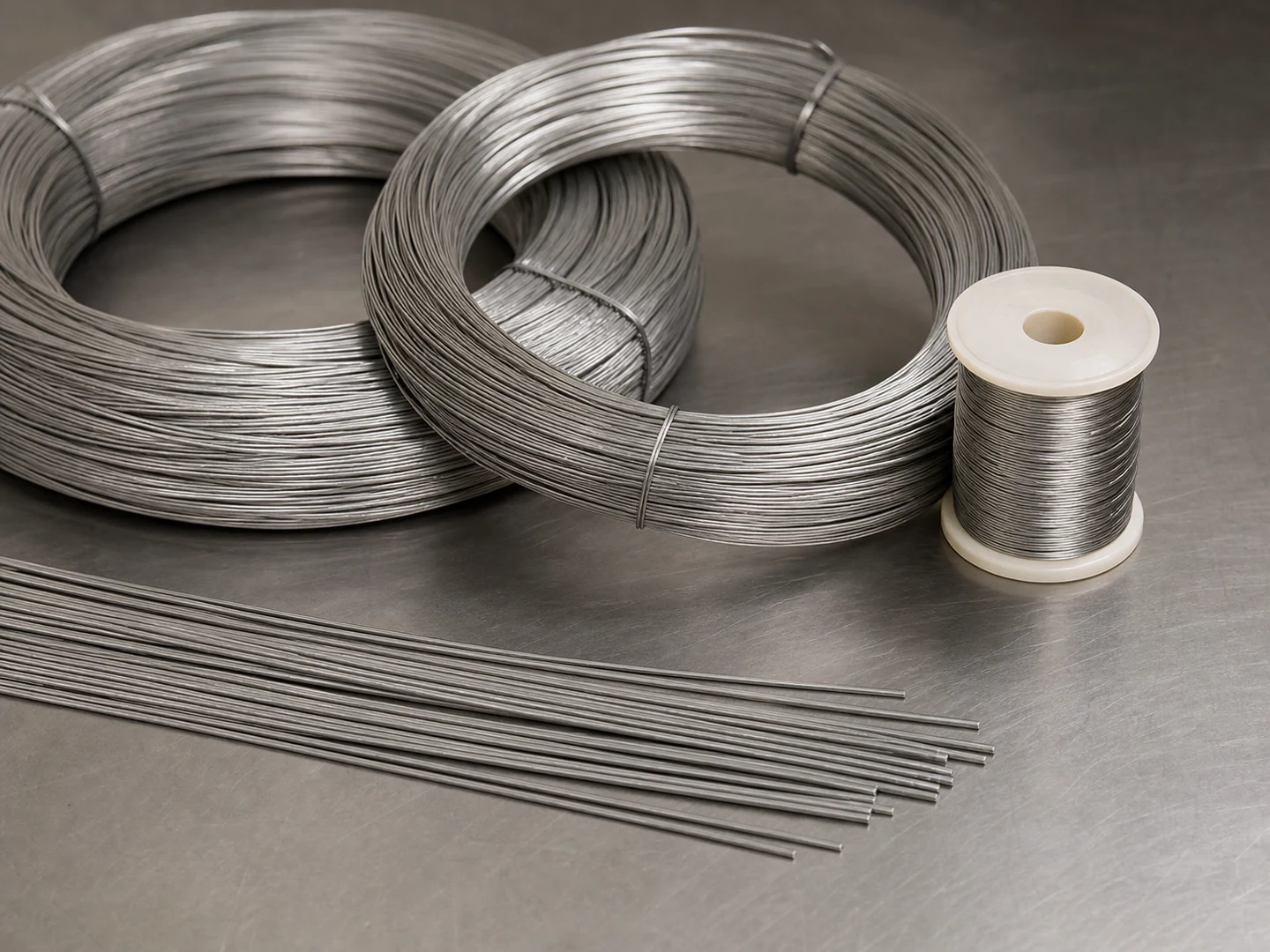
| Core/Wire | Twisted stainless steel, polymer (e.g., PTFE-coated) | Flexible yet stiff enough to push through channels | Navigating bends; autoclave compatibility |
| Handle | Plastic, stainless steel, ergonomic grips | Secure grip, often color-coded for channel size | Manual scrubbing or automated adapters |
| Tip | Soft bristles, sponge, or protective cap | Prevents distal tip damage during insertion | Sealing or atraumatic cleaning at the distal end |
| Diameter | Range typically 1.0–4.2 mm | Must match channel ID with slight fill | Full-wall contact without binding |
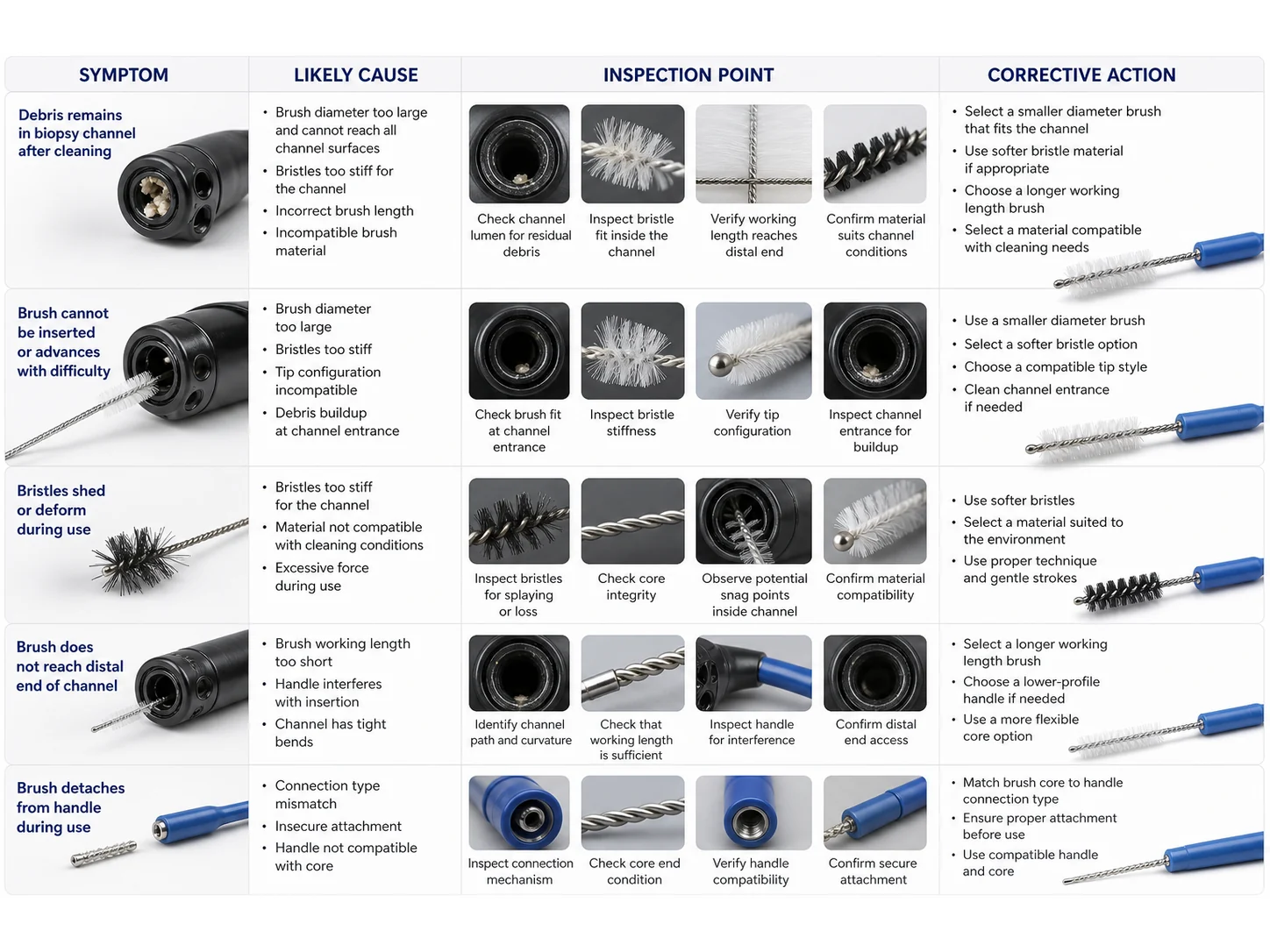
Bristle stiffness varies from extra-soft (for delicate, small channels) to medium (for larger, more robust biopsy channels). Core stiffness is selected based on the tortuosity of the endoscope: highly flexible cores for complex bend radii, stiffer cores for straight or gently curved channels.
How to Choose a Reusable Endoscope Cleaning Brush for Biopsy Channels
Selection goes beyond grabbing a brush that “looks about right.” Use this decision logic:
- Channel diameter match: Measure the exact internal diameter (ID) of the biopsy channel. The brush should be slightly larger than the ID to ensure bristle contact, but not so large that it jams or requires excessive force.
- Residue type: Proteinaceous debris, biofilm, or dried contrast media may require a specific bristle density or material (e.g., softer bristles for biofilm removal to avoid embedding contamination).
- Surface sensitivity: Channels are typically made from PTFE or similar low-friction polymers. Avoid wire bristles or abrasive materials that cause microscratches—these become biofilm havens.
- Chemical exposure: Verify compatibility with enzymatic cleaners, high-level disinfectants (e.g., glutaraldehyde, OPA, peracetic acid), and sterilization methods (steam, EtO, hydrogen peroxide plasma). Nylon bristles and stainless steel cores generally perform well across these environments.
- Maintenance frequency: If the brush is used daily in a high-volume department, choose a model with documented cycle life and replaceable wear indicators.
- Custom sizing needs: Off-the-shelf diameters may not fit older or specialty scopes. In such cases, a custom brush roll with specified core stiffness and bristle type may be justified.
Setup, Usage, and Handling Considerations
Even the best brush fails if used incorrectly:
- Always pre-soak or flush the channel with enzymatic detergent before brushing to soften deposits.
- Insert the brush gently, rotating as you advance and withdraw—no aggressive push-pull motions.
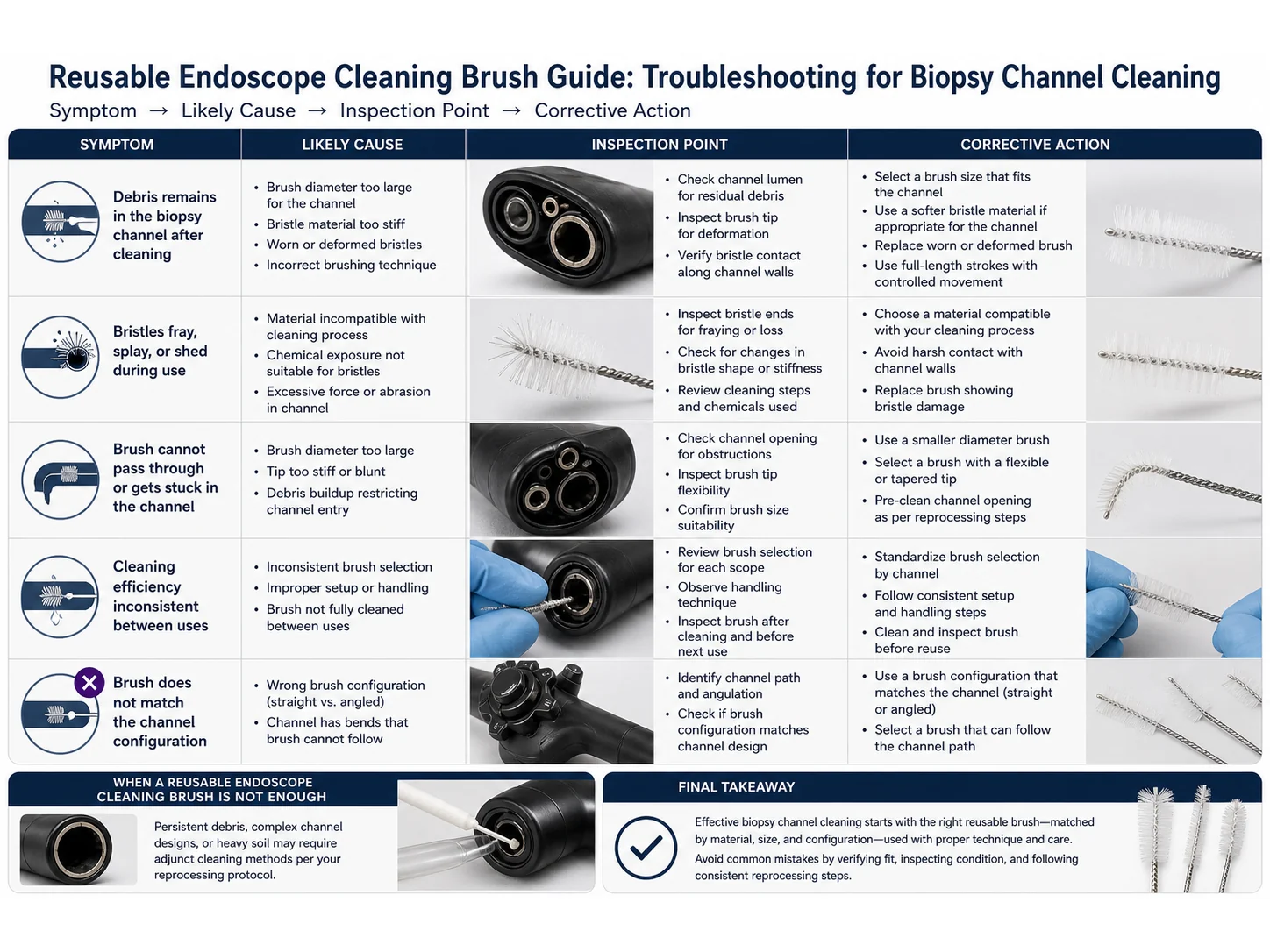
- After use, thoroughly rinse the brush and inspect for bristle loss, fraying, or corrosion before reprocessing.
- Store clean brushes in a dry, ventilated container to prevent microbial growth.
Common Mistakes When Selecting a Reusable Endoscope Cleaning Brush
Avoid these costly errors:
- Choosing by cost drivers alone: A low-cost brush may shed bristles or degrade chemically, leading to cross-contamination.
- Ignoring channel diameter tolerance: An oversized brush can create pressure spots and tear the channel lining; an undersized brush leaves soil behind.
- Using a metal-bristled brush: Wire bristles scratch PTFE channels permanently, increasing infection risk and repair costs.
- Assuming one size fits all: Gastroscopes, colonoscopes, and bronchoscopes have different biopsy channel diameters—always match brush to scope.
- Skipping manufacturer compatibility: Some endoscope IFUs specify allowed brush materials and dimensions; deviating can void warranty or cause damage.
When a Reusable Endoscope Cleaning Brush Is Not Enough
Brushing is critical but is only part of a validated reprocessing protocol. A reusable brush cannot replace:
- Automated Endoscope Reprocessors (AERs): Machines ensure consistent chemical contact, temperature, and cycle times that manual brushing alone cannot Help confirm.
- Enzymatic pre-cleaning: Proteins and fats must be broken down chemically; the brush provides mechanical action to lift debris after softening.
- Regular leak testing and visual inspection: A damaged channel may go unnoticed if only cleaned by brushing; microscopes or borescope cameras verify integrity.
- Written validation by a qualified reprocessing specialist: When changing brush designs, materials, or process steps, a risk assessment and sample testing with a supplier’s technical drawing review may be needed to ensure continued safety and efficacy.
Final Takeaway
For biopsy channel cleaning, the ideal reusable endoscope cleaning brush balances bristle softness, core flexibility, exact diameter fit, and full chemical compatibility. Base your procurement on the endoscope manufacturer’s instructions, not generic assumptions. Prioritize material quality and size precision to protect patient safety and extend scope life.
Practical Use Note
In daily use, the practical test is simple: check whether the brush reaches the full contact area, removes the target residue, and leaves the surface in the required condition. Record what changes when access shape, residue type, manufacturer instructions, and whether the task is general cleaning or validated reprocessing changes, because many brush failures are caused by the working condition shifting rather than by the brush body alone.
Frequently Asked Questions
Can I reuse a brush that has lost a few bristles?
No. Any bristle loss compromises cleaning performance and risks leaving foreign material in the channel. Inspect brushes after each use and replace immediately if damage is found.
How often should a reusable endoscope cleaning brush be replaced?
There is no universal number of cycles, but follow the brush manufacturer’s recommended usage limit. Look for visual wear, corrosion, or stiffness changes, and always adhere to your facility’s preventive maintenance schedule.
Are stainless steel core brushes safe for all endoscope channels?
Most modern endoscope channels are compatible with twisted stainless steel cores, but confirm with the scope IFU. In some cases, a polymer or PTFE-coated core is preferred to eliminate any metal contact risk.
What is the most common mistake when ordering reusable brushes?
Ordering by generic size labels (e.g., “pediatric” or “adult”) without verifying the exact biopsy channel diameter in millimeters. Always use the actual ID measurement from the scope documentation.
Can I use the same brush for different endoscope models?
Only if the biopsy channel diameters are identical and both IFUs permit the same brush materials. A brush optimized for one scope may be too tight or too loose for another, so it’s safest to dedicate brushes per model.
How do I know if a brush is chemically compatible with my disinfectants?
Request a material compatibility chart from the brush supplier. Look for resistance to your facility’s specific cleaning agents (enzymatic, detergent, disinfectant) and sterilization method. If in doubt, perform a small-scale soak test with a sample brush before full implementation.
Do I need a different brush for manual versus automated reprocessing?
Not necessarily, but the brush must match the connector or adapter used in your automated system. Some brushes come with detachable handles or standardized fittings for AERs. Check that the brush length and flexibility are compatible with the machine’s drive mechanism.