
What Is a Bronchoscope Cleaning Brush?
A bronchoscope cleaning brush is a reusable or single-use device designed to pass through the working channel of a flexible bronchoscope during manual or automated cleaning. Its bristles physically disrupt adherent soils inside the biopsy/suction channel, which chemical detergents alone cannot reliably remove. The brush typically consists of a flexible core shaft with a bristle head on the distal end and a handle or attachment interface on the proximal end.
Why Biopsy Channel Cleaning Requires Specialized Brushes
The biopsy channel is a long, narrow lumen (often 2.0–2.8 mm) with a smooth yet potentially scratched interior. After a bronchoscopy procedure, this channel can harbor mucus, blood, tissue fragments, and microbial biofilm. Standard cleaning methods like flushing may not reach all surfaces. A brush must: navigate the full working length without kinking, conform to the channel’s curvature, provide gentle yet thorough scrubbing action, and be compatible with enzymatic detergents and high-level disinfectants. Using the wrong brush can cause channel damage or incomplete cleaning, increasing infection risk.
Key Brush Materials and Their Performance Characteristics
The most important choice is often the bristle material and core material. Brushes for bronchoscopes are typically made from soft, non-abrasive polymers to protect the channel. Common options include:
- Nylon: Good flexibility and chemical resistance; widely used in standard single-use brushes.
- Polypropylene: Often stiffer; suitable for heavier residue but may require careful diameter matching to avoid channel stress.
- PTFE (Teflon) coated core: Provides lubricity to reduce friction during passage.
- Stainless steel core: Rarely used in delicate bronchoscopes due to risk of channel damage, but may be found in certain rigid scope applications.
Here’s a comparison of typical material characteristics for biopsy channel cleaning brushes:
| Material Option | Stiffness | Channel Safety | Chemical Resistance | Typical Use Case |
|---|---|---|---|---|
| Nylon bristle with PTFE-coated core | Low–medium | Very good | Compatible with most enzymatic cleaners | Standard single-use flexible bronchoscope brush |
| Polypropylene bristle with nylon core | Medium | Good if correctly sized | Good resistance to alcohol-based disinfectants | Reusable brushes for moderate soil loads |
| Soft polyurethane foam tip | Low | Excellent, non-scratching | May degrade with certain harsh chemicals | Gentle cleaning of sensitive or small-diameter channels |
| Spiral-wound brush with embedded abrasive particles | Medium–high | Risk of scratching if not used properly | Varies | Heavy debris removal; not recommended for routine bronchoscope maintenance |
Matching Brush Diameter and Length to the Bronchoscope Channel
Using a brush that is too wide can get stuck; one that is too narrow will miss contact with channel walls. Manufacturers specify working channel diameters (e.g., 2.0 mm, 2.2 mm, 2.8 mm). A good rule of thumb is to select a brush diameter that is approximately 70–90% of the channel’s inner diameter to allow easy passage while maintaining wall contact. Brush length must equal or slightly exceed the total working length of the scope (typical bronchoscope working length is around 600 mm) plus a handle section for manual manipulation.
Handle, Core, and Mounting Options
The proximal end design affects how the brush can be used during manual cleaning:
- Fixed loop or ring handle: Offers a grip for hand passage; common in single-use brushes.
- Luer lock or bayonet fitting: Allows attachment to automated flushing systems or extension handles.
- Flexible core with no dedicated handle: The entire brush is a continuous flexible shaft; may be used with a separate reusable handle.
- Color-coded handles: Help staff quickly identify the correct brush for each scope channel; useful in multi-scope reprocessing rooms.
Stiffness of the core is a balancing act: too flexible and the brush may coil inside the channel; too stiff and it can cause buckling or damage. Some brushes feature a graduated stiffness design—stiffer at the handle end and more flexible at the tip—to navigate complex curves.
Common Mistakes When Selecting a Bronchoscope Cleaning Brush
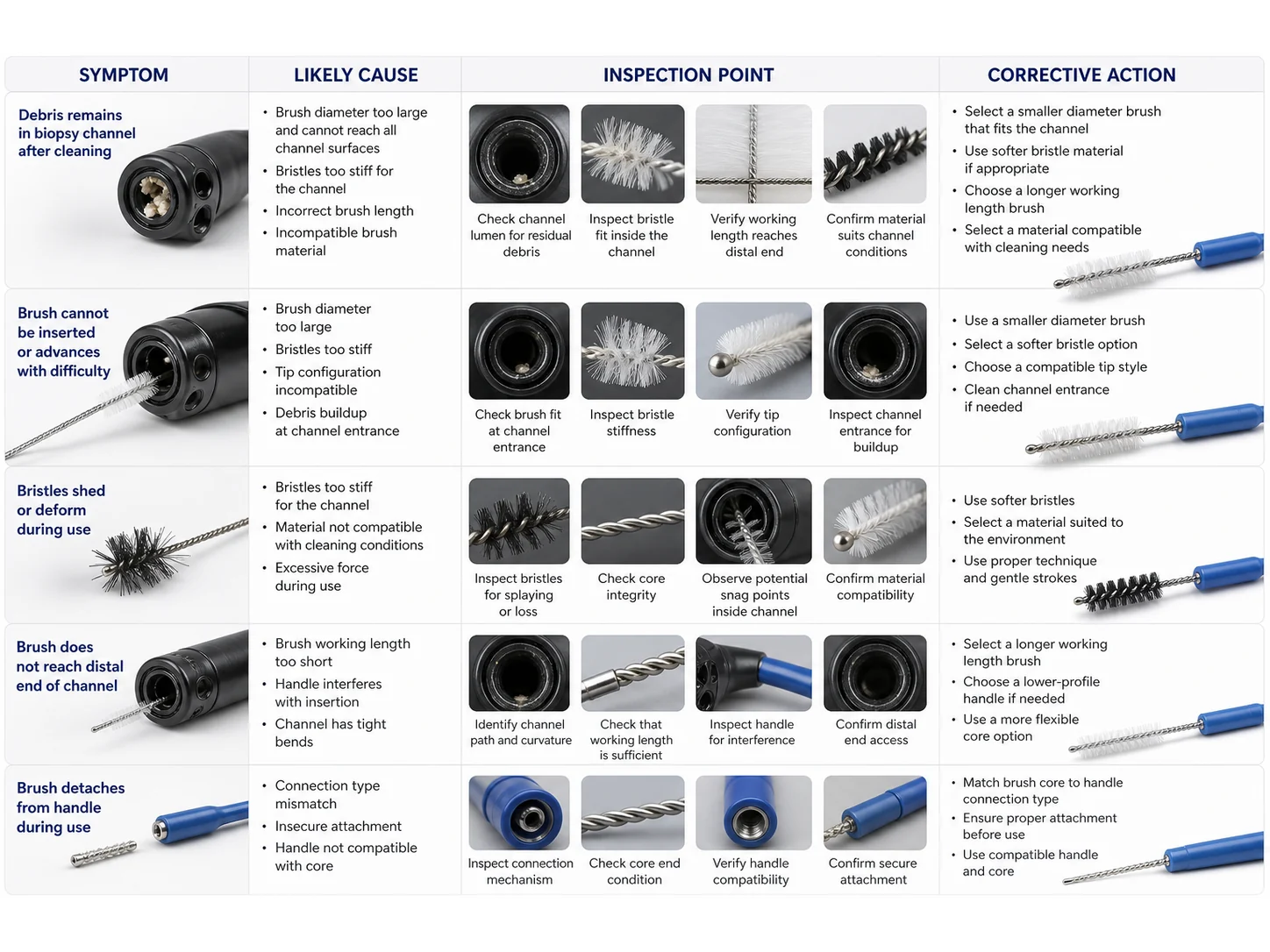
- Assuming one brush fits all scopes: Different bronchoscope models have varying channel diameters and lengths. Using the wrong size is a leading cause of incomplete cleaning and channel damage.
- Overlooking material compatibility: Certain disinfectants or enzymatic solutions may degrade polymeric bristles or cores over time, especially in reusable brushes. Always verify chemical resistance data from the brush supplier.
- Choosing based on cost drivers alone: Inexpensive single-use brushes may shed bristles or have inconsistent diameters, leading to higher reprocessing costs or scope repairs.
- Ignoring stiffness specifications: A brush that is too stiff can abrade the channel surface, creating scratches that trap debris and bacteria. Request stiffness profiles if not provided.
- Skipping validation with automated reprocessors (AERs): Some AERs require brushes with specific proximal connectors. Using a non-compatible brush can cause alarm faults or incomplete cycles.
- Not considering brush shelf life or storage: Single-use brushes may degrade if stored in humid environments. Reusable brushes need proper cleaning and drying to prevent biofilm growth on the brush itself.
When a Standard Bronchoscope Cleaning Brush Isn’t Enough
While a high-quality brush is essential, it should be part of a comprehensive cleaning protocol. Brushes alone cannot replace:
- Proper flushing and suction techniques before and after brushing.
- Enzymatic pre-soaking to loosen dried soils.
- Automated endoscope reprocessors (AERs) that control flow, temperature, and contact time.
- Visual inspection of the channel (via borescope or camera verification) to confirm cleaning effectiveness.
- Leak testing before cleaning to detect channel perforations that could be worsened by brushing.
If your current brush is not achieving satisfactory cleaning, consider whether a custom-designed brush with specific bristle density, spiral pattern, or tip geometry is required. Sharing detailed channel schematics and residue types with a brush manufacturer can help develop a tailored solution. In cases of stubborn biofilm or heavily damaged channels, replacement of the scope component may be more cost-effective than continued aggressive cleaning.
Final Takeaway
Selecting the right bronchoscope cleaning brush means looking beyond generic “endoscope brush” labels. Focus on three critical parameters: material that balances cleaning efficacy with channel safety, a diameter that matches your scope’s working channel, and a core/handle design that fits your cleaning workflow. Always involve your reprocessing staff in the evaluation, and when standard brushes fail, work with a supplier who understands the nuances of biopsy channel anatomy.
Frequently Asked Questions
Can I use the same brush for the suction channel and the biopsy channel?
Often no. The suction channel may have a larger diameter. Using a single brush for both risks under-cleaning the narrower biopsy channel or damaging the larger one. Separate brushes sized for each channel are recommended.
What is the ideal bristle stiffness for a bronchoscope cleaning brush?
Bristles should be firm enough to remove adherent debris but soft enough to avoid scratching the channel lining. Nylon bristles with a flexible PTFE core generally offer a good balance for most bronchoscope models.
How many uses can I get from a reusable bronchoscope cleaning brush?
Reusable brush life depends on material, cleaning frequency, and sterilization method. Typically, brushes should be inspected after each use for bristle deformation, core kinking, or material degradation. Replace at the first sign of wear, or according to the manufacturer’s maximum use recommendations.
Do I need a brush with a luer lock connector for my automated reprocessor?
Check your AER’s specification. Some models require a luer or bayonet-style brush connection to interface with the flushing port. Using an incompatible brush may prevent proper cycle completion.
What diameter brush should I choose for a 2.2 mm bronchoscope channel?
A brush diameter between 1.5 mm and 2.0 mm typically works well. Always confirm the exact channel diameter from the scope’s IFU (Instructions for Use) and select a brush that falls within the 70–90% range of that measurement.
Can I clean a bronchoscope with only immersion and flushing, without a brush?
No. Immersion and flushing help loosen soils, but mechanical friction from a brush is necessary to remove adherent biofilm and debris, especially in biopsy channels where tissue fragments can lodge. Skipping brushing is a major cause of persistent contamination.
What should I do if a brush tip breaks off inside the channel?
Stop any further brushing or flushing. Do not attempt to retrieve it with another brush, as this can push it deeper. Contact the scope manufacturer or a specialized biomedical repair service immediately. They can often retrieve the fragment using specialized tools without damaging the scope.
Are there brushes designed for single-use only, and are they worth the cost?
Yes, many bronchoscope brushes are single-use. They eliminate the risk of cross-contamination from inadequately reprocessed reusable brushes and ensure consistent size and material quality. While unit cost is higher, the savings in reprocessing labor and reduced scope damage can justify their use in many facilities.
Technical References
- CDC — Disinfection and Sterilization Guideline
- CDC — Core Infection Prevention and Control Practices
- FDA — Reprocessing Medical Devices in Health Care Settings
- NIST — Metric SI
Which nylon grade fits this job — Nylon PA, PA6 Nylon or PA66 Nylon?
| Grade | Continuous temperature (°C) | Peak temperature (°C) | Water absorption | Hardness |
|---|---|---|---|---|
| Nylon PA | 93 | 121 | 0.3–9% by PA grade and conditioning | Medium to firm; filament diameter and trim length control bending force. |
| PA6 Nylon | 80–100 | 130–160 | 1.5–3.0% | Shore D 75–85 |
| PA66 Nylon | 100–120 | 150–180 | 1.0–1.8% | Shore D 80–88 |
| PA610 Nylon | 90–110 | 130–150 | 0.5–1.0% | Shore D 72–82 |
| PA612 Nylon | 90–110 | 130–150 | 0.3–0.7% | Shore D 70–80 |
Figures as published by Brushtec / DuPont. Confirm the exact grade against the supplier datasheet before ordering.
When is Nylon PA the wrong choice for biopsy channels?
- Nylon PA — The nylon family spans several grades, so heat, moisture and chemical limits should follow the selected PA resin rather than a generic nylon value.
- AISI 304 Stainless Steel Wire — Avoid using AISI 304 as the default in marine, brine, hypochlorite, and persistent chloride environments; use AISI 316 when higher pitting and crevice-corrosion resistance is required.
What should replace Nylon PA for biopsy channels?
- Nylon PA — Compare Nylon PA with PP, PBT, PET. Change material when wet stiffness, temperature, chemical resistance, conductivity, particle shedding, or surface marking becomes the limiting factor.
- AISI 304 Stainless Steel Wire — Use AISI 316 stainless steel wire for chloride, marine, dairy, beverage, chemical washdown, or higher pitting-resistance requirements. Use carbon steel for dry aggressive cutting and brass or abrasive nylon for lower marking risk.