What Is a Reusable Endoscope Cleaning Brush?
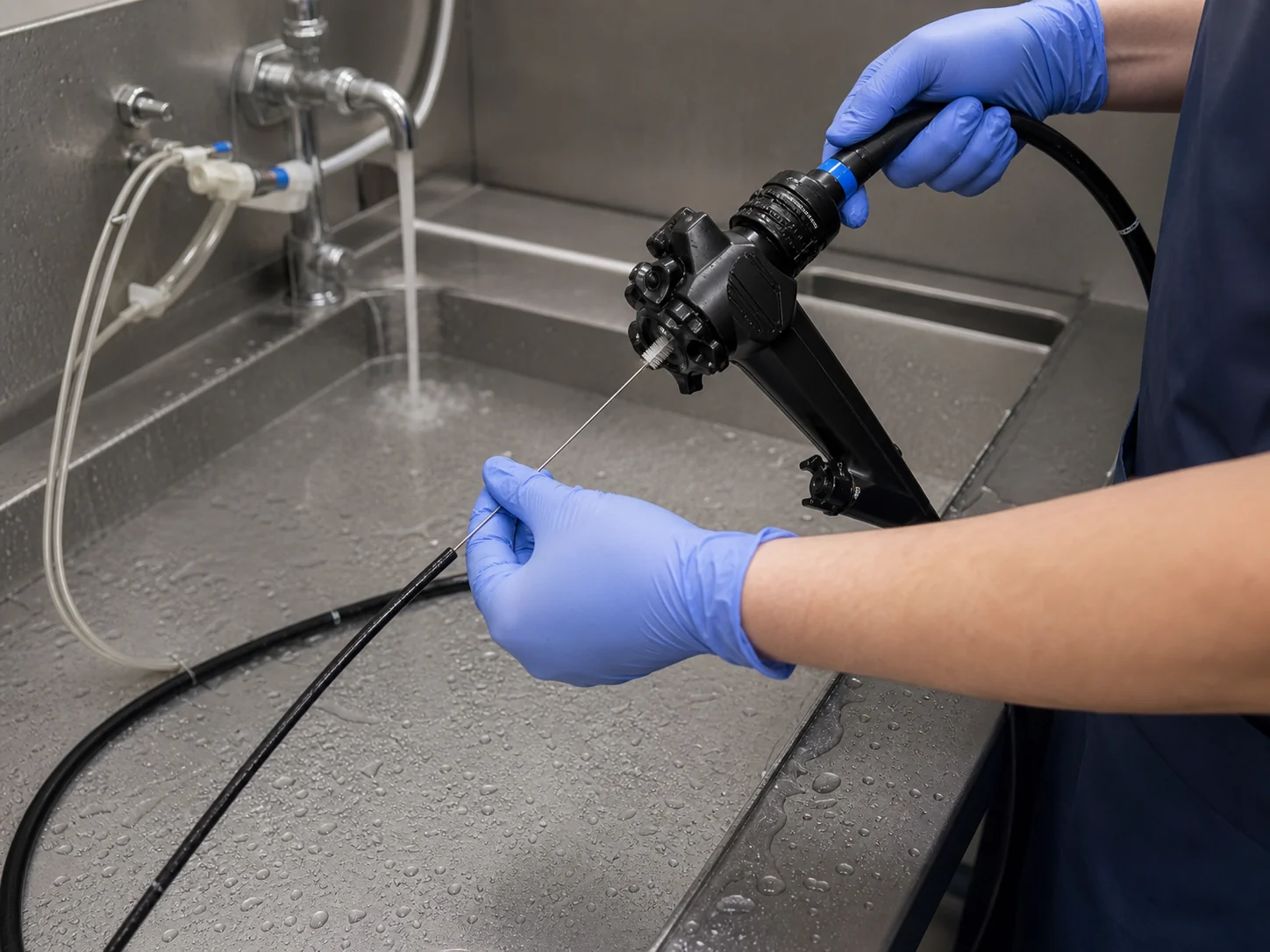
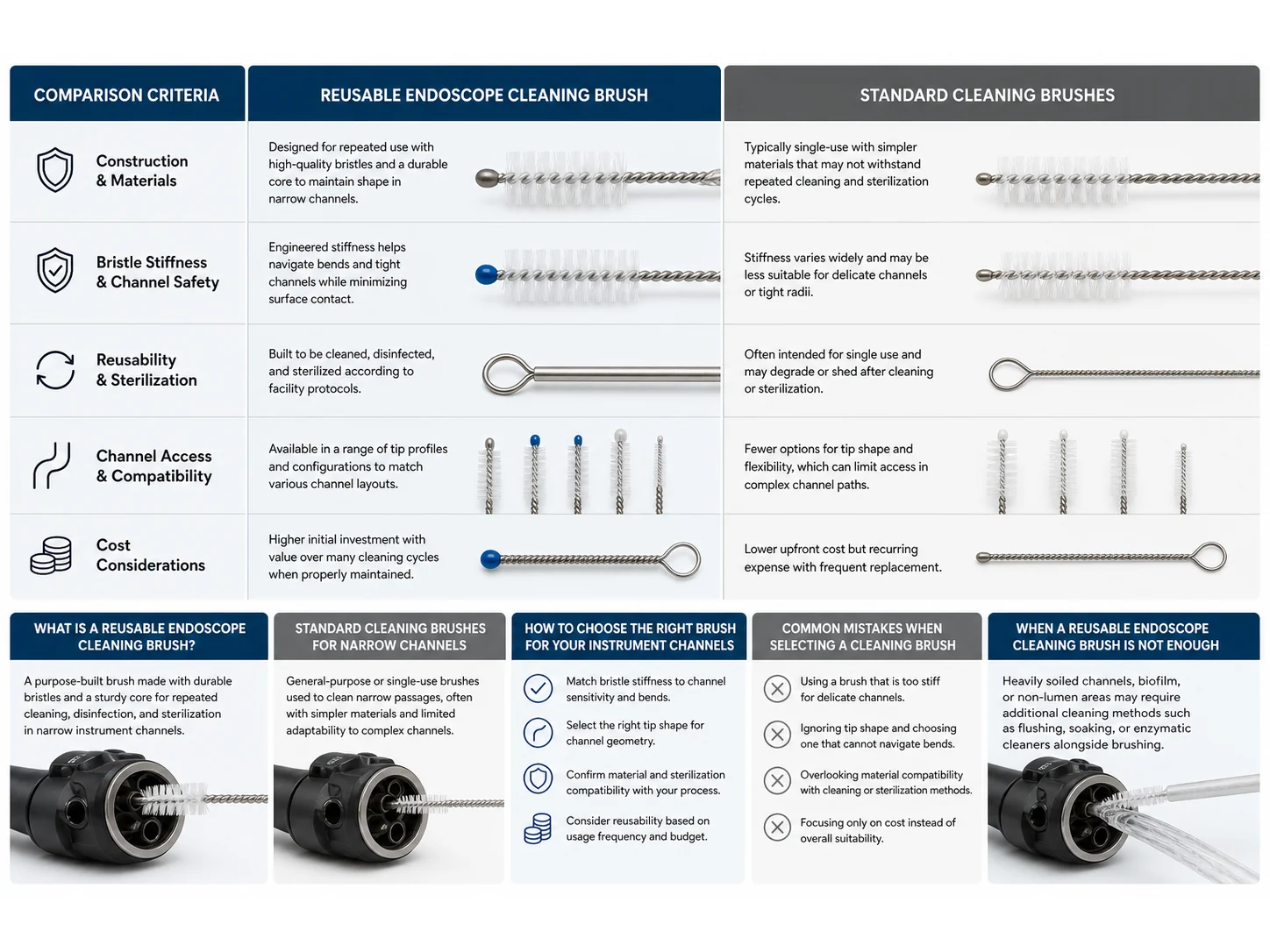
A reusable endoscope cleaning brush is a precision cleaning tool built to remove organic debris, biofilm, and residue from the internal channels of flexible and rigid endoscopes. It typically consists of a flexible twisted-wire core (often stainless steel) with soft, non-abrasive bristles made from materials like nylon or polyester. The bristle design, diameter, and flexibility are engineered to match common endoscope channel sizes without scratching the internal surfaces. After each use, the brush itself can be cleaned, disinfected, and sterilized, allowing it to be reused many times before replacement.
Standard Cleaning Brushes for Narrow Channels
For reusable medical-device cleaning claims, the practical boundary is the device maker’s validated instructions and the FDA — Reprocessing Medical Devices in Health Care Settings rather than a brush-only rule.
For healthcare cleaning language, this article keeps its claims within the general boundary of the CDC — Disinfection and Sterilization Guideline, which is written for disinfection and sterilization in healthcare facilities.
Where the article discusses healthcare settings rather than ordinary cleaning, the CDC — Core Infection Prevention and Control Practices is used as the general infection-control frame.
For brush terminology and construction language, this section references American Brush Manufacturers Association — Brush Lingo.
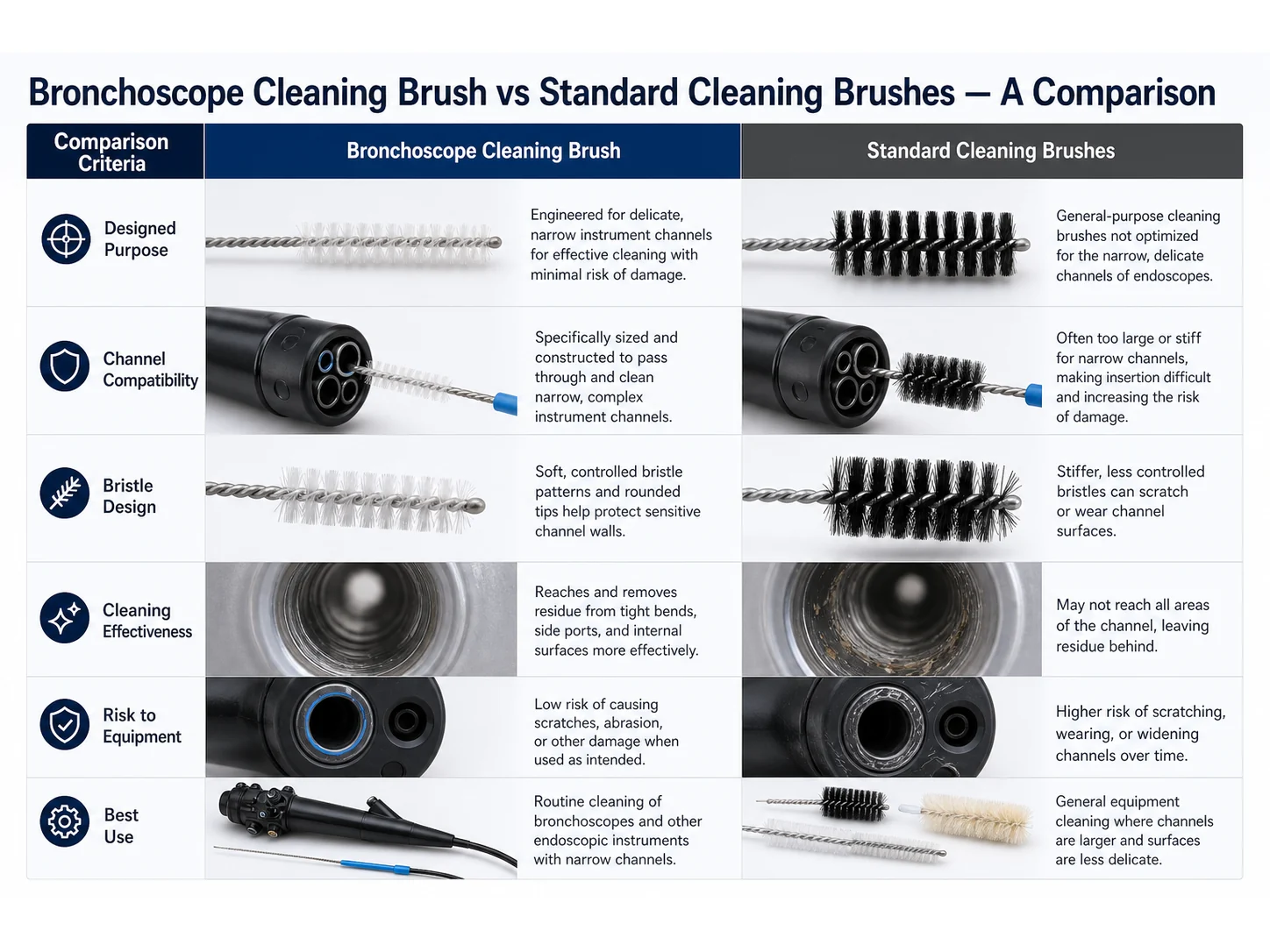
On the other hand, standard cleaning brushes for narrow channels are general-purpose tools found in laboratories, workshops, and industrial settings. Examples include test tube brushes, pipe brushes, and bottle brushes with small diameters. These brushes are often made from stiffer bristle materials (nylon, wire, abrasive compounds) and may have simpler plastic or non-sterilizable handles. While they are effective for many non-medical cleaning tasks, they are not typically designed to meet the exacting requirements of medical instrument reprocessing.
Reusable Endoscope Brush vs. Standard Cleaning Brushes: Key Comparison
| Feature | Reusable Endoscope Cleaning Brush | Standard Narrow Channel Brush |
|---|---|---|
| Intended Use | Medical endoscope channels requiring high-level disinfection and delicate surfaces | General-purpose tube, pipe, or laboratory equipment cleaning |
| Bristle Material | Soft, non-abrasive nylon or polyester; will not scratch channel linings | Often stiffer nylon, wire, or abrasive fibers; can leave micro-scratches |
| Core / Handle | Flexible stainless steel twisted wire for navigation through curved channels; compatible with sterilization | May have plastic handles, uncoated steel, or simple wire with less flexibility |
| Sterilization Capability | Designed for repeated autoclaving, chemical sterilant exposure, or high-level disinfection | Often not rated for sterilization; may degrade or harbor contaminants |
| Diameter Range | Precisely sized for endoscope channels (commonly 0.5 mm to 3 mm) | Broad range, but sizing may not match endoscope IFU requirements |
| Risk to Instrument | Very low when used correctly; bristles flex to avoid scratching | Higher risk of scratching, bristle breakage, or incomplete cleaning |
| Cost Profile | Higher initial purchase, but low cost per use over hundreds of cycles | Lower upfront cost, but may require more frequent replacement if used incorrectly |
| Cleaning Efficacy on Biofilm | Engineered bristle patterns lift and remove biofilm effectively | May push debris or fail to reach all surfaces in curved channels |
How to Choose the Right Brush for Your Instrument Channels
Start by checking your instrument’s Instructions for Use (IFU). The endoscope manufacturer will often specify a recommended channel brush diameter, bristle material, and flexibility. Use these factors as your baseline:
- Channel Material Sensitivity: If the channel is made of a soft polymer, a stiff bristle can cause irreversible damage. Reusable endoscope brushes are designed to be gentle.
- Residue Type: Biofilm and proteinaceous deposits require bristles that can lift without abrasion. Standard brushes may not be as effective.
- Sterilization Requirements: If you must autoclave or soak the brush in high-level disinfectant, choose a brush built for that environment.
- Channel Length and Curvature: A flexible core is essential for navigating bends. A standard stiff brush may fail to follow the channel path.
- Cleaning Frequency: For high-volume reprocessing, a reusable, durable brush is more economical over time.
- Compatibility with Cleaning Chemicals: Ensure the brush materials (bristles, core, adhesive) resist the detergents and disinfectants you use.
If your application involves non-critical, straight metal tubes or pipes and no stringent sterility demands, a standard narrow brush may be acceptable. For any medical endoscope, however, a purpose-designed reusable brush is the safer, more effective choice.
Common Mistakes When Selecting a Cleaning Brush
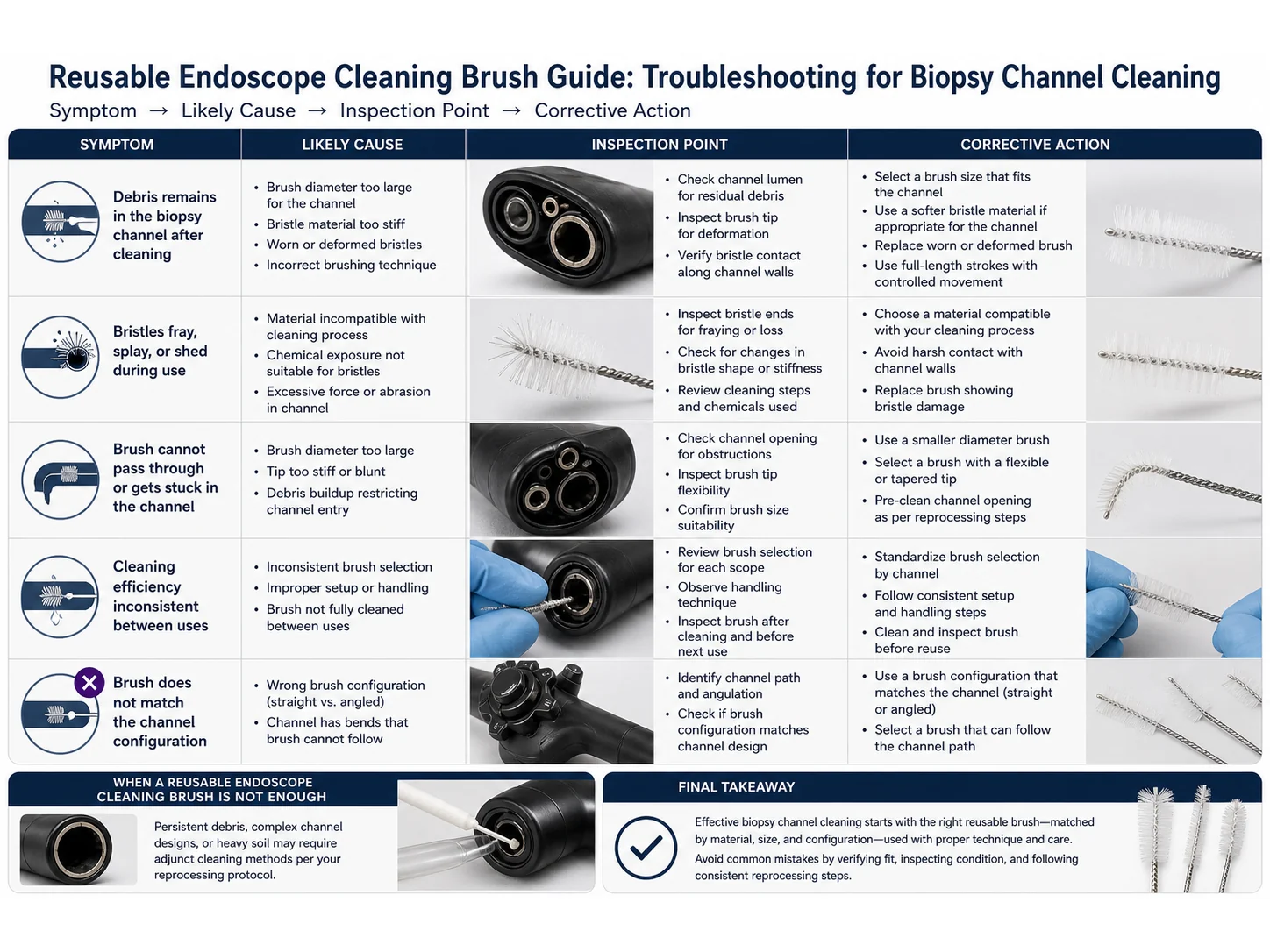
- Matching diameter only: Choosing a brush that fits the channel but has stiff bristles can scratch the lumen and create niches for biofilm.
- Using a laboratory test tube brush on an endoscope: Test tube brushes often have stiffer bristles and are not designed for curved, sensitive channels, increasing the risk of damage.
- Overlooking core flexibility: A brush that cannot follow the channel’s curves may miss surfaces or get stuck.
- Assuming all reusable brushes are equal: Not all reusable brushes are validated for endoscope channel cleaning. Verify against the IFU.
- Ignoring brush wear: Reusable brushes still have a limited life. Bent wires, kinks, or worn bristles reduce cleaning efficacy and can break off inside the channel.
- Mixing brushes between different endoscope models without verification: Diameter and length must match each specific instrument to avoid improper cleaning or damage.
When a Reusable Endoscope Cleaning Brush Is Not Enough
A reusable brush is a core part of channel cleaning, but it has limitations:
- Heavy calcified blockages: If the channel is obstructed by hard deposits or dried debris, enzymatic soaks or specialized cleaning agents may be required before brushing.
- Extremely long or tortuous channels: Some endoscopes have working channels beyond the reach or flexibility of standard reusable brushes. In those cases, you may need a custom brush design or a validated flushing-only protocol.
- Single-use requirements: Certain procedures or protocols mandate disposable brushes, especially when patient-contacted parts cannot be reliably sterilized.
- Non-cylindrical lumens: If the channel cross-section is irregular, a round brush may not clean all surfaces. A brush alone may be insufficient; you may need a combination of liquid flushing and visual inspection.
- Supplier drawing or sample review: For non-standard instruments, it is wise to have a brush supplier review your channel drawings or provide a sample for testing to ensure proper fit and cleaning without damage.
Final Takeaway: When to Use Which Brush
For any medical endoscope channel that requires high-level disinfection and must remain free of scratches, biofilm, or residue, a purpose-built reusable endoscope cleaning brush is the right tool. It may cost more up front, but the protection it offers to expensive instruments and patient safety justifies the investment. Standard narrow tube brushes have their place in industrial or laboratory settings where surface integrity and sterilization are less critical. Always let the instrument IFU, channel material, and sterilization process guide your final decision.
Practical Use Note
In daily use, the practical test is simple: check whether the brush reaches the full contact area, removes the target residue, and leaves the surface in the required condition. Record what changes when access shape, residue type, manufacturer instructions, and whether the task is general cleaning or validated reprocessing changes, because many brush failures are caused by the working condition shifting rather than by the brush body alone.
Frequently Asked Questions
Are all reusable endoscope cleaning brushes autoclavable?
Many are designed for steam autoclaving, but you should always check the brush manufacturer’s specifications. Some brushes may only be compatible with chemical sterilants or high-level disinfectants.
What bristle material is safest for endoscope channels?
Soft nylon or polyester bristles are widely used because they are gentle on channel surfaces yet effectively lift biofilm without scratching.
How can I tell when a reusable endoscope brush needs replacing?
Inspect the brush regularly for bent or kinked wire, worn or missing bristles, or fraying. If the brush no longer easily passes through the channel or shows signs of material fatigue, it should be replaced.
Can a standard test tube brush clean an endoscope channel in a pinch?
It is not recommended. Test tube brushes typically have stiffer bristles and are not designed to navigate the curves of an endoscope. They can scratch the channel and fail to remove biofilm completely.
What size brush do I need for a 2.8 mm endoscope channel?
The brush diameter should be slightly smaller than the channel’s inner diameter, but the exact size is often specified in the endoscope’s IFU. A common rule is to use a brush that is about 80–90% of the channel diameter to allow effective cleaning without jamming.
How should a reusable endoscope brush be stored after cleaning and disinfection?
After reprocessing, brushes should be thoroughly dried and stored in a clean, ventilated container that prevents moisture accumulation. Avoid sealing a damp brush in a closed bag or drawer.
Is a reusable brush more cost-effective than disposable brushes?
Over time, yes. A reusable brush can handle hundreds of cycles, making it cheaper per use despite a higher initial cost. However, you must factor in the labor for brush reprocessing and the cost of replacement based on wear.
Can the same reusable brush be used for different endoscope models?
Only if the channel diameters, lengths, and IFU requirements match exactly. Cross-using a brush between different instruments without verification can lead to under-cleaning or damage, and it may violate reprocessing protocols.