
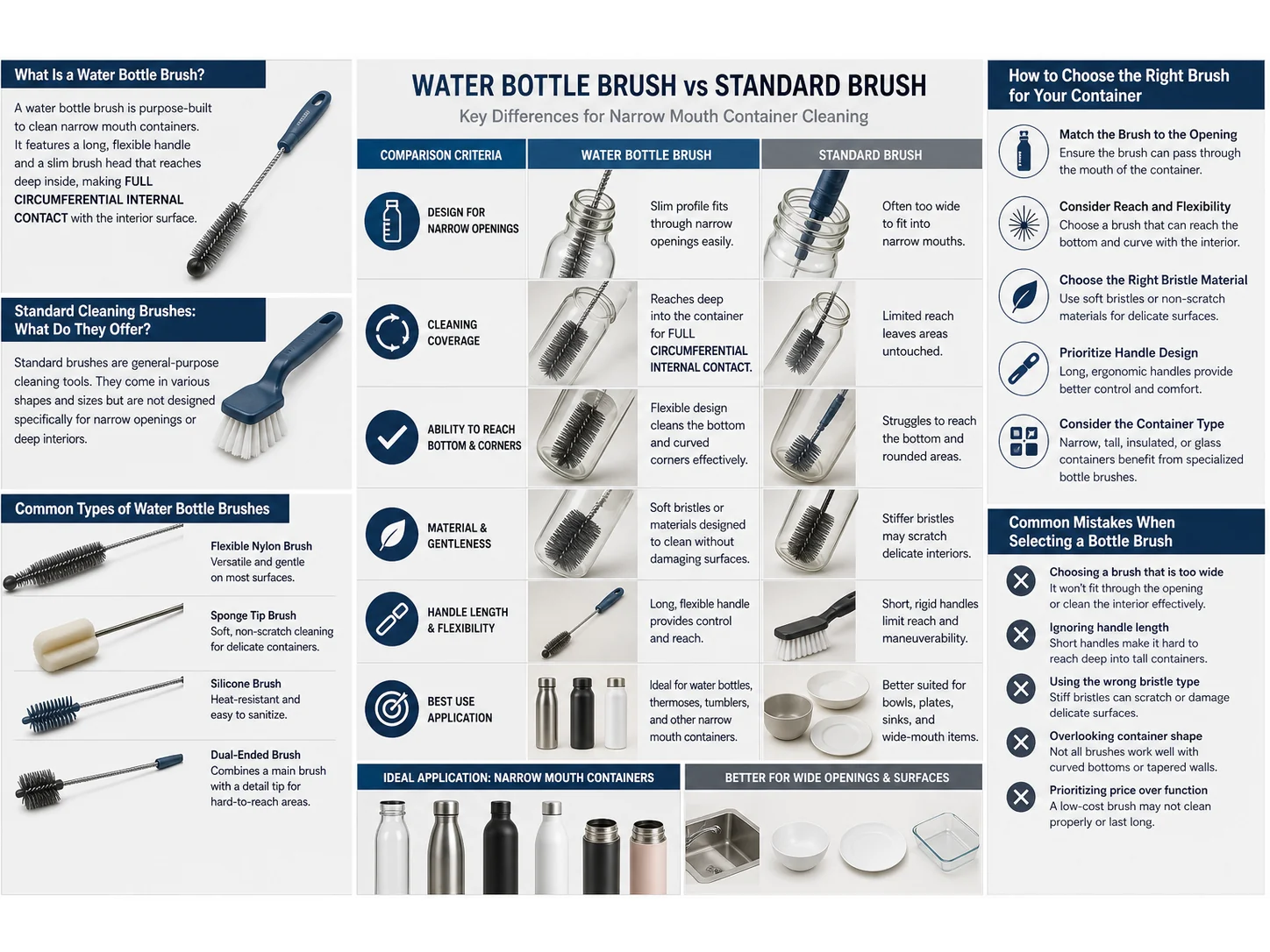
What Is a Water Bottle Brush?
A water bottle brush is a long-handled cleaning tool engineered for reaching the bottom and interior walls of narrow-neck containers. It typically features a small-diameter brush head with a flexible or rigid handle, enabling it to pass through openings that range from 18 mm to 50 mm while scrubbing surfaces that fingers or standard dish brushes cannot reach. The bristle configuration, handle material, and overall length are all designed to remove residues, biofilms, and odors from confined spaces without damaging the container.
Standard Cleaning Brushes: What Do They Offer?
Standard cleaning brushes—such as dish brushes, utility scrub brushes, and general-purpose handled brushes—are built for open surfaces, wide-mouth containers, and large-area cleaning. They typically have broader brush heads, shorter handles, and stiffer bristle patterns that work well on flat items but become obstacles when faced with small openings. While they can handle large-volume cleaning tasks and heavy scrubbing, they often fail at reaching corners or the bottom of a bottle with a restricted neck.
Water Bottle Brush vs Standard Brush: Key Differences
| Feature | Water Bottle Brush | Standard Cleaning Brush |
|---|---|---|
| Head diameter | Typically 0.75 to 2.5 inches (19–63 mm) | Often 2.5 to 6 inches (63–152 mm), too wide for narrow necks |
| Handle length | 8 to 16 inches (20–40 cm), with extended versions for large carboys | Usually 4 to 8 inches (10–20 cm), limiting reach |
| Flexibility | Often has a flexible wire or neck to bend around bottle geometry | Typically rigid, straight handle with limited articulation |
| Typical bristle material | Nylon, silicone, or natural fibers; often softer to protect interior surfaces | Stiffer synthetics or natural fibers; may be abrasive |
| Best for narrow necks | Yes, specifically designed to pass through small openings | No, often cannot enter or causes scraping at the neck |
| Risk of scratching interior | Low when matched to surface sensitivity; silicone or soft nylon options available | Higher, especially with hard plastic bristles or rough edges |
| Cleaning reach | Complete interior coverage, including bottom and curved walls | Partial at best; blind spots common |
| Typical applications | Water bottles, vacuum flasks, sports bottles, laboratory glassware, fermentation carboys, pet bottles | Plates, bowls, wide-mouth jars, kitchen utensils, general surface scrubbing |
| Hygiene compatibility | Available in high-temp, chemical-resistant, and autoclave-safe versions | Limited to general cleaning; may not withstand aggressive sanitization |
Common Types of Water Bottle Brushes
When selecting a water bottle brush, you will encounter several variations that address different cleaning challenges. Understanding these options helps match the brush to your specific container and residue type without overcomplicating procurement.
- Nylon bristle brushes – Offer balanced scrubbing power and durability, good for daily cleaning of protein shakes, juices, and light residues.
- Silicone bristle brushes – Gentle and non-absorbent, ideal for baby bottles, sensitive coatings, and applications where odor retention is a concern.
- Wire-core brushes (twisted-in-wire) – Provide aggressive scrubbing with a flexible stem, often used in industrial or lab settings for stubborn deposits.
- Stainless steel handle brushes – Chemical-resistant and robust, suitable for sanitary processing equipment where sterility matters.
- Sponge-tip or microfiber brushes – Designed for ultra-gentle wiping rather than heavy scrubbing, useful for coated surfaces and final rinse steps.
- Angle-head brushes – Built with a bent or curved shaft to reach under rims and into flask shoulders.
How to Choose the Right Brush for Your Container
Selecting between a water bottle brush and a standard brush requires looking beyond the opening size. Match the brush to the real cleaning demands by evaluating these factors:
- Residue type – Protein, oils, sugars, or mineral scale each respond differently to bristle stiffness and brush design. Sticky or baked-on deposits may require a wire-core brush; delicate rinse-off needs only a soft silicone sweep.
- Surface sensitivity – Glass, stainless steel, plastic, and coated interiors all have different scratch tolerances. Always match bristle material to surface hardness.
- Container shape and internal geometry – A perfectly cylindrical bottle is forgiving; a contoured sport bottle, flask with a narrow shoulder, or square jug may need a flexible neck and angled head.
- Opening diameter – Confirm the brush head can pass through without jamming. The handle diameter should also clear the neck without excessive friction.
- Chemical and temperature exposure – If the brush will contact harsh detergents, sanitizers, or elevated temperatures, choose stainless steel handles and chemical-resistant bristles.
- Hygiene expectations – Food-grade, pharmaceutical, or cleanroom applications demand brushes that resist moisture, won’t shed fibers, and can be sterilized or replaced on a strict schedule.
- Maintenance frequency – High-volume cleaning may justify quick-change brush heads or a set with different bristle stiffnesses to reduce downtime.
- Custom size requirements – For non-standard containers (very tall, extremely narrow, internal baffles), off-the-shelf brushes may not exist; factor in time for custom brush design and sampling.
Common Mistakes When Selecting a Bottle Brush
Avoiding these mistakes will save time, reduce container damage, and improve first-pass cleaning results:
- Using a standard brush just because it is on hand. Attempting to force a wide, rigid brush into a narrow opening often scratches the neck, leaves interior residues untouched, or breaks the brush.
- Choosing by cost drivers or brand name alone. A low-cost brush may shed bristles, harbor bacteria, or wear out quickly in commercial use. Evaluate total cost per cleaning cycle, not purchase cost drivers.
- Ignoring handle length. A brush that is too short won’t reach the bottom; one that is excessively long for lightweight bottles can be awkward and reduce scrubbing control.
- Mixing abrasive brushes with delicate coatings. Copper, ceramic-lined, or PVD-coated bottles can be permanently damaged by stiff wire-wound brushes.
- Assuming one brush fits all containers. A brush that excels on a 1-liter water bottle may be useless inside a 5-gallon carboy or a slim laboratory test tube.
- Neglecting brush hygiene. Even the best brush becomes a contamination risk if it does not dry completely, is not sanitized between uses, or is kept past its service life.
When a Water Bottle Brush Is the Wrong Choice
A water bottle brush solves many narrow-mouth cleaning challenges, but it has practical limits. Recognize these boundaries early to avoid relying on a brush that cannot deliver the required outcome:
- Extremely narrow or long passageways – Openings under 15 mm or depths beyond 18 inches may exceed typical brush dimensions. Tube brushes, twisted-in-wire laboratory brushes, or custom-machined cleaning heads are often necessary.
- Internal baffles, mixing vanes, or sharp corners – Standard bottle brush shapes cannot conform to complex internal structures. Molded sponge brushes, foam swabs, or CIP (clean-in-place) spray systems may be the only solution.
- Sterile or aseptic requirements – Mechanical brushing alone cannot Help confirm sterility. The container may need autoclaving, gamma irradiation, or validated chemical sanitization after brush cleaning.
- Heavy industrial deposits – Cured adhesives, hardened resins, or thick scale that resists manual scrubbing may require power brushing, ultrasonic cleaning, or aggressive soak chemicals.
- High-volume production lines – Manual brushing quickly becomes impractical when cleaning hundreds of bottles per hour. Automated brush systems or spray washers should be evaluated for throughput and consistency.
- Need for documented cleaning validation – In regulated environments, you may need to move beyond simple visual inspection to ATP swab testing or protein residual verification. If a manual brush cannot deliver measurable cleanliness, the cleaning method itself must be reengineered.
Final Takeaway
A water bottle brush outperforms any standard brush when the cleaning target has a narrow opening, complex interior shape, or surface sensitivity that demands controlled contact. Standard brushes remain the practical choice for wide-mouth containers, flatware, and open-surface scrubbing. The decision comes down to matching brush geometry, bristle material, and handle configuration to the exact container, residue, and hygiene requirements you face. If an off-the-shelf water bottle brush cannot meet those requirements, work with a cleaning tool supplier to review custom brush dimensions, conduct sample testing, and ensure the final design fits your application—before you commit to a full purchase.
Frequently Asked Questions
Can I use a standard dish brush for cleaning a water bottle?
In most cases, no. Standard dish brushes are too wide to pass through a bottle neck and may not reach the bottom. If the opening is wide enough (about 2.5 inches or larger), a standard brush might work for basic scrubbing, but it still risks incomplete cleaning at the corners and bottom.
What bristle material is best for daily water bottle cleaning?
For everyday bottles that hold water, coffee, or sports drinks, nylon or silicone bristles work well. Nylon provides effective scrubbing, while silicone resists odors and dries quickly. Choose based on the residue; sticky residues like protein powder often need nylon, while delicate coatings benefit from silicone.
How do I clean and maintain a water bottle brush?
Rinse the brush thoroughly after each use to remove debris, shake off excess water, and hang it with bristles facing down to air dry. Periodically soak the brush in a mild sanitizing solution (as recommended for the bristle material) and replace it every 2–3 months or sooner if bristles become misshapen or worn.
Are silicone bottle brushes better than nylon?
Neither is universally better. Silicone brushes are non-absorbent, odor-resistant, and very gentle on surfaces, making them excellent for baby bottles or coated containers. Nylon brushes typically offer more scrubbing power for dried-on residue. The best choice depends on what you are cleaning and the surface sensitivity.
What length brush do I need for a 32-ounce water bottle?
Measure the bottle’s interior depth from the neck opening to the bottom. For a typical 32 oz (1 liter) bottle, a brush with a handle length of 10 to 12 inches is usually sufficient. Always add 1–2 inches to the total depth to ensure comfortable handling and complete bottom contact.
Can a bottle brush reach the bottom corners of a square or rectangular container?
Standard straight bottle brushes often miss the corners. For square or odd-shaped containers, look for brushes with a flexible wire core and a rounded or angled head that can conform to internal angles, or consider custom sponge-tipped brushes designed to swipe corners.
Is a water bottle brush necessary for wide-mouth bottles?
Not always. If the bottle mouth is wide enough to admit your hand or a standard dish brush, a water bottle brush may be optional for general cleaning. However, a long-handled brush can still help reach the bottom without straining your wrist, especially for tall containers.
How often should I replace a water bottle brush?
Replace your brush when bristles start to splay, flatten, or shed, or if the handle bends permanently. In commercial settings where brushes are used daily, a replacement cycle of 1–3 months is common. Regular inspection for trapped residue or mold will also signal replacement time.
Technical References
- CDC — Preventing Food Poisoning
- eCFR — 21 CFR 177.1500 Nylon Resins
- eCFR — 21 CFR 177.1630 Polyethylene Phthalate Polymers
- FDA — Food Safety in Your Kitchen
Which bristle material fits this job — Nylon PA, Silicone or AISI 304 Stainless Steel Wire?
| Material | Continuous temperature (°C) | Peak temperature (°C) | Water absorption | Hardness |
|---|---|---|---|---|
| Nylon PA | 93 | 121 | 0.3–9% by PA grade and conditioning | Medium to firm; filament diameter and trim length control bending force. |
| Silicone | 200–250 | 280–300 | 0.1–1.0% | Shore A 20–80 |
| AISI 304 Stainless Steel Wire | 400 | 500 | 0% | Rockwell B 70–95 depending on temper and cold work |
| Microfiber | 80–120 | 140–170 | 0.2–1.0%Material Itself ; Structure Can Absorb 3–7 Times Its Own Weight | — |
| Polypropylene PP | 80–100 | 120–140 | ≤0.03% | Shore D 65–75 |
Figures as published by Brushtec / DuPont; Alleima; Perlon. Confirm the exact grade against the supplier datasheet before ordering.
What should replace Bottle & Container Brushes for bottle brush?
- Bottle & Container Brushes — Bottle and container brushes are selected around an opening plus a larger vessel body and bottom geometry; tube and bore brushes are selected mainly around a long diameter-controlled passage. Closest alternative: Tube & Pipe Bore Brushes.
- Nylon PA — Compare Nylon PA with PP, PBT, PET. Change material when wet stiffness, temperature, chemical resistance, conductivity, particle shedding, or surface marking becomes the limiting factor.
- Silicone — Compare Silicone with PP, TPE, Nylon. Change material when wet stiffness, temperature, chemical resistance, conductivity, particle shedding, or surface marking becomes the limiting factor.
- AISI 304 Stainless Steel Wire — Use AISI 316 stainless steel wire for chloride, marine, dairy, beverage, chemical washdown, or higher pitting-resistance requirements. Use carbon steel for dry aggressive cutting and brass or abrasive nylon for lower marking risk.