What Is a Stainless Steel Wire Brush in Weld Cleanup?
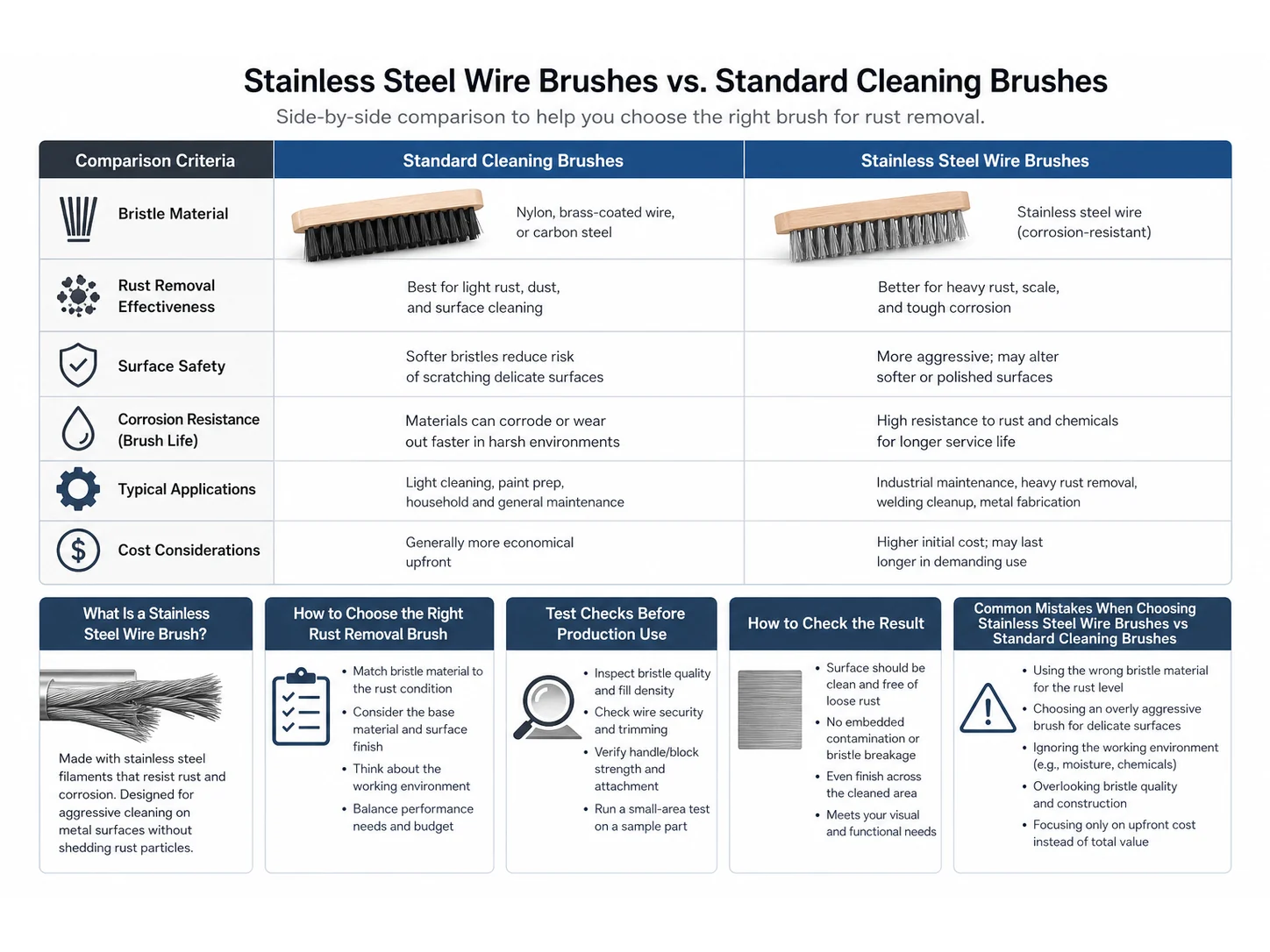
A stainless steel wire brush is a cleaning tool with bristles made from stainless steel wire, used to remove surface contaminants from metal after welding. In weld cleanup, the primary job is often to remove heat tint, welding slag, and spatter while avoiding iron contamination that can rust or degrade the surface. Stainless steel bristles are essential when working with stainless steel and other corrosion-resistant alloys because they don’t leave behind free iron particles that cause rust spots.
Common Types and Options for Weld Cleanup Brushes
For material-selection language, this section is supported by World Stainless — Corrosion Resistance of Stainless Steels.
For the safety point in this section, the relevant OSHA reference is OSHA — Hexavalent Chromium.
For material-selection language, this section is supported by British Plastics Federation — Thermoplastics.
For brush terminology and construction language, this section references American Brush Manufacturers Association — Brush Lingo.
Wire brushes for weld cleanup come in several styles, each suited to different tasks and access requirements:
- Handheld scratch brushes: Wooden or plastic handles with a narrow bristle area. Good for small touch-ups and tight spaces. Wooden handle versions are common for general use; plastic handles offer better resistance to chemicals and solvents.
- Wheel brushes: Circular brushes mounted on a bench grinder or polisher. Useful for cleaning weld seams on flat or curved parts.
- Cup brushes: Designed for angle grinders or drills, cup brushes tackle larger weld areas, bevels, and corners. Crimped wire offers flexibility; knot (twisted) wire is more aggressive.
- End brushes: Small rotary brushes for cleaning inside pipe welds or holes.
- Mini and pen-style brushes: Small handheld or rotary brushes for fine work, often used in TIG weld cleanup.
Stainless Steel vs Other Wire Brush Materials for Weld Cleanup
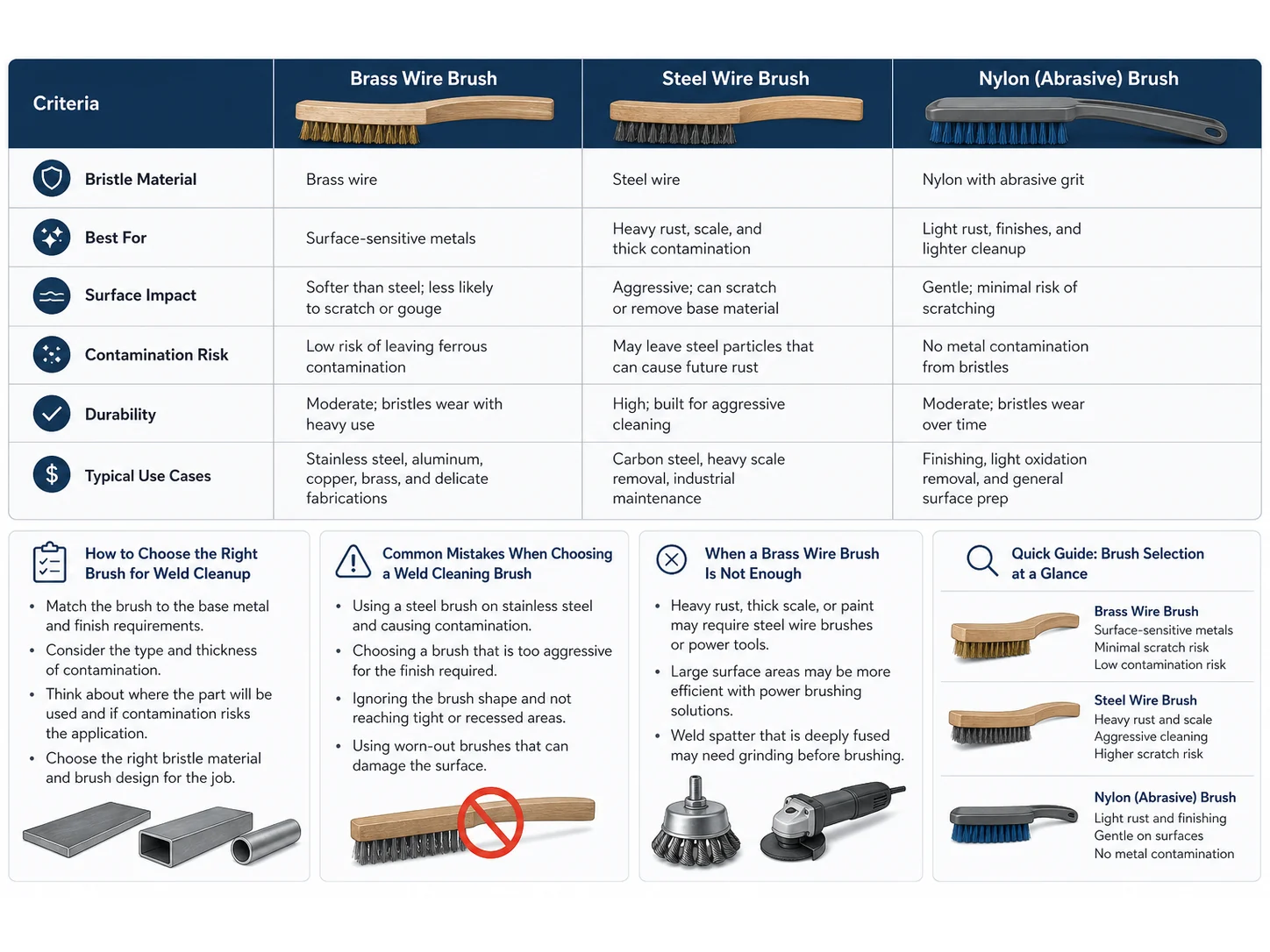
Not all wire brushes are safe or effective for every weld cleaning job. The table below compares common wire materials used in brushes for metal cleaning.
| Brush Material | Contamination Risk | Abrasiveness | Typical Weld Cleanup Use |
|---|---|---|---|
| Stainless Steel | None (no free iron) | Medium | Stainless steel, aluminum (dedicated brush), food-grade, marine, and pharmaceutical welds |
| Carbon Steel | High (iron residue can rust) | Medium | Mild steel only; never use on stainless or aluminum due to corrosion risk |
| Brass | Low (non-ferrous, but can leave brass traces) | Low | Soft metals, decorative work, or where spark prevention is required |
| Nylon Abrasive | None | Varies by grit | Sensitive surfaces where scratch depth must be controlled; often used with chemical pastes for passivation |
How to Choose the Right Stainless Steel Wire Brush for Your Weld Cleanup Job
Selecting the correct brush goes beyond just choosing “stainless steel.” Consider these factors:
- Residue type: Knot wire brushes handle heavy slag and spatter; crimped wire is better for light oxidation and finishing.
- Surface sensitivity: Finer wire diameters (e.g., 0.005–0.010 in.) leave a smoother finish; coarser wires are faster but more likely to scratch.
- Equipment interface: Ensure the brush arbor or shank fits your tool (grinder, drill, bench motor). Hand brushes must match the grip preference and work angle.
- Wet or chemical exposure: Some plastic handles and stainless bristles are better suited for use with chemical cleaners or in washdown environments.
- Hygiene requirements: In food, pharmaceutical, or cleanroom settings, use brushes that can be sterilized or that don’t trap contaminants. Dedicated brushes per metal type are critical.
- Maintenance frequency: In high-volume production, brush life and the ability to re-sharpen or replace knots quickly may influence selection.
- Custom sizes: Deep holes, undercuts, or complex geometries may require non-standard brush dimensions. In such cases, a sample test or supplier drawing review is recommended to avoid poor fit and wasted time.
Common Mistakes When Using Stainless Steel Wire Brushes for Weld Cleanup
- Using a carbon steel brush on stainless steel: This causes “rouge” or rust spots later. Always label and segregate brushes.
- Assuming all stainless brushes are the same: Bristle type, wire diameter, and construction affect cleaning speed and surface finish.
- Overlooking cross-contamination: A stainless brush previously used on carbon steel can carry iron particles to a stainless surface. Use dedicated brushes and mark them clearly.
- Applying too much pressure: Wire brushes clean by displacement, not grinding. Excessive force can embed bristle fragments or scratch the base metal.
- Ignoring ergonomics: For handheld use, a poorly chosen handle can lead to worker fatigue and inconsistent cleaning.
When a Stainless Steel Wire Brush Is Not Enough
Stainless steel wire brushes are effective for light to moderate weld cleaning, but they have limits:
- Heavy mill scale or deep pitting: A wire brush won’t remove thick scale. Pickling paste, electrochemical cleaning, or abrasive blasting may be necessary.
- Passivation requirements: After mechanical cleaning, stainless steel may need a chemical passivation treatment to restore corrosion resistance. A brush alone cannot passivate the surface.
- High-purity applications: Semiconductor, pharmaceutical, or food contact surfaces may require ultra-smooth finishes (Ra < 0.5 µm) that wire brushes cannot achieve. Abrasive pads or electropolishing are better options.
- Large surface areas: Manual brushing is impractical for large structures; consider automated wire brushing, sanding, or chemical processes.
- When base metal must not be scratched: For polished finishes, even a stainless wire brush can leave scratches. Nylon abrasive brushes or felt buffs are less aggressive.
Final Takeaway
The right choice for weld cleanup depends on the base metal, the type of contamination, and the required surface finish. Stainless steel wire brushes are the go-to tool when you need to avoid iron contamination and remove moderate weld residue from corrosion-resistant alloys. However, they are not a universal solution. Always match the brush type (knot, crimped, wire diameter) to the job, and when in doubt, test on a sample piece before committing to a full production routine.
Practical Use Note
In daily use, the practical test is simple: check whether the brush reaches the full contact area, removes the target residue, and leaves the surface in the required condition. Record what changes when access, residue type, surface sensitivity, brush stiffness, operating environment, and replacement routine changes, because many brush failures are caused by the working condition shifting rather than by the brush body alone.
Frequently Asked Questions
Can I use a stainless steel wire brush on aluminum?
Yes, but you must dedicate a brush solely for aluminum to prevent cross-contamination. Using the same brush on steel and aluminum can embed iron particles and cause pitting corrosion.
Do I need stainless steel brushes if I’m welding carbon steel?
No. For carbon steel welds, carbon steel wire brushes are typically sufficient and less expensive. Stainless steel brushes are only necessary when iron contamination must be avoided.
What’s the difference between crimped and knot wire brushes?
Crimped brushes have slightly wavy bristles that are more flexible and provide a finer finish. Knot (or twisted) brushes have tightly twisted wire tufts that are more aggressive, making them better for heavy slag and spatter removal.
Can I use a stainless steel wire brush with a chemical cleaner?
Yes, but ensure the brush handle and any plastic components are resistant to the chemicals. Stainless steel bristles generally resist most cleaning agents well.
How often should I replace a stainless steel wire brush for weld cleaning?
Replace the brush when bristles become broken, flattened, or embedded with debris that can scratch the surface. In high-purity applications, brushes are often replaced or sterilized between jobs to maintain cleanliness.
Does wire diameter matter when choosing a brush?
Yes. Thinner wires (fine) are more flexible and leave a smoother finish, while thicker wires (coarse) remove material faster but can leave deeper scratches. Match the wire diameter to your surface finish requirements.
Can a stainless steel wire brush scratch the surface?
Yes. Even stainless steel bristles can scratch softer metals or polished surfaces. Always test on a scrap piece, and consider using a finer wire or a non-metallic alternative if scratch-free results are critical.
Is a stainless steel wire brush necessary for food-grade welds?
Strictly speaking, yes. Food-grade stainless steel surfaces must remain free of iron contamination to prevent rust and bacterial harborage points. A dedicated stainless steel brush, along with proper passivation, is the standard practice.