What Is a Brewery Tank Brush?
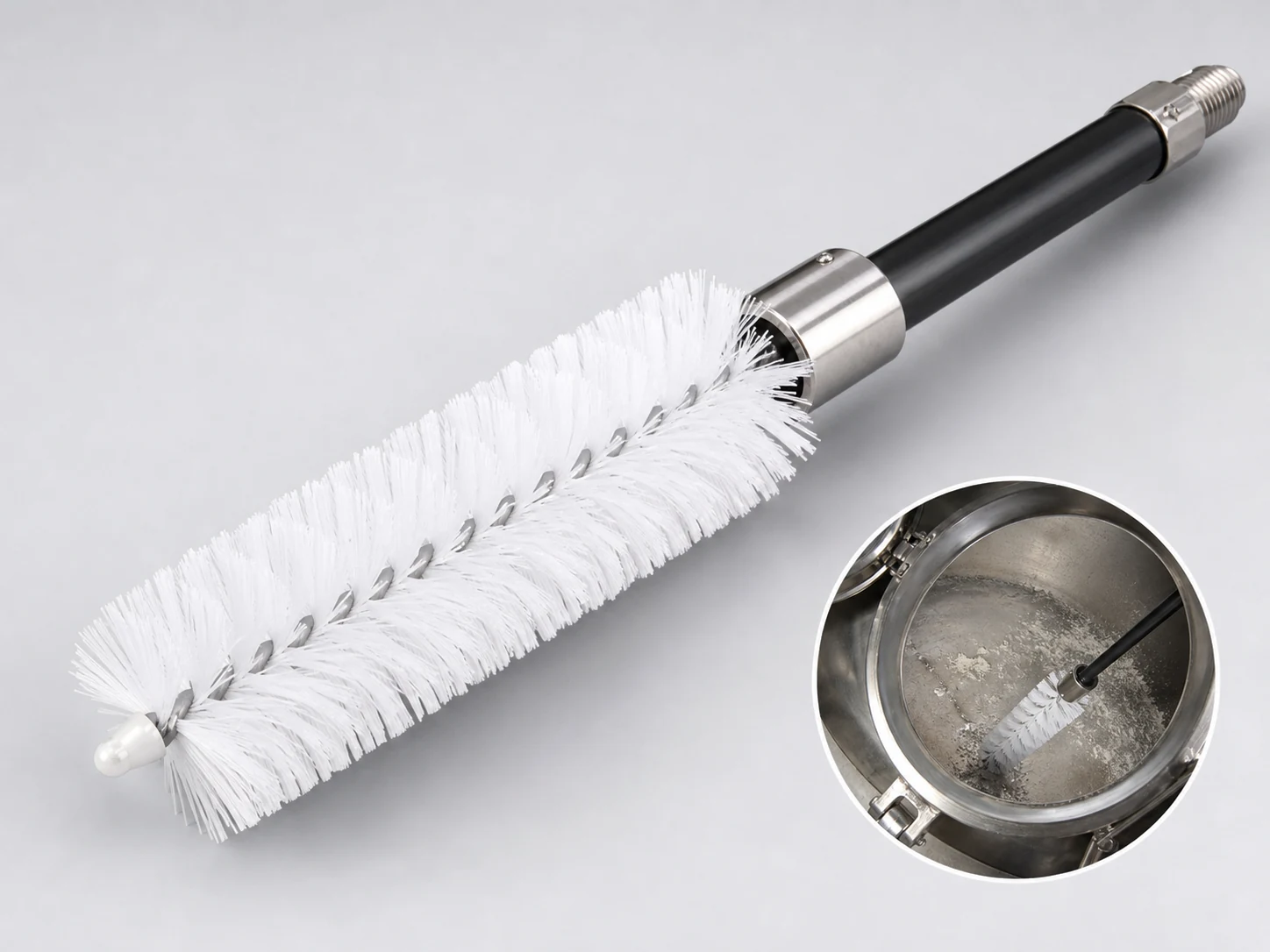
A brewery tank brush is a long-handled, narrow-profile cleaning brush engineered for the interior surfaces of brewing and beverage tanks. Typical features include a twisted stainless steel or plastic core that retains bristles, a handle long enough to reach through corny keg necks or manway ports, and non-abrasive bristles (often nylon, PBT, or polypropylene) that resist common cleaning chemicals and won’t scratch 304 or 316 stainless steel. The bristle pattern is dense enough to scrub krausen, yeast, biofilm, and coffee oils but gentle enough to preserve passivated surfaces.
Common Types of Brewery Tank Brushes vs Standard Brushes
For food-manufacturing equipment and wet food zones, eCFR — 21 CFR Part 117 Human Food CGMP and Preventive Controls is the production-side CGMP and preventive-controls reference.
When the article mentions sanitizing food-contact articles, eCFR — 21 CFR 178.1010 Sanitizing Solutions provides the regulatory context for sanitizing solutions.
For kitchen cleaning examples, the FDA — Food Safety in Your Kitchen supports the distinction between normal cleaning, food handling, and hygiene habits.
For general foodborne-illness prevention language, the CDC — Preventing Food Poisoning is used as the public-health reference.
For the material or regulatory boundary in this section, the supporting reference is eCFR — 21 CFR 177.1500 Nylon Resins.
For the material or regulatory boundary in this section, the supporting reference is eCFR — 21 CFR 177.1520 Olefin Polymers.
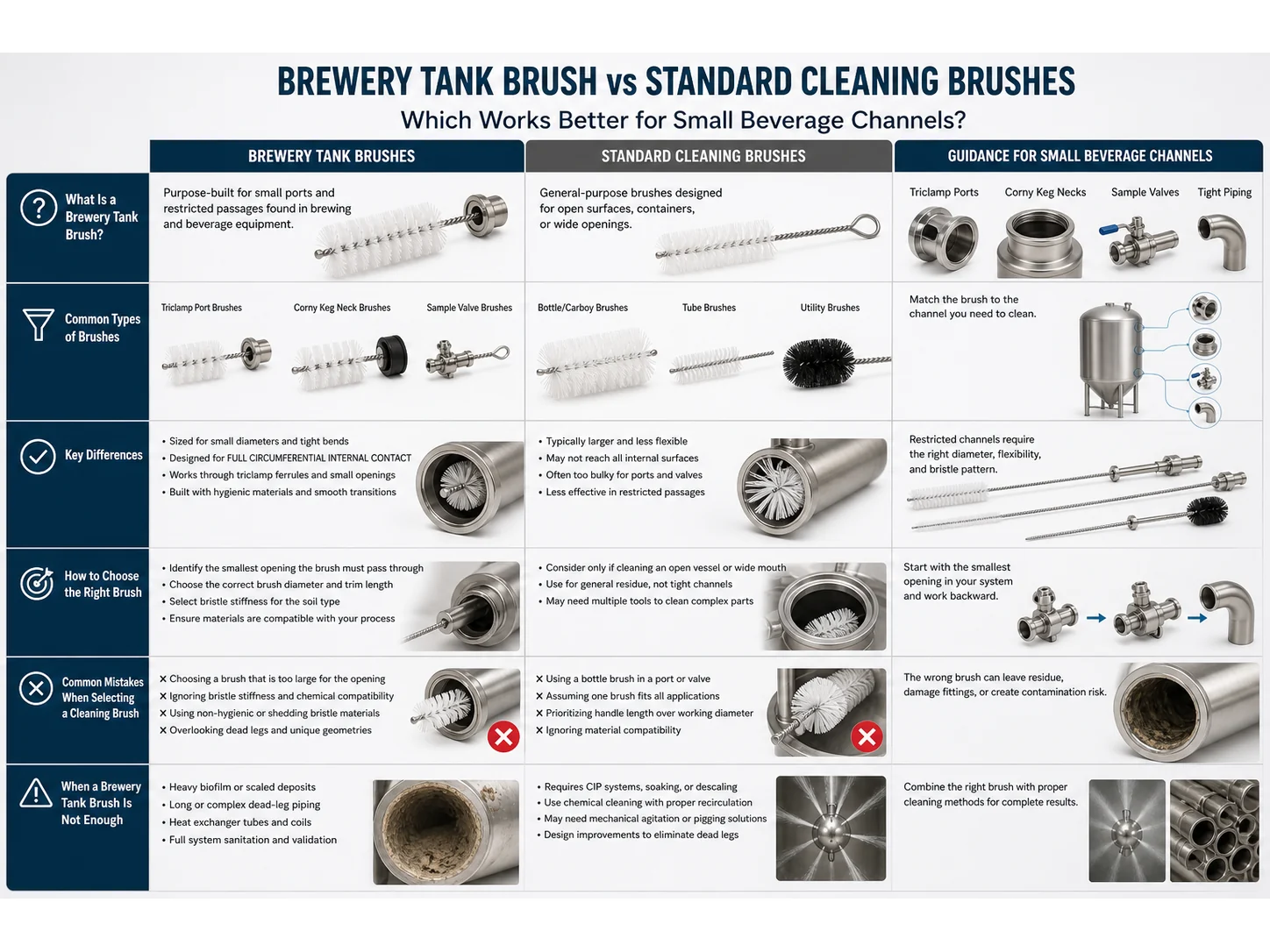
Understanding the available options helps narrow the choice. Brewery tank brushes fall into a few practical categories, while standard brushes cover a much wider range.
- Brewery tank brush (dedicated): Long, straight brush with a uniform diameter, often 1″ to 4″, designed for kegs, bright tanks, fermenters, and brite tanks. Bristles are chemical-resistant and food-safe.
- Standard bottle brush: Generic shape with a plastic-coated wire core and softer bristles. Often too flexible and short for deep tank penetration; may leave scratches if wire core is exposed.
- Tubing brush / small diameter wire brush: Stiff wire bristles for aggressive scrubbing. Effective on carbon or mineral deposits but too abrasive for stainless beverage surfaces.
- Utility scrub brush: Handheld with wide head. Cannot enter channels; only useful for open surfaces.
- Silicone bottle brush: Non-scratching but may not have the stiffness to remove dried krausen or hardened coffee residue.
Brewery Tank Brush vs Standard Brush: Key Differences
| Feature | Brewery Tank Brush | Standard Brush (bottle/tube/utility) |
|---|---|---|
| Bristle material | FDA‑compliant nylon, PBT, or polypropylene | Polyester, natural fiber, wire, silicone, or low‑grade nylon |
| Handle length | Often 18″–48″ to reach through long necks | Typically 6″–18″; too short for tank depth |
| Core type | Galvanized or stainless twisted wire, or sealed plastic core | Exposed steel wire (may scratch), plastic, or hollow tube |
| Diameter options | 1″ to 4″+, often with exact sizing for keg necks or manways | ¼” to 3″; not optimized for specific tank ports |
| Chemical resistance | Built for caustic, acid, and sanitizer solutions | May degrade in strong CIP chemicals |
| Hygiene focus | Smooth, sealed construction to avoid harboring bacteria | Often has crevices where residue can hide |
| Typical applications | Kegs, fermenters, brite tanks, manway ports, sample valves | General cleaning, household uses, non‑food equipment |
How to Choose the Right Brush for Small Beverage Channels
Small beverage channels include racking arms, blow‑off tubes, corny keg dip tubes, sight glass ports, and valve bodies. Match the brush to the job by considering these factors:
- Residue type: Sticky krausen, dried yeast, and cold break require medium-firm bristles that won’t mat down. Loose soils or dust may only need a soft brush.
- Surface sensitivity: Stainless steel tanks demand non‑metallic, non‑abrasive bristles. A standard wire brush will cause micro‑scratches that lead to pitting corrosion.
- Channel diameter and interior profile: Measure the smallest port or tube. A brush that is too wide won’t fit; one that is too narrow won’t apply enough scrubbing force. Custom diameters (e.g., 1.5″ for a corny keg neck) are often available for brewery tank brushes.
- Wet or chemical exposure: Brushes used inside a closed tank during CIP must withstand hot caustic, phosphoric/nitric acids, and PAA sanitizers. Check for chemical resistance specifications on bristle and core materials.
- Hygiene expectations: Look for a sealed, smooth construction with no exposed wire ends or sharp edges that can trap bacteria.
- Maintenance frequency: For daily use, select a brush with a robust core that won’t bend or break. Standard household bottle brushes often kink after a few uses in tight bends.
- Custom size requirements: If standard diameters or lengths don’t match your unique port, a custom brewery tank brush may be the usually safer option. Avoid forcing an ill‑fitting standard brush.
Common Mistakes When Selecting a Cleaning Brush
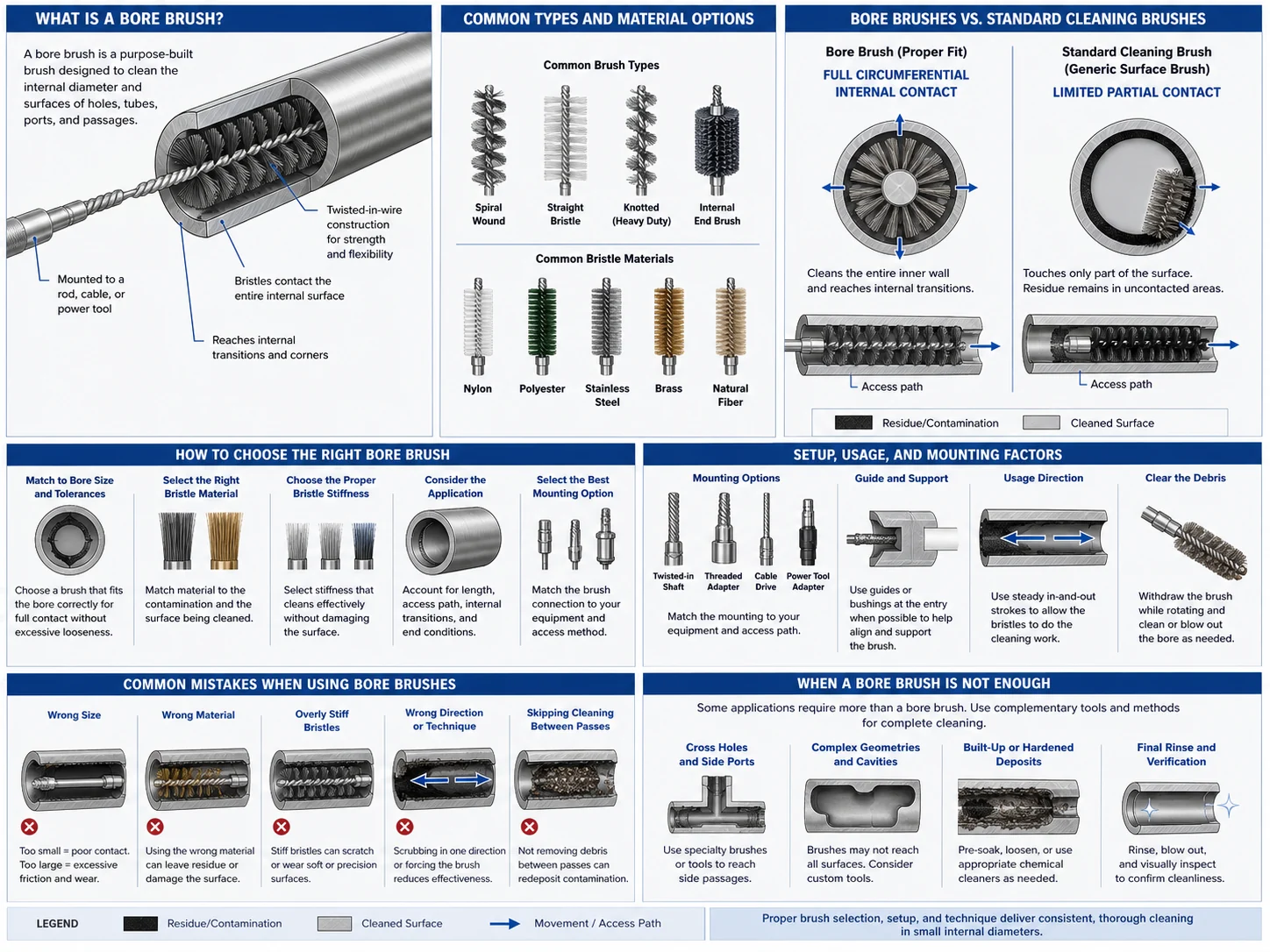
- Using a stainless steel wire brush on stainless tanks: “Stainless on stainless” contact causes galling and leaves microscopic gouges where bacteria can colonize.
- Choosing a brush by diameter alone: A brush that fits the port may still be too short to reach the soil zone or too stiff to navigate a bend without scratching.
- Ignoring chemical compatibility: Some nylon compounds lose stiffness or dissolve in strong alkaline cleaners. Always verify with the brush supplier.
- Assuming a silicone brush cleans as well as a bristle brush: Silicone is gentle but often fails to remove thick, dried-on organic films.
- Not checking the core for exposed wire: Even a “stainless” core can have sharp cut ends that scratch tank walls.
- Relying on a single brush for all tasks: A brewery tank brush is not a pipe brush; internal threads and thin tubing may require a different tool entirely.
When a Brewery Tank Brush Is Not Enough
A brewery tank brush excels at manual spot cleaning and port maintenance, but it has limits:
- Extremely narrow or coiled tubing: Small-diameter, coiled, or kinked transfer lines often need a flexible pull‑through brush or automated clean‑in‑place (CIP) jetting instead of a rigid brush.
- Heavy mineral scale or beer stone: Calcified deposits require acid circulation and sometimes mechanical rotary cleaners, not just hand brushing.
- Critical aseptic zones: Sterile filling valves or membrane ports demand CIP/SIP (sterilize‑in‑place) with no manual brushing.
- Deep, complex tank internals: Spray balls, racking arms, and baffles may obstruct a straight brush, making a custom‑angled or rotary brush necessary.
- When a validated cleaning process must be documented: Manual brushing is hard to validate consistently; automated systems provide repeatable flow, pressure, and chemical contact.
If your cleaning task falls outside these boundaries, consult a brush supplier or cleaning specialist about a custom drawing review or sample test with alternative brush geometries.
Final Takeaway
For small beverage channels inside stainless steel tanks, a dedicated brewery tank brush almost always outperforms a standard cleaning brush in safety, reach, and chemical resistance. The right choice depends on matching the brush’s diameter, bristle stiffness, and handle length to your specific port dimensions, residue type, and hygiene standard. Standard brushes can handle general open‑surface cleaning and some tube work, but they rarely provide the combination of non‑abrasive scrubbing and sealed hygiene that beverage operations require. When in doubt, measure your channels, review chemical compatibility, and opt for a brush purpose‑built for brewery tanks.
Frequently Asked Questions
Can I use a standard bottle brush to clean a corny keg neck?
A standard bottle brush might fit, but the plastic‑coated wire core can still scratch the stainless steel if the coating wears or the ends are sharp. A brewery tank brush with a fully sealed core is safer and usually longer, letting you reach deeper into the keg.
What bristle material is safest for stainless steel tanks?
Nylon, PBT, and polypropylene are common choices. All three are non‑abrasive on 304 and 316 stainless and resist most brew‑house chemicals. Avoid any brush with metal wire bristles.
How often should I replace a brewery tank brush?
Inspect the brush after every use. Replace it immediately if bristles become matted, the core bends, or any metal becomes exposed. In a busy brewery, a high‑quality brush may last several months with proper rinsing and storage.
Is a twisted wire core safe for tank interiors?
Only if the wire is completely sealed or the brush is designed so the core never contacts the tank wall. Exposed twisted wire ends are a common source of scratches. Choose brushes with a protected tip and a smooth, covered core.
Can a brewery tank brush clean small tubing bends?
Straight brushes work poorly in sharp bends. For curved channels, you need a flexible pull‑through brush or a specialty bent‑handle brush. Using a rigid straight brush may scratch the tube wall at the bend.
What size brewery tank brush fits a standard 2-inch tri‑clamp port?
Look for a brush head diameter slightly under 2 inches—typically around 1.75″ to 1.9″—to allow easy passage without jamming. Many suppliers offer brushes sized specifically for common triclamp diameters.
Do I need different brushes for cleaning fermenters and bright tanks?
Not necessarily if the port sizes and residues are similar, but bright tanks often have smoother surfaces and lighter soil loads, so a softer bristle may suffice. A medium‑firm brush that works for both is common; consider color‑coding brushes by use zone to prevent cross‑contamination.
Can a silicone brush replace a bristle brush for heavy krausen?
Silicone brushes are non‑scratching and easy to sanitize, but they lack the scrubbing power to remove thick, dried‑on krausen. For heavy soils, a nylon or PBT bristle brush gives better mechanical cleaning action.