
What Is a Boiler Tube Brush?
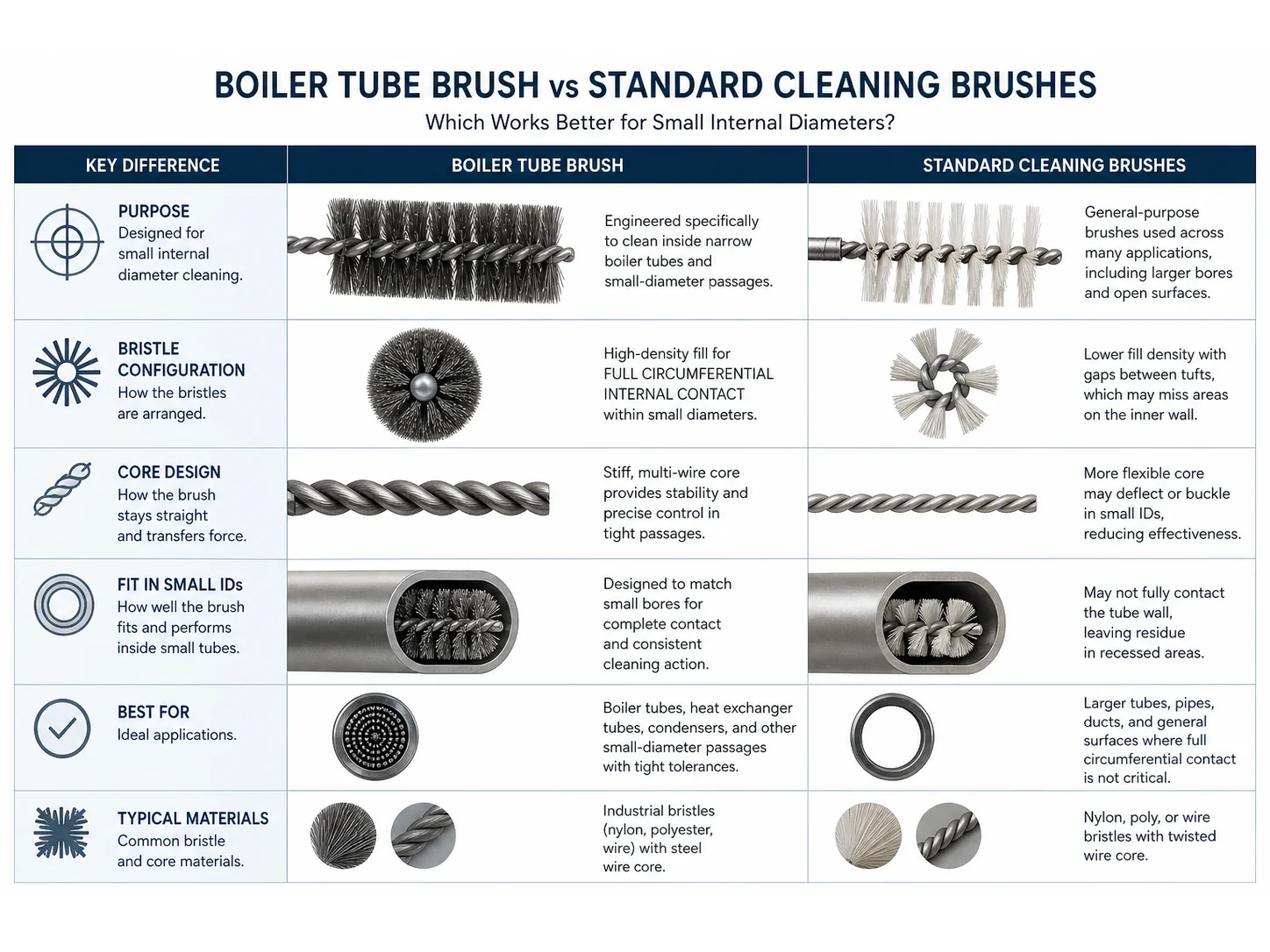
A boiler tube brush is a flexible cleaning tool with a twisted-wire core, densely packed bristles, and a design that conforms to the round shape of tubes. It is built to scrub the inner walls of narrow channels where combustion byproducts, mineral scale, or process fouling accumulate. Unlike general-purpose brushes, a boiler tube brush is engineered for heat exchanger, condenser, and boiler tube maintenance.
For boilers, chillers, cooling towers, condenser systems, heat-exchanger maintenance, and O&M practices, this article cites U.S. Department of Energy FEMP — Operations & Maintenance Best Practices: A Guide to Achieving Operational Efficiency, Release 3.0; boiler, chiller, cooling tower, and heat-exchanger maintenance chapters.
Because small-ID tubes (often ¼” to 2″ in diameter) require both thorough cleaning and protection against scoring, boiler tube brushes are offered in multiple bristle materials, stiffness levels, and mounting options to balance aggressiveness with surface safety.
Standard Cleaning Brushes for Small Internal Diameters
Standard cleaning brushes that are occasionally repurposed for tube cleaning include bottle brushes, test tube brushes, pipe brushes with plastic handles, and general wire-bristle brushes. These brushes are commonly used in laboratory glassware cleaning, small appliance maintenance, or light-duty workshop tasks.
While they can clean open-access bores, they often lack the consistent OD-to-ID fit, core flexibility, and chemical resistance needed for industrial boiler tube applications. Using a standard brush in a hard-to-reach tube can result in uneven cleaning, bristle shedding, or premature breakage.
Boiler Tube Brush vs Standard Brushes: Key Differences
| Factor | Boiler Tube Brush | Standard Cleaning Brush |
|---|---|---|
| Core material | Double-stem twisted wire (galvanized steel or stainless steel) | Single wire, plastic, or wooden handle |
| Bristle fill | High-density, spiral-wound fill for full 360° contact | Lower density, often uneven or glued-set bristles |
| Flexibility | Engineered to navigate bends and U-tubes without kinking | Limited flexibility; may permanently bend or snap |
| Diameter accuracy | Available in exact OD increments matched to tube ID | Approximate sizing; often one-size-fits-many |
| Mounting / drive | Accepts extension rods, flexible shafts, power drill adapters, or air motors | Typically requires hand-holding; limited adapter compatibility |
| Chemical resistance | Bristle options like nylon, polypropylene, brass, or stainless steel for wet/acid/alkaline exposure | Often one material; may degrade rapidly with chemical cleaners |
| Typical applications | Boilers, heat exchangers, condensers, refrigeration chillers | Glassware, sample ports, small pipes, light debris removal |
How to Choose the Right Brush for Small IDs
The correct brush depends on five practical factors:
- Residue type: Soot and carbon call for brass or stainless steel bristles; mineral scale may require a more aggressive wire fill. Light dust or lab powders can be handled by softer nylon or horsehair.
- Surface sensitivity: Bare steel tubes tolerate stiffer wire bristles; internally coated or finned tubes demand non-metallic brushes to prevent scratches.
- Equipment interface: If you plan to mount the brush on a drill-driven rod or flexible shaft, verify that the brush handle or stem end is compatible. Boiler tube brushes often come with threaded ends or loop handles designed for mechanical drive systems.
- Wet or chemical exposure: Acoustic cleaning or chemical flushing requires bristles that won’t absorb solvents, swell, or shed fibers. Stainless steel, brass, and resistant synthetics are preferred over natural fiber or low-grade nylon.
- Maintenance frequency: Daily or weekly cleaning cycles favor durable corrosion-resistant core wires and bristles that withstand repeated flexing. Standard brushes with glued-in bristles deteriorate rapidly under heavy use.
Common Mistakes When Selecting Tube Cleaning Brushes
- Choosing by diameter alone: A brush that fits the tube ID loosely will miss deposits; one that is too tight can jam or score the tube. Always match the brush OD to the tube ID with an interference fit of about 0.005″–0.015″ over the tube ID.
- Ignoring the tube bend radius: If the tube has U-bends, a rigid or oversized brush may not pass through. Boiler tube brushes are available with more flexible cores for curved paths.
- Using the wrong bristle material for the residue: A soft nylon brush on baked-on soot will polish the deposit rather than remove it. Conversely, an aggressive steel brush on copper or coated tubes can cause pitting.
- Skipping a sample test: Before ordering a full set, test one brush on a representative tube section. A fit that works theoretically may fail in practice due to tube ovality or internal obstructions.
- Overlooking the mounting interface: A hand-twisted loop handle can be inefficient for cleaning hundreds of tubes. Adapt or select brushes that match your power cleaning setup.
When a Boiler Tube Brush Is the Wrong Choice
A boiler tube brush removes loose and semi-adherent deposits mechanically, but it cannot replace chemical cleaning, hydroblasting, or professional tube reaming when facing:
- Hard crystalline scale thicker than 1/16″ that requires chemical descaling first.
- Severe pitting or tube wall thinning that makes aggressive brushing risky.
- Contaminants like asbestos or hazardous residues that demand licensed abatement procedures.
- Complex multi-pass exchangers with obstructions beyond the brush’s reach; visual inspection with a borescope is recommended before brushing.
If the tube has irregular internal geometry, a custom brush with a drawing review from the supplier can prevent tool breakage. When in doubt, start with a supplier-provided sample or an on-site trial before committing to a full set.
Final Takeaway
For small internal diameters in boilers and heat exchangers, a dedicated boiler tube brush almost always outperforms repurposed standard brushes. The winning factor is controlled interference fit combined with proper bristle selection and drive compatibility. Start by defining your residue, tube material, bend geometry, and cleaning frequency; then choose a brush engineered for those conditions rather than settling for a generic alternative.
Frequently Asked Questions
What bristle material is best for boiler tubes with sticky soot?
Brass or bronze bristles cut through sticky soot without sparking and are less aggressive on tube walls than hardened steel. For extremely stubborn carbon, a stainless-steel wire brush may be required but should be tested first.
Can I use a standard test tube brush for heat exchanger cleaning?
A standard test tube brush is designed for laboratory glassware, not industrial tube maintenance. It typically lacks the dense bristle fill, chemical resistance, and durable core needed for repeated heat exchanger cleaning. You may risk contaminating the tube with broken plastic or glued bristles.
How do I determine the correct brush diameter for my tubes?
Measure the tube’s actual inside diameter with calipers, not the nominal size. Select a brush with an outside diameter 0.005″–0.015″ larger than the measured ID to ensure good bristle contact. For finned or rifled tubes, consult the tube manufacturer or brush supplier for recommended fit.
Is a flexible shaft always necessary with a boiler tube brush?
Not always. Straight tubes can be cleaned with a rigid extension rod, but curved or coiled tubes require a flexible shaft or a brush with a twisted-wire core that can bend through the tube without kinking. Attempting to force a rigid rod through a bend can damage the tube.
How often should I replace boiler tube brushes?
Replacement depends on bristle wear, core wire fatigue, and cleaning frequency. Inspect brushes after each use for flattened or missing bristle fill, kinked or broken core wires, and reduced OD. In high-cycle maintenance, a brush may last 50–200 cleanings before it no longer provides effective contact.
Can I use boiler tube brushes with chemical cleaners?
Yes, but select a brush with chemically compatible bristles and a stainless-steel core. Nylon and polypropylene bristles resist many alkaline and acidic solutions, while natural fiber or carbon steel will degrade quickly. Always rinse brushes thoroughly after chemical exposure.
What should I do if a brush gets stuck in the tube?
Never pull with excessive force; you may break the brush and leave debris inside. Rotate the brush in reverse while applying gentle withdrawal pressure. If it remains stuck, use a penetrating lubricant approved for the tube service and consider a mechanical extractor designed for broken brush removal.
Technical References
- U.S. Department of Energy — Air Conditioner Maintenance
- ASME — Y14.5 Dimensioning and Tolerancing
- OSHA — 1910.147 Control of Hazardous Energy
- American Brush Manufacturers Association — Brush Lingo
Which bristle material fits this job — AISI 304 Stainless Steel Wire, Nylon PA or Horsehair?
| Material | Continuous temperature (°C) | Peak temperature (°C) | Water absorption | Hardness |
|---|---|---|---|---|
| AISI 304 Stainless Steel Wire | 400 | 500 | 0% | Rockwell B 70–95 depending on temper and cold work |
| Nylon PA | 93 | 121 | 0.3–9% by PA grade and conditioning | Medium to firm; filament diameter and trim length control bending force. |
| Horsehair | 60–80 | 100–120 | 8–15% | — |
| AISI 316 Stainless Steel Wire | 400 | 500 | 0% | Rockwell B 70–95 depending on temper and cold work |
| Carbon Steel Wire | 200–300 | 350–450 | 0% | Rockwell C 40–60 |
Figures as published by Alleima; Brushtec / DuPont. Confirm the exact grade against the supplier datasheet before ordering.
What should replace Tube & Pipe Bore Brushes for boiler tube brush?
- Tube & Pipe Bore Brushes — Tube and bore brushes work by radial contact inside a confined diameter; wire wheels and cups work mainly on external edges, profiles, welds, and broad surfaces.
- AISI 304 Stainless Steel Wire — Use AISI 316 stainless steel wire for chloride, marine, dairy, beverage, chemical washdown, or higher pitting-resistance requirements. Use carbon steel for dry aggressive cutting and brass or abrasive nylon for lower marking risk.
- Nylon PA — Compare Nylon PA with PP, PBT, PET. Change material when wet stiffness, temperature, chemical resistance, conductivity, particle shedding, or surface marking becomes the limiting factor.
- Horsehair — Compare Horsehair with Boar bristle, goat hair, microfiber. Change material when wet stiffness, temperature, chemical resistance, conductivity, particle shedding, or surface marking becomes the limiting factor.