
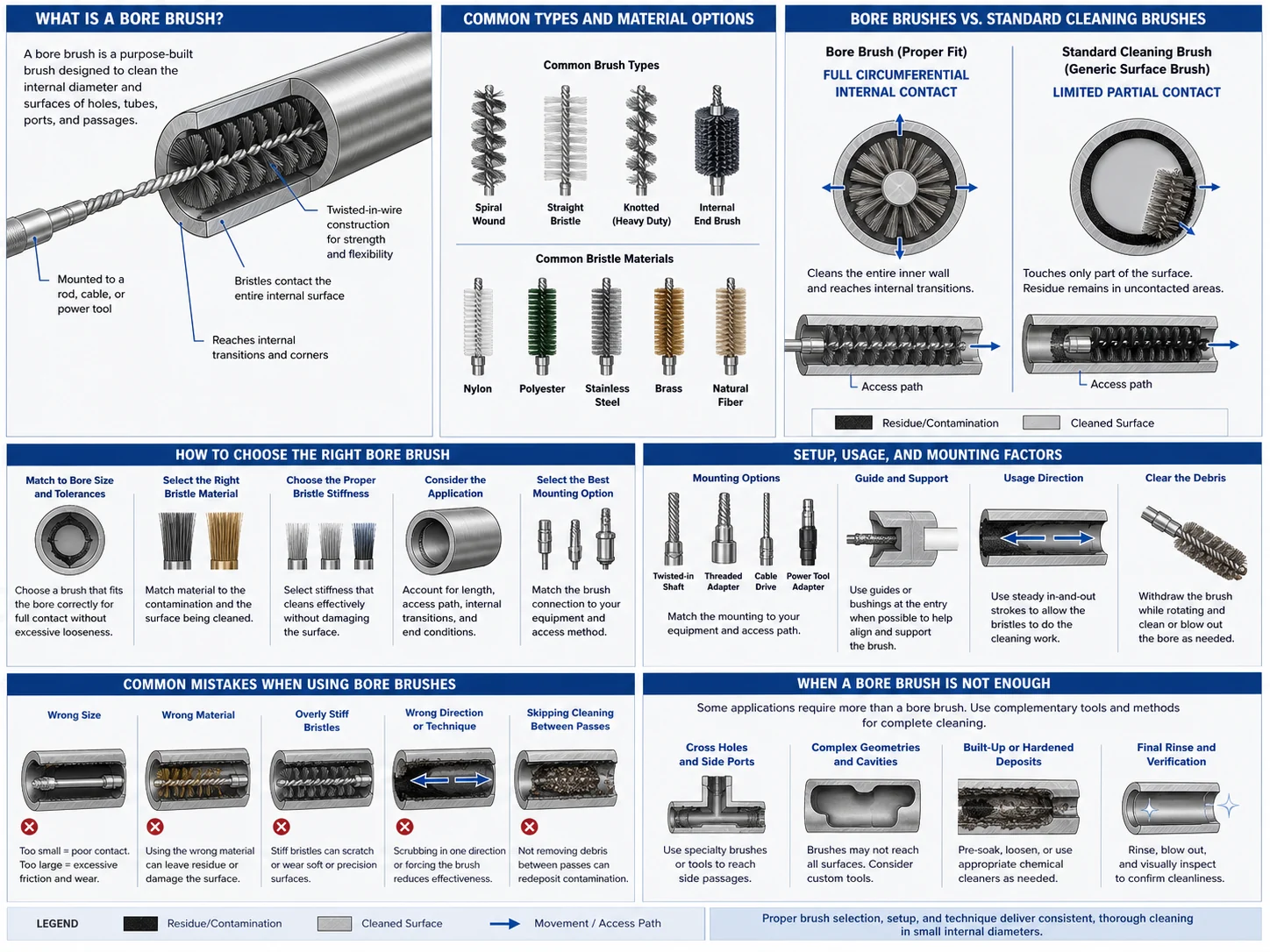
What Is a Bore Brush?
A bore brush is a cleaning tool designed specifically for internal cylindrical surfaces. It features a central core—usually twisted wire, rod, or flexible shaft—with bristles or abrasive filaments radiating outward. The design allows the brush to enter a constrained opening and apply uniform radial pressure to the bore wall, removing carbon, rust, scale, grease, or process residue. Bore brushes are commonly used in firearm maintenance, hydraulic system cleaning, heat exchanger tube care, and precision manufacturing where a standard brush would be too bulky or ineffective.
Common Types and Material Options
Bore brushes come in several constructions to match different cleaning challenges. The bristle material dictates chemical compatibility, abrasiveness, and surface safety.
- Twisted Wire Bore Brushes: Bristles are mechanically captured between the wires of the core. Very durable and aggressive. Often made in stainless steel, brass, or carbon steel wire.
- Nylon Bore Brushes: Use abrasive-impregnated nylon filaments. Less aggressive than wire, safe for softer metals, and resistant to many chemicals. Common in precision cleaning where scratching is a concern.
- Brass/Bronze Bore Brushes: Soft metal bristles that clean effectively without sparking. Good for removing carbon deposits without damaging steel or aluminum bores. Bronze offers slightly better corrosion resistance.
- Stainless Steel Bore Brushes: Provide the highest scrubbing power and durability. Ideal for tough deposits in hard metals, but risk scratching softer substrates. Used in stainless steel tubes and high-temperature applications.
- Flexible Bore Brushes: Have a flexible core (e.g., coiled wire or plastic) to navigate bends or curved passages. Often used with power tools or manual handles.
Bore Brushes vs. Standard Cleaning Brushes
Standard cleaning brushes—bottle brushes, pipe cleaners, tube brushes—work well for general tasks but often fall short in small internal diameters. The table below highlights the key practical differences.
| Factor | Bore Brush | Standard Cleaning Brush |
|---|---|---|
| Diameter Range | Optimized for sub‑1″ down to a few millimeters | Often 1″ and above; fewer precise small sizes |
| Core Construction | Tightly twisted wire or thin rod for stiffness | Thicker handles or loosely twisted wire; can be too bulky |
| Bristle Fill Density | High density for complete 360° contact | Often sparse; may leave streaks |
| Abrasion Control | Material-specific (brass, nylon, steel) matched to surface | Limited material options; often generic nylon |
| Accessibility | Designed for deep, narrow, and blind holes | Better for open cavities or wide necks |
| Attachment / Tool Interface | Often threaded tip or straight shank for drill or rod | Usually manual handle; rarely machine‑mountable |
| Residue Compatibility | Handles carbon, scale, dried grease, light rust | Better suited for loose dust, mild liquid residue |
| Typical Cost per Cleaning Cycle | Moderate; reusable many times with proper care | Lower unit cost but shorter lifetime in abrasive use |
How to Choose the Right Bore Brush
Selecting a bore brush involves more than matching the diameter. Use the following decision factors to narrow down the options.
- Residue Type: Carbon or burnt-on deposits? Choose brass or stainless steel. Gummy grease? Solvent-resistant nylon. Light dust or polishing? Soft bristle nylon.
- Surface Sensitivity: For aluminum, copper, or soft alloys, avoid stainless steel. Bronze or brass are safer. For hardened steel or stainless steel bores, stainless steel wire is acceptable.
- Bore Diameter and Tolerance: Measure the exact ID. The brush should be 0.005″ to 0.010″ larger than the bore for interference fit. Too tight jams; too loose won’t clean.
- Wet or Chemical Exposure: If acids, alkaline cleaners, or solvents are used, verify bristle material resistance. Nylon holds up well; natural fiber does not. Stainless steel resists most chemicals.
- Equipment Interface: Will the brush be used by hand, mounted in a drill, or attached to a rotating rod? Look for a shank or tip style that fits your equipment (hex, round, threaded).
- Hygiene Requirements: In food, pharma, or medical applications, choose FDA-compliant materials and easy-to-sanitize designs. Nylon with a stainless steel core is common.
- Maintenance Frequency: For high-volume cleaning, durability matters. Twisted‑in‑wire stainless steel lasts longer than nylon under aggressive use.
- Custom Size Needs: If off‑the‑shelf diameters don’t exist, consider custom bore brushes built to your exact ID, length, and bristle configuration.
Setup, Usage, and Mounting Factors
How a bore brush is mounted and used directly affects cleaning quality and tool life.
- Hand Use: For occasional manual cleaning, a simple loop handle or enlarged shank works. Slow but controlled.
- Drill or Power Tool: Many bore brushes terminate in a 1/4″ hex or round shank for cordless drills. Match RPM to bristle material—excessive speed can melt nylon or break wire bristles.
- Rod Mounting: In long tubes (boilers, heat exchangers), the brush is attached to a sectional rod and pushed through. The core must be strong enough to resist buckling.
- Direction of Feed: Always push the brush through the bore in one direction; pulling back can fold bristles and reduce contact pressure. For blind holes, use a twisting motion during extraction.
- Chemical Assist: Pre‑soaking or spraying cleaner ahead of the brush boosts performance and reduces bristle wear.
Common Mistakes When Using Bore Brushes
Avoid these frequent errors to keep your bores and brushes in good condition.
- Ignoring Bristle Hardness: Using a stainless steel brush in an aluminum bore will scuff the surface and create a rough finish that traps future debris.
- Wrong Diameter Selection: Forcing an oversized brush can break the core or wedge bristles inside the bore, requiring extraction tools.
- Running Too Fast: Drilling at high RPM generates heat that can anneal wire bristles or melt nylon tips, ruining the brush.
- Neglecting to Clean the Brush: Residue left on bristles hardens and reduces effectiveness. Rinse and dry after every use.
- Using One Brush for Dissimilar Materials: Once a brush is used on a steel bore, embedded particles may scratch a softer metal later. Dedicate brushes by material type.
- Skipping a Test Piece: Before running a new brush material or size through a critical production part, test on a scrap bore to verify fit and finish.
When a Bore Brush Is the Wrong Choice
Bore brushes handle most routine cleaning, but some conditions call for a different approach.
- Heavy Scale or Weld Spatter: A brush cannot remove thick, bonded scale. Consider mechanical boring, honing, or chemical desealing first.
- Precision Surface Finish Requirements: If the bore surface finish must be held to a tight Ra value, a standard brush may be too aggressive. Use a fine polishing brush or honing tool designed for that finish.
- Extremely Deep or Curved Passages: For lengths beyond 20–30x the diameter, bristle pressure drops off, and a flexible hone or specialized pigging system may be superior.
- Cross‑Contamination Risk: In multi‑material setups, even dedicated brushes can carry trace contamination. Critical hydraulic or fuel passages may require a no‑contact cleaning method like solvent flushing or ultrasonic cleaning.
- Regulatory or Safety Standards: Some industries mandate validated cleaning processes that cannot rely on a manual brush. Always check your compliance requirements.
Final Takeaway
For small internal diameters, a correctly selected bore brush almost always outperforms a standard cleaning brush. The key is matching bristle material and diameter to your residue, surface, and operating environment. Standard brushes remain useful for large openings or non‑critical wiping, but in a tight bore they are often the wrong tool. Start by defining your exact cleaning challenge, then use the comparison logic in this guide to pick a bore brush that will clean effectively without damaging the part.
Frequently Asked Questions
Can I use a standard nylon bottle brush for a bore under 0.5 inch?
Most bottle brushes have a core that is too thick and bristles that are too sparse to clean a 0.5″ bore thoroughly. They may fit, but will likely leave residue behind and cannot provide uniform wall contact. A dedicated small‑diameter bore brush is a better choice.
What is the safest bore brush material for aluminum or brass bores?
Bronze or nylon bore brushes are safest for soft metals. Bronze bristles are non‑sparking and less likely to scratch, while nylon (especially non‑abrasive grades) reduces the risk of surface marring.
How do I select the correct bore brush diameter?
Measure the internal diameter of the bore with a caliper. Choose a brush whose nominal diameter is 0.005″ to 0.010″ larger than the bore to ensure light interference that cleans effectively without seizing. For very tight tolerances, request a sample test from the supplier.
Can bore brushes be used with a cordless drill?
Yes, many bore brushes have a standard 1/4″ hex or round shank designed for drill chucks. Operate at low to medium speed (generally under 500–1000 RPM depending on brush material) and use a forward‑only motion. Do not run the drill in reverse while inside the bore.
How should I clean a bore brush after use?
Rinse the brush with a compatible solvent to remove loose debris, then wash with warm water and mild detergent. For wire brushes, dry thoroughly to prevent corrosion. Store bristles facing upward or in a protective tube so they don’t get bent.
Is a bronze bore brush always safer than brass?
Bronze bore brushes offer slightly better corrosion resistance and are still non‑sparking, but both bronze and brass are softer than steel and generally safe for ferrous bores. The difference is marginal for most industrial cleaning tasks unless chemical or moisture exposure is a concern.
What if my bore has a step or multiple diameters?
For stepped bores, you may need multiple brushes—one for each diameter section—or a custom brush with graduated bristle diameters. Standard single‑size bore brushes will only clean the largest continuous section they fit.
Can I reuse a bore brush for different metals?
It’s not recommended. Bristles can trap tiny abrasive particles from a previous cleaning session, which may scratch a different metal. Dedicate brushes to specific metal types, or consider disposable low‑cost options if cross‑contamination is a risk.
Technical References
Which bristle material fits this job — Nylon PA, AISI 304 Stainless Steel Wire or Carbon Steel Wire?
| Material | Continuous temperature (°C) | Peak temperature (°C) | Water absorption | Hardness |
|---|---|---|---|---|
| Nylon PA | 93 | 121 | 0.3–9% by PA grade and conditioning | Medium to firm; filament diameter and trim length control bending force. |
| AISI 304 Stainless Steel Wire | 400 | 500 | 0% | Rockwell B 70–95 depending on temper and cold work |
| Carbon Steel Wire | 200–300 | 350–450 | 0% | Rockwell C 40–60 |
Figures as published by Brushtec / DuPont; Alleima. Confirm the exact grade against the supplier datasheet before ordering.
What should replace Nylon PA when it stops working?
- Nylon PA — Compare Nylon PA with PP, PBT, PET. Change material when wet stiffness, temperature, chemical resistance, conductivity, particle shedding, or surface marking becomes the limiting factor.
- AISI 304 Stainless Steel Wire — Use AISI 316 stainless steel wire for chloride, marine, dairy, beverage, chemical washdown, or higher pitting-resistance requirements. Use carbon steel for dry aggressive cutting and brass or abrasive nylon for lower marking risk.
- Carbon Steel Wire — Compare Carbon Steel Wire with Carbon steel wire, brass wire, abrasive nylon. Change material when wet stiffness, temperature, chemical resistance, conductivity, particle shedding, or surface marking becomes the limiting factor.