What Is a Condenser Tube Brush?
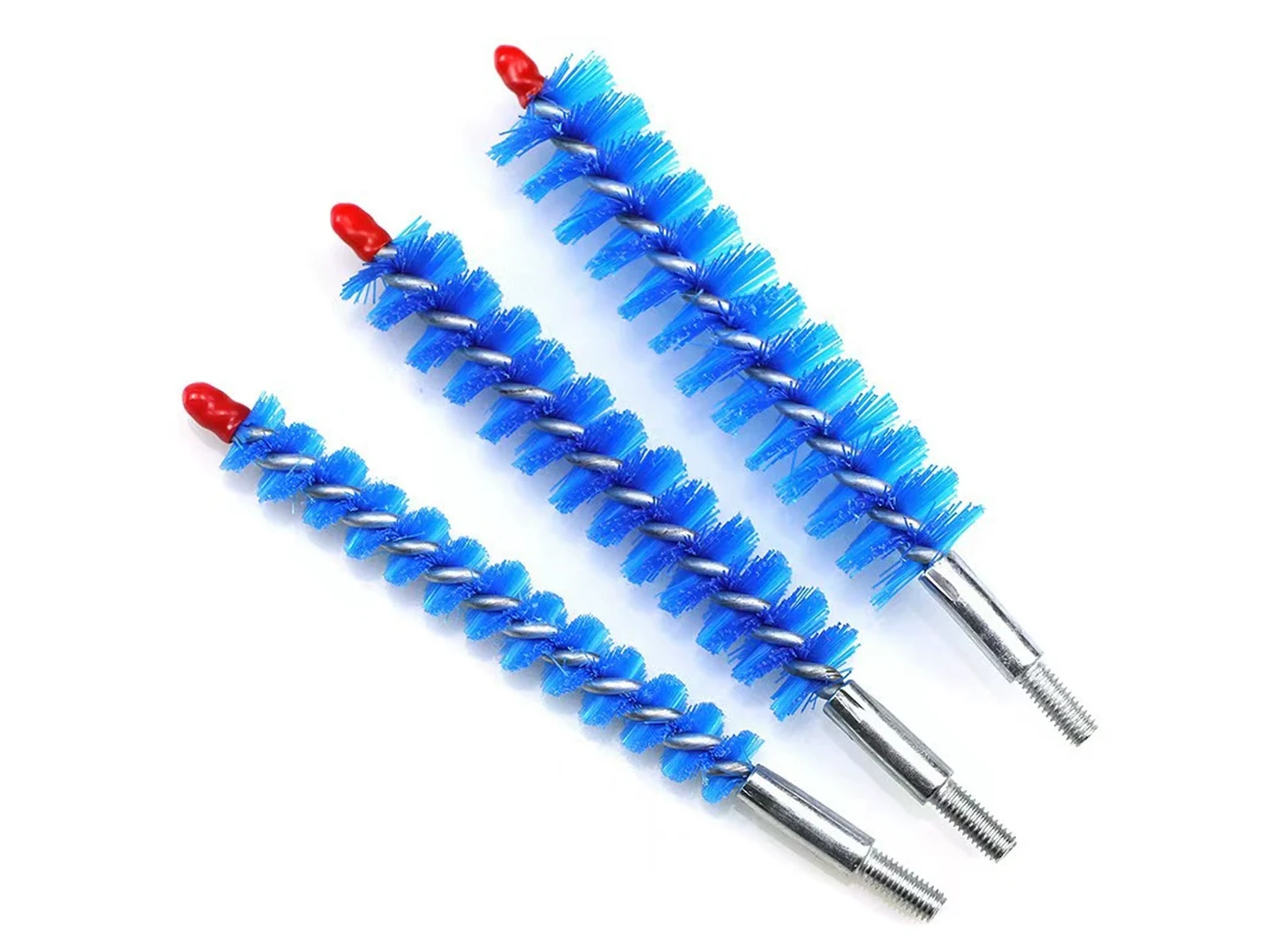
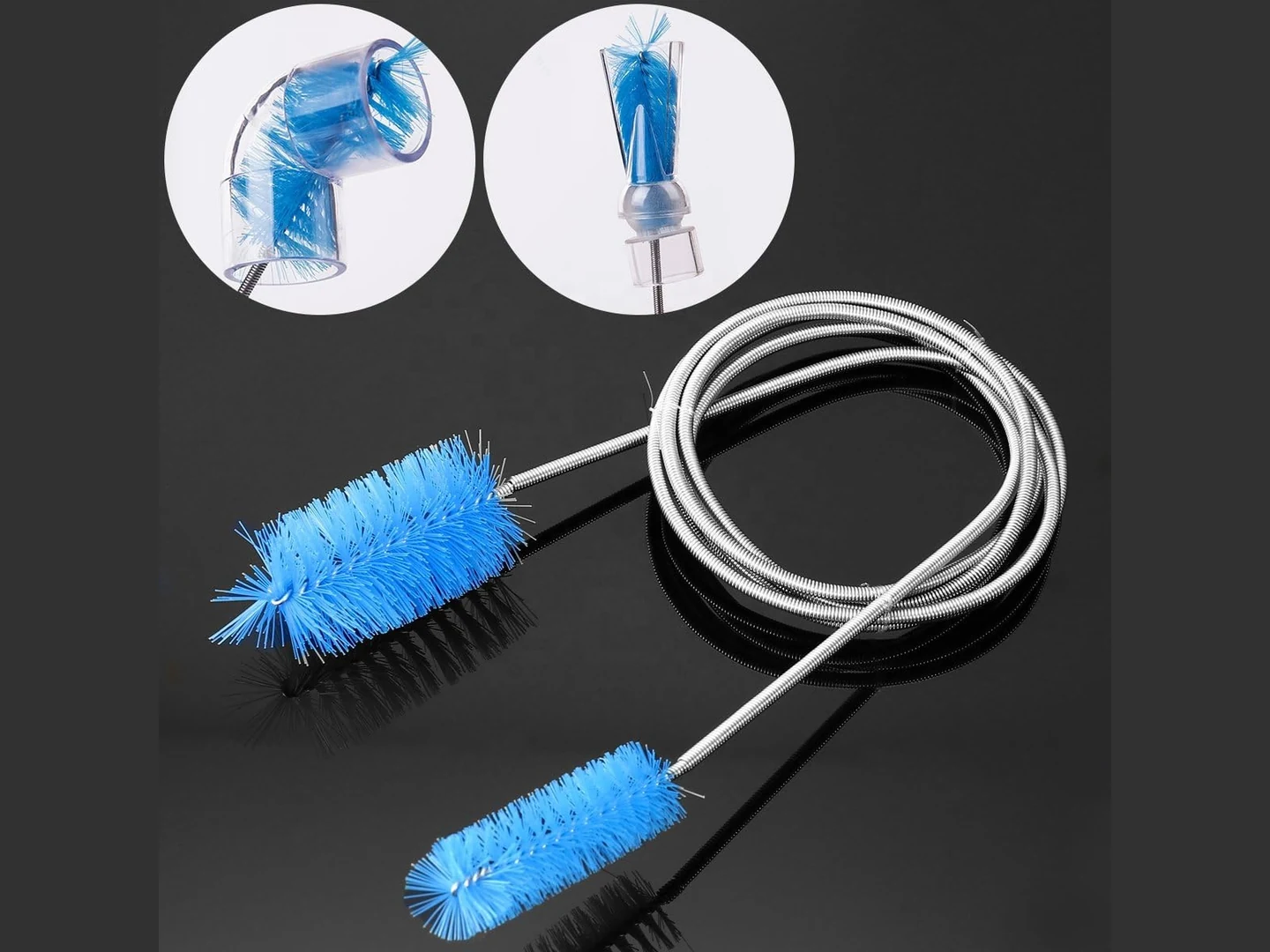
A condenser tube brush is a bristled tool pulled or pushed through the straight tubes of a shell-and-tube condenser to restore heat transfer efficiency. It scrapes away soft deposits (slime, mud) and light scale without damaging the tube wall. The right brush matches the tube material, diameter, and fouling type.
For HVAC filters, coils, fins, condenser coils, condensate drains, and AC maintenance, this article references U.S. Department of Energy — Air Conditioner Maintenance.
For boilers, chillers, cooling towers, condenser systems, heat-exchanger maintenance, and O&M practices, this article cites U.S. Department of Energy FEMP — Operations & Maintenance Best Practices: A Guide to Achieving Operational Efficiency, Release 3.0; boiler, chiller, cooling tower, and heat-exchanger maintenance chapters.
For engineering drawings, GD&T, dimensions, tolerances, model/drawing requirements, and RFQ dimension control, this article references ASME — Y14.5 Dimensioning and Tolerancing.
For lockout/tagout standard during machine servicing, this article references OSHA — 1910.147 Control of Hazardous Energy.
For brush construction terminology, filament/backing/stem terms, this article references American Brush Manufacturers Association — Brush Lingo.
Common Types of Condenser Tube Brushes
Most condenser tube brushes fall into a few practical categories. Knowing the differences helps avoid ordering a brush that is too aggressive, too soft, or the wrong fit for the tube sheet access.
| Type | Material | Best For | Limitations |
|---|---|---|---|
| Nylon bristle brush | Nylon filament, twisted wire core | Soft deposits, slime, algae, light mud; safe for copper and thin-walled tubes | Not for hard scale; can melt above ~200°F if dry |
| Polypropylene or polyester brush | Stiff plastic bristles, often double-stem | Medium fouling, wet environments, chemical cleaning lines | May scratch soft metals if bristle ends are not flagged |
| Stainless steel wire brush | SST wire bristles, typically 302 or 304 | Hard scale, rust, baked-on deposits in steel or stainless tubes | Will scratch copper, brass, cupronickel; can cut tube ends if misused |
| Spiral-wound scraper brush | Flat metal strips wound around a core | Severe scale, mud, and hardened sludge in large ID tubes | Aggressive; must be sized precisely to avoid tube wall thinning |
| Double helix / dual-spiral brush | Stiff nylon or SST wire, extended helix pattern | Deep tube cleaning, debris extraction without jamming | Requires more pull force; not for restricted access |
Material Comparison for Condenser Tube Brushes
Choosing the right bristle material is the first safety check. The table below compares common brush materials by compatibility with typical condenser tube metals and operating conditions.
| Brush Bristle Material | Tube Material OK? | Wet/Chemical Exposure | Temperature Limit | Typical Application |
|---|---|---|---|---|
| Nylon (flagged) | Copper, brass, stainless, titanium | Good; absorbs water, may soften in strong acids | ~200°F continuous | General HVAC condenser tube cleaning |
| Polypropylene | Copper, brass, stainless | Excellent; resists most chemicals | ~180°F | Wet tube brushing, inline CIP applications |
| Stainless steel (302/304) | Steel, stainless steel only | Good; avoid chloride environments | >500°F | Boiler tube cleaning, high-temp condensers |
| Brass wire | Copper, brass, stainless | Poor; dezincification in acidic water | ~400°F | Soft metal tubes needing firmer bristle (least common) |
| Carbon steel wire | Steel only | Poor; rusts when wet | ~450°F | Used only where rust is not a concern (dry applications) |
How to Choose the Right Condenser Tube Brush
Work through these decision steps before writing an order or request for quote.
- Identify tube material and wall thickness. Copper and thin-walled tubes demand non-metallic bristles. Stainless steel tubes can tolerate wire bristles if diameter is matched.
- Define the fouling type. Soft slime needs a flagged nylon brush; hard scale requires stainless wire or spiral scraper.
- Measure accurate tube ID. Condenser tube brushes are sized by actual inside diameter, not nominal pipe size. A mismatch of 0.5 mm can cause jamming or incomplete cleaning.
- Consider brush length and core style. Double-ended brushes with a center stem fit powered cleaning systems. Pull-through brushes with loops at both ends are common for manual cleaning.
- Match stiffness to the driving method. Machine-driven brushes can use stiffer cores; hand-pulled brushes need some flexibility to pass through tube bends or slight misalignment.
- Check chemical exposure. If acid or alkaline cleaners are used, verify brush body and bristle material compatibility.
Size and Fit: Getting the Diameter Right
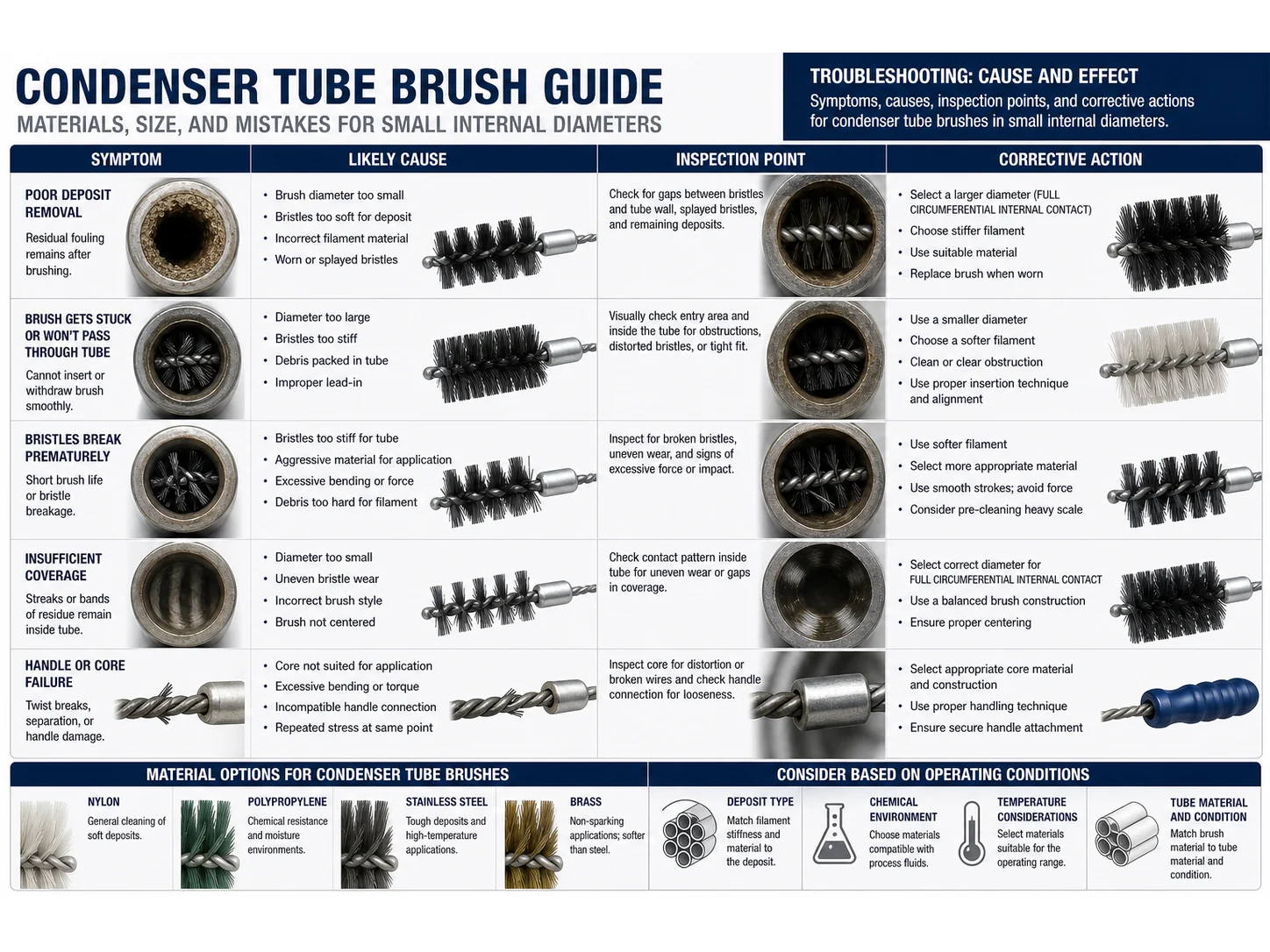
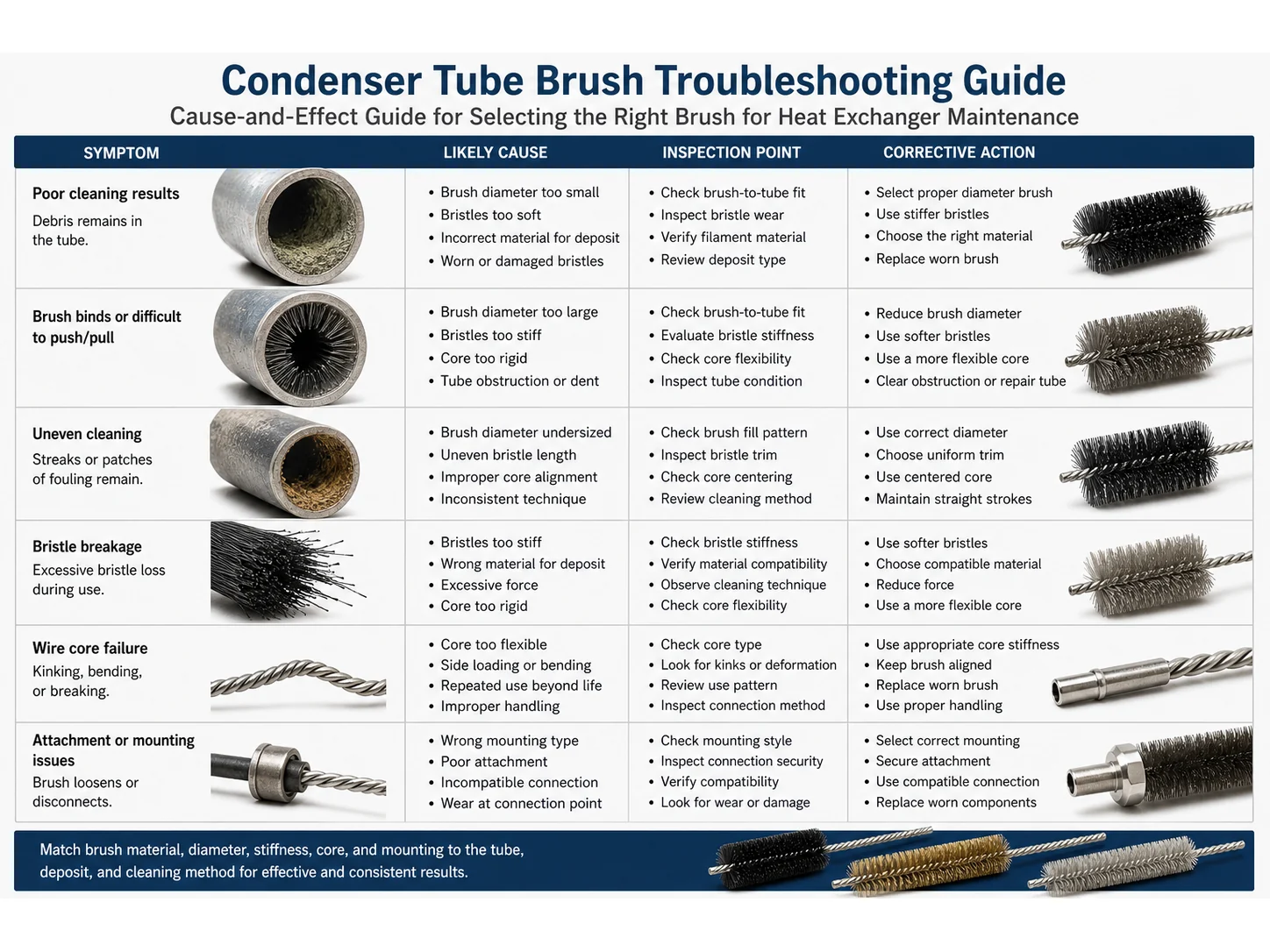
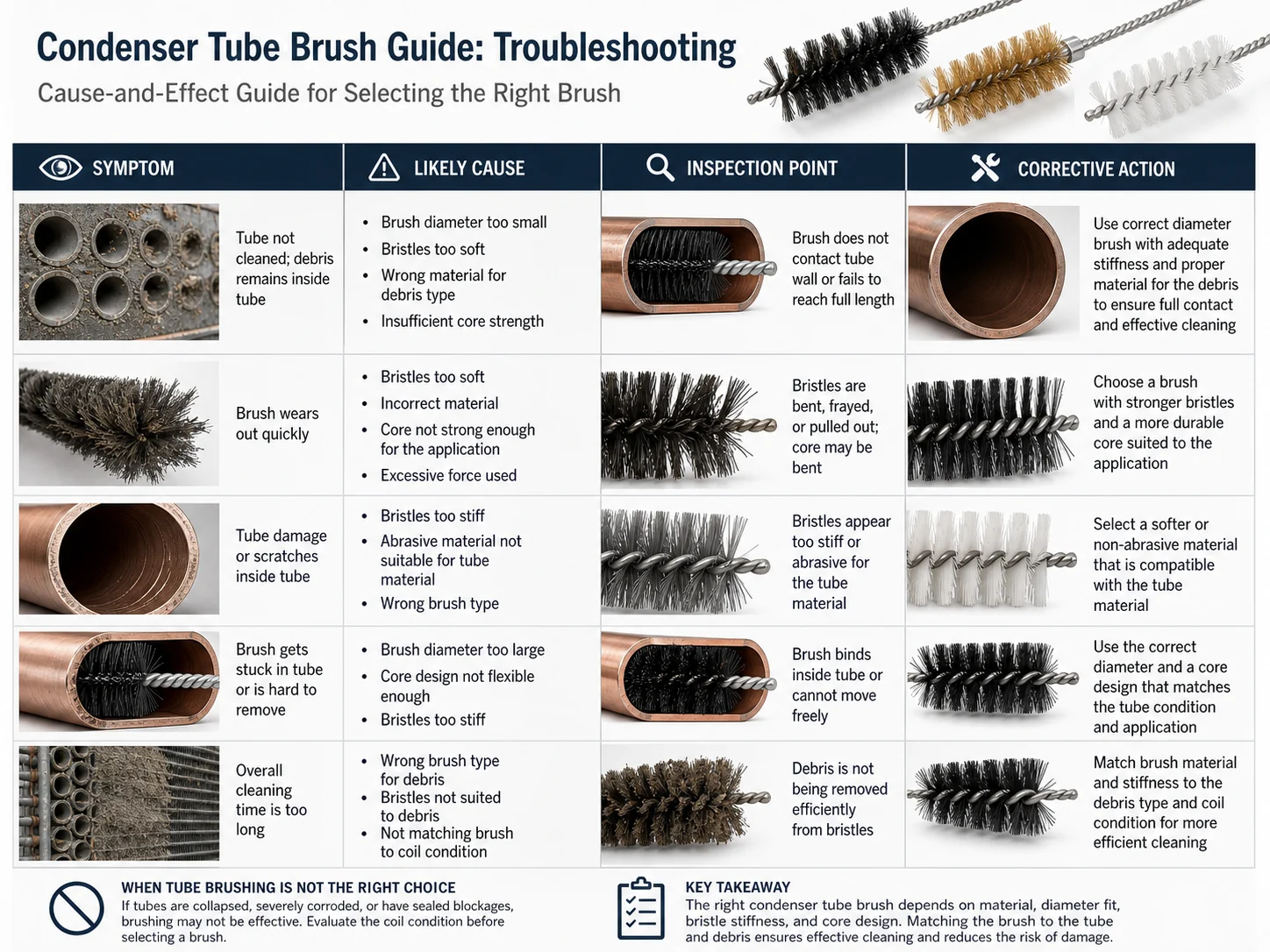
Tube brush diameter is the most critical dimension. Too small, and the brush will not make full contact with the tube wall, leaving a fouling layer. Too large, and the brush will be difficult or impossible to pull through, risking tube damage or brush breakage.
Standard practice: choose a brush diameter 1 to 3 mm (0.040–0.120 inches) larger than the tube ID for nylon or flexible bristles, because bristles deflect during use. For wire brushes, the oversize is typically 0.5 to 1 mm. Always consult a boiler tube cleaning brush size chart or manufacturer’s fit guide when available, especially for thin-wall or finned tubes.
Stiffness and Core Design: When Strength Matters
Stiffness comes from two things: bristle material and core wire diameter. A single spiral nylon brush with a light core wire works well for quick maintenance passes. A double-stem stainless steel brush with heavy core wire is needed for removing baked-on deposits in high-temp condensers. Overly stiff brushes in soft tubes can score the ID and create nucleation sites for future fouling.
Common Mistakes When Selecting a Condenser Tube Brush
- Choosing by cost drivers or diameter alone without verifying bristle material against tube metal.
- Using a stainless steel wire brush on copper or brass tubes, causing deep scratches and premature tube failure.
- Ordering a brush based on outer diameter (OD) of the tube instead of inner diameter (ID).
- Ignoring the difference between “flagged” (split tips) and straight-cut bristles; flagged tips clean more gently and are better for thin-walled tubes.
- Assuming one brush style fits all tube sheets—some condensers require a brush with a specific core end fitting for powered rotary cleaners.
- Not matching brush length to tube length, leaving the far end uncleaned or requiring two passes.
- Failing to test a sample brush on a fouled tube coupon before committing to a large order.
When a Condenser Tube Brush Is Not Enough
A condenser tube brush works well for routine mechanical cleaning, but it won’t solve every fouling problem. If the tubes have hard crystalline scale thicker than about 0.5 mm, a wire brush alone may polish the scale without removing it. In such cases, chemical descaling (acid cleaning) or hydroblasting is needed and a brush only serves as a pre-clean or post-wash tool. Similarly, if the tube ID is severely pitted or eroded, brushing can worsen existing damage. When fouling includes sticky, tar-like hydrocarbons, a mechanical brush can smear the deposit rather than clean it. A supplier drawing review and possibly a lab fouling analysis or sample test are required to confirm the right cleaning method.
Final Takeaway
Selecting a condenser tube brush begins with three questions: What is the tube material? What is the exact inner diameter? What kind of deposit needs to be removed? Match bristle and core materials to the tube and fouling type before considering cost drivers or delivery. Always verify fit with a sample test when possible. Avoid the temptation to use an aggressive wire brush where a flagged nylon brush is sufficient. Correct brush selection lowers cleaning labor, reduces tube damage risk, and extends the time between full chemical cleans.
Frequently Asked Questions
Can I use the same condenser tube brush on copper and stainless steel tubes?
Not directly. A nylon brush works on both, but a stainless steel wire brush will damage copper tubes. If you service multiple tube materials, keep separate brush sets and clearly label them.
How do I measure my condenser tubes to get the right brush size?
Use a calibrated inside micrometer or a snap gauge to measure the actual tube ID at both ends and in the middle if accessible. Do not rely on the original equipment specification sheet because fouling or corrosion can change the effective diameter.
What does “flagged bristle” mean and why does it matter?
Flagged bristle tips are split or frayed. They provide more gentle, even contact with the tube wall and are better at capturing soft deposits. Straight-cut, unflagged bristles are stiffer and more aggressive; they are typically used on harder scales or non-sensitive tubes.
How often should condenser tubes be brushed?
Frequency depends on water quality, cooling tower maintenance, and chiller load. Many facilities perform tube brushing annually during seasonal shutdowns. Sites with poor water quality or biofouling issues may brush every 3–6 months to maintain design approach temperatures.
Can a condenser tube brush be used with a drill or powered cleaner?
Yes, many brushes have a threaded end or square drive to fit mechanical cleaners. However, verify that the brush core can handle the torque and that the bristle material is safe for the tube material at higher rotational speeds.
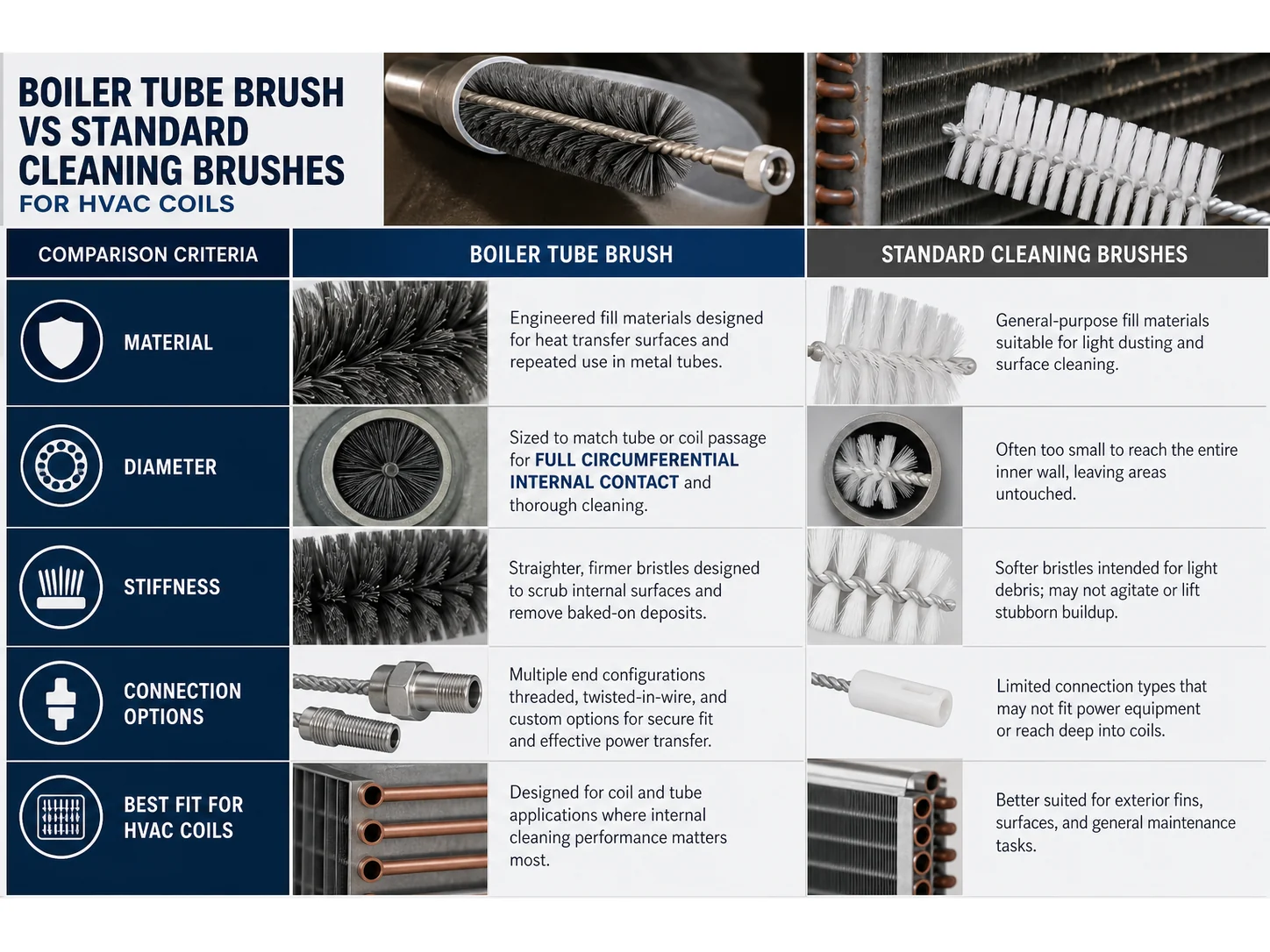
What is the difference between a condenser tube brush and a boiler tube brush?
Boiler tube brushes are usually stiffer and often made with steel wire or heavy spiral construction because boiler tubes face harder scale and higher temperatures. Condenser tube brushes are generally softer because the tubes are thinner and the deposits are usually organic or light mineral scale. Always confirm compatibility before using a boiler brush on condenser tubes.
If my brush keeps getting stuck, is the size wrong?
Possibly. Brushes that jam frequently may be oversized, worn unevenly, or encountering tube deformation. Try a brush with the next smaller oversize or a more flexible core. Also check for burrs or damage at the tube sheet roll that can snag bristles.