
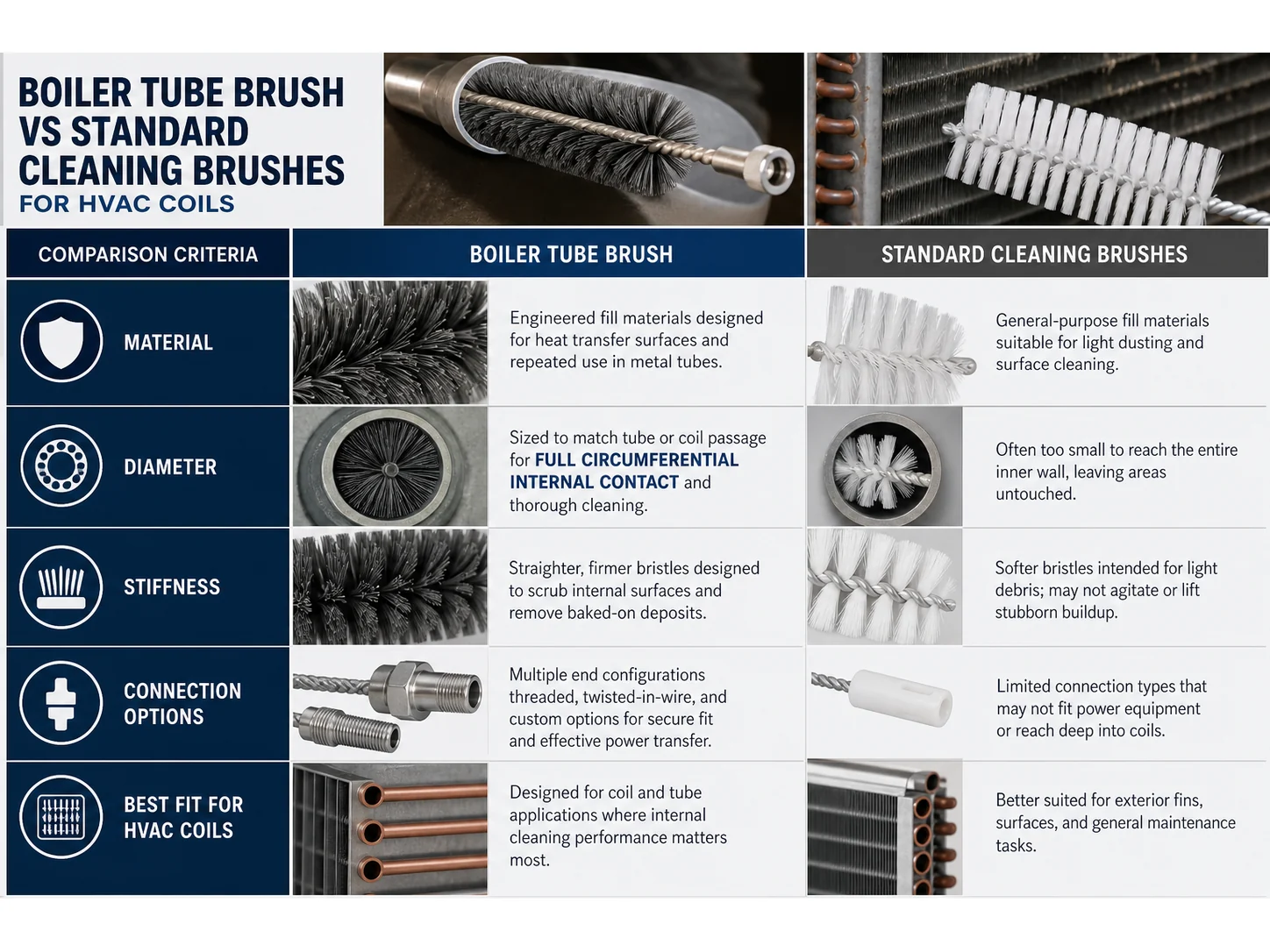
What Is a Boiler Tube Brush?
A boiler tube brush is a long, narrow cleaning brush originally developed to remove soot, scale, and deposits from boiler firetubes and watertubes. The brush head is typically constructed around a central twisted-in-wire core or a solid plastic core, with fill material bristles radiating outward to scrub the entire inner diameter of a tube. In HVAC coil applications, the same working principle applies: the brush is pushed or pulled through coil tubes to dislodge dirt, biofilm, and light mineral scale while protecting the tube walls from abrasion.
For boilers, chillers, cooling towers, condenser systems, heat-exchanger maintenance, and O&M practices, this article cites U.S. Department of Energy FEMP — Operations & Maintenance Best Practices: A Guide to Achieving Operational Efficiency, Release 3.0; boiler, chiller, cooling tower, and heat-exchanger maintenance chapters.
Standard cleaning brushes, by contrast, are general-purpose brushes that might be flat, square, or handheld, designed for open surfaces or wide cavities. They often lack the specific diameter tolerance, stiffness balance, and chemical compatibility needed for repetitive tube cleaning in finned coil packs.
The Real Cleaning Problem Behind HVAC Coils
Heat exchanger coils in air conditioning and refrigeration systems consist of rows of small-diameter tubes (often 1/4″ to 5/8″ ID) with thin aluminum fins pressed onto the outside. Contaminants enter the water or glycol loop over time and form deposits inside the tubes. Even a thin layer of scale or biofilm can significantly reduce heat transfer efficiency, raise energy costs, and shorten equipment life. Cleaning these tubes requires tools that can navigate tight bends, reach the full tube length, and scrub the inner wall uniformly without scratching or flaring the tube ends. Standard stiff brushes or wire brushes can damage the tube surface, leave bristle fragments behind, or simply not fit into tight tube arrays.
Boiler Tube Brush vs Standard Cleaning Brushes: Key Differences
| Feature | Boiler Tube Brush | Standard Cleaning Brush |
|---|---|---|
| Typical diameter range | Precision sizes (e.g., 1/4″ to 2″) to match tube ID | Often limited to common sizes; may not fit tight tubes |
| Brush head shape | Cylindrical, spiral, or twisted-in-wire for full 360° contact | Flat, cup, or wheel shape; partial contact in tubes |
| Core flexibility | Flexible wire core or straight solid core options available | Rarely designed for long pipe travel; can kink or break |
| Fill material choices | Nylon, polypropylene, brass, stainless steel, Tampico, abrasive nylon | Limited to common grades; material may not suit chemical cleaning |
| Connection types | Threaded, loop, or quick-couple ends for extension rods or power tools | Standard handle or small shank; difficult to extend for deep tubes |
| Chemical resistance | Often built for acidic/alkaline cleaners and high-temperature washdown | May soften, swell, or shed bristles in chemical baths |
| Typical cost per brush | Higher unit cost due to precision; longer service life | Lower initial cost but frequent replacement and poor fit |
Material, Diameter, Stiffness, and Connection Options
When selecting a brush specifically for HVAC coil tube cleaning, material, diameter, stiffness, and mounting connection are the primary variables that determine success:
- Fill material: Nylon and polypropylene bristles offer good chemical resistance and gentle scrubbing action for soft deposits and biofilm. Brass and stainless steel wire fill are used for hard scale and rust, but they can scratch copper or aluminum tubes if used aggressively. Tampico fiber is ideal for polishing at moderate speeds. Always match the fill to the tube material and the type of residue.
- Diameter and oversize ratio: A boiler tube brush is typically specified 1/16″ to 1/8″ larger than the tube ID to ensure firm contact without excessive drag. Standard brushes rarely come in such fine increments.
- Stiffness and core design: Flexible wire core brushes can navigate U-bends in coil headers, while straight solid cores are better for straight tube bundles. Stiffness should be balanced: too stiff and the brush may jam; too soft and it won’t scrub effectively.
- Handle, shank, or quick-couple: For manual tube cleaning, a loop end or threaded end allows attachment to a cleaning rod. For power cleaning, a hex shank or quick-couple connector fits electric or pneumatic rotary tools. Standard brushes seldom offer these options.
How to Choose the Right Brush for Your HVAC Coil Cleaning Job
Base your selection on the specific job conditions, not just brand familiarity or cost drivers. Consider these factors in order:
- Tube internal diameter and length: Measure tube ID accurately. Determine if the tube is straight or has bends. Select a brush diameter that will provide appropriate interference fit.
- Type of residue: Soft organic fouling (algae, slime) requires medium-soft nylon bristles; hard mineral scale needs stiffer nylon with abrasive grit or brass/bronze wire; oily residues may dictate polypropylene or chemical-resistant filaments.
- Tube material sensitivity: Copper and aluminum tubes can gouge easily, so avoid steel wire unless absolutely necessary. Stainless steel tubes tolerate more aggressive brush materials.
- Equipment interface: If you will use automated tube cleaning equipment, ensure the brush end connection matches the machine chuck. For manual cleaning, choose a loop or threaded tip that fits your existing rods.
- Wet or chemical exposure: Confirm the brush core and fill materials are compatible with descaling acids, alkaline coil cleaners, or sanitizing solutions you plan to use.
- Hygiene expectations: For food processing or pharmaceutical HVAC systems, use fill materials approved for incidental food contact (e.g., FDA-compliant nylon) and ensure the brush can be sanitized.
- Maintenance frequency: High-frequency cleaning (daily or weekly) may justify a more durable, higher-cost boiler tube brush rather than replacing economy brushes frequently.
- Custom size requirements: If your coil tubes fall outside common fractional sizes, a custom-sized boiler tube brush from a specialty manufacturer may be the only reliable solution.
Common Mistakes When Selecting Tube Brushes for Coils
- Choosing by cost drivers alone: A low-cost brush that doesn’t fit properly or sheds bristles can cost more in rework, tube damage, and system downtime.
- Ignoring tube bends: Forcing a rigid straight-core brush through a U-bend can kink the core or crack the tube. Always confirm bend radius compatibility.
- Overlooking chemical compatibility: Using a natural fiber brush with strong alkaline cleaners can cause rapid bristle deterioration and contamination.
- Assuming one brush fits all tube sizes: Coil tubes can vary slightly even within one unit. Use a GO/NO-GO gauge or request a sample brush before committing to a large order.
- Neglecting operator safety: Long flexible brush shafts can whip if not supported, and wire bristles can cause puncture wounds. Proper technique and PPE are essential.
When a Boiler Tube Brush Is the Wrong Choice
Although a boiler tube brush is effective for many HVAC coil cleaning tasks, there are situations where it may not be the right tool:
- Severe hard scale or baked-on deposits: Thick calcium carbonate or silica scale may require chemical descaling, high-pressure water jetting with a tube lance, or mechanical expandable scrapers before brush cleaning.
- Very delicate finned tubes: Some high-efficiency coils have extremely thin-walled or coated inner tubes. A brush test on an offcut or sample tube is advisable, and sometimes only chemical cleaning or ultrasonic bath methods are safe.
- Tube inspection before and after: A brush alone does not verify cleanliness. Borescope inspection or eddy current testing may be required for critical process chillers.
- Custom tube profiles: Internally grooved, rifled, or microchannel tubes may require a specialized brush profile. Ask the supplier for a drawing review or a test brush before full deployment.
- Regulatory or manufacturer instructions compliance: Some heat exchangers carry manufacturer instructions warranties that specify approved cleaning methods and tools. Always check the equipment manual before using any brush that might void the warranty.
Final Takeaway
Match the brush to the tube, not the other way around. For HVAC coil tube cleaning, a properly sized boiler tube brush with the correct fill material, flexibility, and chemical compatibility will outperform a generic standard brush every time. Define your cleaning variables first—tube ID, length, bends, residue type, and chemical exposure—then select a brush that fits those conditions. When the application exceeds typical brushing, don’t hesitate to consult a brush manufacturer for a drawing review or sample test. A thoughtful selection process reduces tube damage, improves heat transfer, and extends equipment life.
Frequently Asked Questions
Can I use a standard wire brush to clean HVAC coils?
Standard wire brushes are often too stiff and imprecise for tube cleaning. They risk scratching copper or aluminum tubes, may not fit the exact diameter, and can leave metal bristles behind that cause corrosion or blockage. A boiler tube brush with appropriate wire or non-metallic fill is a safer, more effective choice.
What oversize should a boiler tube brush have for HVAC tubes?
For most soft fouling, a brush diameter 1/16″ to 1/8″ larger than the tube ID works well. For harder deposits, a slightly tighter fit can improve cleaning, but test first to avoid excessive drag or tube damage.
Can I use the same brush for wet chemical cleaning?
Yes, if the brush core and bristles are rated for the chemical solution and temperature you plan to use. Polypropylene and stainless steel cores often handle harsh chemicals better than standard carbon steel or natural fibers.
How do I clean a U-bend coil tube without damaging it?
Choose a flexible wire core boiler tube brush specifically designed for bending. Make sure the bend radius of your coil is within the brush’s minimum bend radius. Use slow, steady strokes and avoid forcing the brush if it binds.
What if my tube size doesn’t match standard brush diameters?
Many brush manufacturers offer custom sizing. Provide the exact tube ID, length, and any special features like grooves or fins. A drawing review or sample brush test can confirm fit before you order a production batch.
How often should I replace my boiler tube brush?
Inspect the brush after each use. Replace it when bristles are permanently bent, worn to less than the tube ID, or when the core shows signs of kinking or corrosion. A well-chosen brush used correctly should last through multiple cleaning cycles before replacement.
Can I use boiler tube brushes on microchannel coils?
No, microchannel coils have flat, narrow channels that standard cylindrical brushes cannot fit. These coils require a completely different cleaning method, typically chemical flushing with specialized nozzles.
Technical References
- U.S. Department of Energy — Air Conditioner Maintenance
- ASME — Y14.5 Dimensioning and Tolerancing
- OSHA — 1910.147 Control of Hazardous Energy
- American Brush Manufacturers Association — Brush Lingo
Which bristle material fits this job — Nylon PA, AISI 304 Stainless Steel Wire or Abrasive Nylon?
| Material | Continuous temperature (°C) | Peak temperature (°C) | Water absorption | Hardness |
|---|---|---|---|---|
| Nylon PA | 93 | 121 | 0.3–9% by PA grade and conditioning | Medium to firm; filament diameter and trim length control bending force. |
| AISI 304 Stainless Steel Wire | 400 | 500 | 0% | Rockwell B 70–95 depending on temper and cold work |
| Abrasive Nylon | 120 | 150 | 0.1–1.0% | Abrasive filament; stiffness and cutting level is controlled by PA base, grit type, grit size, filament diameter and trim height. |
| Tampico Fiber | 70–90 | 110–130 | 10–18% | — |
| AISI 316 Stainless Steel Wire | 400 | 500 | 0% | Rockwell B 70–95 depending on temper and cold work |
Figures as published by Brushtec / DuPont; Alleima; Perlon. Confirm the exact grade against the supplier datasheet before ordering.
What should replace Tube & Pipe Bore Brushes for boiler tube brush?
- Tube & Pipe Bore Brushes — Tube and bore brushes work by radial contact inside a confined diameter; wire wheels and cups work mainly on external edges, profiles, welds, and broad surfaces.
- Nylon PA — Compare Nylon PA with PP, PBT, PET. Change material when wet stiffness, temperature, chemical resistance, conductivity, particle shedding, or surface marking becomes the limiting factor.
- AISI 304 Stainless Steel Wire — Use AISI 316 stainless steel wire for chloride, marine, dairy, beverage, chemical washdown, or higher pitting-resistance requirements. Use carbon steel for dry aggressive cutting and brass or abrasive nylon for lower marking risk.
- Abrasive Nylon — Compare Abrasive Nylon with PP, PBT, PET. Change material when wet stiffness, temperature, chemical resistance, conductivity, particle shedding, or surface marking becomes the limiting factor.