What Is a Dryer Vent Lint Cleaner Brush?
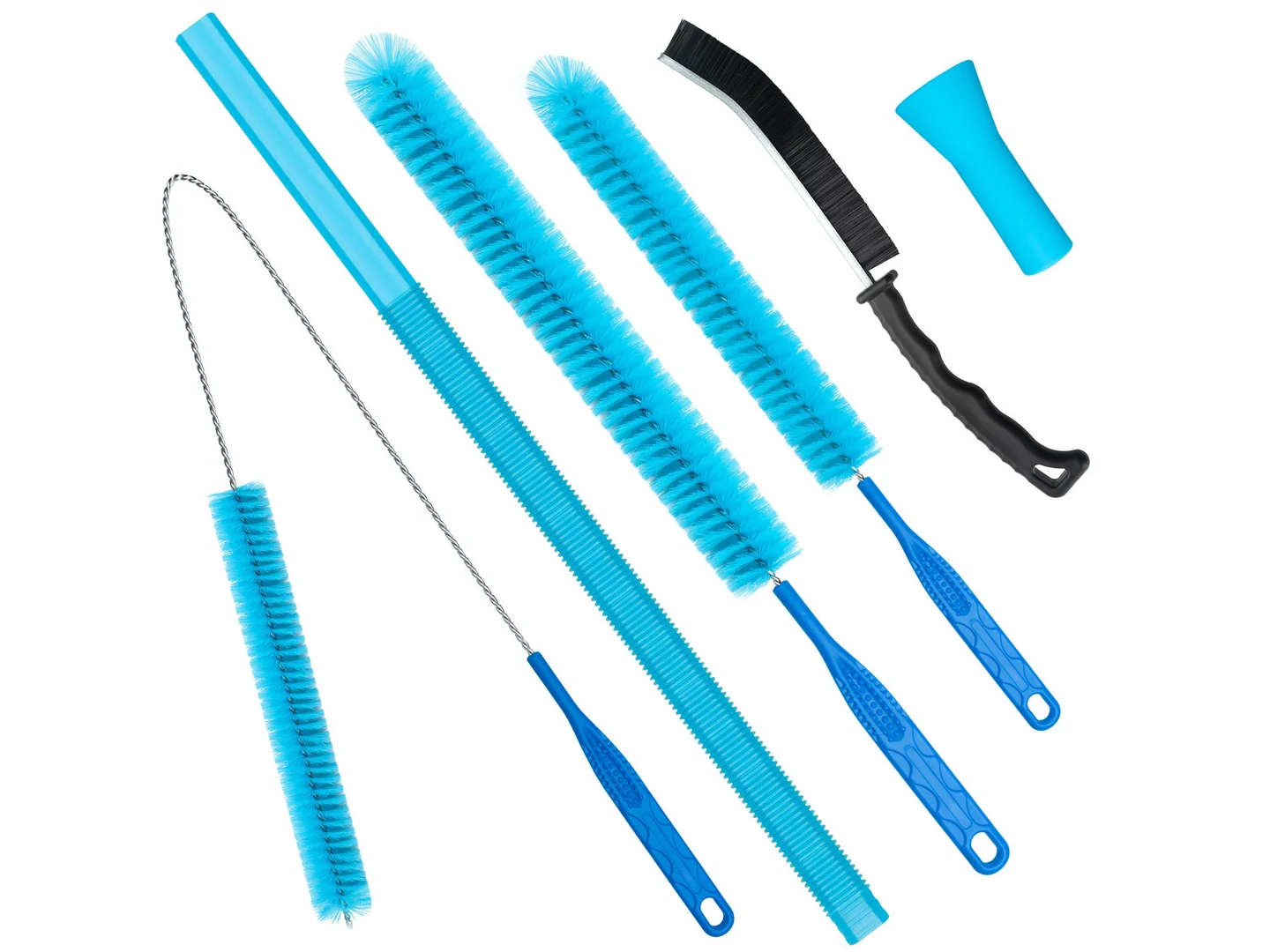
A dryer vent lint cleaner brush is a purpose-built tool consisting of a long, flexible shaft—usually nylon, polypropylene, or twisted wire—with bristles at the tip or along a portion of its length. It is designed to be inserted through the dryer’s lint trap housing or vent opening and pushed, pulled, or spun to dislodge and collect lint buildup. Many are compatible with a power drill for faster, more aggressive cleaning. The brush’s length (commonly 10 to 30 feet) and slim, flexible construction allow it to follow bends without scratching or damaging the vent walls.
Common Types of Cleaning Brushes Found in Home Maintenance Kits
For fire-safety language, this article uses USFA — Heating Fire Safety as the public-safety source.
For combustion-appliance and chimney-adjacent risk language, CPSC — Carbon Monoxide Information Center is used as a safety reference.
For fire-safety language, this article uses USFA — Clothes Dryer Fire Safety Flyer as the public-safety source.
For roof-access and work-at-height cautions, the supporting public-safety reference is HSE — Safe Working on Roofs.
For the safety point in this section, the relevant OSHA reference is OSHA — 1910.23 Ladders.
For the environmental or chemical-safety point in this section, the supporting reference is EPA — Nonpoint Source: Urban Areas.
Before comparing, it helps to understand the main categories of brushes that homeowners and technicians may encounter:
- Dryer vent lint cleaner brush – Extra-long, flexible, light-to-medium stiffness bristles, often drill-driven.
- Standard bottle brush – Short (under 18 inches), stiff bristles, wire core, for cleaning bottles and narrow containers.
- Wire brush (general purpose) – Short handle, metal bristles, for heavy-duty surface scraping; not designed for ducts.
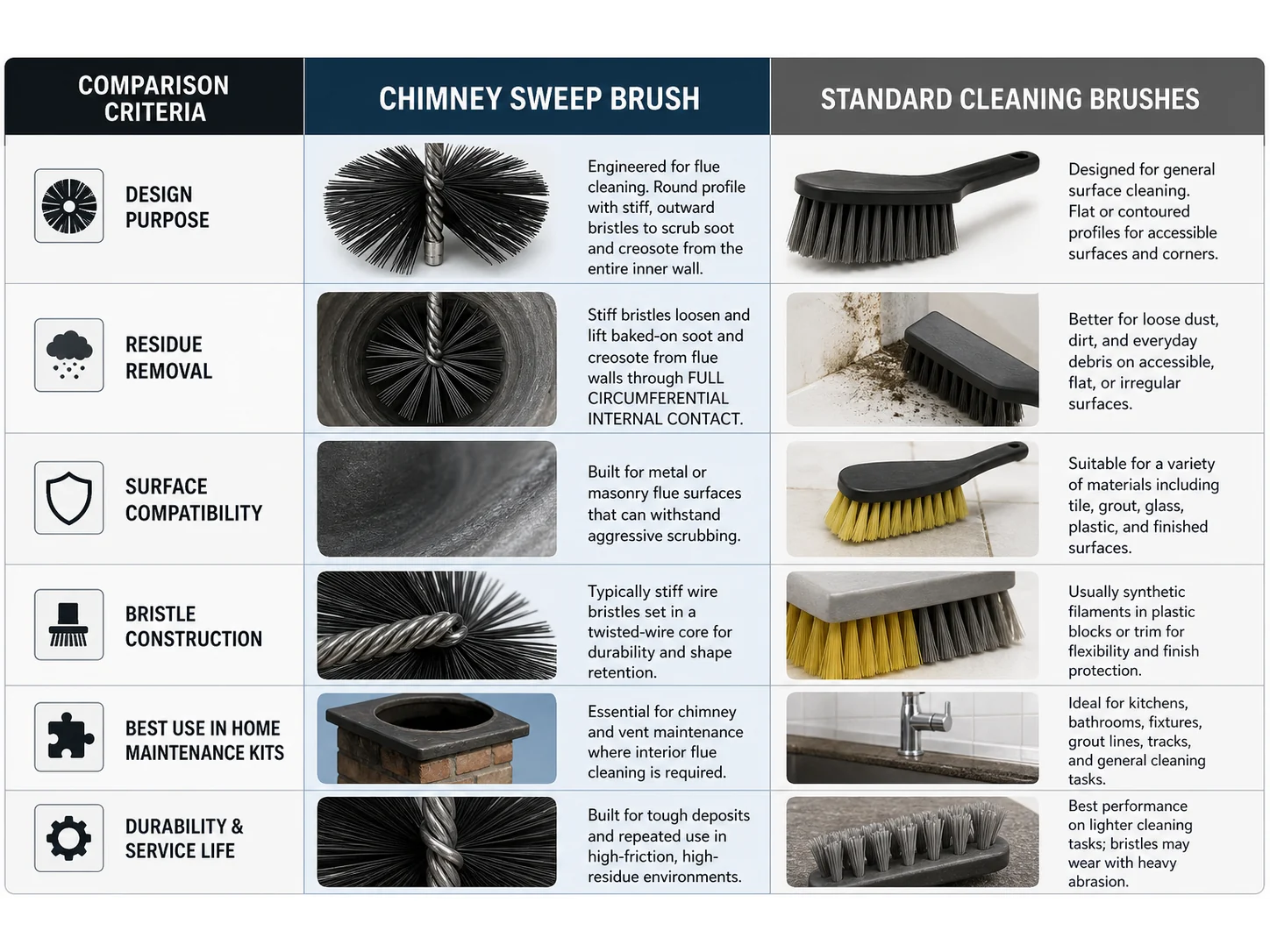
- Chimney cleaning brush – Heavy-gauge wire bristles, large diameter, stiff rod or rope pull; for masonry or metal chimneys.
- Vacuum brush attachments – Soft bristle tools that attach to a vacuum hose; useful for surface lint, but cannot dislodge deep buildup.
- Drill-powered cleaning brush – A broader category that includes many shapes; some dryer vent brushes fall here, but not all drill brushes are vent-safe.
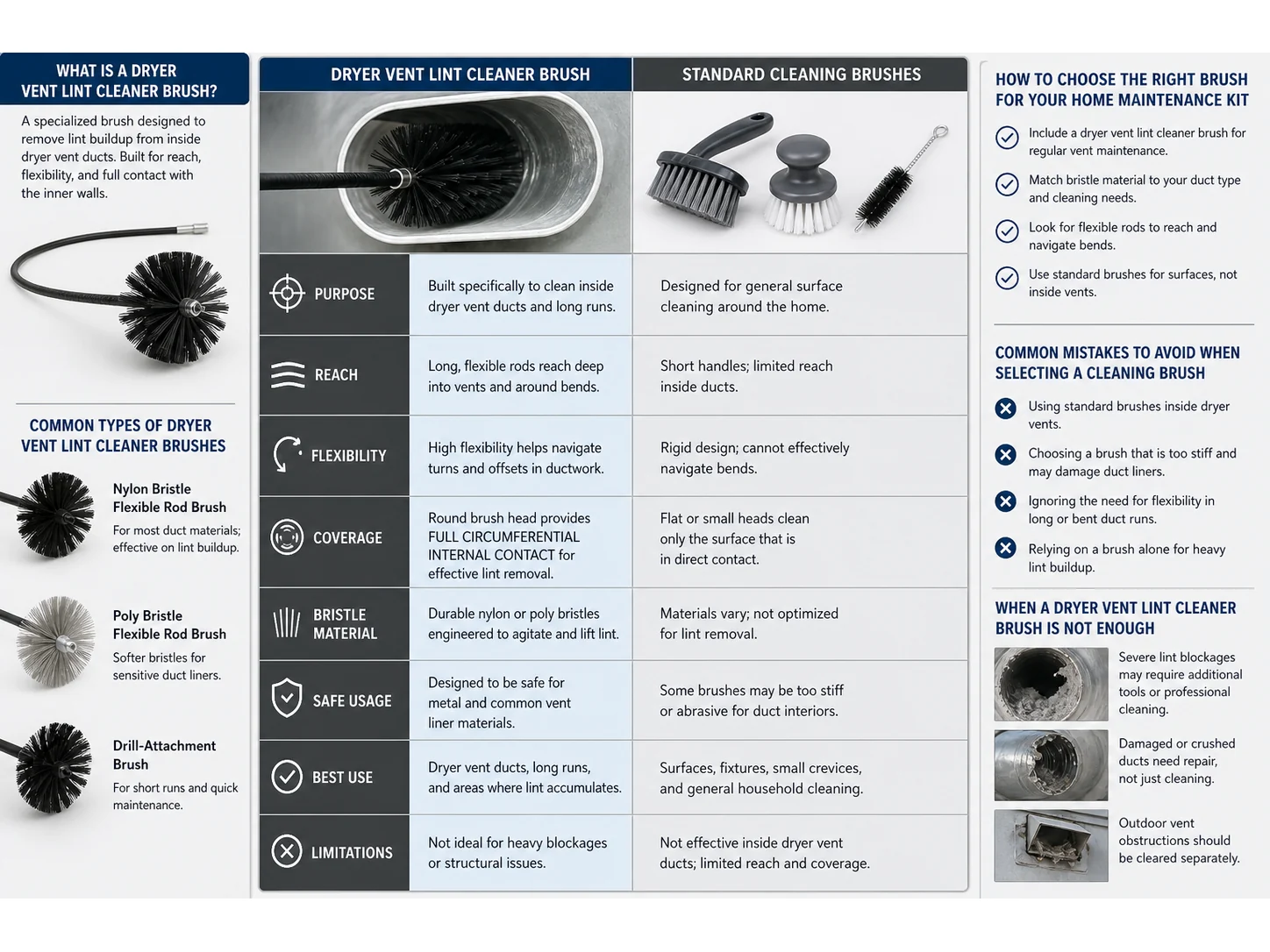
Comparison Table: Dryer Vent Lint Cleaner Brush vs. Standard Cleaning Brushes
| Feature | Dryer Vent Lint Cleaner Brush | Standard General-Purpose Brush (e.g., bottle brush, wire brush) |
|---|---|---|
| Typical Length | 10–30 feet | 6–18 inches |
| Shaft Flexibility | High – bends around curves | Low to moderate – limited bending ability |
| Bristle Material | Polypropylene, nylon, or horsehair | Metal wire, nylon, natural fibers |
| Bristle Stiffness | Medium – dislodges lint without scratching metal | Varies: metal bristles can scrape; nylon can be stiff or soft |
| Surface Safety | Safe for metal and flexible ducts; low risk of scratching | Metal bristles may scratch or puncture thin duct walls |
| Wet Use Suitability | Often yes (nylon/polypropylene resist moisture); not for solvent-heavy applications | Depends on material: metal may rust; natural fibers may degrade |
| Common Interface | Integrated shaft with drill chuck adapter or hand grip | Handle only (bottle brush) or screw-on rod |
| Typical Cost Range | Higher due to length and specialized design | Lower; mass-produced for general cleaning |
| Primary Use | Removing lint from dryer ducts | General scrubbing, de-scaling, small tube cleaning |
How to Choose the Right Brush for Your Home Maintenance Kit
Selecting the best brush depends less on brand and more on the actual cleaning conditions you face. Consider these factors:
- Residue type: Clingy dryer lint calls for a soft-to-medium bristle that can snag and pull out the buildup without compacting it. Hard soot or grease from other appliances may require stiffer bristles or a different cleaning approach altogether.
- Surface sensitivity: Foil or flexible plastic dryer ducts are easily torn. Choose brushes with plastic or nylon bristles, never metal wire.
- Equipment interface: If you plan to use a cordless drill or impact driver, the brush must have a standard ¼-inch hex or round chuck adapter. Manual-only brushes suffice for short, straight runs.
- Wet or chemical exposure: For occasional damp lint or for applying a mild cleaning solution, a brush with polypropylene bristles and a rust-resistant shaft works best.
- Hygiene expectations: In commercial or pet-heavy homes, brushes that can be rinsed and dried quickly prevent odor buildup.
- Maintenance frequency: Light monthly maintenance can be done with a shorter, hand-pushed brush. Annual deep cleans may justify a longer, drill-powered brush.
- Custom size requirements: For unusual duct diameters (e.g., 3-inch or 5-inch vents), check that the brush head diameter matches or can be trimmed to size.
Common Mistakes to Avoid When Selecting a Cleaning Brush
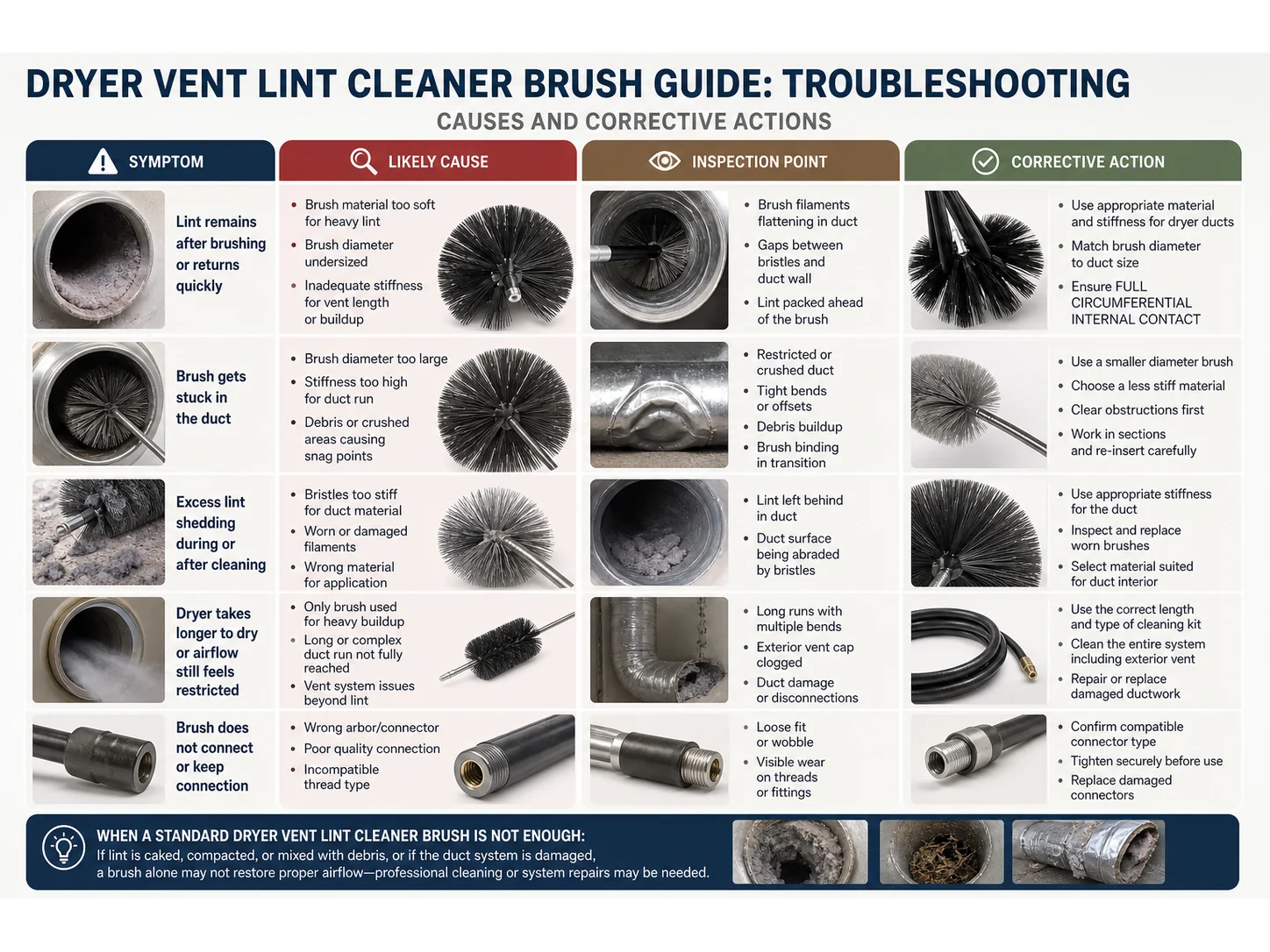
- Using a wire brush – Metal bristles can scratch, dent, or pierce flexible ducts, and they can spark if dragged across metal, creating a fire risk.
- Choosing by cost drivers alone – A low-cost bottle brush may reach only the first few inches of the vent, leaving the rest clogged.
- Ignoring diameter fit – A brush too large can get stuck; one too small will miss most of the lint. Always measure the vent diameter first.
- Assuming all drill brushes are vent-safe – Abrasive nylon cup brushes or heavy-grit brushes designed for paint removal far exceed the stiffness needed for lint.
- Not checking shaft length – Dryer vents can run 15 feet or more. A brush that’s only 6 feet long will not clean the full run.
- Overlooking shaft flexibility – A stiff rod may not navigate the tight bends behind the dryer, risking kinks or damage to the duct.
When a Dryer Vent Lint Cleaner Brush Is Not Enough
A dryer vent lint cleaner brush is designed for dry, fluffy lint accumulation. It is not suited for:
- Heavy soot, creosote, or tar – These residues, common in chimneys and exhaust ducts, require a specialized chimney brush or mechanical rotary whip.
- Industrial ductwork – Metal ducts in commercial settings may need a boiler tube cleaning brush or a powered auger system; a lightweight plastic brush can break.
- Permanently clogged or collapsed vents – If the brush won’t advance despite proper diameter, the vent may be crushed or blocked by a pest nest. A professional inspection and repair is needed.
- Tight spaces where even a flexible brush jams – In some stacked washer/dryer installations, only a professional service with a vacuum extraction system or disassembly will work.
- When a sample test or drawing review is required – For custom-sized vents or unusual materials, it’s wise to request a technical drawing from the supplier to verify dimensions and compatibility before ordering.
Final Takeaway
For most home dryer vent cleaning tasks, a dedicated dryer vent lint cleaner brush—long, flexible, and with medium-soft bristles—outperforms standard cleaning brushes by reaching the full duct length without damaging the walls. Standard bottle or wire brushes are too short and too stiff for this job, and while they have their place in a general home maintenance kit, they should not be used inside a dryer vent. Match the brush to the residue, the duct material, and the access conditions, and you’ll improve both safety and dryer efficiency.
Frequently Asked Questions
Can I use a dryer vent lint cleaner brush to clean other household items?
Yes, a dryer vent brush can be useful for cleaning under appliances, between narrow gaps, or inside large-diameter pipes, provided the bristles won’t scratch the surface. However, do not use a brush previously coated in lint to clean kitchen or bathroom surfaces without washing it first.
How do I know the correct diameter for my dryer vent brush?
Measure the inside diameter of the vent pipe. For 4-inch round metal ducts, a brush head of about 4 inches is standard. Flexible plastic ducts may compress slightly, so a brush that matches the rigid pipe diameter works best. If in doubt, choose a slightly smaller brush to avoid getting stuck.
Is a drill-powered brush always better than a manual one?
Not always. A drill makes quick work of heavy lint buildup, but it can also stress flexible ducts if spun too fast. Manual brushes offer more control and are safer for delicate or older ductwork. Use a cordless drill on low speed if you choose power.
Can I clean a dryer vent without a brush?
Yes, a high-powered vacuum with a narrow hose attachment can remove some lint, but it often fails to dislodge the compacted layer stuck to the walls. A brush is more effective for thorough cleaning, especially in long or convoluted vents.
What should I do if the brush gets stuck in the pipe?
Stop and do not force it. Gently twist the shaft back and forth while pulling slowly. If stuck tight, remove the vent cover at the opposite end or disassemble a section to free it. Never run a drill in reverse without understanding the twist direction of the shaft to avoid unwinding it.
Are nylon bristles enough for heavy lint accumulation?
Yes. Medium-stiffness nylon bristles on a properly sized brush head are adequate for loosening years of compacted lint. Heavier brush types, like wire, are overkill and risk damaging the duct.
How often should I replace a dryer vent lint cleaner brush?
Replace the brush when bristles show permanent flattening, the shaft kinks, or the chuck adapter becomes loose. With typical seasonal use, a quality brush lasts several years. Damaged bristles reduce cleaning effectiveness and can shed into the vent.
Do I need a special brush for cleaning a dryer lint filter?
A dedicated dryer lint filter brush is a smaller, handheld tool with fine bristles meant for cleaning the mesh screen of the filter. While a vent brush can be used gently, a brush specifically designed for the filter screen is better at removing embedded residue without tearing the fine mesh.