
What Is a Chimney Sweep Brush?
A chimney sweep brush is a brush built with a central core (often twisted wire or a threaded rod) and radially arranged, stiff bristles designed to fit the inner diameter of a chimney flue. The bristles are typically made of polypropylene, nylon, or steel wire, and the brush is attached to flexible rods or a drill adapter to push, pull, or rotate through the flue, scrubbing away combustion byproducts. Its key characteristics include a specific diameter range (commonly 4 to 12 inches), high bristle density, and resistance to heat and chemicals encountered in chimney environments.
What Are Standard Cleaning Brushes in Home Maintenance Kits?
Standard cleaning brushes refer to a broad category of brushes used for general household tasks: stiff-bristle scrub brushes for decks, wire brushes for rust removal, tube brushes for appliance vents, and nylon brushes for delicate surfaces. They come in many shapes (flat, round, angled), handle types (wood, plastic, short, long), and materials. While highly versatile, they are not designed for the specific challenges of chimney cleaning—such as long reach, confined spaces, and heavy creosote deposits.
Key Differences: Chimney Sweep Brush vs Standard Cleaning Brush
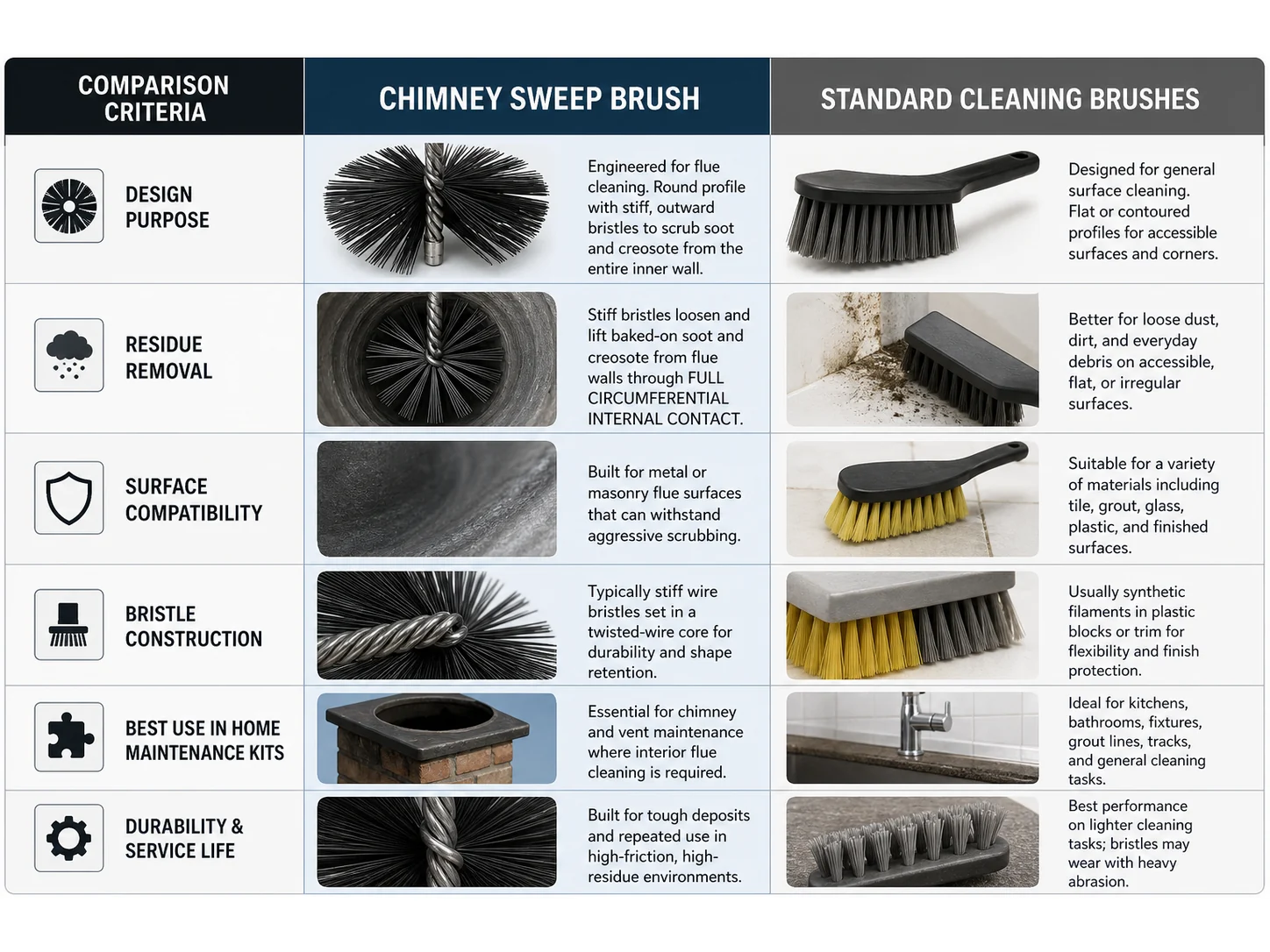
The table below highlights the main differences in design and application between a chimney sweep brush and a standard cleaning brush typically found in home maintenance kits.
| Feature | Chimney Sweep Brush | Standard Cleaning Brush |
|---|---|---|
| Primary Use | Chimney flue cleaning | General household or light industrial tasks |
| Bristle Material | Polypropylene, nylon, or steel wire; heat-resistant | Natural fibers, nylon, brass, steel; not always heat-rated |
| Stiffness | Stiff to very stiff for creosote removal | Ranges from soft to stiff, depending on task |
| Core/Handle | Twisted wire core or threaded rod; designed for extension | Solid handle or simple wire loop; limited length |
| Mounting Options | Threaded rod ends, drill adapters, flexible rods | Fixed handle, sometimes with accessory attachments |
| Typical Diameter Range | 4 to 12 inches, matched to flue size | Varies widely; often not circular or sized for flues |
| Debris Type | Heavy, sticky creosote and soot | Light dust, dirt, rust, or organic matter |
| Surface Sensitivity | Can be aggressive; choose bristle material to protect liner | Many options for both aggressive and delicate surfaces |
| Life Expectancy | Moderate; bristles wear with heavy use | Varies; often replaced frequently in tough tasks |
How to Choose Based on Residue Type and Surface Sensitivity
The type of residue you need to remove should drive your brush selection. Creosote, a tar-like byproduct of wood burning, hardens in flues and requires the stiff, aggressive scrubbing action of a polypropylene or steel-wire chimney sweep brush. Standard nylon or natural-fiber brushes will quickly mat down or lose effectiveness against creosote. However, for light soot or dust in dryer vents or gutter edges, a softer standard brush can clean without scratching surfaces. If your chimney has a stainless steel liner, avoid steel-wire chimney brushes which can cause scratches and promote corrosion; instead use a poly bristle chimney sweep brush.
Equipment Interface and Mounting Options
Chimney sweep brushes are designed to be mounted on flexible rods or a power drill, allowing them to travel the entire length of a chimney flue from either the top or bottom. Standard brushes rarely offer such mounting compatibility; their short handles make them impractical for the deep, vertical reach needed in chimney cleaning. If you plan to clean multiple flues or anticipate hard-to-reach areas, a chimney sweep brush kit with rods and a drill adapter provides the necessary modularity. For occasional light maintenance of horizontal vents or short ducts, a standard brush with an extension pole might suffice, but it will not match the precision or coverage of a correctly sized chimney sweep brush.
Wet or Chemical Exposure and Hygiene Expectations
Chimney cleaning is typically a dry process, but some chemical treatments (like creosote removers) are applied before brushing. Chimney sweep brushes made of polypropylene resist moisture and mild chemicals, while standard brushes with untreated wood handles or natural bristles may degrade. After use, chimney brushes are heavily soiled with soot and creosote; their open bristle design allows for easier cleaning compared to dense standard brushes. For home maintenance kits where hygiene is important (e.g., indoor air quality after cleaning), a dedicated chimney brush that can be thoroughly washed and dried without damage is a better choice than a multipurpose brush that might retain contaminants.
Common Mistakes When Selecting Brushes
- Using the wrong diameter: A brush that is too small won’t clean effectively; too large may jam or damage the flue. Always measure the flue and add ¼ inch for masonry chimneys or match exactly for metal liners.
- Ignoring bristle material: Steel wire brushes can scratch metal liners, leading to rust. Polypropylene is safer for stainless steel but may not be stiff enough for heavy creosote—consider nylon as a middle ground.
- Assuming all brushes are interchangeable: A standard wire brush marketed for rust removal may have loose bristles that can break off inside the flue, creating a fire hazard.
- Neglecting core durability: A low-cost chimney sweep brush with a weak wire core can unravel or snap during use. Look for sturdy twisted wire or rod cores.
- Forgetting about flue shape: Square or rectangular flues require a brush that can reach corners, such as a spiral- or square-shaped brush, not just a round one.
When a Chimney Sweep Brush Is the Wrong Choice
While a chimney sweep brush is excellent for routine maintenance of straight or mildly curved flues, it may not be sufficient in every situation. Extremely heavy glazed creosote might require a rotary chimney whip system or professional chemical treatment prior to brushing. For flues with sharp bends, a flexible rotary cleaning system or professional inspection and cleaning is recommended to avoid damaging the flue or leaving dangerous deposits.
Bottom Line
The best result comes from matching chimney sweep brush vs standard cleaning brushes: which works better for home maintenance kits? to the real cleaning task rather than forcing one brush to solve every condition. Confirm access, residue, surface limits, and replacement routine first; then use a small trial or inspection step before scaling the method into daily work.
Frequently Asked Questions
Can I use a standard wire brush to clean my chimney?
No, standard wire brushes are not designed for chimney cleaning. They often have loose bristles that can break off and become a fire hazard, and they lack the proper mounting and length to effectively clean a chimney flue. Always use a chimney sweep brush specifically made for the job.
How do I know what size chimney sweep brush to buy?
Measure the inside diameter of your chimney flue. For masonry chimneys, add approximately 1/4 inch to ensure a snug fit. For metal liners, match the exact diameter. Always check the manufacturer’s recommendations.
Is a polypropylene or steel chimney sweep brush better?
It depends on your flue type. Polypropylene brushes are safer for stainless steel liners because they won’t scratch and cause rust. Steel brushes are more aggressive and better for heavy creosote in masonry chimneys but can damage metal liners.
How often should I replace my chimney sweep brush?
Replace the brush when bristles become excessively worn, bent, or matted, or when the core shows signs of wear or rust. With regular use, a quality chimney sweep brush can last several seasons, but inspect it before each use.
Can a chimney sweep brush be used for other cleaning tasks?
While it is possible, it is not recommended. Chimney sweep brushes are heavily contaminated with soot and creosote after use. Using them for other tasks could spread hazardous residues. Dedicate the brush solely for chimney maintenance.
Technical References
- USFA — Heating Fire Safety
- USFA — Clothes Dryer Fire Safety Flyer
- OSHA — 1910.23 Ladders
- EPA — Nonpoint Source: Urban Areas
- CPSC — Carbon Monoxide Information Center
- HSE — Safe Working on Roofs
Which nylon grade fits this job — Nylon PA, PA6 Nylon or PA66 Nylon?
| Grade | Continuous temperature (°C) | Peak temperature (°C) | Water absorption | Hardness |
|---|---|---|---|---|
| Nylon PA | 93 | 121 | 0.3–9% by PA grade and conditioning | Medium to firm; filament diameter and trim length control bending force. |
| PA6 Nylon | 80–100 | 130–160 | 1.5–3.0% | Shore D 75–85 |
| PA66 Nylon | 100–120 | 150–180 | 1.0–1.8% | Shore D 80–88 |
| PA610 Nylon | 90–110 | 130–150 | 0.5–1.0% | Shore D 72–82 |
| PA612 Nylon | 90–110 | 130–150 | 0.3–0.7% | Shore D 70–80 |
Figures as published by Brushtec / DuPont. Confirm the exact grade against the supplier datasheet before ordering.
What should replace Nylon PA when it stops working?
- Nylon PA — Compare Nylon PA with PP, PBT, PET. Change material when wet stiffness, temperature, chemical resistance, conductivity, particle shedding, or surface marking becomes the limiting factor.
- AISI 304 Stainless Steel Wire — Use AISI 316 stainless steel wire for chloride, marine, dairy, beverage, chemical washdown, or higher pitting-resistance requirements. Use carbon steel for dry aggressive cutting and brass or abrasive nylon for lower marking risk.