What Is a Tire Cleaning Brush for Mold Grooves?
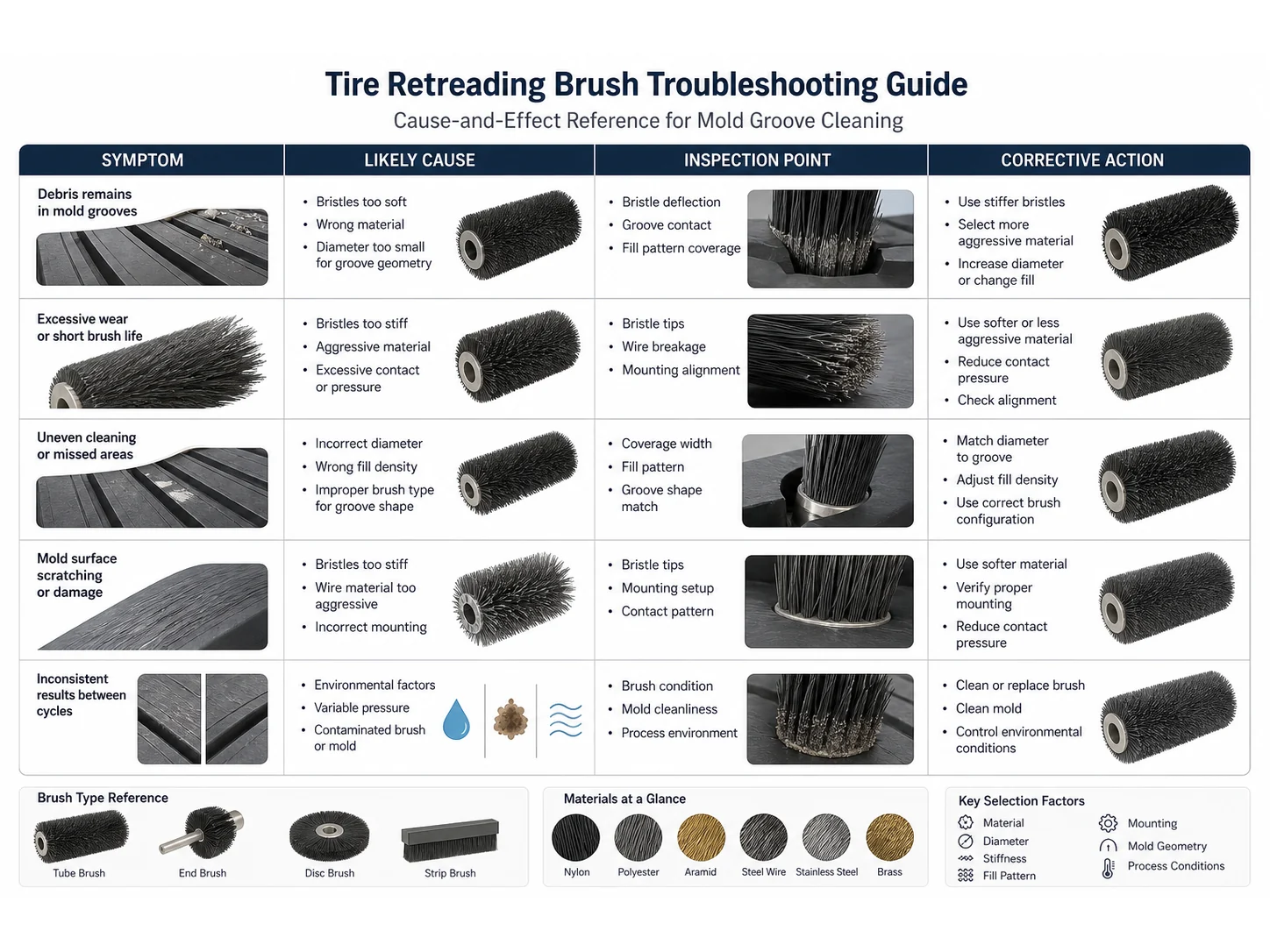
A tire cleaning brush for mold grooves is a narrow-profile brush engineered to reach into the fine, deep recesses of tire molds without damaging the mold surface. Unlike general-purpose brushes, these brushes are selected for precise diameter, filament stiffness, chemical resistance, and durability under repetitive mechanical or manual cleaning. Standard off-the-shelf brushes often fail because they cannot conform to groove dimensions, leave fibers behind, or cause surface scratching that leads to mold wear and tire defects.
Common Types of Tire Cleaning Brushes for Mold Grooves
For material-selection language, this section is supported by World Stainless — Corrosion Resistance of Stainless Steels.
For tire, wheel, and vehicle-safety context, the relevant source is NHTSA — Tire Safety Ratings and Awareness.
For brush terminology and construction language, this section references American Brush Manufacturers Association — Brush Lingo.
There is no single universal brush. The right choice depends on groove shape, cleaning medium, and equipment interface. The most common types include:
- Strip Brushes: Filaments are set in a metal or plastic channel. Available in straight or pre-formed bends for linear grooves.
- Twisted-in-Wire Brushes: Filaments are twisted between wire cores. Good for rotary cleaning of curved or irregular grooves.
- Custom Mold Brushes: Designed to match specific groove profiles, often with abrasive filaments or tiered diameters.
Comparison of Key Selection Factors
Use this table to narrow down options based on real operating conditions.
| Factor | Options | Typical Use Case | Key Considerations |
|---|---|---|---|
| Filament Material | Nylon, Brass, Stainless Steel, Abrasive Nylon | Soft residue vs. baked‑on carbon | Nylon for sensitive surfaces; brass for light abrasion without sparking; stainless for tough deposits; abrasive nylon for moderate scuffing action. |
| Diameter Range | 0.5 mm to 5 mm (filament bundle OD) | Groove width: 1 mm to 10 mm+ | Always measure narrowest groove point. Undersized leaves residue; oversized can jam. |
| Stiffness / Backing | Soft, Medium, Firm (filament + core support) | Manual touch‑up vs. automated CNC cleaning | Stiffer brushes clean faster but increase risk of surface marring on aluminum molds. |
| Handle / Core Mounting | Loop handle, straight handle, threaded stud, arbor hole | Hand‑held, pneumatic tool, rotary spindle | Must match equipment interface exactly. Tapered or quick‑change fittings reduce downtime. |
| Chemical Resistance | Polypropylene, Nylon 6/6, PBT, PTFE | Alkaline cleaners, solvents, high‑temp molds | Verify filament and adhesive compatibility. Some solvents attack nylon filaments or strip embedded abrasive. |
| Abrasiveness | Non‑abrasive, mildly abrasive, aggressive | Clear release agents vs. carbonized buildup | Aggressive brushes reduce mold life. Start with the least abrasive option that meets cycle time. |
How to Choose the Right Brush Based on Your Application
Move from general type to a specific brush by evaluating these real‑world factors:
- Residue Type: Soft, waxy release agents need non‑abrasive nylon. Carbonized or vulcanized rubber patches require brass or stainless steel.
- Surface Sensitivity: Aluminum molds scratch more easily than steel. Use softer filaments and lower stiffness for aluminum.
- Equipment Interface: Is the brush used by hand, in a pneumatic reciprocating tool, or mounted on a robotic arm? Mounting style, overall length, and shank diameter must fit the tooling.
- Wet or Chemical Exposure: If the cleaning process uses solvents or alkaline baths, check that the filament material and core adhesive are chemically resistant. Nylon 6/6 is generally good, but some solvent-based cleaners can weaken it.
- Hygiene Expectations: For tire molds, hygiene typically means no fiber shedding and easy brush cleaning between cycles. Enclosed filament bases and well‑adhesed fibers reduce contamination.
- Maintenance Frequency: High‑volume plants may change brushes daily. Estimate life cycles and keep a safety stock, especially for custom diameters.
- Custom Size Requirements: If standard diameters do not match your groove geometry, request a sample drawing from the brush supplier. Confirm filament density, trim length, and overall profile before production.
Common Mistakes When Selecting a Mold Groove Cleaning Brush
Avoid these pitfalls that can damage molds, waste time, or increase scrap rates:
- Choosing by cost drivers alone. A low-cost brush that wears out in one shift or scratches the mold costs far more in downtime and mold repair.
- Ignoring filament stiffness. A brush that is too stiff for the mold material will create micro‑scratches that trap contamination and accelerate wear.
- Mismatch with chemical environment. Using a nylon brush in a strong solvent bath can cause filament softening, swelling, or complete breakdown.
- Wrong diameter gap. Picking a brush that is too large forces it into the groove, causing the core to bend and filaments to flare, leaving residue in the bottom. Too small a diameter skips the upper sidewalls.
- Overlooking mounting compatibility. A brush with a smooth round shank will slip in a tool designed for a hex drive, leading to inconsistent cleaning and safety hazards.
- Assuming “aggressive” cleans faster always. Overly abrasive brushes can change mold venting geometry and affect tire appearance, leading to costly mold refurbishment.
When a Standard Tire Cleaning Brush Isn’t Enough
A stock brush may be inadequate under certain conditions. Consider moving to a custom‑engineered brush or a different cleaning technology when:
- Baked‑On Carbon Layers Are Hard and Thick: Standard nylon or even brass brushes may not remove heavy carbonization from high‑temperature molds. Dry ice blasting or ultrasonic cleaning might be required as a pre‑step, with brushes used only for final detail work.
- Groove Geometry Is Highly Complex: Sharp turns, variable depth, or undercuts prevent a uniform brush diameter from making full contact. A supplier drawing review and a sample test brush are essential before ordering.
- Brush Life Is Unacceptably Short: If production rates cause brushes to fail within hours, examine the mechanical action (speed, pressure), chemical exposure, and filament material. A custom brush with a different trim, density, or a reinforcing core wire may extend life.
- You Need Documented Repeatability: For automated systems, a standard brush may not provide the consistency required. Custom brushes with exact specifications and lot‑to‑lot control become necessary, and a first‑article inspection should be part of the supplier agreement.
- Safety or Sparking Risk Exists: In environments where flammable vapors may be present, metal brushes that spark must be avoided. Special anti‑static or spark‑free conductive filaments may be required, which are almost always a custom solution.
In any of these cases, start with a sample brush test on a mold that is out of rotation. Document the cleaning result, brush wear, and any mold surface effects before scaling to full production.
Final Takeaway
Selecting a tire cleaning brush for mold grooves means matching the filament material, diameter, stiffness, and mounting to the specific residue, mold material, and cleaning equipment you use. Begin with a clear measurement of the groove width and a test of the least aggressive filament that does the job. Always check chemical compatibility and avoid cost drivers‑only decisions. When standard brushes fall short, work with a supplier to develop a custom solution backed by sample testing and drawing approval. The right brush protects mold investment and keeps tire quality high.
Frequently Asked Questions
What filament material is safest for aluminum tire molds?
Nylon (typically Nylon 6 or 6/6) is the safest choice for aluminum because it is non‑abrasive and won’t scratch. For slightly more cleaning power, an abrasive‑impregnated nylon filament (e.g., silicon carbide grit) can be used with controlled pressure.
Can I use the same brush for different mold groove widths?
Not reliably. A brush that fits a wide groove will be ineffective in a narrower one, and forcing it can damage both the brush and the mold. It’s best to have a matched set of brush diameters for your mold inventory.
How do I measure a groove to specify a brush diameter?
Use a pin gauge or feeler gauge to measure the narrowest point of the groove along its length. The brush filament bundle outside diameter (OD) should be slightly larger than this measurement (typically 10–20%) to ensure full contact without jamming.
How often should I replace a mold cleaning brush?
There is no fixed interval. Replace the brush when filaments become permanently bent (set), wear down to the point where cleaning is incomplete, or the core shows signs of fatigue. High‑volume plants often replace brushes per shift; monitor performance and set a proactive change schedule.
Can tire cleaning brushes handle strong solvents like acetone or toluene?
Many nylon brushes will degrade in ketones or aromatic solvents. Check the filament material datasheet. For aggressive solvents, polypropylene or PTFE filaments offer better chemical resistance. Also verify that the core adhesive is not attacked.
Is it better to use a brush with a flexible or rigid core?
Flexible twisted‑wire cores work well for curved grooves and hand cleaning because they bend without kinking. Rigid strip brushes or solid‑core brushes are better for straight, automated cleaning paths where consistent pressure and tracking are needed.
What’s the difference between a tire cleaning brush and a general‑purpose test tube brush?
A tire cleaning brush is engineered for industrial mold cleaning with precise diameter control, chemical‑resistant filaments, and mounting interfaces that fit cleaning machinery. A test tube brush is a low‑cost laboratory tool with a generic spiral design not suited for production mold care.
Should I buy a custom brush or try off‑the‑shelf first?
Always start with a high‑quality off‑the‑shelf brush that matches your basic diameter and material requirements. If performance, life, or groove fit is insufficient, then provide a drawing or sample groove profile to a brush manufacturer for a custom design.