
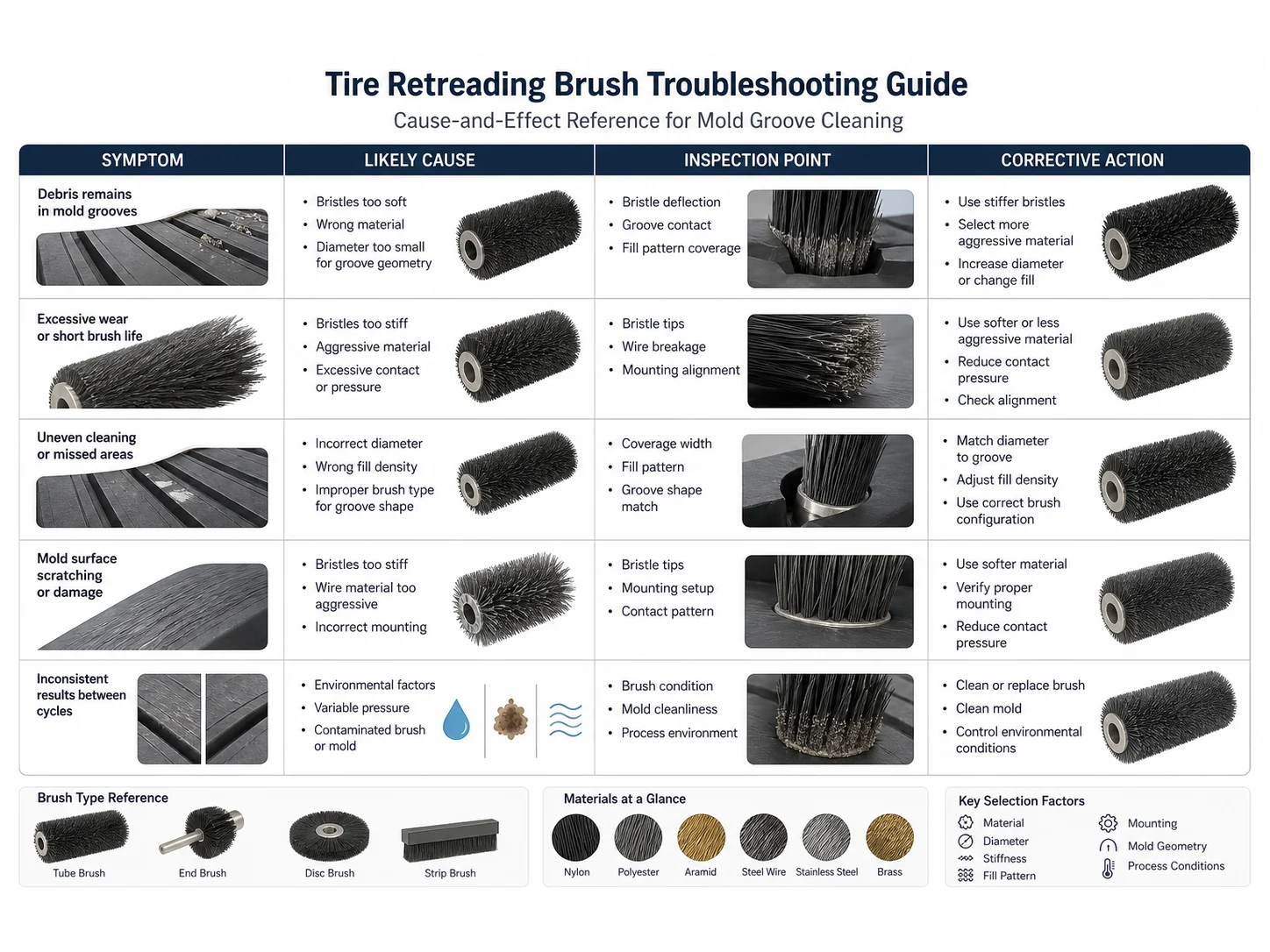
What Is a Tire Retreading Brush?
A tire retreading brush is a cleaning and surface‑conditioning brush designed for the tire retread industry. It is typically built with a central shaft, core, or quick‑change mount and uses wire, abrasive‑filled polymer, or non‑metallic bristles to work inside the narrow mold grooves, vent holes, and sidewall lettering of a used tire casing. The brush can be hand‑held, chucked into a bench motor, or fitted on an automated buffing/cleaning station. In every case, the goal is the same: remove contaminants without distorting the groove shape or scratching the mold surface in a way that transfers to the green tire.
Materials Used in Tire Retreading Brushes
The brush material defines what kind of residue it can remove and how aggressive it will be. Three families cover most retreading applications:
- Carbon steel wire: best for tough, baked‑on rubber deposits and heavy mold‑release buildup. It cuts fast but can scratch if the tip geometry or pressure is wrong.
- Stainless steel wire: chosen where rust contamination is a concern or when the brush works in a wet process. Slightly softer than carbon steel, it reduces the risk of mold pitting over repeated cycles.
- Abrasive‑impregnated nylon: uses silicon carbide or aluminum oxide grit embedded in a nylon filament. It provides a uniform, non‑sparking clean and is gentler on high‑polish mold surfaces while still removing light to medium residue.
Natural fiber and straight nylon brushes also exist but are more common for dusting or light residue removal before buffing, not for heavy groove cleaning.
Common Brush Types and Configurations
Retreading shops typically use one or more of these shapes:
- Wheel brush (full‑face or sectional): mounts on a horizontal shaft and works the tire shoulder and sidewall zones in a controlled pass.
- Cup brush / end brush: designed to reach into narrow grooves and vent holes when the brush is mounted on a flexible shaft or angled grinder.
- Tube brush / spiral brush: used inside deep, curved passages where a solid wheel brush cannot reach. The brush core can be single‑stem, double‑stem, or loop‑handle for manual use.
- Custom‑segment brushes: made to match a specific mold profile, often built from layered strip brush material wound into a precise OD.
Material, Diameter, and Stiffness Comparison
| Material Type | Typical Diameter Range | Relative Stiffness | Wet Process OK? | Best Use Case |
|---|---|---|---|---|
| Carbon Steel Wire | 3″ – 12″ wheel OD1/2″ – 4″ cup/tube | High | Limited (rust risk) | Aggressive baked‑on tread residue removal |
| Stainless Steel Wire | Same as carbon steel | Medium‑High | Yes | Wet cleaning stations, rust‑sensitive molds |
| Abrasive Nylon (SiC or AlO) | 2″ – 10″ wheel OD1/4″ – 3″ cup/tube | Medium (grit‑based stiffness) | Yes | Uniform finish, avoiding mold-mirror scratches |
| Brass‑Coated Steel Wire | 3″ – 8″ wheel OD | Medium | Limited | Light debris on softer mold alloys |
Stiffness is influenced by wire gauge, filament diameter, and trim length. A shorter trim length makes the brush feel stiffer; a longer trim provides better contour following but less penetration.
How to Choose the Right Brush for Your Retreading Process
Start with the residue, not the brush. A checklist helps:
- Identify the main contaminant: hardened rubber, polybag film residue, mold release wax, or light dust?
- Check mold surface sensitivity: polished or textured mold face? Aluminum or steel mold?
- Match brush material to the residue and surface: heavy rubber buildup → carbon steel; wet process → stainless or abrasive nylon; delicate polish → abrasive nylon.
- Measure groove width, depth, and curvature: the brush OD must fit without jamming, and filament length must reach the groove bottom.
- Know your equipment interface: arbor size, max RPM, and mount style (threaded shank, set‑screw collar, keyway, or quick‑change adapter).
- Factor in process speed and duty cycle: high‑volume lines need filament retention features (twisted‑in‑wire or epoxy‑set tufts) to avoid shedding.
Sizing and Mounting Considerations
A brush that does not fit the mold or the machine is wasted money. Pay attention to:
- Overall diameter (OD): must be 1–2 mm smaller than the narrowest groove at operating speed to prevent binding.
- Fill density / face width: a denser fill cleans faster but generates more heat and requires more horsepower.
- Arbor / shank size: common are 1/2″, 5/8″, or metric 12–16 mm. Verify compatibility with your buffing spindle or hand tool chuck.
- Trim length vs. groove depth: the free filament length should be at least 20% longer than the deepest groove to allow bending and reach without bottoming out the core.
- Quick‑change vs. permanent mount: threaded cup‑brush hubs reduce changeover time on manual stations, while keyed shaft brushes suit automated cells.
Environmental and Process Factors
Your cleaning environment changes the material choice and brush life:
- Wet operation: water‑based mold release or wash systems demand stainless steel or abrasive nylon to avoid rust streaks on molds.
- Chemical exposure: alkaline cleaners or acidic pre‑buff solutions can attack nylon; check chemical resistance charts from the filament manufacturer.
- Temperature: residual heat in the mold (40–70°C after strip‑down) can soften some nylon filaments, reducing stiffness; high‑temp nylon or metal wire is safer.
- Hygiene / debris containment: in wet scrubber systems, choose a brush that does not shed loose bristle fragments that could clog drain screens.
Common Specification Mistakes
Many retreaders order a brush based on cost drivers or a familiar catalog number and later find it does not work. The most frequent mistakes include:
- Choosing wire gauge alone, ignoring trim length: a 0.014″ wire with a very long trim can feel identical to a 0.012″ short‑trim brush. Always specify both.
- Assuming “stainless” means rust‑proof: 304 stainless can still corrode under strong alkaline cleaners; 316 may be required for extreme wet conditions.
- Overlooking core material: a steel core may rust in a wet line even if the bristles are stainless. Specify a plated or stainless core when wetness is constant.
- Ignoring RPM compatibility: a brush rated for 4,500 RPM will throw filaments if run at 6,000 RPM. Check the brush manufacturer’s maximum safe free speed.
- Guessing groove clearance: ordering a 4″ OD brush for a groove that measures 4″ at rest will jam when the bristles flex under centrifugal force.
- Forgetting the mount: a perfect brush on the wrong arbor or thread means an adapter, reduced life, or a dangerous setup.
When a Tire Retreading Brush Is the Wrong Choice
A catalog tire retreading brush solves most daily cleaning tasks, but it is not a cure‑all. Consider a custom‑engineered brush or a different cleaning method when:
- The groove geometry is highly irregular or undercut, making it impossible for a standard spiral brush to bottom out.
- The mold has multiple compound curves that require a brush with a pre‑curved core and variable filament length.
- You need to clean inside vent holes smaller than 3 mm, where even a fine tube brush may not fit or may break off and block the vent.
- Residue is chemically bonded and requires a pre‑soak or ultrasonic cleaning step before brushing.
- Production speed demands an automated brush that holds a ±0.2 mm diameter tolerance; at this point, a sample test and supplier drawing review become mandatory.
In these situations, work with a brush manufacturer that can review a mold cross‑section or 3D scan and propose a tailored filament length, core shape, and mounting scheme.
Final Takeaway
A tire retreading brush is a precision wear part, not a generic cleaning tool. The best brush matches the residue type, mold surface sensitivity, and groove dimensions, all while fitting safely on the available equipment. Start by defining the contaminant, then select material and stiffness, double‑check clearance under working conditions, and verify the mount. A small investment in getting the specification right avoids scrap casings and mold damage that cost far more than the brush itself.
Frequently Asked Questions
What is the difference between a buffing brush and a tire retreading brush?
A buffing brush is often a wide‑face wheel that only works the tire crown to texture the surface. A tire retreading brush is designed to reach deeper into tread grooves, sidewall lettering, and vent holes to clean residue without damaging the mold detail.
Can I use the same brush for dry and wet cleaning?
You can if the brush is all‑stainless or abrasive nylon with a non‑rusting core. Carbon steel brushes used in a wet line will quickly rust and may transfer stains to the mold and tire.
How do I know if the brush stiffness is right for my mold?
Test a sample brush on a scrap casing first. If the brush leaves visible scratch marks on the mold or removes material faster than expected, move to a softer filament, longer trim, or a finer grit. If it does not clean in a reasonable number of passes, increase stiffness or switch to wire.
Is a twisted‑wire brush better than a crimped‑wire brush for retreading?
Twisted‑wire (also called knot‑wire) brushes are more aggressive because the wire clusters act like a knot that delivers constant pressure. They are good for heavy buildup. Crimped‑wire brushes have individual strands that flex more, giving a less aggressive action better suited to final cleaning or sensitive molds.
What if my mold groove is too narrow for any standard brush?
When standard tube or cup brushes cannot fit (often below 3 mm groove width), look for miniature brushes with fine wire or abrasive filaments built on a very thin stem. In extreme cases, an automated cleaning method like dry‑ice blasting or a custom laser‑cut brush segment may be needed.
How often should I replace a tire retreading brush?
There is no single hour rating because brush life depends on filament material, pressure, and residue type. Replace the brush when filament breakage causes a noticeable drop in cleaning efficiency, when the OD wears down below the minimum for groove contact, or when the core shows any sign of bending or fatigue. Keep a wear log to plan inventory.
Is it worth upgrading from wire to abrasive nylon for all cleaning?
Not necessarily. Abrasive nylon excels on polished molds and light‑to‑medium residue but wears faster against heavy rubber deposits. Many retreaders use a two‑step process: a wire brush for aggressive primary cleaning, then an abrasive nylon brush for a final, smoother finish that improves bonding surface consistency.
Technical References
- World Stainless — Corrosion Resistance of Stainless Steels
- OSHA — 1910.177 Servicing Multi-Piece and Single Piece Rim Wheels
- NHTSA — Tire Safety Ratings and Awareness
- NIST — Metric SI
Which bristle material fits this job — Abrasive Nylon, Nylon PA or Rubber?
| Material | Continuous temperature (°C) | Peak temperature (°C) | Water absorption | Hardness |
|---|---|---|---|---|
| Abrasive Nylon | 120 | 150 | 0.1–1.0% | Abrasive filament; stiffness and cutting level is controlled by PA base, grit type, grit size, filament diameter and trim height. |
| Nylon PA | 93 | 121 | 0.3–9% by PA grade and conditioning | Medium to firm; filament diameter and trim length control bending force. |
| Rubber | 100 | 130 | very low | Specified by compound and Shore hardness; published TPE families can span roughly 50–80 Shore A, but that is a product-family example rather than a universal rubber range. |
| AISI 304 Stainless Steel Wire | 400 | 500 | 0% | Rockwell B 70–95 depending on temper and cold work |
Figures as published by Perlon; Brushtec / DuPont; Alleima. Confirm the exact grade against the supplier datasheet before ordering.
What should replace Abrasive Nylon for tire?
- Abrasive Nylon — Compare Abrasive Nylon with PP, PBT, PET. Change material when wet stiffness, temperature, chemical resistance, conductivity, particle shedding, or surface marking becomes the limiting factor.
- Nylon PA — Compare Nylon PA with PP, PBT, PET. Change material when wet stiffness, temperature, chemical resistance, conductivity, particle shedding, or surface marking becomes the limiting factor.
- Rubber — Compare Rubber with Silicone elastomer, TPE, PVC profile, PVA sponge. Change material when wet stiffness, temperature, chemical resistance, conductivity, particle shedding, or surface marking becomes the limiting factor.
- AISI 304 Stainless Steel Wire — Use AISI 316 stainless steel wire for chloride, marine, dairy, beverage, chemical washdown, or higher pitting-resistance requirements. Use carbon steel for dry aggressive cutting and brass or abrasive nylon for lower marking risk.