What Is an Industrial Roller Brush?
Before ordering industrial Roller Brush for Sticky Fines, define the working condition clearly enough that a supplier can build and verify the brush against the job. The most useful details are screen opening, belt or surface material, carryback, uptime risk, and whether the brush can clean without process damage. Missing one of these points often leads to a brush that looks correct on paper but fails during installation or daily use.
An industrial roller brush is a rotating cylindrical brush used in production equipment to perform continuous cleaning, wiping, sealing, conveying, or surface treatment. Unlike handheld or consumer-grade roller brushes, industrial versions are built with engineered filaments, precision cores, and shaft interfaces designed for specific machine speeds, chemical environments, and duty cycles.
For the safety point in this section, the relevant OSHA reference is OSHA — Machine Guarding.
For the safety point in this section, the relevant OSHA reference is OSHA — Control of Hazardous Energy.
For the safety point in this section, the relevant OSHA reference is OSHA — Combustible Dust.
For the environmental or chemical-safety point in this section, the supporting reference is EPA — Particulate Matter Basics.
For brush terminology and construction language, this section references American Brush Manufacturers Association — Brush Lingo.
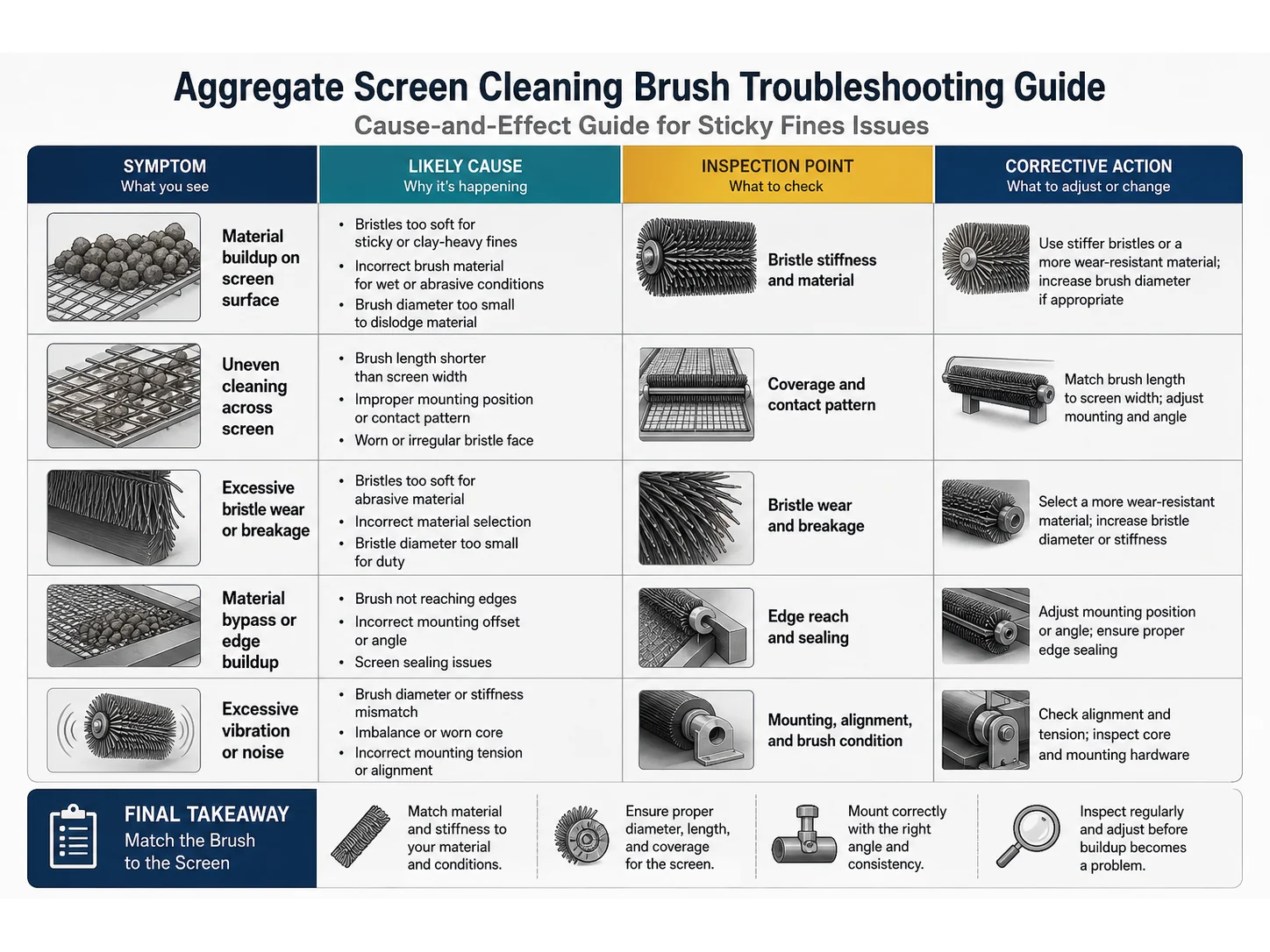
In applications with sticky fines—fine particles that adhere due to moisture, static electricity, oil content, or natural tackiness—the brush is not just a contact surface; it becomes the critical line of defense against buildup on belts, screens, rollers, and chute walls.
Why Standard Brushes Fail with Sticky Fines
Ordinary roller brushes often use generic filament materials and moderate densities that work for dry, free-flowing powders. When challenged with sticky fines, these brushes quickly exhibit:
- Filament encapsulation (filaments become coated and matted together)
- Core packing (residue builds up inside the brush base)
- Uneven wear due to differential cleaning loads
- Surface damage to sensitive belts or coated substrates
- Frequent washdowns that degrade adhesives or non-stainless components
Buying a custom brush specifically designed for sticky fines is not about paying for a special label—it’s about selecting a combination of material, geometry, and mounting that actively resists residue accumulation and makes cleaning manageable.
Critical Design Features to Verify Before Ordering
Use this checklist to evaluate any proposal for a custom industrial roller brush dedicated to sticky fines. Each item should be confirmed with the supplier and ideally tested with a sample run.
| Design Feature | What to Check | Why It Matters for Sticky Fines |
|---|---|---|
| Filament material | Chemical compatibility, moisture absorption, heat tolerance | Non-absorbent filaments reduce residue bonding; wrong material can swell or soften |
| Filament diameter/stiffness | Aggressiveness vs. surface sensitivity | Too stiff may scar belts; too soft may flex and let fines pass through |
| Brush density (fill) | Filament count per hole and hole pattern | High density can trap sticky residues; low density may clean unevenly |
| Trim length & OD | Overall diameter tolerance and free filament length | Wrong size reduces contact pressure or interferes with machinery |
| Core material | Stainless steel, aluminum, engineered plastic, or wood | Wet or hygienic environments require corrosion resistance and cleanability |
| Mounting method | Shaft bore, keyway, set-screws, flanged ends | Must match existing drive system; any mismatch stops the installation |
| Chemical / washdown resistance | Sealed core ends, filament bonding, chemical inertness | Daily cleaning with water or solvents can destroy wrong materials quickly |
| Hygiene requirements | FDA-compliant filaments, 304/316 stainless, absence of crevices | For food, pharma, or dust-sensitive environments, cleanability is non-negotiable |
Filament Material Options Compared
The filament is the primary contact point with your product and the sticky fines. Choosing the right material is the most important decision you will make. The table below compares common industrial brush filament materials for sticky applications.
| Material | Typical Stiffness | Moisture/Absorption | Chemical Resistance | Best for Sticky Fines? | Common Trade-offs |
|---|---|---|---|---|---|
| Nylon 6/6 | Medium to high (depends on diameter) | Absorbs moisture; swells in high humidity | Good overall; resists many chemicals | Conditional—only if dry or indirect food | Too much moisture reduces stiffness and can trap fines |
| Polypropylene | Soft to medium; can be stiffened | Very low moisture absorption | Excellent; resists most acids and alkalis | Yes—preferred for wet or humid sticky fines | Lower temperature limit; may not be as stiff as nylon |
| Polyester | Medium to high | Low moisture absorption | Good resistance to many chemicals | Yes—durable and works in food areas | More expensive than polypropylene; can be abrasive |
| Tampico (natural fiber) | Soft to medium | High; absorbs moisture | Poor—degraded by many chemicals | No—generally avoided for sticky fines | Natural fiber holds moisture and residue; good for dry dust only |
| Horsehair | Very soft | High moisture absorption | Poor | No—too flexible and absorbent | Quickly mats with sticky residue; hard to clean |
| Abrasive-impregnated nylon (e.g., silicon carbide) | Medium to high (stiff from grit) | Similar to nylon base | Based on nylon; grit is inert | Specialized—only if fines cause heavy buildup | Can scratch sensitive surfaces; higher cost; not for food contact |
How to Match Brush Specifications to Real Operating Conditions
Once you understand material options, you must map them to your actual process. Ask these six questions before finalizing any brush drawing.
- What is the residue like? Is it powdery but hygroscopic, oily, or resinous? Hygroscopic residues demand non-absorbent filaments.
- How sensitive is the surface being cleaned? If you are cleaning a polished metal belt, a soft polyester filament may be needed; for a rough rubber belt, a medium nylon may work.
- What is the equipment interface? Measure shaft diameter, keyway size, and available space envelope. Even a perfect brush design fails if the mounting does not fit.
- Is there wet cleaning or chemical exposure? If the brush will be washed down daily or exposed to cleaning chemicals, choose all-stainless cores and chemically inert filaments.
- Do hygiene standards apply? For food contact or pharmaceutical environments, insist on FDA-compliant materials, stainless cores, and designs without crevices where residues hide.
- What maintenance frequency is acceptable? A brush that requires disassembly for manual cleaning every week may not fit a high-volume line; sometimes a more open-face design or a different mounting style simplifies maintenance.
Common Mistakes When Specifying Brushes for Sticky Fines
Many first-time buyers make avoidable errors that lead to underperforming brushes. Watch for these pitfalls:
- Guessing the filament stiffness instead of testing. Request filament samples or a test coupon to see how the material behaves with your residue.
- Focusing only on cost drivers. A cheaper filament that absorbs moisture will fail quickly and cause more downtime.
- Not considering cleanability. A denser brush may clean better initially but may become impossible to clear without disassembly.
- Ignoring the mounting interface. Failing to specify a keyway or a particular shaft diameter leads to field modifications that compromise brush balance.
- Assuming one brush design works for all sticky materials. A brush optimized for oily talc will not perform the same with moist sugar dust; get a design tailored to the specific residue.
- Skipping a trial run. For large quantities, always test a single brush on the line to validate performance before committing to the full order.
When a Custom Industrial Roller Brush Is Not Enough
An industrial roller brush is a powerful tool, but it has limits—especially with extremely adhesive or voluminous sticky fines. Consider alternative or additional measures if:
- The residue buildup thickness exceeds what a brush can remove without heavy pressure that risks surface damage.
- The production environment requires frequent washdowns that the brush materials cannot survive (even with stainless and polypropylene, some design details may fail).
- The conveyor or machinery runs at speeds so high that a strip brush or a spray bar might be more effective for cleaning.
- Hygiene requirements demand CIP (clean-in-place) compatibility, and the brush core geometry cannot be fully cleaned without disassembly. In such cases, a quick-release brush design or a different cleaning technology (e.g., ultrasonic or spray) may be required.
- After a real-world sample test, the brush still loads up quickly. In that situation, a supplier drawing review or an engineered redesign—possibly a spiral-wound brush or an angled trim—is the next step.
How to Build an RFQ That Gets the Right Brush
Preparing a clear request for quotation not only speeds up supplier response but also reduces the risk of mismatched expectations. Include these items in your inquiry:
| RFQ Item | What to Provide |
|---|---|
| Process description | What the brush cleans or contacts, material of the surface it touches, and what the sticky fines are (chemical name if known). |
| Residue characteristics | Moisture content, particle size, tackiness level, temperature at contact point. |
| Operating speed and duty | Conveyor speed (ft/min or m/min), brush RPM, hours of operation per day. |
| Environment | Wet/dry, washdown frequency, chemical sprays used, ambient temperature. |
| Equipment interface | Shaft diameter and length, keyway dimensions, set-screw or flange details, available mounting space. |
| Brush dimensions | Outer diameter, face length, overall length, desired trim length (if known). |
| Material preferences | Any specific filament or core material you want to explore, based on hygienic or chemical constraints. |
| Quantity and trial expectations | Number of brushes needed now and forecast, and whether you require a sample for testing before full production. |
| Additional requirements | Any regulatory compliance (FDA, USDA) or standards that must be met. |
When suppliers understand the exact conditions, they can suggest the most reliable configuration instead of guessing—and you can compare proposals on a like-for-like basis.
Final Takeaway: Verify, Don’t Assume
Ordering a custom industrial roller brush for sticky fines is not a transaction—it’s an engineering decision. By verifying filament behavior, core durability, cleanability, and exact mounting details before you place an order, you shorten commissioning time and gain a brush that stays operational longer. The simplest rule: if you cannot clearly describe your sticky residue and the environment it lives in, get a sample and start small.
Frequently Asked Questions
How do I know if a filament is too stiff or too soft for sticky fines?
Start with a sample brush or a small set of filament gauges. Run it on your line and look for two signs: if the brush leaves scratch marks or burnishes the surface, it’s too stiff; if sticky fines build up quickly and the brush smears rather than lifts residue, it may be too soft. Medium stiffness with a moderate recovery (ability to spring back) often works best.
Can I use the same brush design for a dry sticky powder and a damp sticky powder?
Rarely. A dry sticky powder may load up due to static, so a conductive filament or a grounding option might be needed. A damp sticky powder demands non-absorbent, chemically resistant filaments and a stainless core. Always specify the moisture level to your supplier.
What if my residue is both sticky and abrasive?
In that case, you need a filament that resists both chemical attack and mechanical wear. Polyester or a special abrasive-impregnated nylon may be candidates, but you trade off surface friendliness. A careful balance or a two-stage cleaning system (scraper followed by brush) might be necessary.
Should I order a sample before the full batch?
Absolutely, especially for sticky fines. One sample brush tested on your line for a few hours will reveal whether the material, density, and diameter work. A small upfront cost prevents a large order of unusable brushes.
How often should I replace a brush handling sticky residues?
There is no universal interval. Monitor for a drop in cleaning effectiveness or increases in manual cleaning time. Nylon may fatigue after 6–9 months in a high-load sticky environment, while polypropylene can last longer. Keep a log to establish a change schedule based on your conditions.
What information must I give my supplier to avoid mistakes?
At minimum, provide: the type of sticky fines, moisture content, operating temperature, the material of the surface being cleaned, machine speed, shaft dimensions, and washdown routine. A simple sketch with critical dimensions reduces quoting errors significantly.
Can I retrofit an existing brush roll with different filaments?
Sometimes, but only if the core is still in good condition and the stripped core accepts the same filament hole pattern and density. However, when dealing with sticky fines, a new core with a proven filament combination often delivers more reliable cleaning than a retrofit, because the core design (hole spacing, trim angle) is tuned for that specific filament.