
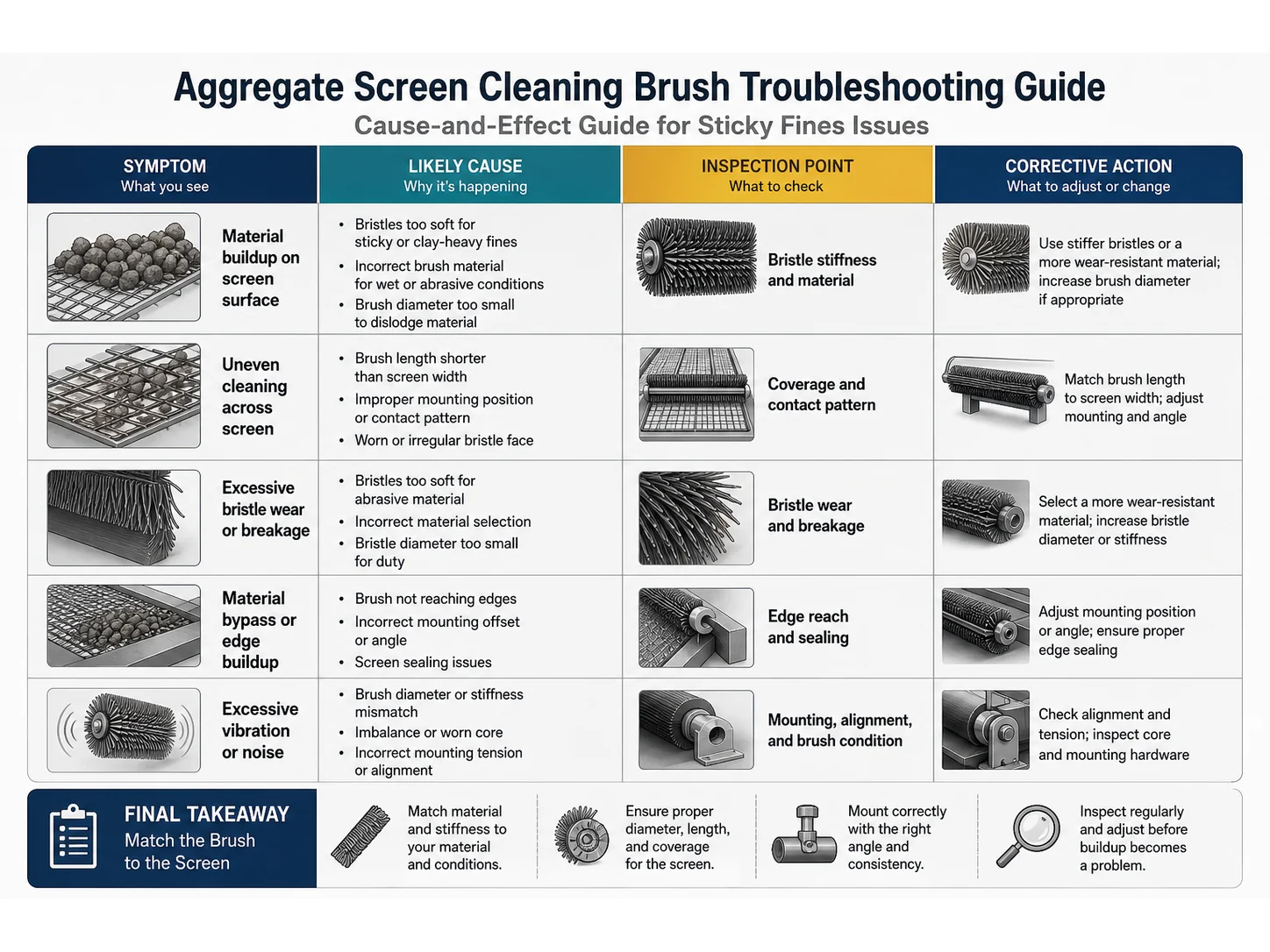
What Is an Aggregate Screen Cleaning Brush?
An aggregate screen cleaning brush is a rotary or stationary bristled tool engineered to mechanically dislodge particles that adhere to screening surfaces. Unlike a simple hand brush or a generic industrial brush, it is designed around specific screen aperture sizes, deck materials, and the rheology of the sticky fines. The brush can be mounted on a motorized shaft that sweeps across the screen, or it can be installed underneath the deck in a tensioned rail system so that the screen’s vibration drives the cleaning action. In both cases, the brush’s diameter, bristle material, filament stiffness, and core construction are the variables that determine cleaning effectiveness and screen wear.
Common Types and Material Options
The bristle material defines how the brush interacts with both the screen surface and the sticky material. Most aggregate screen cleaning brushes use one of four bristle families:
- Nylon (solid or abrasive-filled): High wear resistance, moderate stiffness. Good for moderately abrasive fines on metal or synthetic screens. Abrasive-filled nylon adds a mild cutting action for hardened deposits without aggressive scratching.
- Polypropylene: Softer, chemically inert, and moisture-resistant. Ideal for wet, acidic, or caustic environments where nylon might degrade. Less stiff, so it applies gentler scrubbing pressure.
- Natural fibers (horsehair, Tampico): Very soft and flexible. Used on delicate synthetic screen media, fine mesh under 60 mesh, or when preserving screen surface finish is critical. Soaks up water and chemicals, which can be an advantage in some wet processes.
- Steel wire (carbon, stainless, brass): Stiff, aggressive cleaning for heavy clay, cemented fines, or baked-on residue. Only suitable for robust metal screens such as punch plate or heavy woven wire. Risks screen wear if bristle diameter is too large or if contact pressure is too high.
Brush cores and handles are typically molded polypropylene, aluminum, or steel tubing. Molded cores reduce weight and resist chemical attack. Aluminum cores offer a balance of strength and corrosion resistance. Steel cores are used for heavy-duty flanged brush sections on motorized sweep assemblies.
Material Comparison Table
| Bristle Material | Best For | Screen Compatibility | Stiffness | Moisture / Chemical Resistance | Typical Wear Rate |
|---|---|---|---|---|---|
| Nylon 6/12 | Moderately sticky fines, general aggregate | Woven wire, polyurethane, rubber | Medium | Fair; can absorb some moisture | Low–medium |
| Abrasive nylon | Hardened deposits, light scale | Metal screens, punch plate | Medium–high | Similar to solid nylon | Medium |
| Polypropylene | Wet, acidic, or chemical washdown | All screen types, especially synthetic | Low–medium | Excellent | Medium |
| Horsehair / Tampico | Fine mesh, delicate synthetic screens | Fine woven wire, polyurethane, rubber | Very low | Poor; absorbs water, may swell | High |
| Carbon steel wire | Heavy clay, cemented fines, rough cleaning | Punch plate, heavy woven wire only | Very high | Poor; rusts unless plated | Low on bristle, can wear screen |
| Stainless steel wire | Aggressive cleaning in wet, corrosive environments | Metal screens, wedge wire | Very high | Excellent | Very low |
How to Choose the Right Aggregate Screen Cleaning Brush
Start with the screen surface, not the brush. Ask these five questions in order:
- What is the screen material and aperture size?
Fine mesh and synthetic screens cannot withstand steel. A soft natural fiber or polypropylene bristle is mandatory. Even stiff nylon can cut fine polyurethane screens if the bristle diameter is too large. For heavy punch plate, a steel bristle may be the only option that actually removes clay.
- What exactly is sticking?
Sticky clay responds differently than wet limestone dust or oily asphalt coatings. Dry, electrostatic fines often respond to a soft, fast-moving brush that prevents particle attraction. Wet, cohesive clays need a stiffer bristle that can cut the material cake. Hydrophobic residues may shed better with a low-absorption synthetic bristle.
- What is the brush diameter and fill density?
Brush diameter must be larger than the distance from the brush mounting point to the screen surface, typically 10–25 mm oversize to maintain contact as bristles wear. Dense fills clean more aggressively but can load up with sticky material. An open spiral wound brush may self-clean better in high-moisture applications.
- Is the brush mounted overhead, underneath, or between decks?
Overhead sweep brushes often use larger diameters and must resist sag. Under-screen brushes in tension rails require a secure core locking mechanism. Between-deck brushes need to be sized for confined spaces and may require segmented designs for installation.
- What is the chemical and temperature exposure?
Hot mix asphalt plants may require heat-resistant nylon (up to 250°F/120°C) or wire. Wet screening with acidic process water calls for polypropylene or stainless steel. Simple horsehair will swell, soften, and fail quickly in such conditions.
Common Specification Mistakes
Even with a good material choice, these errors show up repeatedly in field installations and RFQs:
- Assuming one brush fits all screens: Different screen decks on the same plant may need different bristle materials or stiffness. A secondary fines screen often needs a softer brush than the primary scalping deck.
- Choosing by cost drivers per brush instead of life-cycle cost: low-cost natural-fiber brushes wear quickly and require frequent change-outs. An abrasive nylon brush may cost more up front but last five times longer in the right application.
- Ignoring core attachment details: A brush with the correct bristle but a core that does not match the existing drive shaft or tension rail can lead to field modifications, slippage, and early failure. Always confirm bore size, keyway, set-screw pattern, or end-fitting style.
- Skipping a stiffness test: “Medium stiffness” means different things across suppliers. Request a sample or stiffness specification (e.g., filament diameter, gauge, or deflection force) if the application is sensitive. Overly stiff brushes on fine mesh will elongate apertures and destroy screen tension.
- Ignoring brush weight and balance at speed: On high-speed rotary sweep systems, an unbalanced brush can vibrate and wear the drive bearings. Molded cores are lighter and easier to balance than heavy steel pipe cores.
- Overlooking safety and lockout/tagout: Brushes on moving screen decks create pinch points. Designs with exposed set screws or rotating flanges should be evaluated for guarding and maintenance access.
When an Aggregate Screen Cleaning Brush Is the Wrong Choice
A brush cannot solve every blinding problem. Recognize these boundaries:
- Sticky material that re-adheres instantly: If the fines are so cohesive that they smear rather than release, consider surface modifications (e.g., polyurethane screen with tapered openings) or spray bars upstream. A brush will just push the material around.
- Screen deflection beyond brush contact range: If the screen deck flexes more than the brush oversize, the brush loses contact. Reinforcing the screen or using a tensioned under-screen brush with a larger diameter may be required, but a mechanical redesign might be more effective.
- Abrasive wear that destroys bristles within days: In high-silica or high-iron ore applications, even nylon wears quickly. Evaluate tungsten-carbide-tipped brushes or scraper blades as alternatives, though these are harder on screens.
- Complex aperture shapes or slotted screens: A standard rotary brush may not clean the corners of rectangular or slotted openings. A shaped brush or a segmented brush array might be needed, but these often require a custom drawing review and sample testing.
- When the real problem is upstream: If clay balls or wood debris are entering the screen, blinding will continue regardless of brush selection. Fix the scalping or washing step first.
Final Takeaway: Match the Brush to the Screen, Not the cost drivers
Choosing an aggregate screen cleaning brush is a materials-engineering decision disguised as a maintenance purchase. The best brush removes the sticky fines without damaging the screen, fits correctly into the existing drive or rail system, and survives the chemical and moisture environment long enough to justify its cost. Start by identifying the screen surface and the exact nature of the residue, select a bristle material and stiffness that physically can dislodge it without harming the screen, then verify the core, diameter, and mounting geometry before ordering. If the application sits at the boundary—very aggressive residue on delicate mesh, for example—request a sample brush or a supplier drawing review and run a short trial before committing to a full set. The goal is sustained open area, not the lowest brush cost drivers per piece.
Frequently Asked Questions
Can I use the same brush on polyurethane and woven wire screens?
It depends on the bristle material. Soft polypropylene or horsehair can work on both, but a nylon brush stiff enough for wire mesh may cut polyurethane. Test on a small area or use a less stiff bristle for synthetic decks.
How much oversize should a brush have relative to the screen surface?
Typically 10–25 mm of oversize in diameter when new. This ensures contact even as bristles wear. Too much oversize increases drag and can stall the drive motor; too little loses cleaning effectiveness early.
What is the difference between a rotary sweep brush and an under-screen tension brush?
A rotary sweep brush is driven by a motor and travels across the top of the screen deck. An under-screen brush is mounted below the deck, often in a rail, and uses the screen’s vibration to move the brush against the underside of the mesh. Rotary brushes are more common for heavy blinding; under-screen brushes are simpler and self-cleaning.
How do I know if I need a stiff brush or a soft brush?
Start with the screen mesh. Fine mesh (above 40 mesh) and synthetic screens need soft bristles. Coarse heavy-duty screens can tolerate stiff bristles. Then consider the residue: sticky, cohesive material requires more stiffness to break the bond, while dry, friable fines may need only a light sweep.
Can I request a custom brush diameter or core configuration?
Yes, most manufacturers offer custom diameters, fill materials, and core designs (e.g., specific bore sizes, keyways, or flanged mounts). Provide a detailed drawing or a sample of the existing brush to avoid interface mistakes.
Why does my brush wear out in a few days?
Common causes: highly abrasive material (high silica or sharp aggregate), incorrect bristle material for the abrasive load, excessive oversize causing constant heavy pressure, or chemical degradation from process water. Switching to an abrasive-filled nylon or a wire brush, reducing oversize, or changing to a chemically resistant material can extend life.
Is it safe to run a wire brush on a vibrating screen?
Only if the screen deck is designed for it. Wire bristles can scratch, wear, or catch on screen openings, creating safety hazards if a bristle breaks and becomes a projectile. Always use wire brushes on robust metal screens only, and inspect regularly for loose or broken wires.
What should I include in an RFQ for aggregate screen cleaning brushes?
Specify brush overall length, diameter, bristle material, core material, bore size and attachment style, fill style (spiral or solid), and the screen type and aperture size you are cleaning. Adding a photo of the residue and screen deck helps the supplier validate the recommendation.
Technical References
- OSHA — Machine Guarding
- OSHA — Control of Hazardous Energy
- OSHA — Combustible Dust
- EPA — Particulate Matter Basics
- OSHA — Respirable Crystalline Silica
Which bristle material fits this job — Nylon PA, Horsehair or AISI 304 Stainless Steel Wire?
| Material | Continuous temperature (°C) | Peak temperature (°C) | Water absorption | Hardness |
|---|---|---|---|---|
| Nylon PA | 93 | 121 | 0.3–9% by PA grade and conditioning | Medium to firm; filament diameter and trim length control bending force. |
| Horsehair | 60–80 | 100–120 | 8–15% | — |
| AISI 304 Stainless Steel Wire | 400 | 500 | 0% | Rockwell B 70–95 depending on temper and cold work |
| Abrasive Nylon | 120 | 150 | 0.1–1.0% | Abrasive filament; stiffness and cutting level is controlled by PA base, grit type, grit size, filament diameter and trim height. |
| Polypropylene PP | 80–100 | 120–140 | ≤0.03% | Shore D 65–75 |
Figures as published by Brushtec / DuPont; Alleima; Perlon. Confirm the exact grade against the supplier datasheet before ordering.
What should replace Roller and Conveyor Brushes for aggregate screen cleaning brush?
- Roller and Conveyor Brushes — Roller and conveyor brushes hold cylindrical line contact across a working width, including helix-wound builds where the filament path is set to move loosened material toward one side; a strip brush holds the same line without rotating, so it seals or wipes but cannot carry residue along the width.
- Nylon PA — Compare Nylon PA with PP, PBT, PET. Change material when wet stiffness, temperature, chemical resistance, conductivity, particle shedding, or surface marking becomes the limiting factor.
- Horsehair — Compare Horsehair with Boar bristle, goat hair, microfiber. Change material when wet stiffness, temperature, chemical resistance, conductivity, particle shedding, or surface marking becomes the limiting factor.
- AISI 304 Stainless Steel Wire — Use AISI 316 stainless steel wire for chloride, marine, dairy, beverage, chemical washdown, or higher pitting-resistance requirements. Use carbon steel for dry aggressive cutting and brass or abrasive nylon for lower marking risk.