What Is a Feeder Bottle Brush?
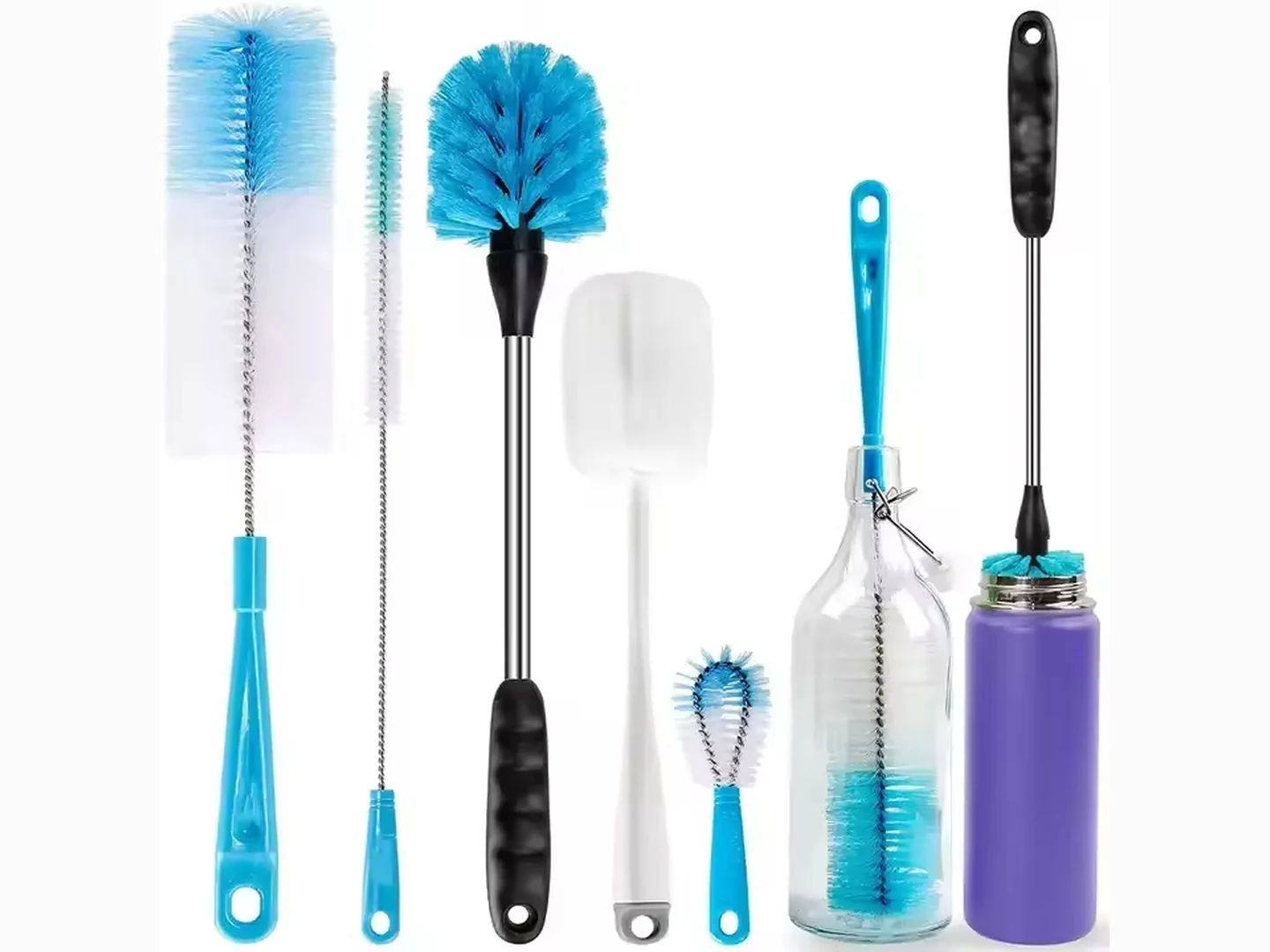
A feeder bottle brush is a specialized cleaning brush built for industrial feeders and hoppers handling dry bulk solids. Unlike a kitchen bottle brush, it uses durable materials and constructions to withstand frequent use, chemical exposure, or high temperatures. The brush typically consists of a central core or handle with bristles that conform to cylindrical or tapered feeder necks. It removes residual material without damaging sensitive linings, sensors, or coatings.
Why Sticky Fines Demand a Different Approach
For kitchen cleaning examples, the FDA — Food Safety in Your Kitchen supports the distinction between normal cleaning, food handling, and hygiene habits.
For general foodborne-illness prevention language, the CDC — Preventing Food Poisoning is used as the public-health reference.
For the material or regulatory boundary in this section, the supporting reference is eCFR — 21 CFR 177.1500 Nylon Resins.
For the material or regulatory boundary in this section, the supporting reference is eCFR — 21 CFR 177.1520 Olefin Polymers.
For the material or regulatory boundary in this section, the supporting reference is eCFR — 21 CFR 177.1630 Polyethylene Phthalate Polymers.
For the safety point in this section, the relevant OSHA reference is OSHA — Machine Guarding.
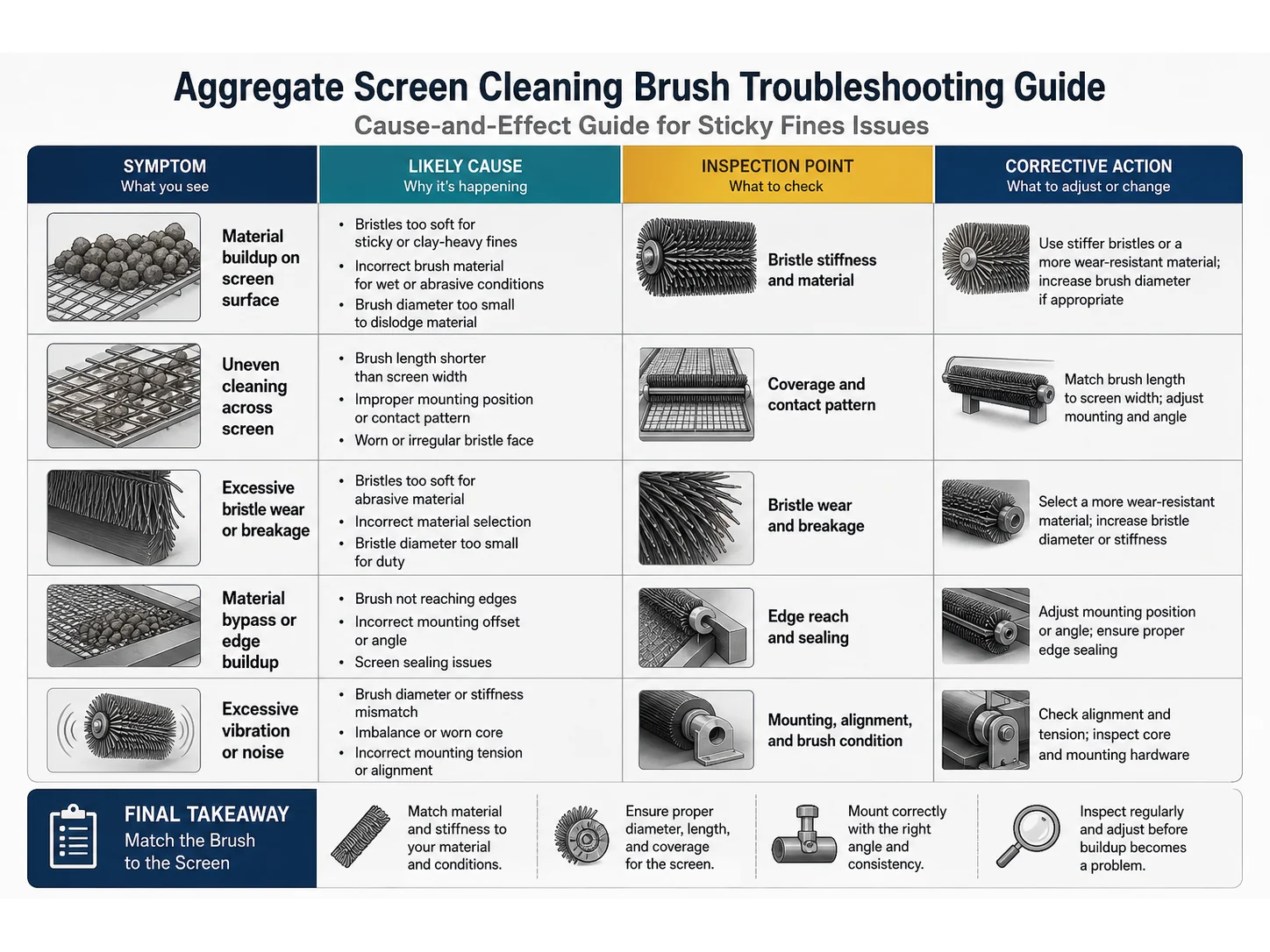
Sticky fines—such as hygroscopic powders, fatty food ingredients, or statically charged pigments—adhere aggressively to surfaces. A standard dry brush often smears or compacts the layer instead of removing it. Effective cleaning may require a brush with chemical-resistant bristles, a configuration that reaches all corners, and a stiffness that scrapes without scratching. Ignoring the stickiness factor leads to buildup that eventually shuts down the process line.
Common Brush Material Options
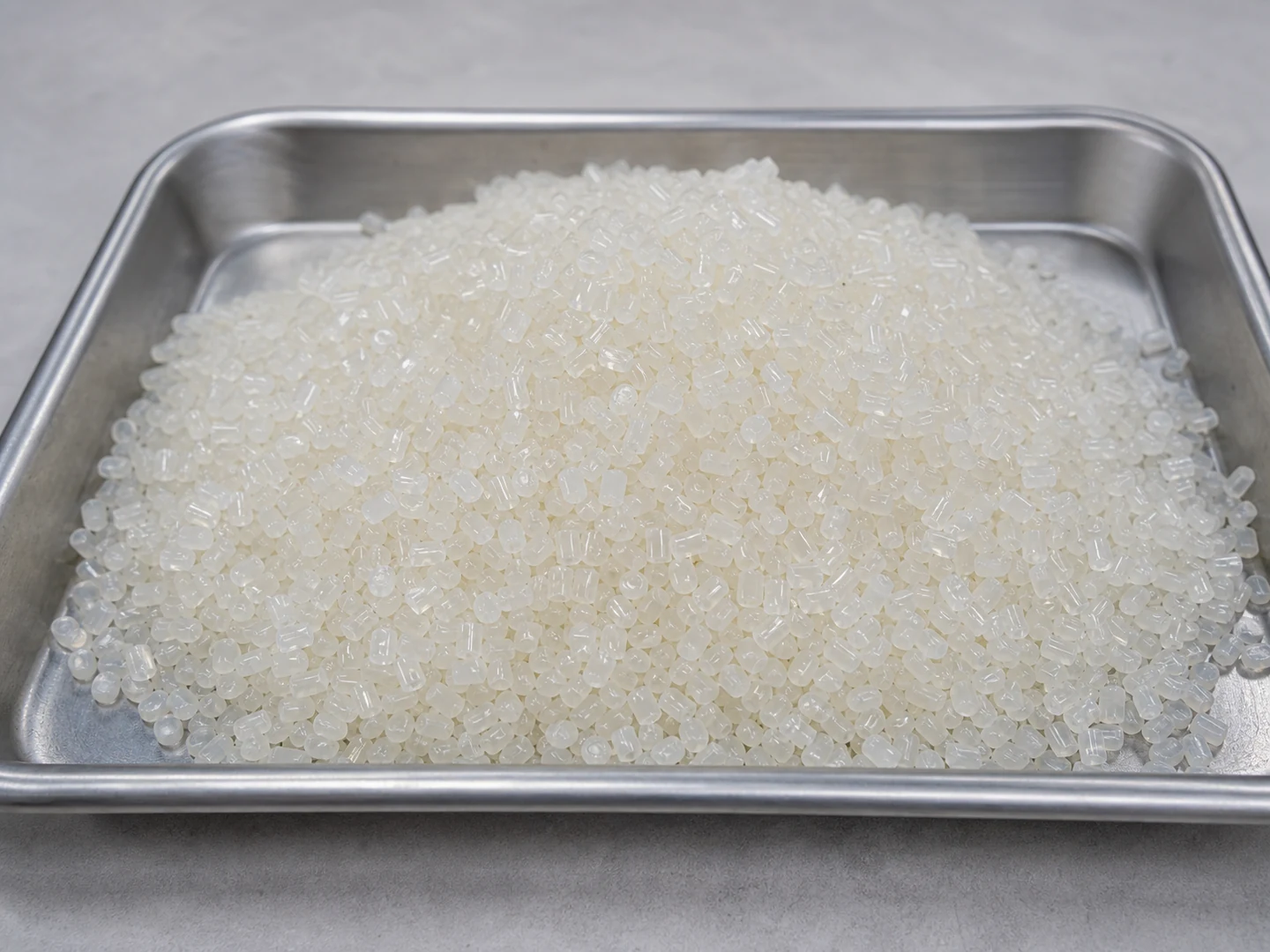
Bristle material drives chemical compatibility, temperature resistance, and abrasiveness. The most common industrial options are:
| Material | Stiffness | Chemical Resistance | Temperature Limit | Typical Use |
|---|---|---|---|---|
| Nylon | Medium-soft | Good, limited with strong acids | ~120°C | Food powders, general chemicals |
| Polypropylene | Soft | Excellent against acids/alkalis | ~90°C | Wet chemical lines, humid areas |
| Polyester | Medium-stiff | Good, better than nylon for acids | ~150°C | Hot fine powders, abrasive dusts |
| Tampico (natural fiber) | Medium | Poor, degrades with moisture/chem | ~80°C | Low-abrasion dry fines, gentle scrub |
| Stainless Steel | Very stiff | Excellent | Up to 300°C | Baked-on or hardened residues |
| Brass | Stiff | Moderate, sparks risk | ~150°C | Non-sparking applications excluded |
Diameter and Stiffness: Sizing for Performance
The brush diameter must be slightly smaller than the feeder’s internal opening to allow insertion without jamming, yet large enough to make firm contact with the walls. Stiffness depends on bristle material, filament thickness, and trim length. A brush that is too stiff can scratch soft liner coatings or polish surfaces, making future cleaning harder. A brush that is too soft may not remove caked fines. Always test on a small area or request material samples.
- Measure the feeder’s smallest internal diameter and choose a brush 1–2 mm smaller.
- For heavily caked residues, consider stiffer bristles or a spiral-wound brush with shorter trim.
- For sensitive PTFE or ceramic coatings, use soft polymer bristles (nylon or polypropylene).
Handle and Core: Durability Meets Hygiene
The handle and core must survive repeated pushing, twisting, and pulling, often while wet or coated in fines. Common constructions include:
- Twisted-in-wire: A galvanized or stainless steel wire core with bristles captured between twisted wires. Long-lasting and easy to shape, but may trap material in the wire.
- Plastic handle with tufted head: Injection-molded handle with heat-set bristle tufts. Smooth surface that is easy to clean, suitable for food or pharmaceutical areas.
- Replaceable brush heads: A handle with a threaded or snap-on brush head, reducing full brush replacement cost when bristles wear.
- Loop handle: A wire loop at the end for hanging or attaching a pull cord. Helpful for deep feeders or confined access.
Mounting: Manual vs. Machine-Driven
Feeder bottle brushes can be used manually or attached to a rotary tool, pneumatic motor, or automated cleaning arm.
- Manual cleaning: Best for low-volume lines or frequent but quick wipe-downs. Handle length must match operator reach.
- Machine-driven: When cleaning cycles are short or labor cost is high, a brush mounted on a shaft and driven at controlled speed ensures uniform cleaning. Requires precise concentricity and balancing.
- Static brushes (fixed in place): A brush ring or segment brush installed inside the feeder neck that continuously wipes turning components. Not a replacement for deep cleaning but reduces buildup.
Key Selection Factors for Sticky Fines
When sticky fines are the main challenge, rank these factors in order of importance for your process:
- Residue chemistry: Is the fine acidic, alkaline, hygroscopic, oily? This decides bristle material and rinse compatibility.
- Surface sensitivity: Polished 316L stainless steel, PTFE coating, or rubber gaskets each need different brush stiffness to avoid damage.
- Feeder geometry: Measure the narrowest neck, any internal baffles, or probe ports that the brush must bypass.
- Cleaning method: Dry brush only, or will you use water, detergent, solvent? Ensure the brush core and handle can handle the chemical and moisture.
- Hygiene standards: For food, dairy, or pharma, choose brush materials that comply with relevant regulations (e.g., FDA 21 CFR, EU 10/2011). Request documentation from the supplier.
- Frequency of cleaning: Daily scrubbing with abrasive media needs harder wearing bristles; infrequent heavy cleaning may favor aggressive stiffness.
- Custom size requirements: If off-the-shelf brushes do not match your feeder dimensions, plan for a custom diameter, length, or bristle profile. Provide a scale drawing with critical dimensions to the brush manufacturer.
Common Mistakes in Brush Selection
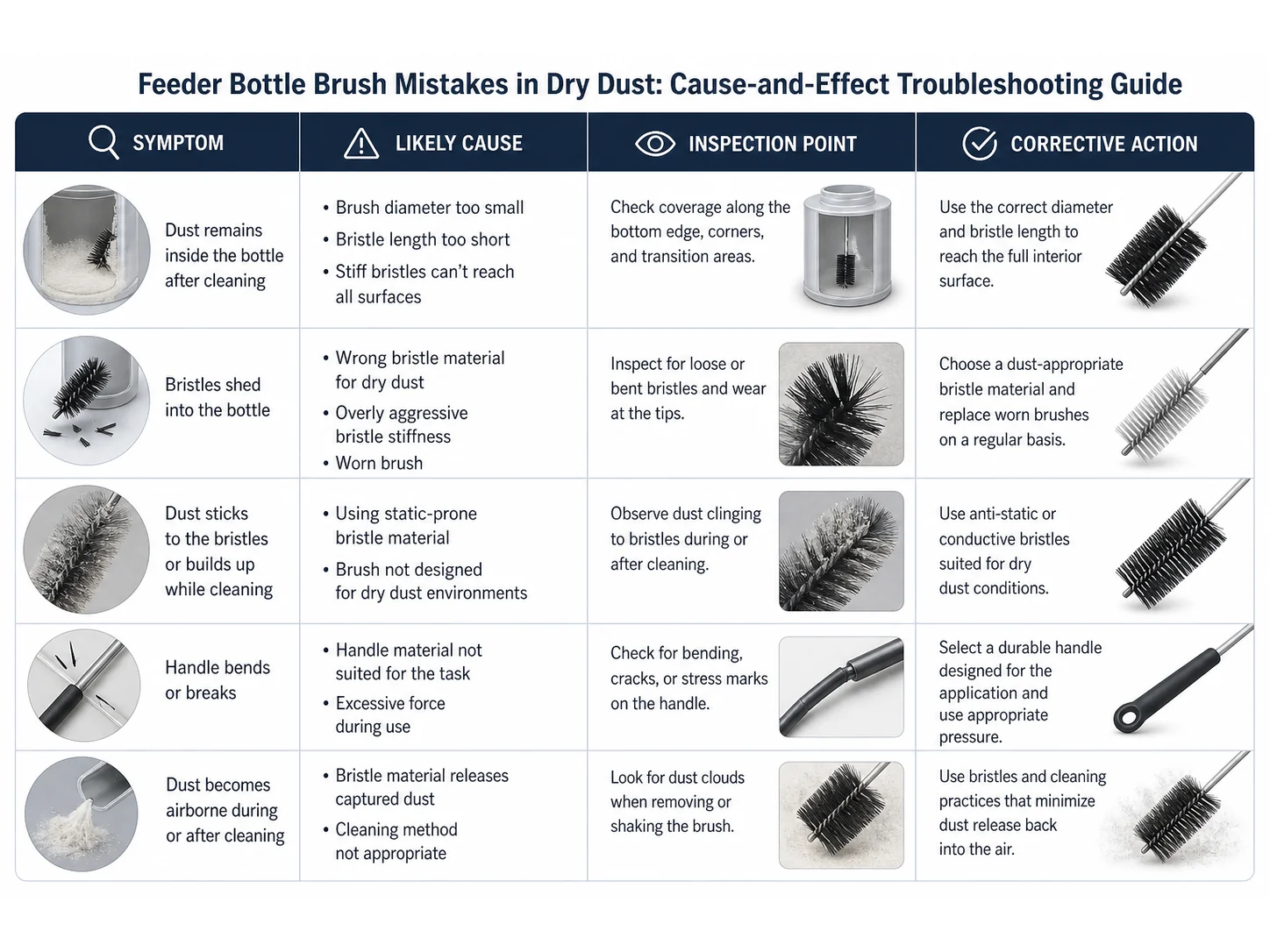
- Choosing by cost drivers alone: A low-cost brush that sheds bristles or damages your feeder liner costs far more in downtime and product contamination.
- Ignoring diameter tolerances: A brush that is too tight seizes inside the feeder; one too loose leaves a film of fines.
- Using the wrong bristle material: A natural fiber brush in a wet chemical line rots quickly, while a stiff steel brush on a plastic liner gouges the surface.
- Overlooking handle length: A handle that is too short forces the operator to reach into the equipment, risking injury or incomplete cleaning.
- Assuming one brush fits all: Different parts of the feeder (neck, cone, discharge) may require separate brush styles or angles.
When a Feeder Bottle Brush Is Not Enough
A feeder bottle brush solves many buildup problems, but it has limits. Recognize when a different approach is needed:
- Hardened or baked-on layers: If the residue carbonizes or crosslinks, a brush alone cannot remove it. Consider a pre-soak with solvent or an ultrasonic bath before manual scrubbing.
- Complex internal features: Feeders with multiple ports, level probes, or agitators may need a combination of brush styles, scrapers, or foam swabs. A single bottle brush misses critical areas.
- High-hygiene validated systems: In aseptic or pharma filling, a brush is only a pre-clean tool. Final cleaning validation must come from a CIP/SIP system. The brush material must be compatible with the cleaning chemistry and not leave any residue behind.
- Non-standard dimensions: If your feeder’s internal shape is proprietary or tapered uniquely, an off-the-shelf brush will not match. At this stage, request a custom drawing and perhaps a sample prototype from the manufacturer. The supplier will need the exact inner profile, material of construction, and operating conditions.
Final Takeaway
Selecting a feeder bottle brush for sticky fines starts with the residue and the surface, not with the brush catalog. Match bristle material to chemical and temperature needs, confirm the diameter allows full insertion without hurting the feeder lining, and decide whether manual or machine-driven operation fits your maintenance schedule. When standard brushes fall short because of geometry, hardness, or hygiene, involve a supplier early for a custom design and sample test. The right brush keeps fines moving and your line running without surprise failures.
Frequently Asked Questions
What bristle material works best for sticky food powders?
For food contact, choose nylon or polyester bristles from a supplier that can document FDA-compliant raw materials. Polypropylene is also common in wet food environments. Always verify that the specific grade meets your regulatory requirements.
How often should I clean a feeder that handles sticky fines?
Frequency depends on buildup rate, but many processors clean between product changeovers, at the end of a shift, or whenever flow sensors indicate bridging. Sticky materials often demand daily attention.
Can I use the same brush for dry and wet cleaning?
Yes, if the bristle material absorbs minimal moisture and resists the cleaning chemicals. Nylon, polypropylene, and polyester are common choices. Avoid natural fibers like tampico for wet applications.
How do I know if I need a custom brush size?
If your feeder’s internal diameter or neck profile does not match standard brush offerings (e.g., non-circular cross-section, extra-long reach), a custom brush is likely needed. Send a dimensional drawing and photos to a brush manufacturer for a feasibility check.
Will a stainless steel brush damage my plastic feeder?
Yes, steel bristles will scratch plastic surfaces, creating grooves where fines collect and bacteria can harbor. For plastic feeders, use polymer bristles such as polypropylene or soft nylon.
How can I prevent the brush from shedding bristles during cleaning?
Look for brushes with durable anchoring: twisted-in-wire construction with a crimped core, or heat-set tufted bristles in a molded head. Avoid brushes with glued-only bristles in high-temperature or chemical environments.
What should I check if the brush still leaves a film of fines?
First, confirm the brush diameter fills the feeder space with slight friction. If the film remains, the bristle stiffness may be too low, or the residue may need a cleaning agent. In some cases, a secondary wipe with a lint-free cloth or a different brush type (e.g., a paddle brush) can complete the job.