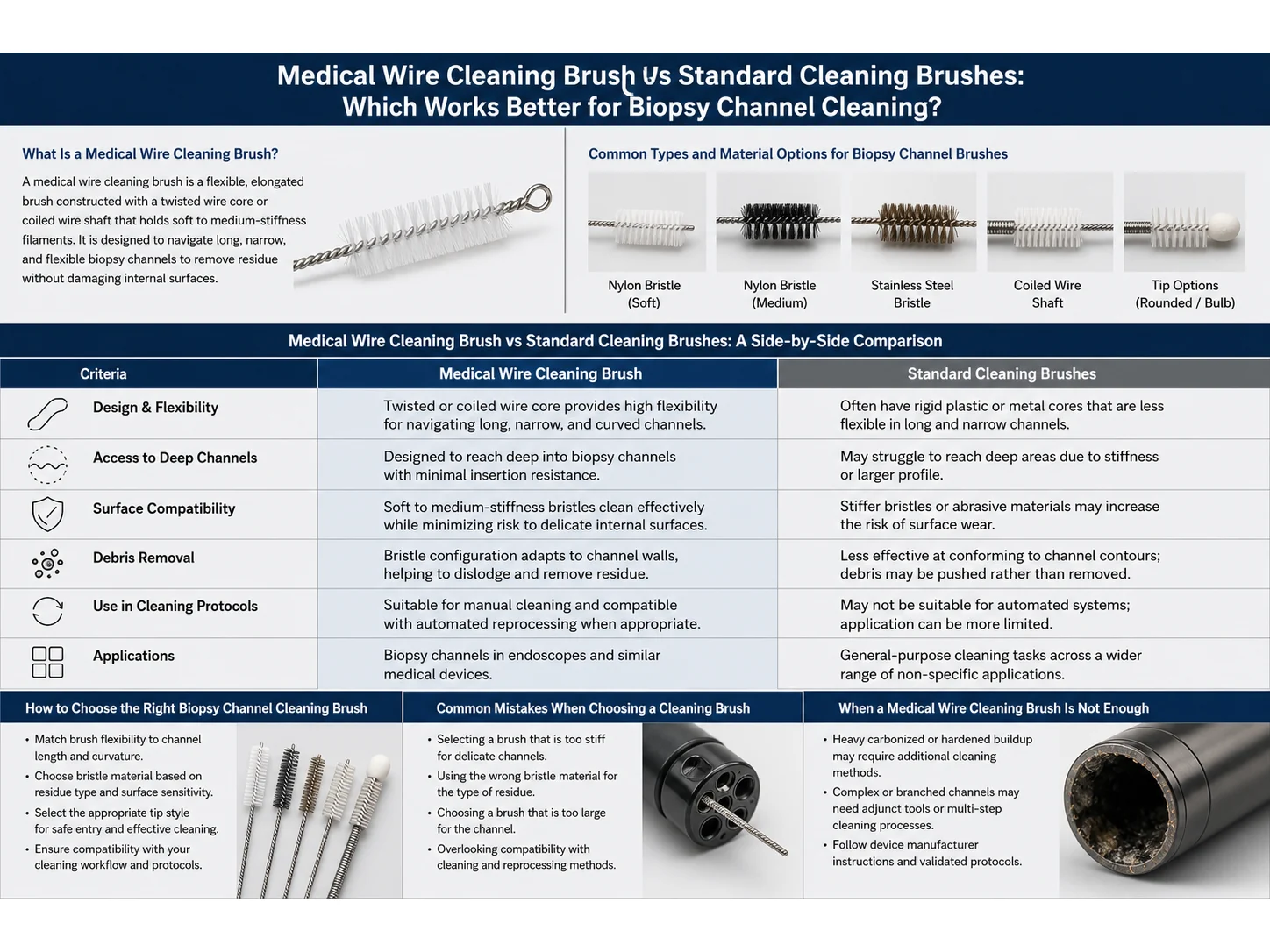
What Is a Medical Wire Cleaning Brush?
A medical wire cleaning brush is a flexible, elongated brush constructed with a twisted wire core or coiled wire shaft that holds soft to medium-stiffness bristles, intended for cleaning narrow lumens in medical devices, particularly endoscope biopsy channels, suction channels, and air/water channels. Unlike general-purpose wire brushes, medical wire brushes prioritize atraumatic cleaning, chemical compatibility, and debris removal without scratching delicate internal linings. They are often single-use or validated for a specific number of reprocessing cycles.
Common Types and Material Options for Biopsy Channel Brushes
For reusable medical-device cleaning claims, the practical boundary is the device maker’s validated instructions and the FDA — Reprocessing Medical Devices in Health Care Settings rather than a brush-only rule.
For healthcare cleaning language, this article keeps its claims within the general boundary of the CDC — Disinfection and Sterilization Guideline, which is written for disinfection and sterilization in healthcare facilities.
Where the article discusses healthcare settings rather than ordinary cleaning, the CDC — Core Infection Prevention and Control Practices is used as the general infection-control frame.
For brush terminology and construction language, this section references American Brush Manufacturers Association — Brush Lingo.
Medical wire cleaning brushes come in several configurations, each suited to different channel sizes, residue types, and cleaning methods:
- Bristle material: Nylon, polyester, or polypropylene bristles offer chemical resistance and gentle scrubbing. Natural hair bristles are sometimes used for ultra-soft channels.
- Brush tip shape: Radial brushes have bristles radiating outward for circumferential cleaning; spiral brushes use a helical bristle pattern for longer channel coverage; end brushes focus on cleaning the distal tip.
- Handle or hub design: Loop handles facilitate manual twisting, straight handles provide grip for linear strokes, and some brushes have no handle for use in automated endoscope reprocessors (AER).
- Core material: Twisted stainless steel wire is common; coated wire or monofilament plastic cores reduce the risk of scratching.
- Size range: Diameters typically range from 1.0 mm to 3.2 mm, with lengths up to 2300 mm, carefully matched to specific endoscope models.
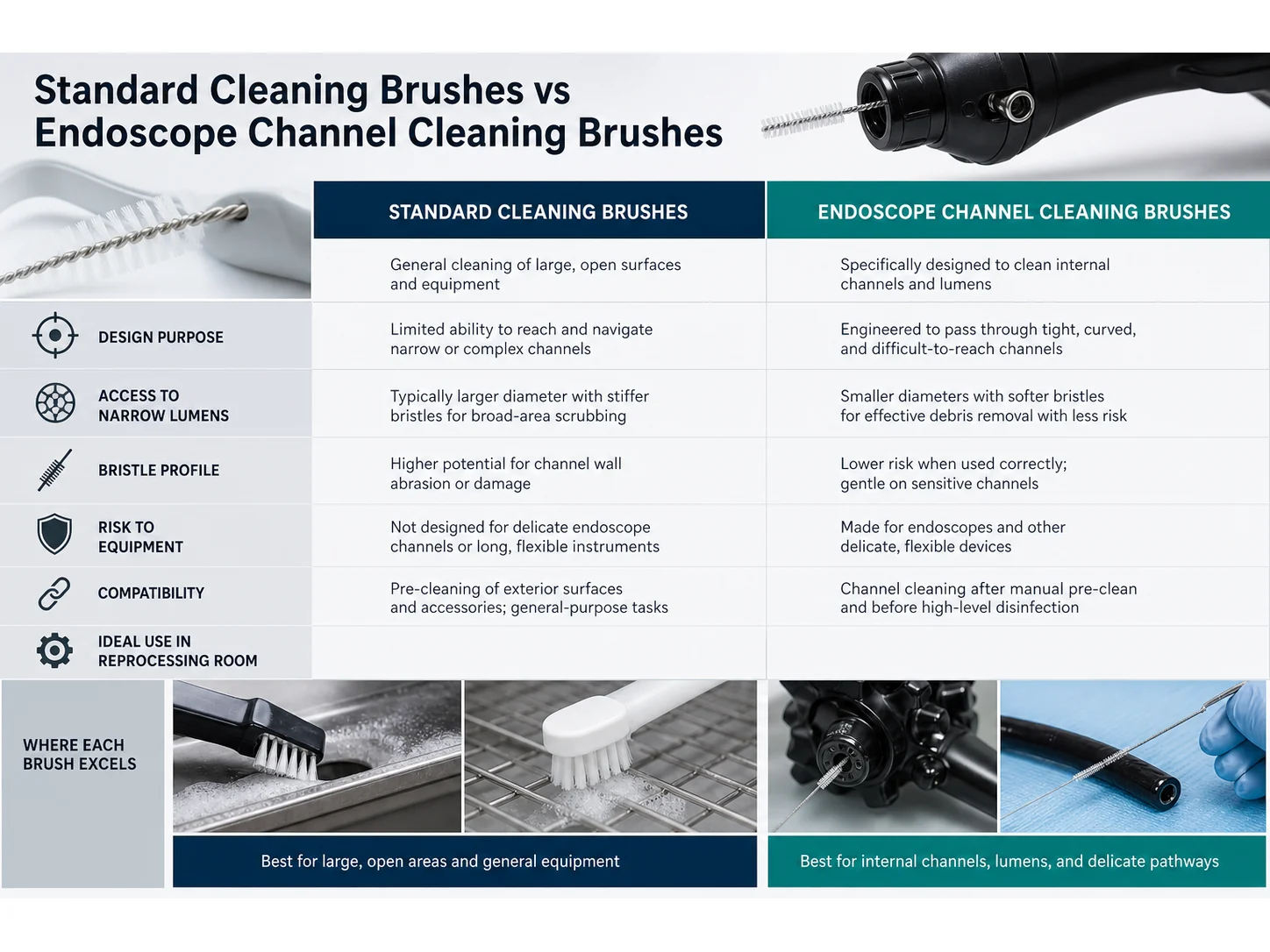
Medical Wire Cleaning Brush vs Standard Cleaning Brushes: A Side-by-Side Comparison
The table below highlights key differences between a medical wire cleaning brush and common standard brushes to guide your decision.
| Factor | Medical Wire Cleaning Brush | Standard Wire Brush (Industrial) | Standard Nylon Tube Brush |
|---|---|---|---|
| Intended use | Endoscope biopsy channel reprocessing | General metal surface cleaning, deburring | Cleaning pipes, tubing, or lab equipment |
| Bristle material | Soft nylon, polyester, or natural hair | Hard steel, stainless steel, or brass wire | Medium-stiff nylon or polyester |
| Shaft design | Flexible twisted wire or coated core | Rigid twisted wire or straight shaft | Flexible twisted wire, often uncoated |
| Diameter precision | ±0.1 mm tolerance for channel fit | General sizing, not precision | Nominal tube sizing, less precise |
| Risk of channel damage | Very low (designed to be atraumatic) | High (metal bristles scratch and abrade) | Moderate (bristles may be too stiff) |
| Chemical compatibility | Validated for enzymatic cleaners, HLDs | May corrode or degrade in disinfectants | Variable; check material specs |
| Typical cost per use | Higher (single-use or limited reuse) | Lower (long-life, reusable) | Low to moderate (reusable) |
| Reusability | Single-use or manufacturer-validated cycles | Reusable until bristle wear | Reusable, cleanable |
How to Choose the Right Biopsy Channel Cleaning Brush
Selecting the correct medical wire cleaning brush requires evaluating several practical factors:
- Channel diameter and length: Measure the biopsy channel exactly. The brush must match the manufacturer’s specification to avoid jamming or incomplete cleaning. Brushes are often labeled by endoscope model.
- Residue type: Soft, freshly deposited bioburden may only need a gentle brush. Dried or sticky debris may require a slightly stiffer bristle, but never metal.
- Chemical exposure: Confirm the bristle and core material can withstand your enzymatic cleaners, detergents, and high-level disinfectants (e.g., glutaraldehyde, peracetic acid).
- Cleaning method: Manual cleaning with a handle vs. use in an AER. Brushes for AERs often have a specific hub design.
- Single-use vs. reusable: Single-use eliminates cross-contamination risk but increases cost. Reusable brushes require validated cleaning and sterilization between uses.
- Custom sizing: If your endoscope has a non-standard channel, work with a supplier to review drawings and create a custom wire brush. Provide exact diameter, length, tip shape, and handle requirements.
Common Mistakes When Choosing a Cleaning Brush for Biopsy Channels
- Assuming any wire brush will work: Industrial wire brushes can scratch the channel, creating biofilm harborage and leading to costly repairs.
- Ignoring brush diameter tolerance: A brush that is too large can get stuck; too small leaves behind debris. Always verify with the endoscope IFU.
- Using worn or damaged brushes: Bent bristles, frayed wires, or kinked shafts reduce cleaning efficacy and may shed contaminants.
- Not verifying chemical compatibility: Harsh disinfectants can degrade bristles, causing them to fall out or release particles.
- Choosing cost drivers over performance: A low-cost, non-medical brush may pass inspection but eventually causes channel damage or infection risk.
- Skipping manufacturer guidelines: Endoscope manufacturers provide validated brush specifications; ignoring them can void warranties or compromise safety.
When a Medical Wire Cleaning Brush Is Not Enough
While a medical wire cleaning brush is essential, it has limitations. If the biopsy channel has dried, calcified debris or established biofilm, mechanical brushing alone may not suffice. In such cases, a prolonged enzymatic soak or automated flushing process must precede brushing. For channels with tight bends or scope models not listed by standard brush suppliers, a custom brush designed from a supplier drawing review may be needed. Additionally, if the channel shows signs of damage or ongoing contamination despite proper brushing, an expert inspection or borescope evaluation should be considered to rule out internal tears or manufacturing defects.
Final Takeaway
For safe and effective biopsy channel cleaning, a purpose-designed medical wire cleaning brush is the clear choice over standard wire or tube brushes. Its atraumatic bristles, precise sizing, chemical compatibility, and adherence to medical reprocessing standards help maintain endoscope integrity and patient safety. When selecting a brush, prioritize accurate channel measurements, material validation, and compatibility with your cleaning workflow. A disciplined selection process will protect both patients and expensive endoscopic equipment.
Practical Use Note
In daily use, the practical test is simple: check whether the brush reaches the full contact area, removes the target residue, and leaves the surface in the required condition. Record what changes when access shape, residue type, manufacturer instructions, and whether the task is general cleaning or validated reprocessing changes, because many brush failures are caused by the working condition shifting rather than by the brush body alone.
Frequently Asked Questions
Can I use a standard test tube brush instead of a medical wire cleaning brush?
No. Standard test tube brushes are typically thicker, stiffer, and not designed for the delicate inner linings of endoscope biopsy channels. They can scratch or abrade the channel, leading to biofilm accumulation and potential device failure.
What bristle material is safest for endoscope channels?
Soft nylon, polyester, or natural goat hair are common and safe for flexible endoscope channels. These materials provide adequate scrubbing without scratching. Always confirm compatibility with your cleaning chemicals.
How do I determine the correct brush diameter for my biopsy channel?
Check the endoscope manufacturer’s instructions for use (IFU). The recommended brush diameter and length are usually listed. If not available, use a bore gauge to measure the internal diameter and consult with a brush supplier who can match the tolerance required.
Is a reusable medical wire cleaning brush as safe as a single-use brush?
Reusable brushes can be safe if they are properly cleaned, disinfected, and sterilized between uses, following validated protocols. However, single-use brushes eliminate the risk of cross-contamination and avoid the time and validation burden of reprocessing. Many facilities now prefer single-use for critical channels.
What happens if I use a brush with metal bristles in an endoscope channel?
Metal bristles will scratch and damage the inner lining of the channel. These scratches can trap soil and bacteria, making effective cleaning impossible and increasing the risk of infection. Never use metal-bristled brushes inside flexible endoscope channels.
How often should biopsy channel brushes be replaced?
Replace single-use brushes after one procedure. Reusable brushes should be inspected before each use and discarded at any sign of wear: bent bristles, kinked wire, corrosion, or bristle loss. Many manufacturers specify a maximum number of uses or a replacement interval.
Can a wire brush cause damage to an endoscope biopsy channel?
A properly designed medical wire cleaning brush with soft, non-metallic bristles and a coated or smooth core should not cause damage. Damage occurs when brushes are incorrect in size, material, or condition. Always follow the equipment IFU and inspect brushes before use.
What is the difference between a radial brush and a spiral brush for channel cleaning?
A radial brush has bristles that extend evenly around the circumference in a ring pattern, providing thorough contact in a short section. A spiral brush positions bristles in a helical arrangement, which often makes it easier to pass through longer channels and pull debris outward. The choice depends on channel length and specific cleaning protocol.