
What Is Wet Material Carryback on Cement Conveyors?
Wet material carryback is the layer of moist, sticky cement, clinker, or aggregate that adheres to the belt surface after the main discharge point and gets carried back along the return side of the conveyor. This buildup can cause belt mistracking, increased wear on rollers and pulleys, safety hazards from spillage, and higher maintenance costs. Standard brushes often fail to clean effectively when moisture turns cement into a paste that fills bristles and hardens.
How Cement Conveyor Cleaning Brushes Solve the Problem
Cement conveyor cleaning brushes are engineered with specific bristle materials, stiffness, and mounting configurations to handle abrasive, wet, and often chemically aggressive residues. Unlike standard brushes, they maintain cleaning contact without damaging the belt surface, and they resist loading or clogging when exposed to sticky materials. Many feature reinforced cores, quick-change hubs, and adjustable mounts for use on heavy-duty conveyor systems.
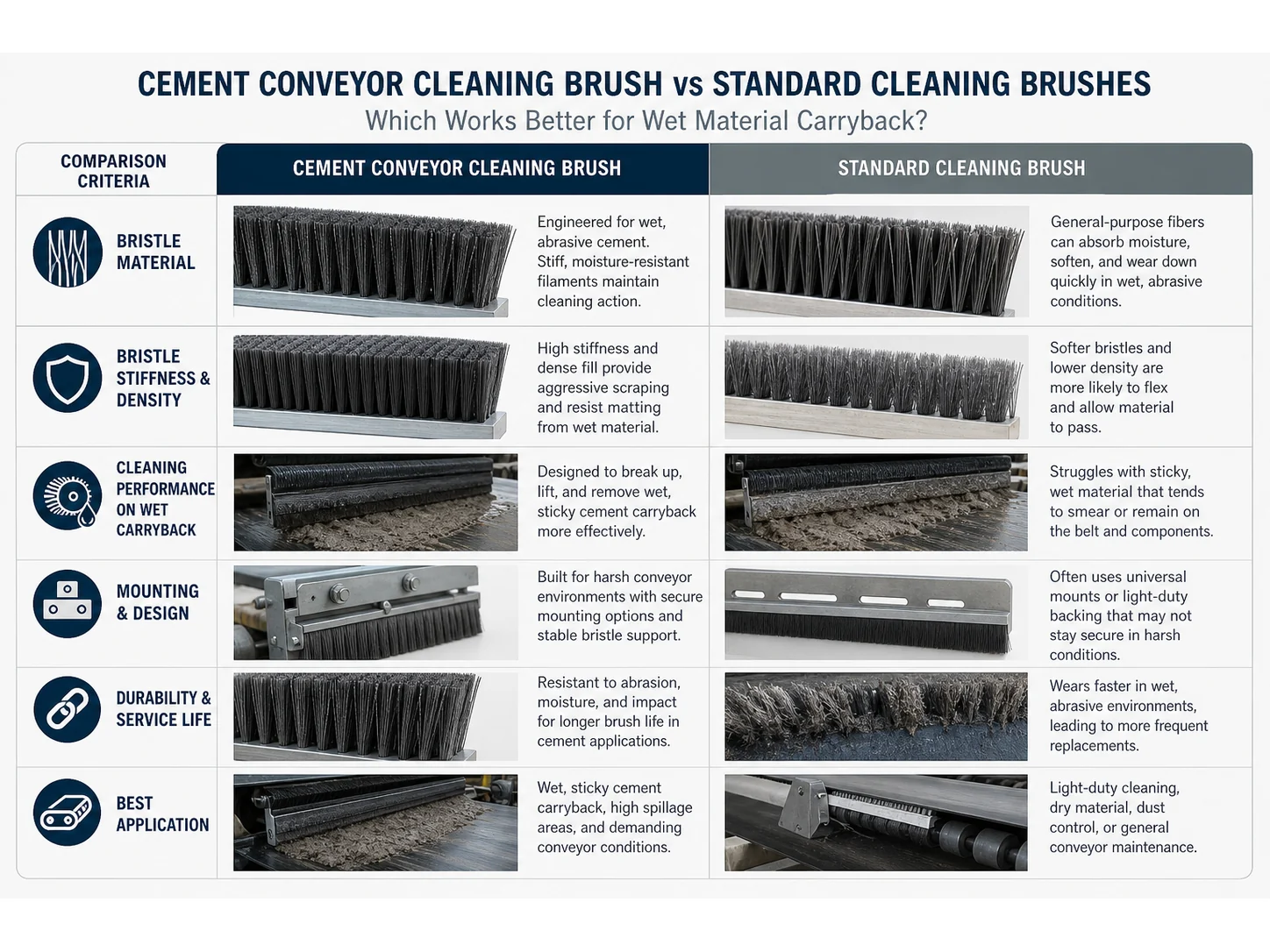
Cement Conveyor Cleaning Brush vs Standard Cleaning Brushes: Key Differences
| Feature | Cement Conveyor Cleaning Brush | Standard Cleaning Brush |
|---|---|---|
| Bristle Material | Abrasion-resistant nylon, polypropylene, or wire blends designed for high moisture and chemical exposure | General-purpose nylon, polyester, or natural fibers, often less chemical-resistant |
| Stiffness | Medium to extremely stiff, depending on residue type; often custom-tuned | Wide range, but typically less aggressive to avoid belt damage |
| Core / Handle | Heavy-duty steel or aluminum cores with keyed or splined drive ends for direct machine mounting | Standard shaft or molded hub; may require adapters for industrial conveyors |
| Mounting | Flange, pillow block, or linear actuator mounts; designed for continuous, high-load use | Simple bolt-on or clamp mounts; may not withstand constant heavy pressure |
| Resistance to Moisture & Abrasion | Sealed bearings, corrosion-resistant components, and bristles that shed water and resist packing | Often unsealed; moisture can lead to rust, bristle clumping, and premature failure |
| Typical Use Case | Wet cement, clinker, limestone, fly ash on heavy conveyors in harsh environments | Dry, light, or non-abrasive materials on smaller conveyors or in food processing |
How to Choose the Right Cleaning Brush for Wet Cement Carryback
Selecting the best brush means looking beyond product labels and evaluating real operating conditions. Use this checklist to guide your decision:
- Residue type and moisture content: Paste-like cement requires stiffer, more open bristle configurations to prevent clogging.
- Belt surface and speed: Abrasive or textured belts may need softer bristles to avoid damage, but faster lines demand higher stiffness and larger diameters for effective contact.
- Equipment interface: Verify that the brush core diameter, keyway, and mounting pattern match your conveyor frame and drive system.
- Chemical or water exposure: Washdown areas or chemical dusts call for stainless steel cores and chemically inert bristles (e.g., polypropylene).
- Hygiene expectations: For plants with strict dust control, brushes should minimize bristle shedding and be easy to clean or replace.
- Maintenance frequency: Quick-change designs reduce downtime; consider a conveyor belt brush cleaning system that allows tool-free roll swaps.
- Custom sizing: Off-the-shelf brushes often fail in non-standard installations. Work with a supplier who can adjust brush diameter, face length, and bristle pattern based on your drawings and sampling data.
Common Mistakes When Selecting Cement Conveyor Cleaning Brushes
- Choosing by cost drivers or generic specifications alone. A low-cost standard brush may last only days in wet cement, while a purpose-built brush can run for months with proper adjustment.
- Ignoring bristle memory and fatigue. Standard brushes often take a permanent set and lose effectiveness quickly under constant pressure.
- Overlooking the mounting interface. A brush that fits the roll diameter but not the shaft key or bearing mounts creates unnecessary retrofit work.
- Assuming water absorption isn’t an issue. Natural fibers absorb moisture, swell, and lose stiffness; even some nylons can degrade when wet for extended periods.
- Not planning for tension and tracking. Even the best brush fails if it cannot maintain consistent contact across the belt width due to poor tensioning.
When a Cement Conveyor Cleaning Brush Is the Wrong Choice
In extreme cases—such as belts carrying highly cohesive materials with high clay content or when carryback has already compacted into hard deposits—a brush alone may not solve the problem. Additional steps may be needed:
- Pre-cleaner scrapers to remove the bulk of the carryback before brushing.
- Wash boxes or spray systems to soften residues prior to mechanical cleaning.
- Belt tracking devices and improved skirting to prevent material from reaching the return side in the first place.
- Engineering review by the brush manufacturer to test different bristle materials, diameters, or patterns through a sample testing program.
If your conveyor operates under high-pressure washdown, extreme temperatures, or chemical attack, request a custom drawing review from your brush supplier to ensure the brush materials and seals are rated for the environment.
Final Takeaway
Wet material carryback is a system-level challenge that demands a cleaning solution matched to the specific residue, belt, and operating conditions. A cement conveyor cleaning brush offers clear advantages over standard brushes in terms of durability, chemical resistance, and design for heavy, sticky loads. Start by analyzing your carryback’s moisture, abrasiveness, and how it interacts with the belt, then match the brush bristle type, stiffness, and mount to those factors. When in doubt, work with an experienced brush manufacturer to run a trial or review your conveyor drawings—this small step can prevent hours of unscheduled downtime.
Frequently Asked Questions
What makes a cement conveyor cleaning brush different from a regular rotary brush?
It uses specialized bristle materials and a heavy‑duty core engineered to withstand abrasive, wet cement residues and continuous high‑load operation. Standard brushes typically lack the chemical resistance and structural strength needed in cement plants.
Can I use a standard conveyor belt cleaning brush if my material is only occasionally wet?
It is not recommended. Even intermittent moisture can cause standard bristles to load up, lose stiffness, and fail prematurely. A brush designed for wet service will have bristle patterns that shed water and resist packing.
How do I determine the right bristle stiffness for wet cement?
Start by assessing the belt surface and the residue’s stickiness. If the belt is smooth and the residue pasty, a stiffer bristle is usually needed. For textured belts, you may need a slightly softer bristle to avoid belt cover damage. Many suppliers offer stiffness testing or sample trials.
What mounting options are available for cement conveyor cleaning brushes?
Common options include flange‑mounted cores, pillow block bearing mounts, and linear tensioners. The right choice depends on your conveyor frame design and how much adjustment you need to maintain belt contact as the brush wears.
How often should I inspect or replace a cement conveyor cleaning brush?
Inspect weekly for bristle wear, buildup, and bearing condition. Replacement frequency varies from weeks to several months depending on material abrasiveness, hours of operation, and the effectiveness of pre‑cleaning steps.
Do I need a complete conveyor belt brush cleaning system, or can I use a single brush?
For severe carryback, a system with multiple brushes or a combination of a pre‑cleaner scraper and a brush often works best. A single brush may be sufficient for moderate carryback, but system-level design yields more consistent results.
Are there any alternatives to brushes for wet material carryback?
Yes. Polyurethane or metal‑blade scrapers, air knives, and water wash boxes can also remove carryback. However, brushes are often preferred when you need to clean the belt without damaging the cover or when residues are too sticky for blade scrapers alone.
Technical References
- OSHA — Machine Guarding
- OSHA — Control of Hazardous Energy
- OSHA — Combustible Dust
- EPA — Particulate Matter Basics
- OSHA — Respirable Crystalline Silica
Which bristle material fits this job — Nylon PA, AISI 304 Stainless Steel Wire or Polypropylene PP?
| Material | Continuous temperature (°C) | Peak temperature (°C) | Water absorption | Hardness |
|---|---|---|---|---|
| Nylon PA | 93 | 121 | 0.3–9% by PA grade and conditioning | Medium to firm; filament diameter and trim length control bending force. |
| AISI 304 Stainless Steel Wire | 400 | 500 | 0% | Rockwell B 70–95 depending on temper and cold work |
| Polypropylene PP | 80–100 | 120–140 | ≤0.03% | Shore D 65–75 |
| PA6 Nylon | 80–100 | 130–160 | 1.5–3.0% | Shore D 75–85 |
| PA66 Nylon | 100–120 | 150–180 | 1.0–1.8% | Shore D 80–88 |
Figures as published by Brushtec / DuPont; Alleima; Perlon. Confirm the exact grade against the supplier datasheet before ordering.
What should replace Roller and Conveyor Brushes for conveyor belt?
- Roller and Conveyor Brushes — Roller and conveyor brushes hold cylindrical line contact across a working width, including helix-wound builds where the filament path is set to move loosened material toward one side; a strip brush holds the same line without rotating, so it seals or wipes but cannot carry residue along the width.
- Nylon PA — Compare Nylon PA with PP, PBT, PET. Change material when wet stiffness, temperature, chemical resistance, conductivity, particle shedding, or surface marking becomes the limiting factor.
- AISI 304 Stainless Steel Wire — Use AISI 316 stainless steel wire for chloride, marine, dairy, beverage, chemical washdown, or higher pitting-resistance requirements. Use carbon steel for dry aggressive cutting and brass or abrasive nylon for lower marking risk.
- Polypropylene PP — Compare Polypropylene PP with Nylon, PBT, PET. Change material when wet stiffness, temperature, chemical resistance, conductivity, particle shedding, or surface marking becomes the limiting factor.