What Is a Wire Tire Brush?
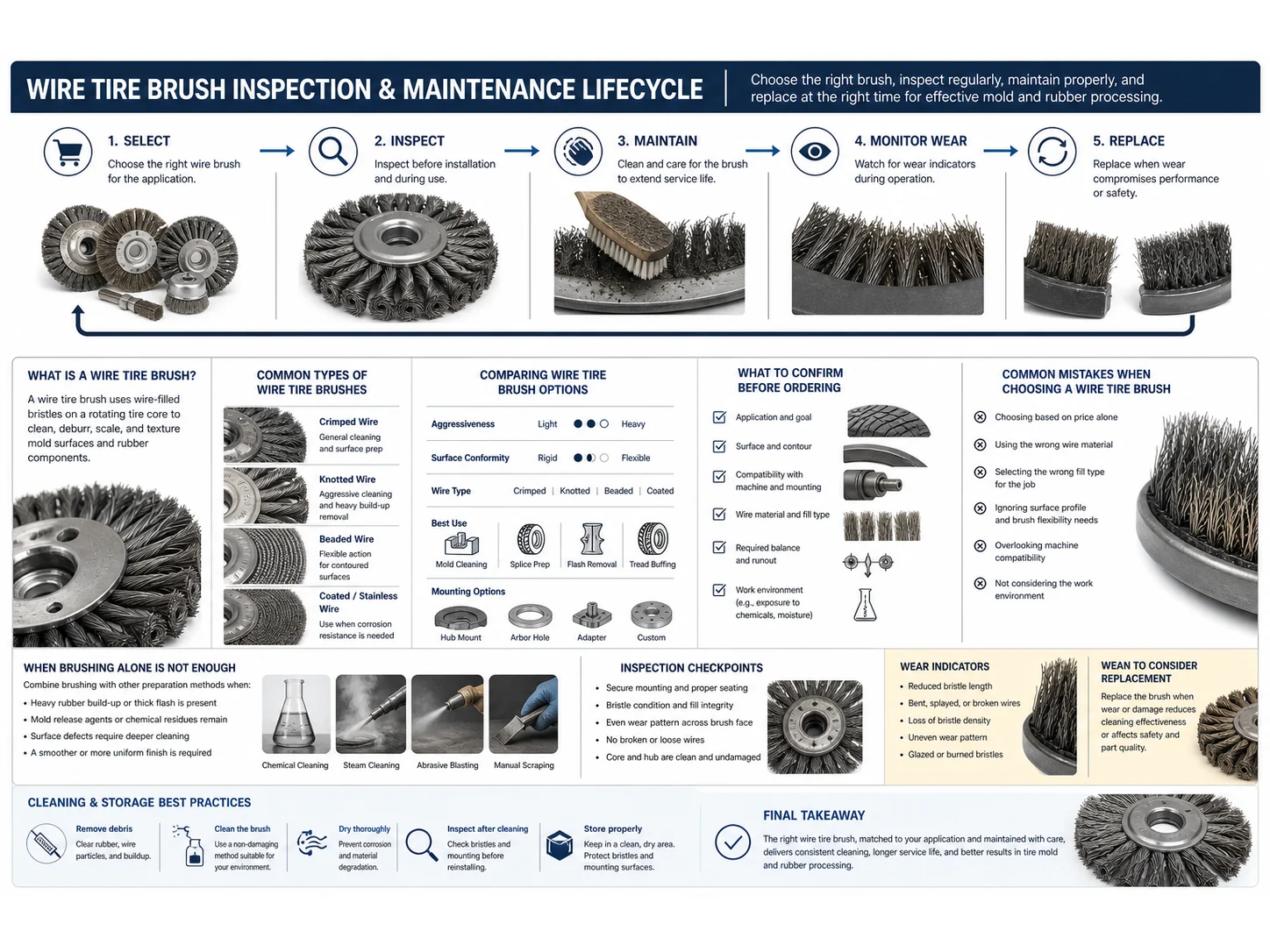
A wire tire brush is a rotary or stationary brush assembly filled with metal or abrasive-filled filaments, engineered to provide controlled mechanical cleaning of tire components. Unlike general-purpose wire brushes, tire brushes are designed for repeatable, high-volume production environments and must consider rubber compound sensitivity, release agent chemistry, and line speed synchronization.
Common Types of Wire Tire Brushes
For the safety point in this section, the relevant OSHA reference is OSHA — Heat Exposure.
For material-selection language, this section is supported by World Stainless — Corrosion Resistance of Stainless Steels.
For tire, wheel, and vehicle-safety context, the relevant source is NHTSA — Tire Safety Ratings and Awareness.
For the safety point in this section, the relevant OSHA reference is OSHA — 1910.177 Servicing Multi-Piece and Single Piece Rim Wheels.
For brush terminology and construction language, this section references American Brush Manufacturers Association — Brush Lingo.
Tire cleaning applications use several brush configurations, each suited to different mounting positions and cleaning actions:
- Cup / wheel brushes: Mount directly on a motor spindle for localized cleaning of tread shoulders or bead areas.
- Strip brushes: Long flexible holders clamped into a backing plate, often used in wide conveyors to clean full tread widths.
- Cylinder / roller brushes: Large rotating brushes that span the tire width, ideal for uniform across-tread cleaning at high line speeds.
- Internal / tube brushes: Small diameter brushes for cleaning inner liner or sidewall interiors in retreading steps.
Bristle materials range from carbon steel for aggressive removal to brass and nylon-abrasive composites for softer, non-marring cleaning.
Comparing Wire Tire Brush Options
| Bristle Material | Best For | Surface Sensitivity | Wet / Dry / Chemical Exposure | Line Speed Compatibility | Maintenance Access |
|---|---|---|---|---|---|
| Carbon steel wire | Flash removal, heavy release agent stripping | Moderate to aggressive; may abrade soft compounds | Dry or light lubricant; avoid prolonged chemical soak | Medium to high (up to ~30 m/min) | Replaceable strip or wheel sections |
| Stainless steel wire | Corrosive environments, high-pressure washdowns, CIP compatibility | Similar to carbon steel but corrosion-resistant | Wet, chemical splash, steam | Medium | Sealed bearing mounts preferred |
| Brass wire | non-sparking applications, softer cleaning where metal transfer must be avoided | Low; minimal surface marking | Dry or light oil; avoid strong acids/bases that tarnish brass | Medium | Periodic re‑dressing may be needed |
| Nylon with silicon carbide or aluminum oxide grit | Light wiping, anti-static cleaning, sensitive surface prep | Very low; won’t scratch even uncured rubber | Dry preferred; some wet-tolerant grades | Low to medium | Bristles wear faster, replace full brush more frequently |
| Combination (wire + nylon) | Mixed residue, two-stage cleaning in one pass | Moderate control by adjusting brush pressure | Limited wet compatibility with nylon section | Medium | Monitor uneven wear between segments |
What to Confirm Before Ordering
To avoid mismatches, buyers should clarify these technical details with their supplier or engineering team:
- Overall dimensions: brush outer diameter, face width, bore/arbor size, and overall length.
- Mounting method: shaft clamp, flange, quick-change adapter, or custom carrier compatibility.
- Working environment: presence of water, solvents, steam, or elevated temperatures that affect bristle material and hub material.
- Target surface and residue: specify rubber compound hardness, residue type (wax, silicone, powder, flash thickness), and whether surface must remain visually unmarked.
- Expected cleaning result: required surface roughness or cleanliness level for downstream bonding, painting, or inspection.
- Reference sample or drawing: provide a dimensional sketch, existing part number, or worn-out brush for reverse engineering.
Common Mistakes When Choosing a Wire Tire Brush
- Picking the lowest-cost bristle material without checking rubber compound sensitivity – carbon steel may leave micro-scratches that affect bond strength or appearance on certain tread compounds.
- Ignoring wet/dry operating conditions – standard steel wire rusts quickly in high-moisture environments, leading to contamination.
- Using the wrong brush diameter for the line speed – a brush that is too small runs at excessive RPM, shortening life and generating heat; too large may not clean effectively.
- Mounting a brush designed for a different spindle type – improper fit causes vibration, uneven wear, and potential spindle damage.
- Neglecting clearance for easy replacement – in tight machine spaces, a brush that requires major disassembly to replace will increase downtime.
When Brushing Alone Is Not Enough
Wire tire brushes are effective for mechanical scrubbing, but they should be combined with other processes when:
- Heavy tacky residues or thick wax coatings require a scraper blade or pre-wash spray to reduce brush loading.
- Fine dust or static cling remains after brushing – add an air knife, vacuum extraction, or ionizing bar for final cleaning.
- Hygienic or pharmaceutical standards demand validated cleanliness – integrate CIP (clean-in-place) or ultrasonic bath for whole-tire cleaning.
- Surface activation for adhesive or paint bonding needs controlled micro-roughness beyond what a wire brush provides – consider plasma, corona, or chemical etching.
- High-speed lines with very short cleaning windows may require a combination brush-roll with integrated vacuum hood to meet cycle time.
Final Takeaway
Selecting a wire tire brush starts with understanding the tire surface material, residue type, and line conditions. Match bristle aggressiveness to the compound sensitivity, confirm mounting compatibility, and always verify cleaning results with a test run or reference sample. When mechanical brushing reaches its limit, supplement the process with complementary technologies rather than overworking the brush, which increases wear and contamination risk.
Practical Use Note
In daily use, the practical test is simple: check whether the brush reaches the full contact area, removes the target residue, and leaves the surface in the required condition. Record what changes when surface finish, solvent exposure, access angle, scratch tolerance, and soil severity changes, because many brush failures are caused by the working condition shifting rather than by the brush body alone.
Frequently Asked Questions
Can a wire tire brush damage the tire surface?
Yes, if the bristle material is too aggressive for the rubber compound. Always test carbon steel brushes on softer compounds, and consider brass or nylon abrasive brushes for sensitive surfaces.
How often should wire tire brushes be replaced?
Replacement frequency depends on line speed, residue abrasiveness, and brush pressure. Monitor for uneven bristle length, loss of cleaning effectiveness, or hub wear. A typical industrial brush may last weeks to months, but track performance rather than relying on a fixed schedule.
What is the difference between crimped and knotted wire brushes for tire use?
Crimped wire has wavy filaments for gentle brushing and better flexibility, while knotted wire is tightly twisted for aggressive material removal. Tire applications usually favor crimped wire for even cleaning without gouging; knotted brushes are rare except for heavy flash removal on rigid compounds.
Can the same brush be used for both wet and dry tire cleaning?
Only if the bristle and hub material are corrosion-resistant. Dry-only steel brushes will rust and contaminate rubber in wet conditions. Stainless steel or brass brushes are safer for occasional wet use, while dedicated wet lines often use nylon abrasive brushes.
How do I choose the right brush diameter?
Match diameter to the available mounting space and the line speed. The brush should rotate at a peripheral speed that effectively cleans without overheating. For a given motor RPM, a larger diameter increases tip speed and cleaning force. Work with your supplier to calculate the correct size.
Do I need a custom brush or an off-the-shelf size?
Start with standard catalog sizes if they meet your dimensional and mounting needs. Custom brushes are necessary when the brush length, diameter, bore, or bristle pattern must fit a unique machine design. Provide a drawing or a worn sample to reduce production schedule and cost.
Can I mount a wire tire brush on a standard motor shaft?
Many cup and wheel brushes have standard arbor holes, but strip and cylinder brushes often require specific hub adapters or clamping systems. Always verify the shaft diameter, keyway, and set-screw configuration before ordering.