
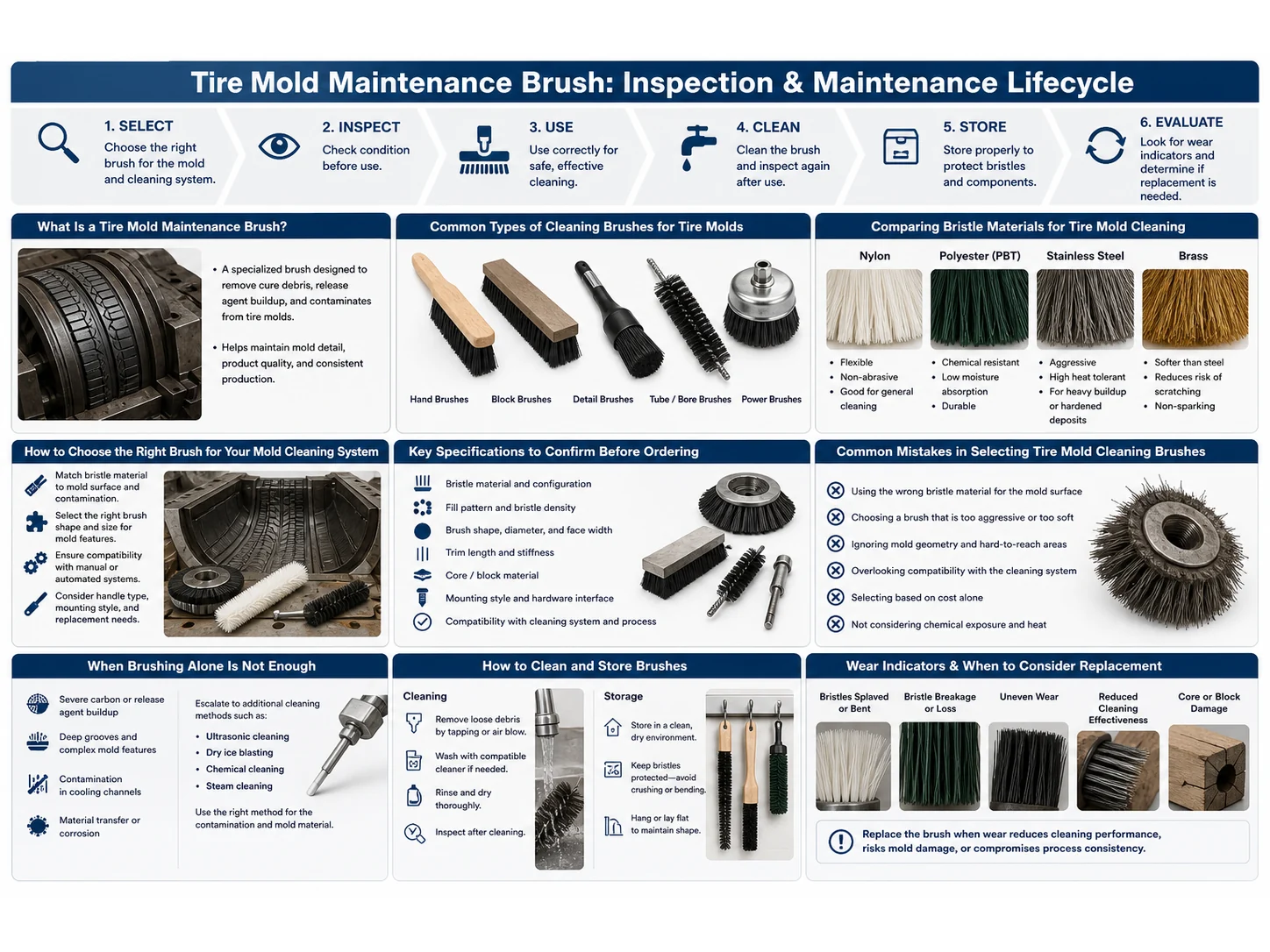
What Is a Tire Mold Maintenance Brush?
A tire mold maintenance brush is a specialized industrial brush engineered to clean the intricate surfaces of tire segment molds, bladder mechanisms, and sidewall plates. Brush filaments contact the land areas, grooves, and vents to abrade or wipe away baked‑on residues while preserving the mold surface finish and critical tolerances. Applications range from handheld touch‑up tools to high‑speed rotary discs integrated into laser‑guided automated cleaning cells.
Common Types of Cleaning Brushes for Tire Molds
Brushes are typically selected by machine position and cleaning motion. The most common configurations include:
- Rotary disc brushes – Used in automated sidewall and tread segment cleaning; often gang‑mounted on multi‑axis robotic arms.
- Cup brushes – Suitable for internal vent cleaning and hard‑to‑reach corners when mounted on right‑angle tools.
- Strip brushes – Held in fixed channels along a conveyor or radial arm for wiping entire tread arcs in one pass.
- Tube/cylinder brushes – Internally mounted for cleaning bladder drums or small‑diameter cores where external access is limited.
- Hand brushes – Stiff scrapers or wire‑bristle brushes used during manual mold inspections and touch‑ups.
Comparing Bristle Materials for Tire Mold Cleaning
Filament choice determines cleaning aggressiveness, heat resistance, and compatibility with cleaning agents. The table below compares frequently specified materials.
| Bristle Material | Surface Sensitivity | Dry / Wet Operation | Temperature Limit (°F) | Chemical Exposure | Line Speed Suitability | Installation Space & Maintenance Access |
|---|---|---|---|---|---|---|
| Standard Nylon (PA6/66) | Low risk on steel, may scratch aluminum | Dry or wet with alkaline detergents | 200–250 | Resistant to diluted alkalis, moderate acids | Medium to high | Flexible, fits tight radii; easy to replace |
| Abrasive Nylon (SiC/AlOx) | Moderate; can polish tool steel if grit is fine | Dry preferred; wet may reduce cut rate | Up to 250 | Grit may load with oil‑based compounds | Medium; depends on filament density | Stiffer, requires adequate clearance |
| Brass‑Coated Steel Wire | Medium‑high; leaves micro‑scratches | Dry; may corrode in high humidity | Up to 350 | Avoid acids and aggressive degreasers | Low to medium | Strong backbone, needs straight mount |
| Stainless Steel Wire (302/304) | High; removes heavy carbon but will change surface finish | Dry or wet; rust‑free | Up to 500 | Excellent chemical resistance | Low; aggressive cutting reduces speed | Rigid, minimal deflection; robust mounting |
| Natural Tampico Fiber | Very low; polishes and wipes only | Wet recommended; dries out and splits | Up to 160 | Do not use with strong alkalis | High for light dust removal | Compressible, fits irregular contours |
How to Choose the Right Brush for Your Mold Cleaning System
Match brush characteristics to your actual cleaning cycle and equipment. Evaluate each factor below.
- Residue type and adhesion: Light mold release powder needs a soft nylon tampico mix; thick baked carbon demands abrasive nylon or wire.
- Mold material and surface finish: Polished P20 steel tolerates only fine abrasive or non‑metallic filaments. Textured aluminum sidewalls require caution with wire.
- Cleaning method: Dry manual cleaning can tolerate more aggressive media because the operator controls contact. Automated dry cells must avoid over‑aggression that changes vent geometry.
- Machine configuration: Measure available mounting clearance, shaft diameter, flange pattern, and required brush OD and face width. Ensure the brush can track the mold profile without interference.
- Operating environment: If heated molds are cleaned (150–250 °F), verify bristle temperature rating. If chemical cleaners or ultrasonic baths are used, check filament chemical compatibility.
- Line speed and duty cycle: High‑cycle presses demand brushes that maintain consistent cleaning action over thousands of cycles without excessive bristle set or wear.
Key Specifications to Confirm Before Ordering
Before placing an order, buyers should resolve these practical details to avoid costly mismatches.
- Dimensions: Overall diameter, face width, hub ID/OD, bolt circle, and flange dimensions. Confirm metric vs. imperial.
- Mounting method: Keyed shaft, arbor hole with set screw, threaded hub, or flange plate. Match to the cleaning machine spindle.
- Bristle trim and density: Specify if a solid‑face brush or segment strip is needed. Provide original sample or manufacturer drawing for exact trim length and fill pattern.
- Reference sample or drawing: If replacing an existing brush, send a worn sample or detailed sketch so the supplier can duplicate the profile and mounting.
- Expected cleaning result: Define acceptable cleanliness—e.g., free of visible carbon deposits versus Ra surface roughness unchanged—so filament selection matches the requirement.
- Compatibility with existing process: Will the brush be used dry or with a specific cleaning agent? Confirm chemical resistance and bristle binding agent tolerance.
Common Mistakes in Selecting Tire Mold Cleaning Brushes
- Choosing by cost alone: lowest-cost filament may wear rapidly, generate inconsistent cleaning, and force more frequent downtime.
- Overlooking filament trim and density: A brush that is too dense retains heat and debris; too sparse misses contamination. Trim length affects stiffness and reach into vents.
- Missing mounting compatibility: Assuming standard arbor dimensions without checking the hub design leads to brushes that cannot be secured or balanced.
- Ignoring wet vs. dry behavior: Nylon bristles soften when wet and require denser packing to maintain the same effective stiffness.
- Using wire brushes on vented sidewalls without monitoring: Wire can peen over vent edges, reducing airflow and causing curing defects.
- Not planning for brush changeout access: Automated cells need quick‑change hubs or indexed positions; otherwise, maintenance time balloons.
When a Tire Mold Cleaning Brush Is the Wrong Choice
A brush removes adhered residues but does not capture airborne fines or completely clean deep micro‑vents. In many tire plants, brushing is most effective when paired with complementary processes.
- Vacuum extraction: Immediately removes loose dust and bristles before they settle back onto the mold. Essential for clean‑room or vision‑inspection environments.
- Air knife or compressed air: Blows particles out of blind vents after brushing. Often sequenced in the same cleaning head.
- Scraper or chisel blade: Required for thick, hardened rubber crust in mold grooves that brushes cannot penetrate.
- Clean‑in‑place (CIP) or ultrasonic bath: For complete removal of oil‑based release agents and microscopic residue, especially in segmented molds that can be removed from the press.
- Dry ice blasting or laser cleaning: Non‑contact alternatives when mold geometry or surface finish prohibits any mechanical contact. These methods leave no filament waste but may not be cost‑effective for all mold sets.
A layered approach—brush plus vacuum plus air knife—reduces manual touch‑up and extends brush life.
Final Takeaway
Selecting the right tire mold maintenance brush is a system‑dependent decision. Start by defining the contamination, mold sensitivity, and machine interface. Then match bristle material, trim, and mounting to the actual operating conditions. Always confirm dimensions and compatibility with a physical sample or detailed drawing before ordering. When in doubt, pair brushing with vacuum or air assistance for consistent, repeatable mold cleanliness.
Frequently Asked Questions
Can I use the same brush for sidewall and tread molds?
Not always. Tread molds often have deeper grooves and harder residues, requiring denser, shorter trim brushes. Sidewall plates may be more sensitive to scratching and benefit from softer filaments. Test on a sample mold segment first.
How often should cleaning brushes be replaced?
Replacement depends on cycle count, contamination load, and bristle wear pattern. A visual inspection schedule—checking for uneven trim length, cracking, or reduction in cleaning effectiveness—is safer than a fixed calendar interval.
What is the best bristle material for hot mold cleaning?
If molds are cleaned while still above 200 °F, choose heat‑stable materials: stainless steel wire or high‑temperature nylon (PA46/PA66). Natural fibers and standard nylons will soften or degrade.
Does brush speed affect mold surface damage?
Yes. Excessive surface speed with abrasive or wire filaments can generate frictional heat and alter surface finish. Follow the brush manufacturer’s recommended SFM (surface feet per minute) for the molded cleaning cycle.
Can I use a wire brush on aluminum mold components?
Stainless and carbon steel wire will scratch and gall soft aluminum surfaces. Brass‑coated wire is slightly gentler but still risky. Use non‑metallic filaments on aluminum unless the surface finish is non‑critical.
What should I do if the brush leaves bristles on the mold?
Check for excessive interference, dry operation causing brittle breakage, or chemical attack weakening the filament. Increase vacuum capture at the point of contact and consider a filament material with better flex fatigue resistance.
Are there explosion‑proof or ESD‑safe brush options?
Yes. In solvent‑based cleaning or dusty environments, static‑dissipative nylon filaments with conductive carbon fill can be specified. Always confirm the brush handle/hub is also grounded.
How do I clean the brush itself?
Remove excess debris with compressed air or a vacuum. For nylon brushes, occasional washing with mild detergent and warm water can restore flexibility. Wire brushes can be rinsed with solvent, but avoid prolonged soaking that attacks the hub adhesive.
Technical References
- OSHA — Heat Exposure
- World Stainless — Corrosion Resistance of Stainless Steels
- OSHA — 1910.177 Servicing Multi-Piece and Single Piece Rim Wheels
- NHTSA — Tire Safety Ratings and Awareness
Which bristle material fits this job — Nylon PA, AISI 304 Stainless Steel Wire or Abrasive Nylon?
| Material | Continuous temperature (°C) | Peak temperature (°C) | Water absorption | Hardness |
|---|---|---|---|---|
| Nylon PA | 93 | 121 | 0.3–9% by PA grade and conditioning | Medium to firm; filament diameter and trim length control bending force. |
| AISI 304 Stainless Steel Wire | 400 | 500 | 0% | Rockwell B 70–95 depending on temper and cold work |
| Abrasive Nylon | 120 | 150 | 0.1–1.0% | Abrasive filament; stiffness and cutting level is controlled by PA base, grit type, grit size, filament diameter and trim height. |
| Carbon Steel Wire | 200–300 | 350–450 | 0% | Rockwell C 40–60 |
Figures as published by Brushtec / DuPont; Alleima; Perlon. Confirm the exact grade against the supplier datasheet before ordering.
What should replace Nylon PA for tire?
- Nylon PA — Compare Nylon PA with PP, PBT, PET. Change material when wet stiffness, temperature, chemical resistance, conductivity, particle shedding, or surface marking becomes the limiting factor.
- AISI 304 Stainless Steel Wire — Use AISI 316 stainless steel wire for chloride, marine, dairy, beverage, chemical washdown, or higher pitting-resistance requirements. Use carbon steel for dry aggressive cutting and brass or abrasive nylon for lower marking risk.
- Abrasive Nylon — Compare Abrasive Nylon with PP, PBT, PET. Change material when wet stiffness, temperature, chemical resistance, conductivity, particle shedding, or surface marking becomes the limiting factor.
- Carbon Steel Wire — Compare Carbon Steel Wire with Carbon steel wire, brass wire, abrasive nylon. Change material when wet stiffness, temperature, chemical resistance, conductivity, particle shedding, or surface marking becomes the limiting factor.