
Application
Heavy Grease Industrial Floor Cleaning
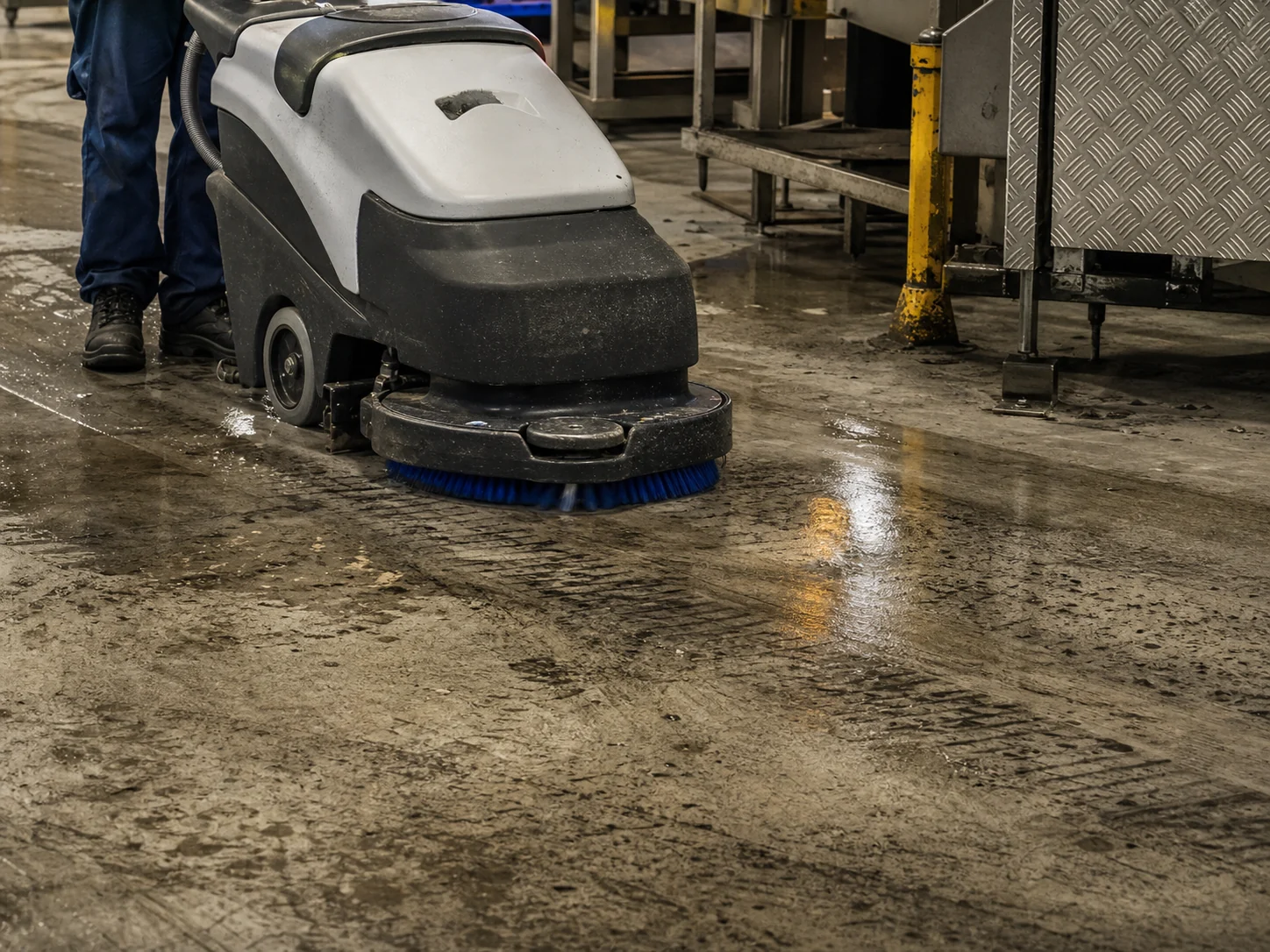
For Heavy Grease Industrial Floor Cleaning, the brush must reach the working area, disturb or collect heavy grease/rubber marks/scale, and release it without creating unacceptable surface damage or process interference. The suitable brush structure depends on access, the required contact motion, and the cleaning method.
At a glance
- Cleaning target
- Heavy Grease/Rubber Marks/Scale
- Working environment
- Wet Indoor Area
- Cleaning method
- Wet Brushing
- Requirements to check
- Slip-Prevention and Chemical-Safety SOP; Equipment Rated-motion Control
Heavy grease films make a floor slippery long before they look dirty, so these brushes are specified for chemical resistance and contact pressure rather than for sweeping efficiency.
What makes Heavy Grease Industrial Floor Cleaning different from other facility, floor and outdoor cleaning?
The task is to remove Heavy Grease/Rubber Marks/Scale while controlling surface damage, residue carryover, brush shedding and chemical or temperature degradation.
The work happens in wet indoor area against heavy grease, rubber marks and scale.
The part people get wrong: the residue tells you the filament, but the access opening tells you the construction. Get them in that order and the shortlist is short.
What are the most common cleaning targets in Heavy Grease Industrial Floor Cleaning?
One target, and it is continuous: the floor surface itself, where the same grease film covers traffic lanes, machine bays and drain surrounds alike.
| Part or area | Residue type | Cleaning requirement |
|---|---|---|
| Industrial Floor Surface | Heavy Grease, Rubber Marks, Scale | The brush must cover a large area per pass and keep even pressure across the whole width. |
What the equipment leaves you to work inside:
| Parameter | Typical range |
|---|---|
| Contaminant | Heavy Grease/Rubber Marks/Scale |
| Required hardness | Hard |
| Maximum temperature | 80°C |
| Chemical exposure | Strong Alkaline Degreaser pH 11–14; Hydrocarbon Solvent |
| Cleaning method | Wet Brushing |
| Environment | Wet Indoor Area |
Which brush types work for each cleaning target?
Machine-mounted cylindrical or disc brushes carried on a walk-behind or ride-on scrubber, sized to the deck rather than to the floor area.
| Cleaning target | Recommended brush type | Why it fits |
|---|---|---|
| Industrial Floor Surface | Floor Scrubber Sweeper Brushes | A scrubber-mounted brush holds contact pressure across the full path width, which is what lifts a grease film once the degreaser has had its dwell time. |
The brush is deck-mounted on a walk-behind or ride-on scrubber, with the recovery squeegee taking away what it lifts.
In practical brush terms: match the construction to the access before anything else. A geometry that cannot reach the target will not be rescued by a better filament.
What filament materials work best for Heavy Grease Industrial Floor Cleaning?
Polypropylene resists a strong alkaline degreaser at pH 11–14 better than nylon, PBT keeps its stiffness wet at 80°C, and nylon is used only where the floor coating is soft enough to need the gentler fill.
| If the condition is… | Filament to start with | Why |
|---|---|---|
| Strong alkaline degreaser at pH 11–14 | Polypropylene PP | resists the degreaser where nylon hydrolyses |
| Wet scrubbing at 80°C | PBT | keeps its stiffness hot and wet |
| Soft or coated floor finish | Nylon PA | gentler fill where a harder one would cut the coating |
What the duty rules out before you start comparing grades:
| Constraint | Value for this application |
|---|---|
| Filament hardness | Hard |
| Maximum service temperature | 80°C |
| Chemical exposure | Strong Alkaline Degreaser pH 11–14; Hydrocarbon Solvent |
| Cleaning method | Wet Brushing |
How do I choose the right brush for my heavy grease industrial floor equipment?
Start with hard fill, an 80°C ceiling and a strong alkaline degreaser at pH 11–14, then match the mount and diameter to your machine.
Work through it in this order:
- Identify the target part and measure the access opening or clearance
- Describe the residue: what it is, how thick it sits, and how strongly it holds
- Choose the construction that can physically reach that target
- Set the filament from surface risk, working temperature and cleaning chemistry
- Fix filament diameter, free trim length and density for the contact pressure you need
- Run one cycle and check the result before committing to a production quantity
Before you commit to a quantity, send the floor coating, the machine’s brush mount and diameter, and the degreaser you use.
When is a heavy grease industrial floor brush the wrong tool?
A degreaser with real dwell time does the chemical work, and brushing before that simply spreads the film over a wider area. Where the floor coating itself has broken down, the surface is re-coated rather than scrubbed harder.
What common mistakes should I avoid in Heavy Grease Industrial Floor Cleaning?
- Specifying by floor area, when the decision is chemical resistance and contact pressure
- Changing the filament while leaving excessive engagement, poor alignment or no discharge path unchanged
- Copying a worn brush without first recording its motion, direction, mounting and original working diameter
If the brush is already in service and the result is wrong, work from the symptom:
| Symptom | What to change |
|---|---|
| Residue remains | Increase discharge or relative motion before adding pressure |
| Surface marks | Reduce engagement and use finer/softer fill |
| Rapid wear | Check alignment, temperature and chemical attack |
| Redeposition | Add wash, vacuum or collection path |
Questions this page is asked
How is a brush or pad trialed on a grease-contaminated industrial floor?
Identify the concrete, resin, tile or coating system plus joints, texture and damage, then test the least aggressive compatible brush or pad in a controlled area with the intended machine. Accept it only if grease removal improves without gloss change, scratching, coating lift, joint attack or unsafe machine handling.
What controls detergent use during heavy-grease floor scrubbing?
Use only chemistry permitted by the floor and machine makers at the defined dilution and dwell time, with the ventilation and protection required by its safety information. Recover the contaminated solution before it dries or spreads, keep it out of unapproved drains, and repeat with a compatible rinse when residue remains.
When can an industrial floor reopen after grease scrubbing?
Keep the area isolated until recovered solution, detergent film and loosened grease are removed and the surface reaches the facility's dry or otherwise controlled condition. Inspect edges, drains, transitions and traffic lanes for remaining slip or coating damage before barriers are removed.
No catalogue item for this yet
Every brush here is made to order, and this one has no catalogue entry so far. Send the working surface, the residue, the access opening and the quantity, and it is quoted through the same specification route as the rest of the range.
Custom Manufacturing RFQ
Discuss This Application
Share the working surface, residue, dimensions, material direction, interface, quantity and drawing or sample photo.
Custom Brush RFQ
Request a Custom Cleaning Brush Quote
Upload a drawing, product photo, or sample photo and provide the core dimensions and cleaning conditions.
“We need a brush to remove wet residue from a stainless steel conveyor, about 800mm wide. The current brush wears quickly. We can send photos.”
“We sell drinkware and need a cleaning brush to include with the product. Quantity around 5,000 pieces.”