
Application
Woodworking Sanding & Furniture Surface Brushing
Woodworking Sanding & Furniture Surface Brushing is a process-use page rather than a general cleaning category. Select the brush from the required contact function, working surface, motion, and interface, then verify how Wood Chips/Sawdust/Resin Dust and Dry Indoor Area / Hazardous Area affect the construction.
At a glance
- Cleaning target
- Wood Chips/Sawdust/Resin Dust
- Working environment
- Dry Indoor Area / Hazardous Area
- Cleaning method
- Dry Brushing
- Requirements to check
- Wood-Dust Explosion Protection and Occupational-Safety Requirements
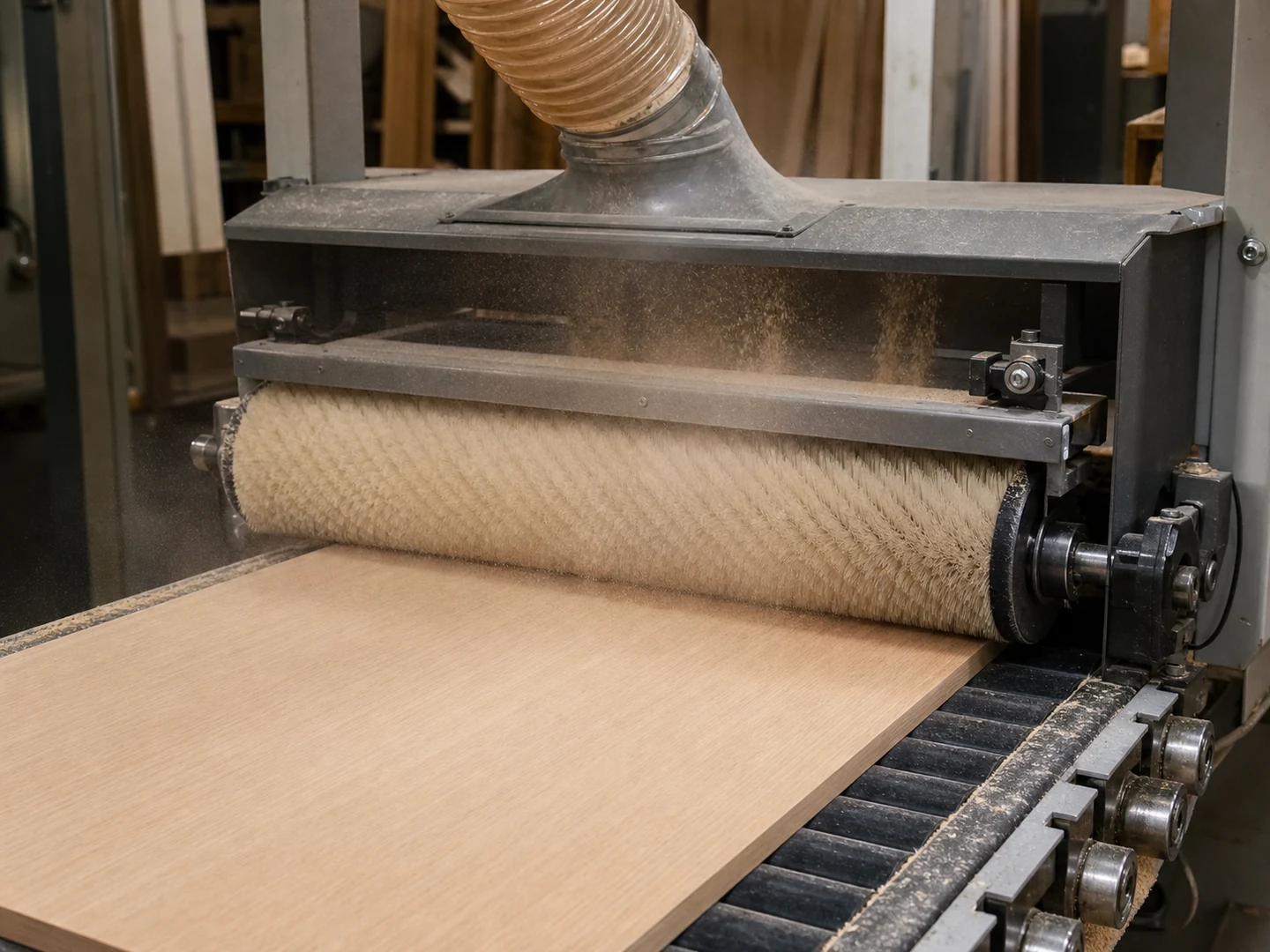
Brush sanding follows the grain instead of flattening it, which is why it is used to raise, structure and denib wood surfaces that a flat abrasive would simply level.
What makes Woodworking Sanding & Furniture Surface Brushing different from other industrial and manufacturing cleaning?
The main difficulty is removing burrs, oxide, glaze, coating, sanding dust, and texture peaks from metal, wood, ceramic, glass, leather, and machined surfaces without damaging the surface, loading the brush, or carrying contamination back into the process.
The work happens in dry indoor area and hazardous area against wood chips, sawdust and resin dust.
The part people get wrong: this is not one job. The same equipment carries several targets, each with a different opening and a different residue, and one brush rarely covers them all.
What are the most common cleaning targets in Woodworking Sanding & Furniture Surface Brushing?
There are 5 distinct targets here, and the brush that suits one will usually not reach another.
| Part or area | Residue type | Cleaning requirement |
|---|---|---|
| Wood Distressing and Texturing | Wood Chips, Sawdust, Resin Dust | The filament must cut at a controlled depth and hold the same profile across the whole contact band, because here the surface the brush leaves is the product rather than a by-product. |
| Sanding-Sealer Denibbing | ||
| Grain Raising and Structuring | ||
| Furniture Surface Dusting | The face must stay flat against the surface so the whole working width contacts, with filament soft enough not to mark it. | |
| Panel and Flooring Brush Sanding | The filament must cut at a controlled depth and hold the same profile across the whole contact band, because here the surface the brush leaves is the product rather than a by-product. |
The dimensional envelope those targets impose on the brush:
| Parameter | Typical range |
|---|---|
| Working width | 100–1500 mm; 200–5000 mm |
| Tool outside diameter | 5–350 mm |
| Abrasive working width | 3–200 mm |
| Tool diameter | 20–500 mm |
| Filament / abrasive size | 0.15–2.0 mm or 46–1,000 grit |
Which brush types work for each cleaning target?
Wide roller, sanding brush, radial bristle wheel, or handheld detail brush chosen based on panel width, profile, and machine direction.
| Cleaning target | Recommended brush type | Why it fits |
|---|---|---|
| Wood Distressing and Texturing | Roller and Conveyor Brushes | Distressing wears the soft early wood away and leaves the hard grain standing, so a brush roll does what abrasive paper cannot: it cuts selectively. |
| Sanding-Sealer Denibbing | Denibbing takes off raised nibs without cutting the sealer film, so a light brush roll skims at a depth a sanding belt cannot hold. | |
| Grain Raising and Structuring | Structuring is a controlled depth of grain relief, so the roll’s filament and the pass depth are what set the effect and repeat it panel after panel. | |
| Furniture Surface Dusting | A finished panel has to be dust-free before coating, so a brush roll takes the dust off the full width without pressing it into the surface. | |
| Panel and Flooring Brush Sanding | Panel lines run continuously at width, so a full-width brush roll gives the same finish edge to edge with no overlap marks. |
The layouts this application is normally built in:
- Driven brush — use when burrs, oxide, glaze, coating, sanding dust, and texture peaks needs repeatable scrubbing or controlled relative movement
- Passive or free-running brush — use for loose contamination and lower process complexity on metal, wood, ceramic, glass, leather, and machined surfaces
- Localized hand, strip, or tube brush — use where only an edge, gap, port, or maintenance point needs contact
In practical brush terms: reach first, then residue. A brush that fits but is too soft can be stiffened; a brush that does not fit is simply the wrong tool.
What filament materials work best for Woodworking Sanding & Furniture Surface Brushing?
Natural fiber or soft synthetic filament suits dusting and finish-sensitive contact; choose silicon-carbide or aluminum-oxide abrasive nylon only for controlled denibbing, defuzzing, or texturing.
| If the condition is… | Filament to start with | Why |
|---|---|---|
| Sensitive or coated surface | Abrasive Nylon | controlled cutting without loose wire |
| Wet, washdown, or detergent service | Sisal Fiber | firm compound-carrying polishing |
| Bonded residue or aggressive cleaning | Horsehair | soft dusting and liquid carrying |
The constraints this application puts on the filament:
| Constraint | Value for this application |
|---|---|
| Filament hardness | Medium–Hard |
| Maximum service temperature | 80°C |
| Chemical exposure | No Added Medium; Rosin Cleaner/Organic Solvent |
| Cleaning method | Dry Brushing |
How do I choose the right brush for my woodworking sanding & furniture surface brushing equipment?
Decide the effect first — raising, structuring or denibbing — then size the roller to the panel width and to the machine’s shaft.
The order that avoids rework:
- Identify the target part and measure the access opening or clearance
- Describe the residue: what it is, how thick it sits, and how strongly it holds
- Choose the construction that can physically reach that target
- Set the filament from surface risk, working temperature and cleaning chemistry
- Fix filament diameter, free trim length and density for the contact pressure you need
- Run one cycle and check the result before committing to a production quantity
Before you commit to a quantity, send the panel width, the machine’s roller length and shaft, and the effect you want — raising, structuring or denibbing.
When is a woodworking sanding and furniture surface brush the wrong tool?
Where the goal is a flat, level surface, a wide-belt or orbital abrasive is the correct machine, because a brush follows the grain and will not level. Brushing also cannot rescue a surface whose finish needs stripping and rebuilding.
What common mistakes should I avoid in Woodworking Sanding & Furniture Surface Brushing?
- Asking for a sanding brush when the requirement is a flat surface, which a brush will not produce
- Changing brush material while leaving excessive engagement, poor alignment, or no discharge path unchanged
- Copying a worn brush without recording motion, direction, mounting, and the original working diameter
When a brush is running but not cleaning, start here rather than adding pressure:
| Symptom | What to change |
|---|---|
| Residue remains | Increase relative motion or discharge, then change filament diameter or density; do not add pressure before checking loading by burrs, oxide, glaze, coating, sanding dust, and texture peaks. |
| Surface marks or scratches | Reduce engagement, use finer or softer fill, and remove trapped abrasive particles from contact with metal, wood, ceramic, glass, leather, and machined surfaces. |
| Rapid wear or uneven cleaning | Check alignment, runout, support, motion, temperature, chemical attack, and whether the brush covers the complete working path. |
| Brush loads or redeposits residue | Open the fill pattern or add wash, vacuum, air, scraping, or a collection path so removed burrs, oxide, glaze, coating, sanding dust, and texture peaks leaves the contact zone. |
Questions this page is asked
How should a woodworking brush be qualified on a sample panel?
Use representative flat areas, edges, end grain and profiles while recording filament or abrasive grade, speed, engagement, feed direction and passes. Inspect in finishing light for torn or raised fibres, cross-grain marks, veneer breakthrough, rounded edges, uneven texture and coating response before approving the machine setting.
What dust controls belong with powered furniture brushing or sanding?
Evaluate the wood and coating dust, connect effective source capture at the contact zone, and maintain the collector and ducting under the facility combustible-dust plan. Keep deposits from motors, bearings and overhead surfaces, avoid compressed-air dispersal, and isolate the machine before clearing a blocked brush or extraction path.
Guides that go deeper on this
No catalogue item for this yet
Every brush here is made to order, and this one has no catalogue entry so far. Send the working surface, the residue, the access opening and the quantity, and it is quoted through the same specification route as the rest of the range.
Custom Manufacturing RFQ
Discuss This Application
Share the working surface, residue, dimensions, material direction, interface, quantity and drawing or sample photo.
Custom Brush RFQ
Request a Custom Cleaning Brush Quote
Upload a drawing, product photo, or sample photo and provide the core dimensions and cleaning conditions.
“We need a brush to remove wet residue from a stainless steel conveyor, about 800mm wide. The current brush wears quickly. We can send photos.”
“We sell drinkware and need a cleaning brush to include with the product. Quantity around 5,000 pieces.”