
What Is a Bore Brush?
A bore brush is a cylindrical cleaning tool built around a twisted wire core that holds bristles securely along its length. Unlike standard brushes with rigid handles or stubby heads, the twisted-wire design gives the bore brush flexibility to snake through bends, elbows, and variable-diameter passages while keeping consistent bristle contact with the inner wall. This makes it effective for removing loose debris, light rust, carbon deposits, and light films from curved pipes, hose assemblies, and small bores where a standard brush would jam or leave blind spots.
Common Types of Bore Brushes
Bore brushes come in several material and construction variations, each suited to different pipe conditions and cleaning requirements:
- Twisted wire bore brushes: The most common style, using a single or double twisted wire stem to anchor bristles. Excellent flexibility and availability in many diameters.
- Nylon bore brushes: Use nylon filaments for soft scrubbing, non-scratch cleaning on polished or delicate surfaces, and compatibility with a wide range of chemicals.
- Bronze/brass bore brushes: Opt for brass or bronze wire bristles for non-sparking cleaning on ferrous metals, light deburring, and moderate abrasion without damaging softer substrates.
- Stainless steel bore brushes: Aggressive cleaning for heavy carbon, scale, or rust on robust metal pipes. Not recommended for sensitive surfaces due to scratching risk.
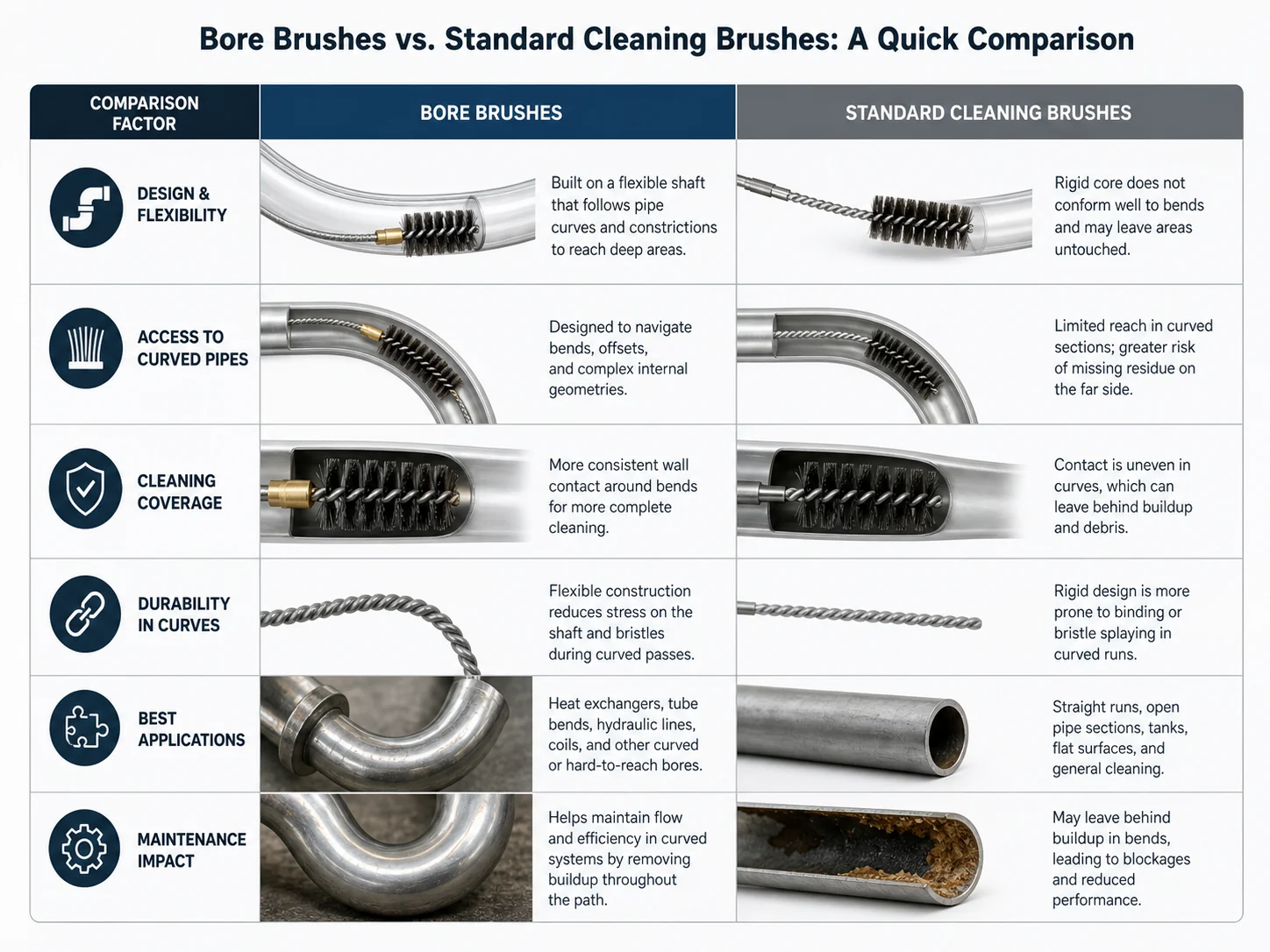
Bore Brushes vs. Standard Cleaning Brushes: A Quick Comparison
| Feature | Bore Brush | Standard Cleaning Brush |
|---|---|---|
| Flexibility | High; twisted core bends through curves | Low; rigid handle/head limits access |
| Bristle coverage in curved pipes | Full 360° contact along entire brush length | Partial contact; often misses interior bends |
| Reach in deep or narrow passages | Excellent; extensions and small diameters available | Limited by handle and brush head design |
| Typical materials | Nylon, stainless steel, brass, bronze, abrasive nylon | Nylon, polyester, Tampico, wire, mixed materials |
| Mounting options | Hand-held, drill, air motor, or automated systems | Mostly hand-held; some spindle versions |
| Best applications | Curved tubes, hoses, heat exchanger tubes, firearm bores, valve bodies | Straight pipes, open cylinders, surface cleaning |
How to Choose a Bore Brush for Curved Pipe Cleaning
Selecting the right bore brush goes beyond finding the nominal pipe size. Evaluate these factors before ordering:
- Residue type: Light dust, oil, carbon, or light corrosion? Go with nylon or soft metal bristles. Heavy scale or baked-on deposits might need stainless steel or a more aggressive abrasive filament.
- Surface sensitivity: Polished, plated, or hygienic surfaces call for nylon or natural fiber brushes. Avoid steel on soft metals like aluminum or brass unless testing confirms it’s safe.
- Inner diameter (ID) match: The brush diameter should be slightly larger than the pipe ID to ensure positive scrubbing. For curved pipes, leave enough clearance so the brush doesn’t bind. Many suppliers provide bore brush size charts based on pipe schedule.
- Wet or chemical exposure: For solvent or water-based cleaning, ensure the core material (often galvanized or stainless steel wire) and bristles resist corrosion. Nylon and stainless steel cores handle moisture better than plain steel.
- Hygiene expectations: In food, pharmaceutical, or medical applications, use FDA-compliant nylon bristles and stainless cores that can be autoclaved or sanitized.
- Maintenance frequency: High-volume production may justify more durable brush materials (e.g., abrasive nylon-impregnated with grit) that wear slower, reducing changeover time.
- Custom size requirements: For non-standard pipe IDs, complex bends, or special bristle trim lengths, a custom bore brush drawing and sample run with a supplier prevents misfits and performance gaps.
Common Mistakes to Avoid When Selecting Bore Brushes
- Choosing by diameter alone: Ignoring core stiffness, bristle material, and brush length can lead to poor cleaning or even pipe jamming.
- Using stainless steel bristles on soft metals: This scratches aluminum, brass, or copper and can embed contaminants.
- Overlooking core flexibility: A brush that is too stiff will not track the curve; too flexible may lack scrubbing force.
- Skipping a sample test: Always test a few brush prototypes in actual pipe bends before committing to a bulk purchase, especially for tight radii.
- Ignoring mounting compatibility: Confirm shank diameter, length, and drive mechanism match your power tool or fixture to avoid wobble and premature wear.
When a Bore Brush Is the Wrong Choice
Bore brushes excel at light to medium cleaning and surface conditioning, but they have limits. If the pipe has hardened scale, thick epoxy, or welded slag, a mechanical scraper, chemical bath, or hydro-blasting may be needed. For extreme bends (e.g., below 1.5x pipe diameter centerline radius), even the most flexible bore brush may not conform without kinking. In high-purity applications where trace metal contamination is unacceptable, non-contact cleaning methods like ultrasonic or CO₂ blasting are safer. Always review a supplier’s technical drawing and discuss your exact bend geometry and residue before assuming a bore brush will solve the problem.
Final Takeaway
For cleaning curved pipes, bore brushes outperform standard brushes almost every time because of their flexible twisted-wire core and 360-degree bristle coverage. The real decision is matching bristle material, core stiffness, and diameter to the residue type, surface sensitivity, and bend radius. When in doubt, test a sample, and don’t hesitate to ask for a custom design if off-the-shelf options feel like a compromise.
Frequently Asked Questions
Are bronze bore brushes safe for use in stainless steel pipes?
Yes. Bronze is softer than stainless steel, so it removes deposits without scratching the base metal. It is often used in food and dairy processing where ferrous contamination must be avoided.
How do I clean a bore brush after use?
Rinse the brush in a compatible solvent or water immediately after use, shake off excess, and hang to dry. For nylon brushes, avoid prolonged soaking in strong acids. Periodically inspect for bristle loss or core deformation.
What size bore brush should I use for a curved pipe?
Choose a brush diameter that is 0.005 to 0.010 inches (0.13–0.25 mm) larger than the pipe’s inner diameter. For tight bends, you may need a slightly smaller diameter or a more flexible core to prevent binding.
Can I use a bore brush with a drill?
Many bore brushes are designed with shanks that fit standard drill chucks. Always match the maximum RPM recommended by the brush manufacturer and start at low speed to prevent bristle flare or core whip.
What’s the difference between twisted wire and standard bore brushes?
All bore brushes have some kind of core, but twisted wire (single or double stem) is the classic design that provides high flexibility. “Standard” in some contexts may refer to a looped wire or solid spindle brush, which is less flexible and not ideal for curved pipes.
How do I know if I need a custom bore brush?
If your pipe has a non-standard bore size, extreme bend radius, or requires a specific bristle material not found in stock catalogs, request a custom quote with a dimensional drawing. Testing a sample is the best way to confirm fit and performance.
Are nylon bore brushes better for sensitive surfaces?
Yes. Nylon bristles are non-abrasive and won’t scratch polished, plated, or soft metal surfaces. Choose a nylon fill that is chemical-resistant if you work with aggressive cleaning agents.
What is the typical service life of a bore brush?
Service life varies widely based on usage. Light dust removal may keep a brush effective for thousands of cycles; heavy scale or high-speed rotation can wear bristles in days. Monitor bristle length and core condition regularly.
Which bristle material fits this job — Nylon PA, AISI 304 Stainless Steel Wire or Abrasive Nylon?
| Material | Continuous temperature (°C) | Peak temperature (°C) | Water absorption | Hardness |
|---|---|---|---|---|
| Nylon PA | 93 | 121 | 0.3–9% by PA grade and conditioning | Medium to firm; filament diameter and trim length control bending force. |
| AISI 304 Stainless Steel Wire | 400 | 500 | 0% | Rockwell B 70–95 depending on temper and cold work |
| Abrasive Nylon | 120 | 150 | 0.1–1.0% | Abrasive filament; stiffness and cutting level is controlled by PA base, grit type, grit size, filament diameter and trim height. |
Figures as published by Brushtec / DuPont; Alleima; Perlon. Confirm the exact grade against the supplier datasheet before ordering.
What should replace Nylon PA for curved pipes?
- Nylon PA — Compare Nylon PA with PP, PBT, PET. Change material when wet stiffness, temperature, chemical resistance, conductivity, particle shedding, or surface marking becomes the limiting factor.
- AISI 304 Stainless Steel Wire — Use AISI 316 stainless steel wire for chloride, marine, dairy, beverage, chemical washdown, or higher pitting-resistance requirements. Use carbon steel for dry aggressive cutting and brass or abrasive nylon for lower marking risk.
- Abrasive Nylon — Compare Abrasive Nylon with PP, PBT, PET. Change material when wet stiffness, temperature, chemical resistance, conductivity, particle shedding, or surface marking becomes the limiting factor.