
What Is a Flexible Stainless Tube Brush?
A flexible stainless tube brush is a cylindrical cleaning tool with stainless steel bristles wound onto a flexible stem or wire core. It is designed to pass through bends and curves inside tubes, pipes, and narrow channels to remove product residue, scale, biofilms, or other deposits. In food and beverage applications, the brush must be compatible with wet environments, cleaning chemicals, and strict hygiene standards without shedding bristles or damaging the tubing surface.
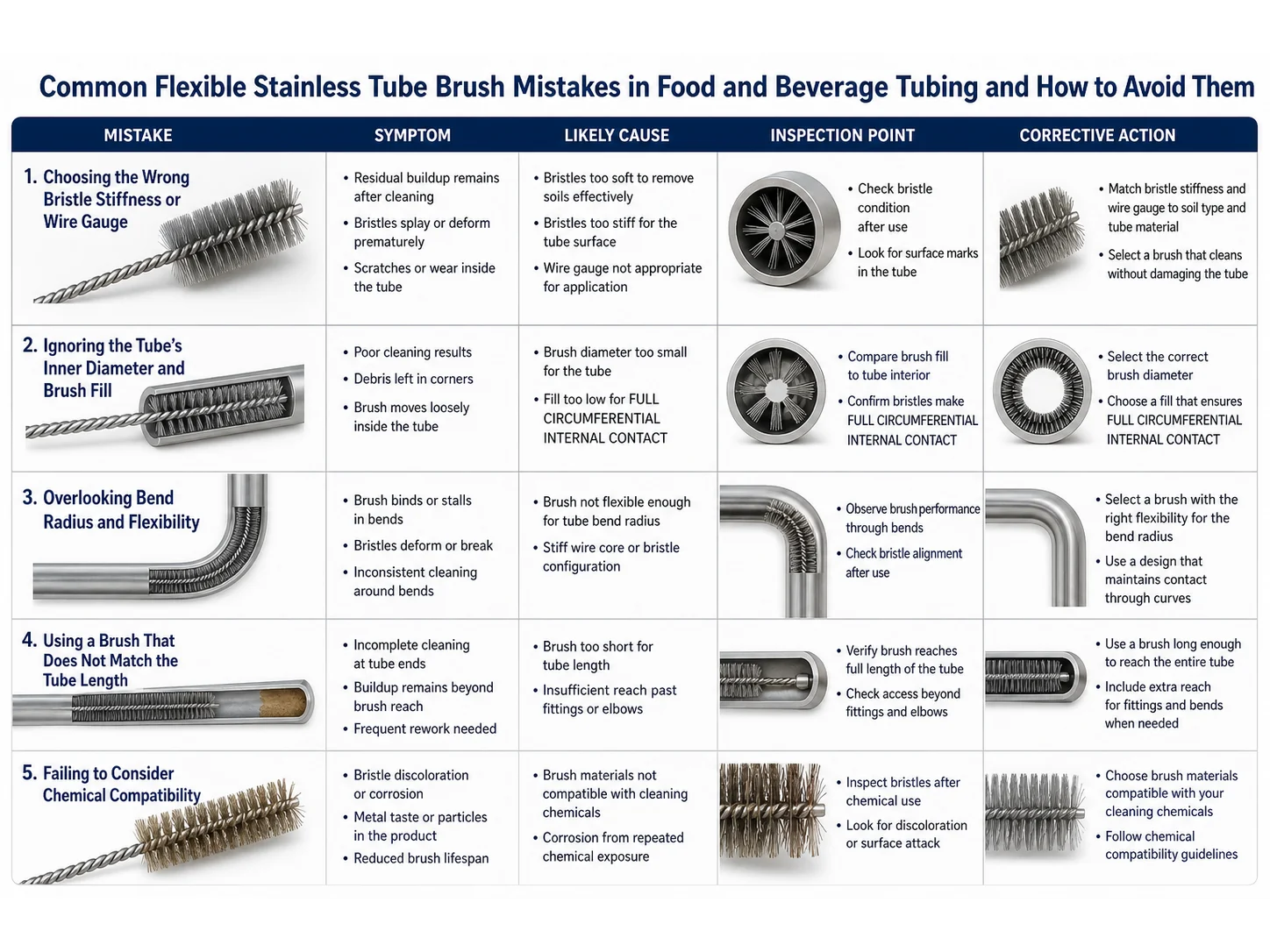
Common Flexible Stainless Tube Brush Mistakes and How to Prevent Them
Many problems with tube cleaning arise not from the brush itself, but from how it is chosen and used. Below are the most common mistakes and practical ways to avoid them.
1. Choosing the Wrong Bristle Stiffness or Wire Gauge
Stainless steel bristles come in different wire diameters and stiffness levels. If bristles are too aggressive, they can scratch the tubing interior, creating harborage points for bacteria. If too soft, they may fail to remove stubborn residues. Always match bristle stiffness to the residue type and surface sensitivity. For example, soft fouling like fruit pulp may only need fine bristles, while caramelized sugars or mineral scale require thicker, more aggressive bristles.
2. Ignoring the Tube’s Inner Diameter and Brush Fill
A brush that is too small will not make adequate wall contact, leaving residue behind. One that is too large can jam, bend, or cause operator fatigue. A correct brush diameter should fill the tube’s inner diameter with slight resistance—typically 10–20% oversize—so that the bristles press against the surface without excessive force.
3. Overlooking Bend Radius and Flexibility
Many food and beverage tubing layouts include tight bends. A brush with a stiff core or short bristle section may not navigate these curves, leading to incomplete cleaning or brush damage. Check the tube’s minimum bend radius and confirm the brush’s flexible length and core material can handle it. A looped-end or spiral-wound stem often improves flexibility.
4. Using a Brush That Does Not Match the Tube Length
If the brush is shorter than the tube, a section remains uncleaned. If it is too long, the excess stem can whip or bind. Always measure the full reach needed, including any elbows, and select a brush with an active bristle length that covers the entire internal surface.
5. Failing to Consider Chemical Compatibility
Some cleaning chemicals or sanitizers can attack brush stem materials or coatings. While 304 or 316 stainless steel bristles are generally resistant, the stem may be made of galvanized steel, nylon, or coated wire. Verify that all brush components withstand the chemicals and temperatures used in your CIP or manual cleaning cycles.
6. Using the Wrong Drive or Mounting Method
Flexible tube brushes can be hand-operated, attached to a drill, or integrated into a power system. The required fitting (e.g., straight shank, quick-couple, threaded stud) must match the equipment. A mismatch can cause slippage, downtime, or safety hazards. Always confirm the stem end type and power source compatibility before ordering.
7. Not Inspecting or Replacing Brushes on a Schedule
Bristles wear down, stems kink, and bristle shedding increases with age. A worn brush can leave metal fragments or fail to clean effectively. Implement a regular inspection routine—check for broken bristles, bent stems, and buildup—and replace brushes based on usage cycles or visible wear, not just when they fail.
How to Choose the Right Flexible Stainless Tube Brush
Avoiding mistakes starts with a clear selection process. Use the table below to check the key factors when specifying a brush for food and beverage tubing.
| Selection Factor | What to Confirm | Common Mistake to Avoid |
|---|---|---|
| Tube inner diameter (ID) | Exact ID measurement; choose brush OD 10–20% larger | Guessing size; ordering nominal “pipe size” instead of actual ID |
| Bristle material | 304 or 316 stainless steel; wire gauge suitable for residue | Selecting stainless without checking surface sensitivity or hardness requirements |
| Bristle stiffness | Compare bristle wire diameter and density; test sample if possible | Over-specifying stiffness and causing surface scratches |
| Core/stem type | Single-spiral, double-spiral, looped end; check for chemical resistance | Using a galvanized stem in acidic cleaners or high-moisture areas |
| Overall length | Measure the full path including bends; add extra for grip | Ordering a brush that is too short to reach the far end |
| Bend radius compatibility | Confirm brush flexibility matches the tightest tube bend | Assuming any “flexible” brush will navigate all elbows |
| End fitting | Straight shank, threaded stud, quick-couple, or handle type | Mismatching the drive adapter, causing slippage or safety issues |
| Temperature range | Max temperature of CIP fluid or process; stem and bristle rating | Overheating a nylon or coated stem, leading to premature failure |
Setup and Best Practices for Food-Grade Tubing
Even a well-chosen brush can deliver poor results if used incorrectly. Follow these usage guidelines:
- Use slow, steady rotation (200–400 RPM for power-driven brushes) to prevent bristle flare or breakage.
- Apply a compatible cleaning solution or foam before brushing to soften residues.
- Start from the end farthest from the equipment connection and draw the brush toward you to avoid pushing debris further into the system.
- After cleaning, rinse the tube thoroughly and sanitize according to your SOP.
- Store brushes in a dry, clean environment to prevent corrosion or contamination between uses.
When a Flexible Stainless Tube Brush Is the Wrong Choice
Tube brushes excel at manual or semi-automated cleaning of straight and gently curved tubing, but they have limits. Consider alternative methods or complementary approaches in these situations:
- Extremely tight bends or complex circuits may require a rotary cleaning nozzle, pigging system, or disassembly for manual cleaning.
- Ultra-small diameters (under 1/8 inch) might be inaccessible even for miniature brushes; ultrasonic cleaning could be a better option.
- Heavy, baked-on carbon or scale in steam or heat exchanger tubes may demand chemical descaling or hydroblasting before brushing.
- Sanitary tubing with low surface roughness (Ra) requirements needs validation through swab testing or ATP monitoring, not just visual inspection after brushing.
- When you are unsure about bristle material compatibility with a new cleaning chemical or food product, request a sample brush and test it on a non-critical piece of tubing or a sample coupon.
Final Takeaway
A flexible stainless tube brush is only as effective as the selection and usage decisions behind it. Always specify the correct diameter, bristle stiffness, stem material, and length for your exact tubing layout and residue challenge. Pair the right brush with proper technique and regular inspection, and you will improve cleaning reliability, reduce contamination risks, and extend the life of your processing equipment.
Frequently Asked Questions
How do I measure the inner diameter for a tube brush?
Use a caliper or a precision gauge on the actual tubing, not the nominal pipe size. For very small diameters, a pin gauge set can help. Always measure the inside, as wall thickness varies.
Can I use the same flexible stainless tube brush for different food products?
It is possible, but you must clean and sanitize the brush thoroughly between uses to prevent cross-contamination. Consider dedicated brushes for allergenic or strong-flavor products to avoid carryover.
What should I do if bristles break off inside the tube?
Stop cleaning immediately. Flush the tube with water or a clean-in-place solution to push debris to a collection point. Inspect with a borescope to ensure all fragments are removed. Replace the brush and review whether the bristle stiffness was too high or the brush speed too fast.
Is a nylon brush better than a stainless steel brush for food tubing?
Nylon brushes are softer and safer for polished or electro-polished surfaces that might scratch. Stainless steel is better for removing hard, dried-on residues or scale. The choice depends on the tubing material and soil type, not simply a better/worse comparison.
How often should I replace a flexible stainless tube brush?
Replace the brush when bristles show noticeable wear, when the stem kinks permanently, or when cleaning efficiency drops. In high-cycle plants, this could be weekly; in low-use areas, monthly visual checks may suffice. Keep a log to establish your own replacement interval.
Can I order a custom-length flexible tube brush?
Yes. Many manufacturers build brushes to your specified overall length and bristle portion length. Always provide a drawing or detailed dimensional requirements to ensure the brush fits your tubing exactly.
What is the difference between a single-spiral and double-spiral stem?
A single-spiral stem winds the wire in one direction, giving moderate flexibility. A double-spiral adds a second wire twisted in the opposite direction, greatly increasing flexibility and resistance to unwinding under torque. For complex tube paths, a double-spiral is usually preferred.
Technical References
- FDA — Food Code
- eCFR — 21 CFR 177.1500 Nylon Resins
- World Stainless — Corrosion Resistance of Stainless Steels
Which bristle material fits this job — AISI 304 Stainless Steel Wire, Nylon PA or Carbon Steel Wire?
| Material | Continuous temperature (°C) | Peak temperature (°C) | Water absorption | Hardness |
|---|---|---|---|---|
| AISI 304 Stainless Steel Wire | 400 | 500 | 0% | Rockwell B 70–95 depending on temper and cold work |
| Nylon PA | 93 | 121 | 0.3–9% by PA grade and conditioning | Medium to firm; filament diameter and trim length control bending force. |
| Carbon Steel Wire | 200–300 | 350–450 | 0% | Rockwell C 40–60 |
| Abrasive Nylon | 120 | 150 | 0.1–1.0% | Abrasive filament; stiffness and cutting level is controlled by PA base, grit type, grit size, filament diameter and trim height. |
| Brass Wire | 150–200 | 250–300 | 0% | Rockwell B 40–90 |
Figures as published by Alleima; Brushtec / DuPont; Perlon. Confirm the exact grade against the supplier datasheet before ordering.
What should replace Tube & Pipe Bore Brushes for tube brush?
- Tube & Pipe Bore Brushes — Tube and bore brushes work by radial contact inside a confined diameter; wire wheels and cups work mainly on external edges, profiles, welds, and broad surfaces.
- AISI 304 Stainless Steel Wire — Use AISI 316 stainless steel wire for chloride, marine, dairy, beverage, chemical washdown, or higher pitting-resistance requirements. Use carbon steel for dry aggressive cutting and brass or abrasive nylon for lower marking risk.
- Nylon PA — Compare Nylon PA with PP, PBT, PET. Change material when wet stiffness, temperature, chemical resistance, conductivity, particle shedding, or surface marking becomes the limiting factor.
- Carbon Steel Wire — Compare Carbon Steel Wire with Carbon steel wire, brass wire, abrasive nylon. Change material when wet stiffness, temperature, chemical resistance, conductivity, particle shedding, or surface marking becomes the limiting factor.