
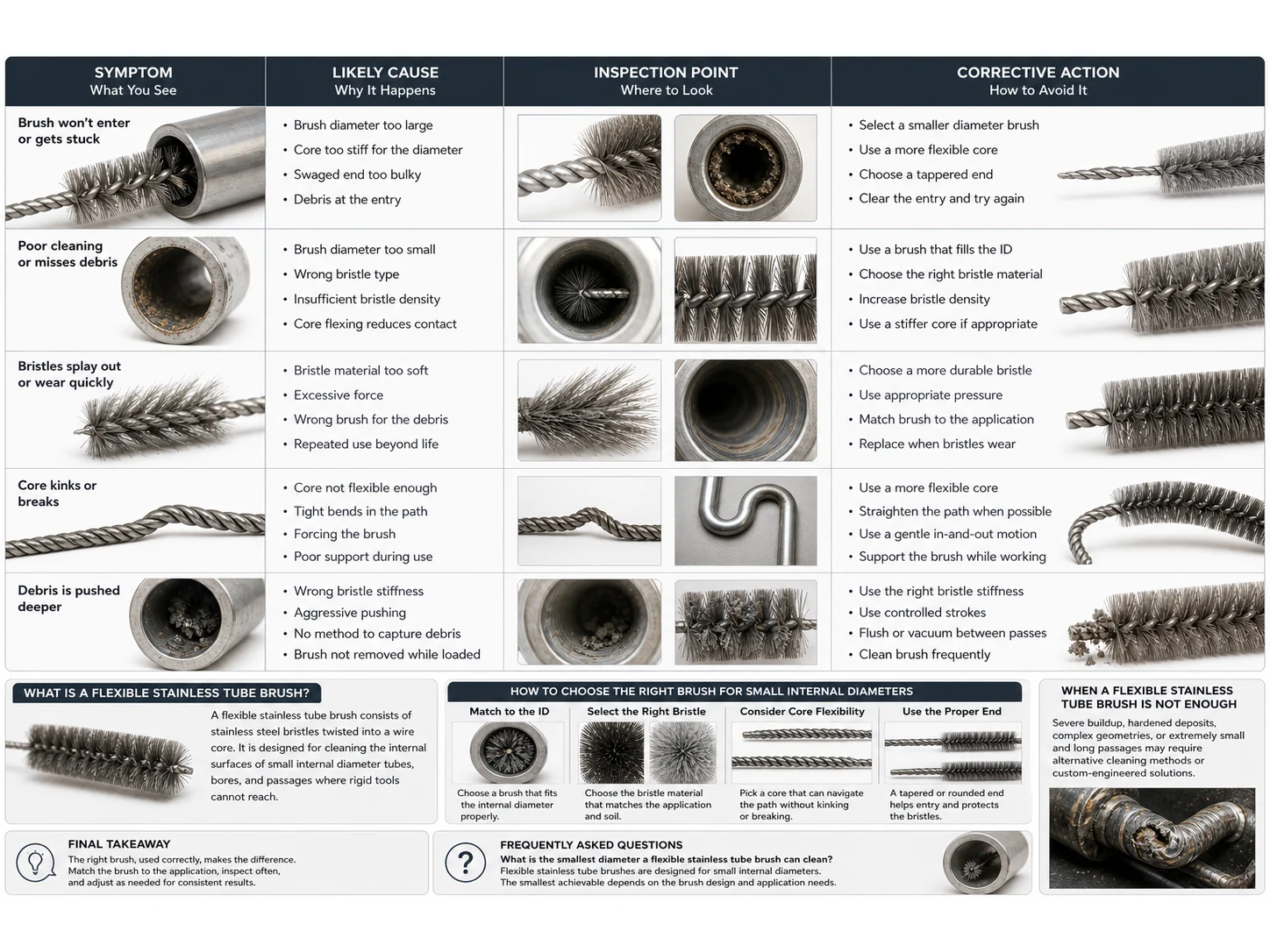
What Is a Flexible Stainless Tube Brush?
A flexible stainless tube brush consists of a wire core, usually made of galvanized or stainless steel, that has stainless steel bristles (filaments) twisted between the core wires. The core is flexible enough to follow gentle bends in tubing, while the bristles, available in different wire diameters and materials, provide the scrubbing action. These brushes are widely used in applications like heat exchanger tubes, hydraulic lines, laboratory glassware, and food processing equipment where rigid rods cannot reach.
Common Types and Configurations
Flexible stainless tube brushes vary mainly in core construction, bristle type, and end termination. The table below compares the most common options and their typical use cases.
| Option | Description | Typical Application | Key Consideration |
|---|---|---|---|
| Single-spiral core | One wire with bristles twisted in | Light cleaning, large-volume small IDs | Economical, moderate flexibility |
| Double-spiral core | Two wire stems twisted together, capturing bristles firmly | Moderate to aggressive cleaning | Higher stiffness, better bristle retention |
| Long-length flexible wire core | Continuous wire core with no joints, often 36″ or longer | Long tubes, heat exchangers, boiler tubes | Check bend radius before ordering |
| Crimped stainless bristles | Bristles have a wavy shape, increasing surface contact | Light to medium soot, powder, or soft deposits | Gentler than straight wire |
| Straight stainless bristles | Straight, stiff wire bristles for more cutting action | Hard deposits, light scale, rust removal | Can scratch sensitive surfaces |
| Loop-end handle | Simple loop at one end for manual use or hanging | Occasional manual cleaning | Not for power tools |
| Threaded end (e.g., 1/4-20) | Standard thread for mounting in powered spindles | Automated or machine-assisted cleaning | Verify thread size and direction |
How to Choose the Right Brush for Small Internal Diameters
Selection starts with the tube’s ID, material, and the residue to be removed. Beyond diameter, consider the factors below. For small IDs, even a 0.005″ difference can mean a brush that sticks, folds, or misses the wall entirely.
- Residue type: Light powder or oil only needs soft or crimped stainless bristles; hard carbon or scale demands straight, more aggressive wire.
- Surface sensitivity: Polished or coated bores may require a less aggressive brush or a non-stainless alternative like nylon.
- Equipment interface: Manual cleaning can use a loop handle; powered drive needs a threaded or shank adapter. Verify RPM limits.
- Wet or chemical exposure: If the brush runs in contact with water, steam, or acid/alkali solutions, the core material and bristle alloy become critical to avoid rust or corrosion.
- Hygiene expectations: Food, pharmaceutical, or medical applications may demand 316 stainless, passivated finish, and documented cleanability.
- Maintenance frequency: High‑cycle automated lines need a consistent wear life and reliable bristle retention. Select double‑spiral or reinforced construction.
- Custom size requirements: When off‑the‑shelf diameters fall between standard steps, or tube length, bend radius, and brush overall length don’t match, a custom brush may be the usually safer option. Always request a drawing review before ordering.
Common Mistakes When Selecting and Using Flexible Stainless Tube Brushes
These errors are frequently reported by users working with small internal diameters. Recognizing them early can prevent downtime, part damage, and wasted brushes.
- Buying by approximate ID instead of measuring: Using a caliper or gauge pin on the actual tube ID, not the nominal pipe size, is essential. A brush even 0.002″ oversized can jam; undersized cleans poorly.
- Ignoring core stiffness: A too‑stiff core will not follow gentle bends; too flexible may buckle and fold back inside the tube.
- Choosing the wrong bristle thickness: Wire diameter is often expressed in wire gauge. Thicker wire scrubs harder but can scratch and wear the tube. For very small IDs (e.g., under 0.25″), fine wire (0.004″–0.006″) is common.
- Over‑bending the brush: Every brush has a minimum bend radius. Forcing it into a tight elbow will permanently kink the core and break bristles.
- Using in wet environments without proper alloy: Standard 304 stainless can pit or rust in chlorinated water. For washdown or steam‑in‑place, 316 is often preferred.
- Running at excessive RPM: A power drill or motor can fling bristles outward and cause rapid breakage, especially in small diameters where the brush may hit imperfections and snag. Slow speeds (often under 500 RPM) are safer unless the supplier specifies otherwise.
- Neglecting end‑connector compatibility: A brush with a loop handle cannot be securely mounted in a drill chuck. Always match the drive end to the intended tool.
- Assuming “flexible” means unlimited bending: Even the most flexible wire core has physical limits. For tubes with tight 90° bends, consider a brush designed for the specific curvature or a pull‑through cleaning method.
When a Flexible Stainless Tube Brush Is the Wrong Choice
There are clear boundaries where a standard flexible stainless tube brush cannot do the job safely or effectively. Recognizing these situations can prevent costly damage and delays.
- Tight bends or kinked tubes: If the tube radius is smaller than the brush’s minimum bend, it will bind. In such cases, a sectional or articulated brush, or a chemical soak followed by a flexible pull‑through swab, may be required.
- Heavy, baked‑on scale: Extremely hard deposits often require powered scrapers, reamers, or hydro‑mechanical cleaning. Brushes may burnish the scale without removing it.
- Delicate or precision bores: Fuel injector nozzles, capillary tubes, and optical bores demand non‑abrasive methods. A stainless brush can irreversibly damage the surface finish.
- Cross‑section changes: A single brush cannot effectively clean a tube that flares or steps down unless it is custom‑made with the matching contour.
- Need for verification: When clean‑out requires proof (e.g., borescope inspection or swab test), the brush alone is insufficient. Pair mechanical cleaning with visual or analytical verification.
- Extreme chemical environments: Even 316 stainless can fail in strong acids or high‑temperature caustics. Material compatibility charts and supplier consultation become mandatory.
- Custom brush approvals: If the tube ID falls outside standard sizes or the brush length, bristle type, and mounting are all non‑standard, insist on a supplier drawing review and, if possible, a sample test against a scrap tube before a full order.
Final Takeaway
For small internal diameters, accurate measurement of the actual ID, matching the core flexibility to the tube pathway, and choosing the correct bristle grade and alloy for the contamination and operating environment will avoid the vast majority of cleaning failures. When conditions are non‑standard, invest in a sample or drawing review. A correctly chosen flexible stainless tube brush lasts longer, cleans better, and protects both your tubes and your process.
Frequently Asked Questions
What is the smallest diameter a flexible stainless tube brush can clean?
Standard catalog brushes go down to about 0.125 inch ID, and custom brushes can be made for even smaller bores. The limiting factor is the core wire diameter and bristle wire gauge; below 0.100 inch, the brush becomes very delicate.
Can I use a flexible stainless tube brush in food processing equipment?
Yes, provided the brush uses a food‑grade stainless alloy like 316, is free of ferrous contamination that could cause rust, and can be validated for cleanliness. Many food plants use them for daily CIP‑cleanable parts, but always confirm with the brush supplier and your QA team.
How do I measure the inside diameter correctly before ordering?
Use a digital caliper or inside micrometer on the actual tube, not the nominal pipe schedule. For very small or irregular bores, pin gauges give the most reliable reading. Mistaking the outside diameter or pipe schedule for the ID is a common ordering error.
What if my tube has a 90‑degree elbow close to the opening?
First, check the manufacturer’s minimum bend radius for the brush. If the bend is too tight, you may need a longer brush that enters after the elbow, or a special flexible pull‑through brush. Never force a standard brush around a sharp bend—it will kink and shed bristles inside the tube.
Should I choose a spiral‑wound core or a double‑spiral core?
A single‑spiral core is lighter and less expensive for gentle cleaning. A double‑spiral core holds bristles more securely, resists unwinding under torque, and is better for power‑driven use or when frequent breakage is a concern.
How can I prevent bristles from breaking inside the tube?
Select the correct brush diameter (oversizing is a major cause), use slow RPM when power cleaning, avoid excessive side pressure, and never use a brush with loose or rusted bristles. Inspect each brush before insertion and replace any with visible damage.
When should I request a custom brush instead of using a standard catalog size?
Request a custom brush when your tube ID falls between standard sizes, the brush must navigate a specific bend profile, the overall length is outside catalog ranges, or you need a unique mounting adapter. A drawing review from the supplier is the best safeguard against ordering errors.
Technical References
Which bristle material fits this job — AISI 304 Stainless Steel Wire, Nylon PA or Carbon Steel Wire?
| Material | Continuous temperature (°C) | Peak temperature (°C) | Water absorption | Hardness |
|---|---|---|---|---|
| AISI 304 Stainless Steel Wire | 400 | 500 | 0% | Rockwell B 70–95 depending on temper and cold work |
| Nylon PA | 93 | 121 | 0.3–9% by PA grade and conditioning | Medium to firm; filament diameter and trim length control bending force. |
| Carbon Steel Wire | 200–300 | 350–450 | 0% | Rockwell C 40–60 |
| Abrasive Nylon | 120 | 150 | 0.1–1.0% | Abrasive filament; stiffness and cutting level is controlled by PA base, grit type, grit size, filament diameter and trim height. |
| Brass Wire | 150–200 | 250–300 | 0% | Rockwell B 40–90 |
Figures as published by Alleima; Brushtec / DuPont; Perlon. Confirm the exact grade against the supplier datasheet before ordering.
What should replace Tube & Pipe Bore Brushes for tube brush?
- Tube & Pipe Bore Brushes — Tube and bore brushes work by radial contact inside a confined diameter; wire wheels and cups work mainly on external edges, profiles, welds, and broad surfaces.
- AISI 304 Stainless Steel Wire — Use AISI 316 stainless steel wire for chloride, marine, dairy, beverage, chemical washdown, or higher pitting-resistance requirements. Use carbon steel for dry aggressive cutting and brass or abrasive nylon for lower marking risk.
- Nylon PA — Compare Nylon PA with PP, PBT, PET. Change material when wet stiffness, temperature, chemical resistance, conductivity, particle shedding, or surface marking becomes the limiting factor.
- Carbon Steel Wire — Compare Carbon Steel Wire with Carbon steel wire, brass wire, abrasive nylon. Change material when wet stiffness, temperature, chemical resistance, conductivity, particle shedding, or surface marking becomes the limiting factor.