
What Is a Food Conveyor Belt Brush?
A food conveyor belt brush is a specialized cleaning component designed to scrub away food residues from the belt surface as it returns. It can be a powered rotating cylinder brush mounted under the belt, a static strip brush that makes passive contact, or a driven roller brush integrated into the cleaning system. In wet applications, the brush’s filament material, stiffness, and mounting must be carefully matched to the residue type and belt surface to avoid smearing, bacterial harborage, or premature wear.
Common Wet Material Carryback Challenges
Wet carryback is harder to remove than dry dust or granules. Sticky food materials cling to the belt, resist mechanical scraping, and can redeposit on downstream rollers. Common challenges include:
- Sticky residue buildup that causes belt tracking issues.
- Bacterial growth in moisture-trapping filaments or brush cores.
- Belt surface damage from overly aggressive bristles.
- Sanitation downtime if brushes are difficult to clean or replace.
- Chemical exposure that degrades brush materials.
Key Food Conveyor Belt Brush Options for Wet Carryback
Not all brushes are suitable for wet conditions. The table below compares common brush types, filaments, and mounting approaches relevant to wet food carryback.
| Brush Type | Best For | Typical Filament Material | Stiffness Range | Mounting Style | Notes for Wet Carryback |
|---|---|---|---|---|---|
| Powered Rotary Cylinder Brush | Continuous cleaning of wide belts with heavy, sticky residues | Nylon, Polypropylene, Polyester | Medium to Stiff | Shaft-driven, quick-release hubs | High contact frequency; needs good drainage and possible spray assist |
| Static Strip Brush | Light to moderate carryback on narrow belts, or as a secondary barrier | Nylon, Polypropylene | Soft to Medium | Bolt-on bracket or clamp-on holder | Not ideal for thick pastes; easy to swap for cleaning |
| Driven Roller Brush (motorized belt cleaner) | High-speed lines with difficult residues that require independent rotation speed | Polyester, Nylon | Medium | Integrated motor hub or chain drive | Complex installation; ensures aggressive cleaning without belt contact pressure |
| Custom Profile Brush | Belts with grooves, sidewalls, or curved surfaces | FDA-compliant Nylon, Polypropylene | Varies by application | Custom core and bracket | Often requires sample testing and supplier drawing review |
How to Choose a Food Conveyor Belt Brush for Wet Carryback
Selecting the right brush involves more than buying a standard size. Evaluate these factors:
- Residue type: Is it sticky (dough, jam), abrasive (vegetable grit), or fatty (meat emulsions)? Sticky residues require medium-stiff filaments; abrasive ones need durable, abrasion-resistant materials.
- Belt surface: Plastic modular belts tolerate stiffer brushes; fabric belts need softer filaments to avoid tearing; smooth rubber belts can be damaged by overly aggressive bristles.
- Sanitation requirements: Filaments must be USDA/FDA-compliant, non-absorbent, and resistant to washdown chemicals. Nylon and polypropylene are common choices.
- Chemical exposure: Acidic or alkaline cleaning agents can degrade natural fibers or low-grade plastics. Verify chemical compatibility.
- Brush core material: Stainless steel cores resist corrosion in wet environments; plastic cores avoid rust but may lack rigidity for wide belts; aluminum should be avoided if caustic cleaners are used.
- Maintenance frequency: Choose a mounting style that allows quick removal for daily sanitation (e.g., quick-release hubs).
- Custom sizing: Belt width, brush diameter, and shaft length often need customization to match existing conveyor frames.
Setup and Placement Factors
Even the best brush will fail if poorly positioned. Key installation considerations:
- Contact angle and pressure: The brush should make uniform contact across the entire belt width without excessive deflection. Too little pressure leaves residue; too much accelerates wear.
- Brush location: Position immediately after the head pulley where carryback is most accessible, before it can dry or fall onto rollers.
- Cleaning the brush itself: In wet applications, the brush can quickly become a contamination source. Install spray nozzles or a washdown system to rinse the brush while running, or ensure easy removal for CIP.
- Belt support: Install a support roller or slider bed opposite the brush to prevent belt sag and maintain consistent contact.
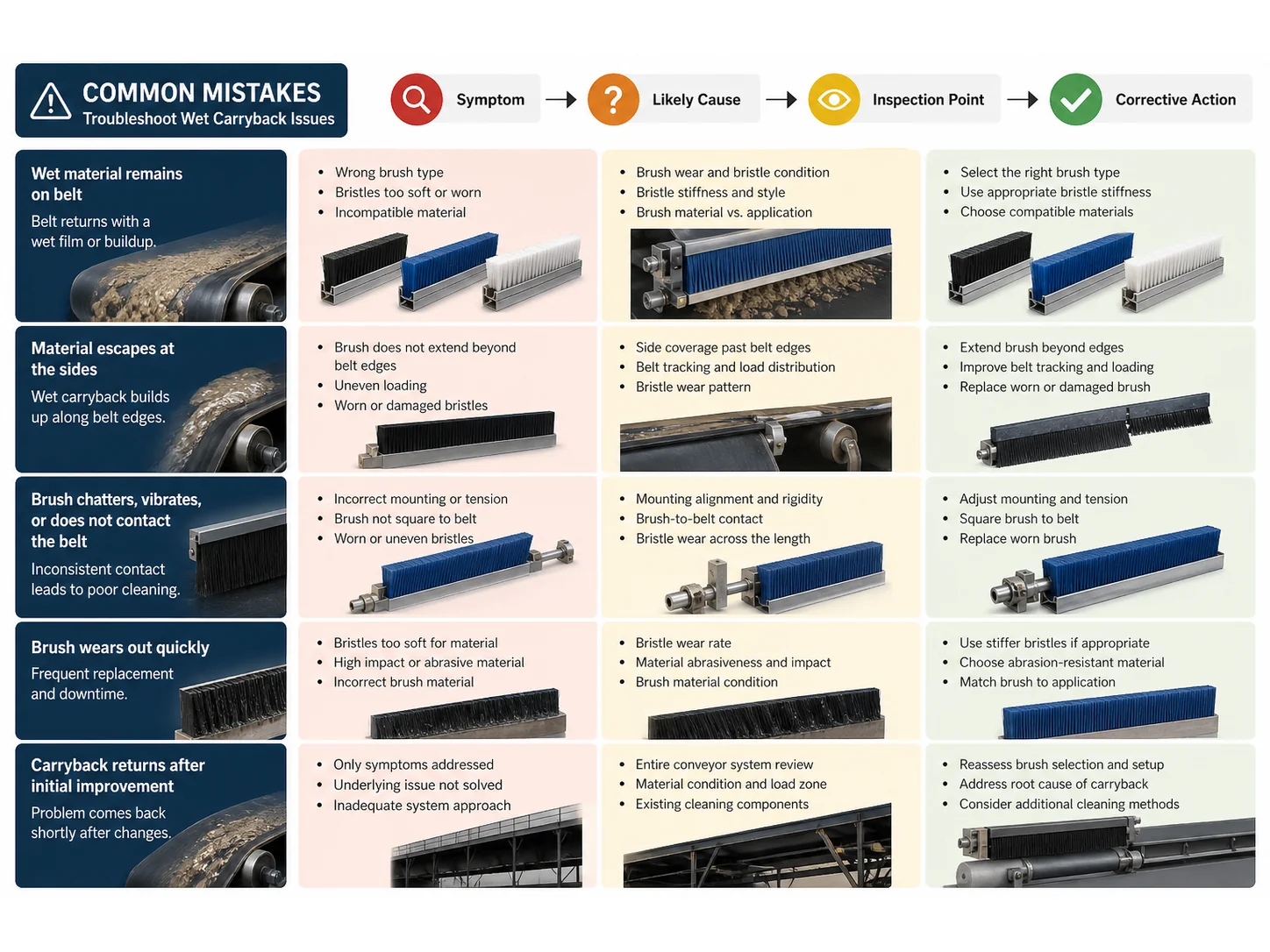
Common Mistakes
- Mistake 1: Using a brush with absorbent filaments. Natural fibers or low-grade plastics absorb water and food particles, leading to bacterial growth and premature decay. Always specify non-absorbent, FDA-compliant materials.
- Mistake 2: Choosing bristles that are too stiff. Overly stiff brushes can gouge belts, create fiber contamination, and generate excess friction. Match stiffness to belt type and residue adhesion.
- Mistake 3: Undersized brush diameter. A small diameter brush wears faster, reduces cleaning efficiency, and increases replacement frequency. For heavy carryback, use a larger diameter to increase filament life and contact stability.
- Mistake 4: Uneven mounting. Brushes that are not parallel to the belt cause uneven pressure, leaving stripes of residue. Use adjustable mounting brackets and check alignment regularly.
- Mistake 5: Ignoring a brush maintenance schedule. Even the best brush loses effectiveness as filaments wear or become matted with residue. Establish a preventive replacement interval based on visual inspection or hours of operation.
- Mistake 6: Selecting by cost drivers instead of material compliance. low-cost brushes may use non-certified filaments or cores that corrode, risking product contamination and audit failure.
- Mistake 7: Treating all wet carryback the same. High-sugar residues, fats, and water-based slurries each require different brush characteristics. Tailor the brush to the exact material.
When a Food Conveyor Belt Brush Is the Wrong Choice
A brush alone may not solve wet carryback if:
- The residue is highly abrasive and requires a pre-scraper to remove bulk material before brushing.
- Extreme stickiness (e.g., caramel, thick fondant) demands hot water or steam injection combined with the brush.
- The belt has deep grooves or profiles that a standard brush cannot reach; a custom-designed profile brush or secondary belt washing system is needed.
- Hygiene standards are ultra-strict and the brush itself is difficult to sanitize; consider a foam cleaning station or a completely different cleaning technology like ultrasonic cleaning.
- Space constraints prevent proper brush installation; consult a supplier for compact designs or alternative conveyor cleaning methods.
In such cases, a sample test on your actual belt with your production residues is recommended. Request a drawing review from the brush manufacturer to ensure the proposed design fits your equipment and hygiene requirements.
Final Takeaway
Avoid the most common food conveyor belt brush mistakes by matching filament material, stiffness, diameter, and mounting to the specific wet material, belt surface, and sanitation protocol. A properly selected and maintained brush reduces carryback, extends belt life, and supports food safety compliance. When in doubt, test a sample and involve the brush supplier early in the decision process.
Frequently Asked Questions
Can I use the same brush for dry and wet food conveyor belts?
Not usually. Wet carryback requires filaments that do not absorb moisture or harbor bacteria. A brush designed for dry materials may degrade quickly in wet conditions or become a contamination source.
How do I know if my brush is too stiff?
Look for signs of belt surface scuffing, excessive filament breakage, or audible squeaking. If the residue is being smeared rather than removed, the bristles may be too soft—not too stiff. A balance test on a scrap belt section can help determine the correct stiffness.
What filament materials are FDA-compliant for food contact?
Common FDA-compliant materials for food conveyor belt brushes include nylon, polypropylene, and polyester. Always ask for compliance documentation from the brush supplier and avoid natural fibers in wet environments.
How often should I replace a food conveyor belt brush?
Replacement frequency depends on usage intensity, residue abrasiveness, and cleaning practices. Visual inspections once a week can reveal matted, worn, or broken filaments. Set a preventive replacement interval once a clear wear pattern is established.
Can a static strip brush handle heavy wet carryback?
Static strip brushes work best for light residues or as a secondary cleaning stage. For heavy, sticky carryback, a powered rotary brush provides the necessary agitation to lift and displace material.
Do I need a custom brush if my belt is an odd width or thickness?
Often, yes. Many conveyor systems require custom brush lengths, shaft diameters, or mounting configurations. Providing accurate belt width, frame dimensions, and cleaning goals to a brush manufacturer ensures a proper fit.
Should I use a brush with a metal core in a wet food environment?
Only if the core is stainless steel. Mild steel or aluminum cores can corrode, contaminating product and damaging the brush. Plastic cores are an alternative but may lack stiffness for wide belts.
What’s the best way to clean the brush itself during production?
Installing a dedicated spray bar or jet washer directed at the brush while it rotates helps keep filaments clear of buildup. For full sanitation, choose a brush design with quick-release hubs so the brush can be removed and cleaned during washdown cycles.
Technical References
- FDA — Food Code
- eCFR — 21 CFR 177.1500 Nylon Resins
- eCFR — 21 CFR 177.1520 Olefin Polymers
- eCFR — 21 CFR 177.1630 Polyethylene Phthalate Polymers
- OSHA — Machine Guarding
- OSHA — Control of Hazardous Energy
Which bristle material fits this job — Nylon PA, AISI 304 Stainless Steel Wire or Rubber?
| Material | Continuous temperature (°C) | Peak temperature (°C) | Water absorption | Hardness |
|---|---|---|---|---|
| Nylon PA | 93 | 121 | 0.3–9% by PA grade and conditioning | Medium to firm; filament diameter and trim length control bending force. |
| AISI 304 Stainless Steel Wire | 400 | 500 | 0% | Rockwell B 70–95 depending on temper and cold work |
| Rubber | 100 | 130 | very low | Specified by compound and Shore hardness; published TPE families can span roughly 50–80 Shore A, but that is a product-family example rather than a universal rubber range. |
| AISI 316 Stainless Steel Wire | 400 | 500 | 0% | Rockwell B 70–95 depending on temper and cold work |
| Polypropylene PP | 80–100 | 120–140 | ≤0.03% | Shore D 65–75 |
Figures as published by Brushtec / DuPont; Alleima; Perlon. Confirm the exact grade against the supplier datasheet before ordering.
What should replace Roller and Conveyor Brushes for conveyor belt?
- Roller and Conveyor Brushes — Roller and conveyor brushes hold cylindrical line contact across a working width, including helix-wound builds where the filament path is set to move loosened material toward one side; a strip brush holds the same line without rotating, so it seals or wipes but cannot carry residue along the width.
- Nylon PA — Compare Nylon PA with PP, PBT, PET. Change material when wet stiffness, temperature, chemical resistance, conductivity, particle shedding, or surface marking becomes the limiting factor.
- AISI 304 Stainless Steel Wire — Use AISI 316 stainless steel wire for chloride, marine, dairy, beverage, chemical washdown, or higher pitting-resistance requirements. Use carbon steel for dry aggressive cutting and brass or abrasive nylon for lower marking risk.
- Rubber — Compare Rubber with Silicone elastomer, TPE, PVC profile, PVA sponge. Change material when wet stiffness, temperature, chemical resistance, conductivity, particle shedding, or surface marking becomes the limiting factor.