
What Is an Instrument Cleaning Brush?
An instrument cleaning brush is a slender, flexible or rigid tool with bristles or abrasive material at one end, used to manually scrub the interior surfaces of tubes, ports, and lumens. It is often employed in reprocessing reusable medical devices, maintaining laboratory glassware, and cleaning industrial sampling lines. The brush must effectively contact all internal surfaces without scratching, shedding, or leaving fibers that could cause blockages or contamination.
Why Narrow Instrument Channels Create a Special Challenge
Narrow channels—often less than 5 mm in diameter and up to several meters long—pose unique cleaning difficulties. Residue can be tenacious (e.g., dried blood, mucus, oils), and channels may include bends, valves, or dead spaces. Limited visual access means operators must rely on the brush to do the work consistently. The wrong brush diameter can either fail to contact surfaces or jam and damage the channel lining.
Common Types of Instrument Cleaning Brushes for Narrow Channels
The following table outlines typical brush constructions used in narrow-channel cleaning. Each type balances stiffness, reach, and material compatibility.
| Type | Typical Core/Handle | Bristle Material | Best For |
|---|---|---|---|
| Single‑use disposable brush | Plastic or thin wire | Nylon, polyester | Endoscope channels, strict hygiene protocols |
| Reusable flexible brush | Twisted stainless steel wire | Nylon, stainless steel, brass | Sturdy metal or plastic channels, industrial tubes |
| Twisted‑in‑wire brush | Twisted wire (stem is also handle) | Stainless steel, brass, nylon | Heavy residue in metal tubes, boiler tubes |
| Tube brush with loop handle | Metal wire with loop end | Natural bristle, nylon, abrasive | Laboratory glassware, test tubes |
| Channel cleaning swab | Flexible plastic handle | Foam, microfiber tip | Small ports, delicate optics, part of validation kits |
Comparison of Brush Materials for Narrow Channel Cleaning
Material selection is critical for both cleaning efficacy and instrument safety. The table below compares the most common bristle materials used in narrow-channel brushes.
| Material | Compatible Surfaces | Risk of Scratching | Chemical Resistance | Typical Use |
|---|---|---|---|---|
| Nylon | Plastic, soft metal, glass | Low | Good (acids & alkalis OK) | Endoscope channels, lab glassware |
| Polyester (PET) | Plastic, stainless steel | Very low | Excellent | Cleanroom, pharmaceutical equipment |
| Brass | Stainless steel, cast iron | Moderate | Good; avoid acids | Boiler tubes, heavy deposits |
| Stainless steel | Stainless steel, hard alloys | High | Excellent | Rust removal, industrial lines |
| Natural bristle (Tampico, horsehair) | Delicate metals, polished surfaces | Very low | Moderate; absorbs water | Optical components, fine polishing |
How to Choose the Right Instrument Cleaning Brush
Begin by measuring the channel’s inner diameter and length. The brush diameter should be 0.5–1.0 mm larger than the channel for effective wall contact without excessive drag. Then consider these factors:
- Residue type: Soft biofilms can be removed with nylon; dried, caked-on material may require brass or stainless steel.
- Surface sensitivity: Soft plastics, coatings, or optical surfaces demand non‑abrasive bristles like polyester or natural fiber.
- Wet or dry cleaning: Some chemicals degrade natural bristles; nylon and polyester are more chemical resistant.
- Hygiene expectations: Single‑use brushes eliminate cross‑contamination risk in sterile processing.
- Maintenance frequency: High‑volume reprocessing may justify reusable brushes with validated cleaning protocols.
- Custom size requirements: Odd‑shaped channels often need a supplier drawing review; never force an off‑the‑shelf brush.
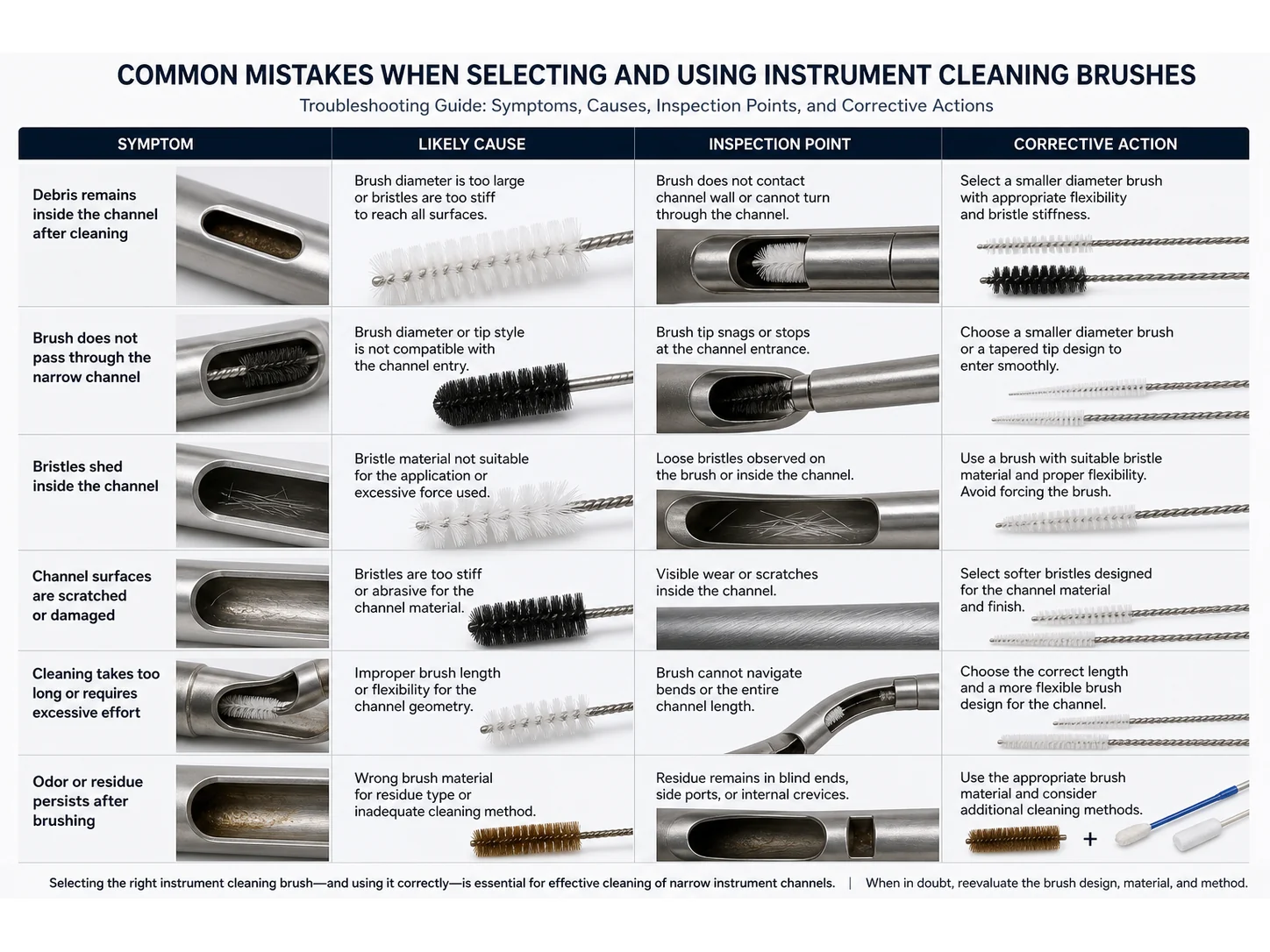
Common Mistakes When Selecting and Using Instrument Cleaning Brushes
Many cleaning failures trace back to one of these preventable errors:
- Wrong diameter choice. A brush too thin misses residues; too thick can stick, break, or scratch the channel.
- Ignoring material compatibility. Using a brass brush on plastic endoscope channels leaves scratches that harbor bacteria.
- Reusing single‑use brushes. Bristles fatigue and shed, and bioburden may remain; reprocessing instructions must be followed exactly.
- Failing to inspect the brush before use. Bent, kinked, or frayed brushes can break inside the channel.
- Using excessive force. Pushing a brush through a tight bend can snap the core or strip the channel lining.
- Skipping pre‑cleaning or enzyme soak. Brushes alone cannot dissolve hardened residues; they work best after a presoak.
- Not tracking brush life. Reusable brushes degrade over time; replace them according to manufacturer recommendations, not just when they look worn.
When an Instrument Cleaning Brush Is the Wrong Choice
A brush is one step in a multi‑step cleaning process. In narrow channels, manual brushing alone may miss biofilm in crevices or around valves. If visual inspection or validation (e.g., ATP or protein tests) fails, complement brushing with:
- Ultrasonic cleaning for fine, complex lumens
- Automated flushing systems that control pressure and flow
- Enzymatic cleaners that target specific soils
- Supplier‑recommended cleaning kits with matched brush and adapter
If a channel has an irregular cross‑section, blind holes, or extremely small diameters (<1 mm), a brush may be impossible. In these cases, request a drawing review from an experienced brush manufacturer or switch to a non‑brush method like high‑pressure fluidic cleaning.
Final Takeaway: Preventing Brush‑Related Failures
Narrow instrument channels demand a careful match between brush and application. Define the channel dimensions, residue, and material sensitivity first. Choose a brush material that cleans effectively without damaging the surface. Follow a validated cleaning protocol, inspect brushes before each use, and never substitute a brush that is too large or too stiff. When in doubt, consult the instrument manufacturer’s IFU and consider a custom brush design supported by a technical review.
Frequently Asked Questions
Can I reuse a brush labeled as single‑use?
No. Single‑use brushes are validated for one cleaning cycle only. Re‑sterilizing or reusing them can lead to bristle damage, loss of cleaning efficacy, and cross‑contamination.
What should I do if the brush gets stuck in a narrow channel?
Stop immediately. Do not pull hard. Rotate the brush gently while withdrawing it. If that fails, follow the instrument manufacturer’s emergency retrieval procedure—often involving lubrication and careful extraction to avoid channel damage.
How do I confirm a replacement brush will fit my instrument’s channel?
Use a pin gauge or calibrated measuring tool to determine the channel’s inner diameter and length. Compare these measurements against the brush’s stated working dimensions. For critical devices, request a sample brush or a dimensional drawing from the supplier.
Are wire brushes safe for delicate endoscope channels?
Generally no. Most endoscope channels have soft plastic or rubber linings that can be scored by wire bristles. Use only brushes specifically designed and approved by the endoscope manufacturer, typically nylon or polyester.
What cleaning solution should I use with an instrument cleaning brush?
Always follow the instrument manufacturer’s instructions for use (IFU). Typically, a low‑foaming enzymatic or neutral pH cleaner is recommended. The brush must be chemically compatible with the cleaning agent.
How often should reusable instrument cleaning brushes be replaced?
Replace them when bristles show wear, the core becomes kinked, or after the number of cycles specified by the brush manufacturer. Visual inspection before each use is essential; if any doubt exists, replace the brush.
Can I use the same brush for different types of instruments?
Not without a robust cleaning and disinfection procedure between uses. Cross‑contamination risk is high. Dedicated brushes for specific instrument families are recommended, especially in medical settings.
Technical References
- CDC — Disinfection and Sterilization Guideline
- CDC — Core Infection Prevention and Control Practices
- FDA — Reprocessing Medical Devices in Health Care Settings
Which bristle material fits this job — AISI 304 Stainless Steel Wire, Nylon PA or Microfiber?
| Material | Continuous temperature (°C) | Peak temperature (°C) | Water absorption | Hardness |
|---|---|---|---|---|
| AISI 304 Stainless Steel Wire | 400 | 500 | 0% | Rockwell B 70–95 depending on temper and cold work |
| Nylon PA | 93 | 121 | 0.3–9% by PA grade and conditioning | Medium to firm; filament diameter and trim length control bending force. |
| Microfiber | 80–120 | 140–170 | 0.2–1.0%Material Itself ; Structure Can Absorb 3–7 Times Its Own Weight | — |
| Horsehair | 60–80 | 100–120 | 8–15% | — |
Figures as published by Alleima; Brushtec / DuPont. Confirm the exact grade against the supplier datasheet before ordering.
What should replace AISI 304 Stainless Steel Wire for narrow channels?
- AISI 304 Stainless Steel Wire — Use AISI 316 stainless steel wire for chloride, marine, dairy, beverage, chemical washdown, or higher pitting-resistance requirements. Use carbon steel for dry aggressive cutting and brass or abrasive nylon for lower marking risk.
- Nylon PA — Compare Nylon PA with PP, PBT, PET. Change material when wet stiffness, temperature, chemical resistance, conductivity, particle shedding, or surface marking becomes the limiting factor.
- Microfiber — Compare Microfiber with Cotton yarn, wool, felt, soft PBT filament. Change material when wet stiffness, temperature, chemical resistance, conductivity, particle shedding, or surface marking becomes the limiting factor.
- Horsehair — Compare Horsehair with Boar bristle, goat hair, microfiber. Change material when wet stiffness, temperature, chemical resistance, conductivity, particle shedding, or surface marking becomes the limiting factor.