
What Is a Sieve Cleaning Brush?
A sieve cleaning brush is a brush that physically contacts the sieve mesh to remove lodged particles. It can be a manually handled tool or a component integrated into an automatic screen cleaning system. The brush’s bristles penetrate the mesh openings, pushing out fines that would otherwise reduce throughput, alter particle size distribution, or cause cross-batch contamination. In sticky applications, the brush must overcome adhesion forces without abrading the mesh or leaving behind bristle fragments.
Common Types of Sieve Cleaning Brushes
Selecting the wrong brush type for sticky fines is a frequent mistake. The table below outlines the most relevant options, their typical material properties, and their suitability for cohesive residues.
| Brush Material | Typical Bristle Stiffness | Mesh Compatibility | Sticky Fines Suitability | Notes |
|---|---|---|---|---|
| Nylon (standard) | Medium | Coarse to medium meshes | Moderate—may require frequent cleaning | Affordable; risk of bristle breakage over time |
| Nylon (abrasive-filled) | Medium to stiff | Medium meshes | Good—abrasive aids removal but increases mesh wear | Use only on robust mesh types; not for fine wires |
| Polypropylene | Soft to medium | Fine and delicate meshes | Limited—swells with some sticky pastes | Chemically resistant; low moisture absorption |
| Brass wire | Stiff | Coarse, heavy-duty meshes | Excellent—metal bristles scrape tenacious residue | Risk of sparking and metal contamination |
| Stainless steel wire | Very stiff | Heavy-duty wedge wire and perforated plates | Best—handles hardened deposits | Required for food-grade or corrosion-resistant settings |
| Horsehair | Soft | Ultra-fine meshes | Fair—gentle but may absorb moisture and product | Natural fiber; not for wet or sanitary applications |
| Custom composite | Tailored | Varied | Highest—engineered per residue and mesh | Recommended when standard options fail |
How to Choose the Right Sieve Cleaning Brush
Decision factors go beyond bristle material. Evaluate the following when specifying a brush for sticky fines:
- Residue composition: Is the fines moisture content above 5%? Does it contain oils, sugars, or salts that cause caking? The brush must resist chemical softening.
- Mesh sensitivity: Wire diameter and opening size dictate bristle diameter and tip radius. A stiff brush on fine mesh will tear openings.
- Brush diameter and filling density: A larger diameter brush with dense bristle packing improves cleaning contact but may require more drive torque.
- Handle, core, or mounting interface: For manual brushes, consider ergonomics and hygienic seals. For automatic systems, confirm shaft diameter, keyway, or quick-connect style.
- Operating environment: Wet washdowns, chemical exposure, or high temperatures (above 80°C) limit material choices. Polypropylene handles acidic streams; stainless steel cores handle heat.
- Maintenance frequency: In continuous operations, select materials that resist abrasive wear and allow for quick replacement without full system disassembly.
Common Mistakes When Using Sieve Cleaning Brushes on Sticky Fines
| Mistake | Why It Happens | How to Avoid It |
|---|---|---|
| Using a brush that is too soft | Assuming all sticky powders are alike; choosing based on low cost | Test stiffness with a small sample; upgrade to abrasive nylon or metal wire for tenacious fines |
| Ignoring bristle diameter relative to mesh opening | Standard “one size fits all” purchasing | Measure mesh aperture; bristle diameter should be 50–70% of the opening to avoid snagging |
| Overlooking chemical compatibility | Brush failure after first washdown or CIP cycle | Check MSDS of cleaning agents and product; choose PP or 316 stainless as needed |
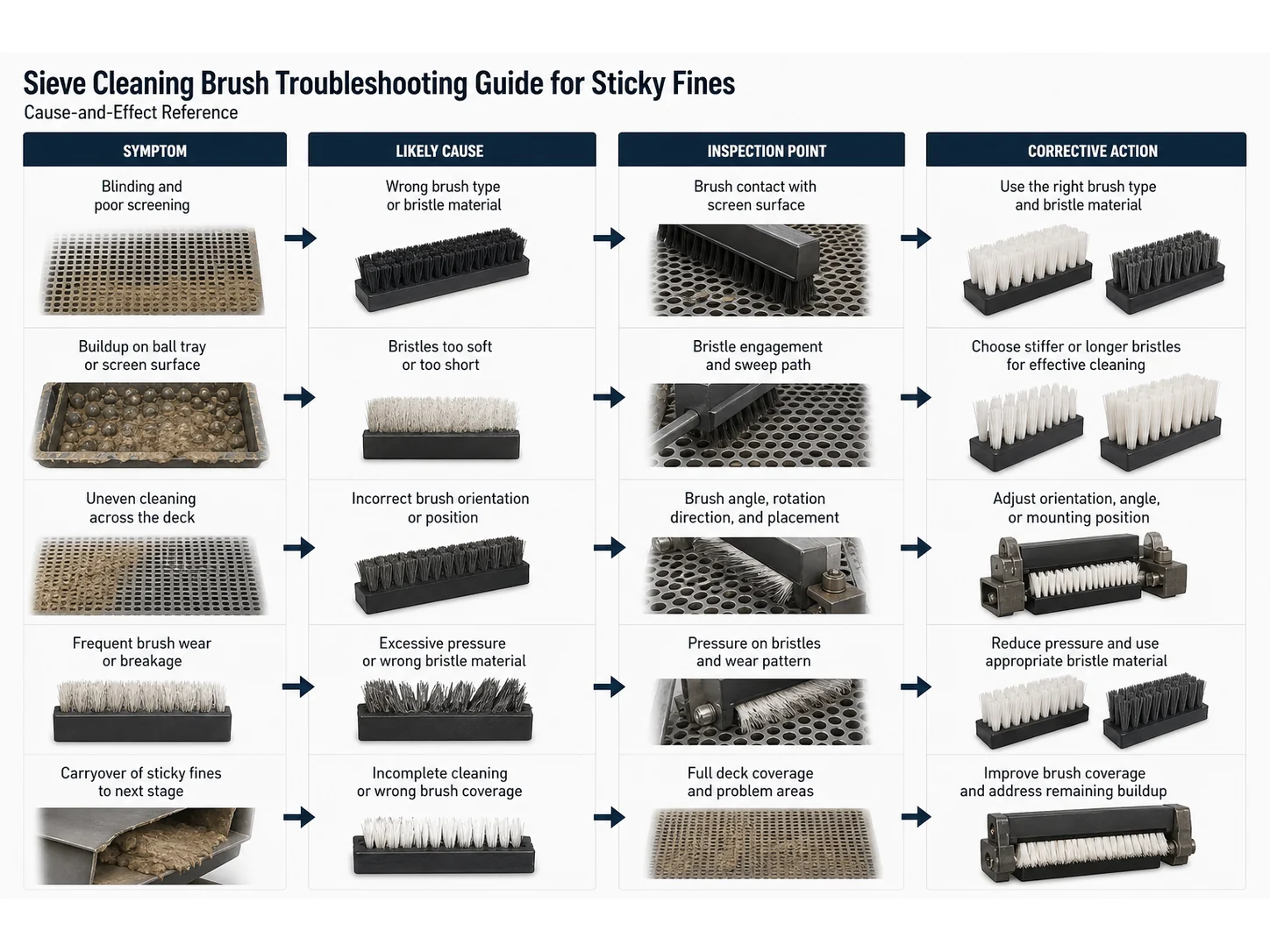
| Neglecting brush mounting alignment | Uneven wear, incomplete cleaning in spots | Ensure brush holders or shafts are perfectly parallel to the screen surface |
| Running brush at wrong speed or pressure | Operating automatic brush systems at the motor’s default setting | Adjust contact pressure and rotational speed to match residue adherence; start low, increase gradually |
| Failing to check for bristle loss | Believing synthetic brushes never shed | Implement daily visual checks; use metal-detectable bristle materials in food processing |
When a Sieve Cleaning Brush Is the Wrong Choice
A brush alone cannot resolve every blinding scenario. Consider supplemental or alternative measures when:
- Sticky fines have a high fat or moisture content that causes immediate re-adhesion after brushing. Integrated air knives or ultrasonic deblinding may be necessary.
- The mesh is extremely fine (below 50 µm) and bristle contact damages it. Non-contact methods like pneumatic tapping or vibrational fluidization should be evaluated.
- Hygienic standards require zero bristle-loss risk. Single-piece polymer scraping blades or dedicated squeegee systems may replace brushes entirely.
- You have completed a brush trial and still observe throughput drop-offs. It is time to request a drawing review from your engineering team or a sample test with a brush supplier to redesign the cleaning interface.
Final Takeaway
Mistakes with sieve cleaning brushes on sticky fines are almost always preventable through systematic selection. Start by profiling your residue and mesh, then match bristle material, stiffness, and mounting. Do not default to the lowest-cost or most available option. When in doubt, run a small-patch test before full implementation, and remember that a brush is just one element of a complete screen hygiene strategy.
Frequently Asked Questions
What makes a sieve cleaning brush different from an ordinary cleaning brush?
A sieve cleaning brush is designed specifically for mesh contact. It features controlled bristle diameters, stiffness, and tip geometry to clear openings without stretching or tearing the wire. Ordinary brushes can damage sieves or leave fibers behind.
Can I use a natural fiber brush for food-grade sticky powders?
Natural fibers like horsehair absorb moisture and can harbor bacteria. For food applications, use FDA-compliant synthetic materials such as polypropylene or polyester with metal-detectable additives to maintain hygiene and safety.
How often should I replace a sieve cleaning brush?
Replacement depends on bristle wear, loss, and cleaning efficiency. In sticky fines applications, check brushes weekly. Set a replacement schedule based on mesh quality: if throughput drops by 10% or visible bristle breakage occurs, it is time to replace.
Can I trim a brush to fit a smaller sieve?
Trimming can expose the internal core and create sharp edges that snag the mesh. It is better to order a custom-sized brush from a supplier that can match the exact length and diameter while maintaining bristle integrity.
What bristle material works best for both acidic product and frequent chemical washing?
Polypropylene bristles with a stainless steel or polypropylene core typically offer the best balance. Avoid natural fibers and standard nylon, which degrade in acidic environments.
Is a wire brush safe for ultra-fine stainless steel mesh?
No. Wire bristles can permanently deform fine mesh openings, causing oversized product escape. Use soft synthetic or natural bristles for meshes finer than 100 mesh (150 µm). Verify mesh opening size before selecting any brush.
How can I test a brush before buying large quantities?
Request sample segments from your supplier and run a small-scale trial on your actual product and mesh. Check for cleaning efficiency, bristle shedding, and mesh wear after a defined cycle count. Document results to justify the final selection.
Why does my brush clean well at first but then lose effectiveness?
Sticky fines can gradually coat bristles, filling the space between them until the brush becomes a smooth surface. Choose materials with natural anti-adhesive properties, or incorporate a cleaning spray or secondary scraper into the brush system.
Technical References
Which bristle material fits this job — AISI 304 Stainless Steel Wire, Nylon PA or Horsehair?
| Material | Continuous temperature (°C) | Peak temperature (°C) | Water absorption | Hardness |
|---|---|---|---|---|
| AISI 304 Stainless Steel Wire | 400 | 500 | 0% | Rockwell B 70–95 depending on temper and cold work |
| Nylon PA | 93 | 121 | 0.3–9% by PA grade and conditioning | Medium to firm; filament diameter and trim length control bending force. |
| Horsehair | 60–80 | 100–120 | 8–15% | — |
| Abrasive Nylon | 120 | 150 | 0.1–1.0% | Abrasive filament; stiffness and cutting level is controlled by PA base, grit type, grit size, filament diameter and trim height. |
Figures as published by Alleima; Brushtec / DuPont; Perlon. Confirm the exact grade against the supplier datasheet before ordering.
What should replace AISI 304 Stainless Steel Wire when it stops working?
- AISI 304 Stainless Steel Wire — Use AISI 316 stainless steel wire for chloride, marine, dairy, beverage, chemical washdown, or higher pitting-resistance requirements. Use carbon steel for dry aggressive cutting and brass or abrasive nylon for lower marking risk.
- Nylon PA — Compare Nylon PA with PP, PBT, PET. Change material when wet stiffness, temperature, chemical resistance, conductivity, particle shedding, or surface marking becomes the limiting factor.
- Horsehair — Compare Horsehair with Boar bristle, goat hair, microfiber. Change material when wet stiffness, temperature, chemical resistance, conductivity, particle shedding, or surface marking becomes the limiting factor.
- Abrasive Nylon — Compare Abrasive Nylon with PP, PBT, PET. Change material when wet stiffness, temperature, chemical resistance, conductivity, particle shedding, or surface marking becomes the limiting factor.