
What Is CPAP Tube Brush Sizing?
CPAP tube brush sizing means selecting a cleaning brush whose core dimensions—diameter, working length, and tip profile—are appropriate for the specific CPAP hose being cleaned. A correctly sized brush removes debris from the entire internal surface, reaches the full length of the tube, and supports effective drying afterward. Poor sizing leads to three main risks: incomplete surface contact, physical damage to the tubing, or moisture retention that turns a cleaned tube into a contamination source.
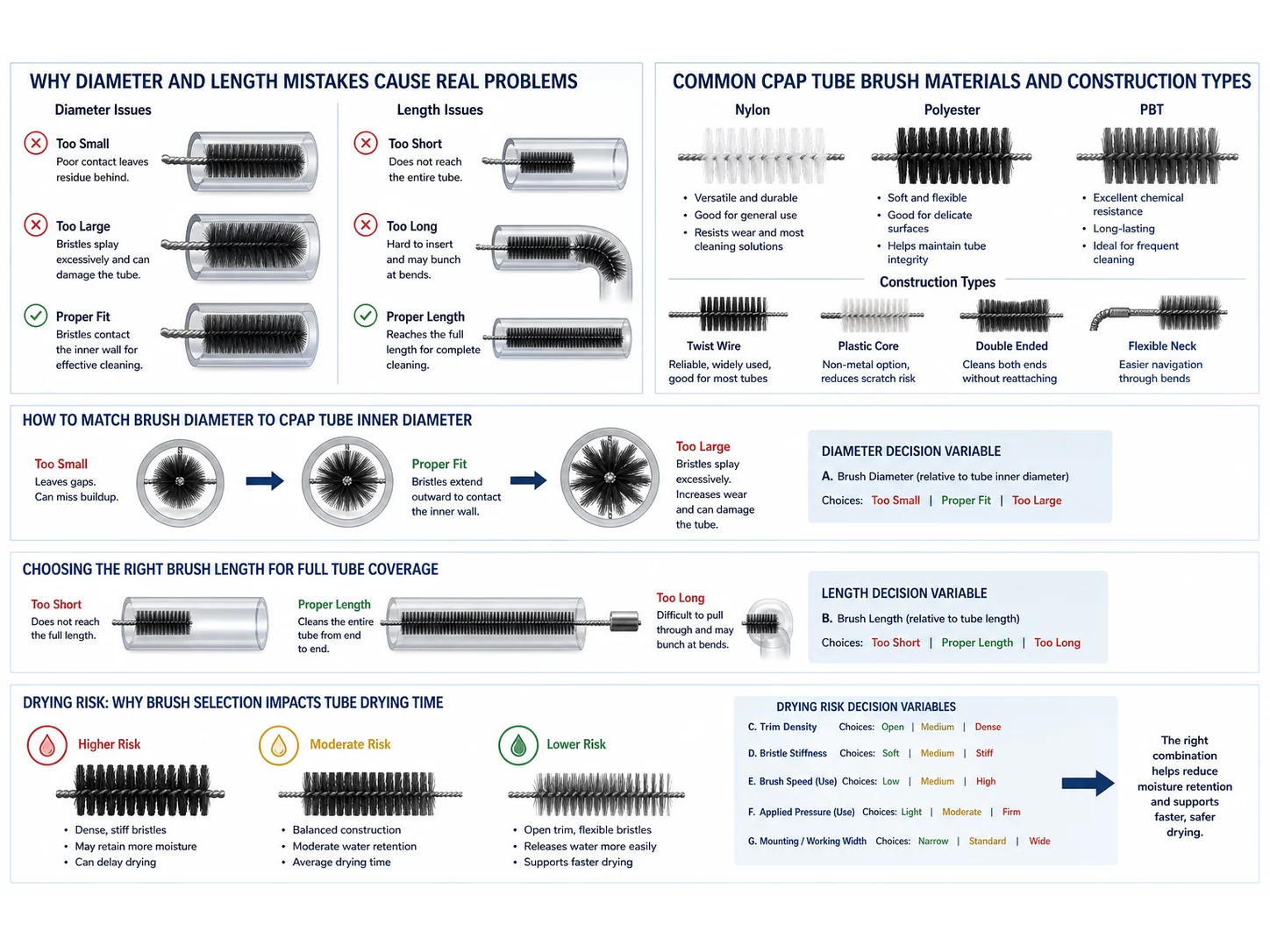
Why Diameter and Length Mistakes Cause Real Problems
An undersized brush will not press against the tube wall with enough pressure to dislodge biofilm, oils, and dried particulate. This leaves a thin layer of contamination that can become a breeding ground for pathogens. An oversized brush can jam inside the tubing, stretch the hose material, or cause micro-tears that trap moisture. A brush that is too short cannot reach the full length of a standard 6-foot CPAP tube, leaving the far end uncleaned. Even a slight length mismatch often forces users to “work from both ends,” which increases the risk of pushing debris back into the middle of the tube.
Common CPAP Tube Brush Materials and Construction Types
Not all tube brushes clean the same way. Material choice affects scrubbing action, durability, how much water the brush holds, and whether the brush itself can be properly dried. The table below compares widely used materials and constructions for CPAP tube cleaning.
| Brush Type | Material / Core | Stiffness | Water Retention | Best Use Case |
|---|---|---|---|---|
| Nylon spiral brush | Nylon bristles on flexible wire core | Medium-high | Low | General CPAP tube cleaning; dries quickly |
| Polyester brush | Polyester bristles, often on twisted wire | Medium | Low-medium | Softer scrubbing where scratch risk is a concern |
| Microfiber brush head | Microfiber strands, plastic core | Low | High | Wiping and polishing; requires careful drying |
| Foam tip brush | Open-cell foam on plastic stem | Very low | Very high | Gentle interior wiping; high drying risk |
| Combination brush/drying aid | Bristles plus absorbent drying strip | Varies | Varies | One-pass cleaning + drying; fit still critical |
How to Match Brush Diameter to CPAP Tube Inner Diameter
CPAP hoses typically have an inner diameter (ID) of 15 mm or 22 mm. A cleaning brush should be slightly larger than the tube ID to create the necessary friction without excessive force. For a 15 mm ID tube, a brush diameter of about 16–17 mm usually works. For a 22 mm tube, look for 23–24 mm. A brush that is more than 2 mm larger than the tube ID risks binding. Always measure the ID of your specific hose—not the outside diameter—and choose a brush with a soft, flexible tip that can enter the tube without snagging.
Choosing the Right Brush Length for Full Tube Coverage
A standard CPAP tube is 6 feet (1.8 meters) long. The brush working length should be at least that long, plus a few extra inches to hold and guide the brush without your hand touching the tube opening. If you use a heated tube, the internal wiring adds complexity; a brush that is too stiff may damage the sensor wire. Look for a flexible but kink-resistant shaft that can follow the tube’s curves. Brushes sold as “CPAP tube brushes” are often pre-sized for this, but always verify the cleaning portion length, not just the overall package length.
Drying Risk: Why Brush Selection Impacts Tube Drying Time
Even after scrubbing, the final rinse leaves water droplets inside the tube. Some brush materials act like a wick and pull moisture away, while others trap water inside the bristles or foam tip, releasing it back into the tube later. A slow-drying tube becomes a mold and bacteria risk. A brush with low water retention (such as a nylon spiral) combined with a separate drying aid—like a CPAP tube dryer that pushes warm, filtered air through the hose—minimizes this risk. If you rely on air drying only, the brush itself must be a material that dries quickly and does not shed moisture inside the tube after cleaning.
Common CPAP Tube Brush Sizing Mistakes
- Guessing instead of measuring. Assuming all CPAP tubes are the same ID leads to a poor fit. Measure with a caliper or check the manufacturer’s specs.
- Buying by cost drivers alone. A low-cost brush that is undersized or made of sponge material may clean poorly and hold moisture.
- Ignoring core flexibility. A stiff wire core can kink and permanently deform the tube if forced.
- “One-size-fits-all” assumption. A brush labeled for CPAP might still be designed for 22 mm tubes and be too large for a 15 mm slim tubing.
- Forgetting the drying step. Sizing for cleaning is useless if the brush material promotes moisture buildup. Always pair the brush choice with a verified drying method.
- Using a brush with a bare metal tip. Exposed wire at the leading end can scratch or puncture the tube interior.
When CPAP Tube Brush Sizing Is the Wrong Choice
Even a perfectly sized brush cannot eliminate all contamination if the tube has deep biofilm, mineral deposits from hard water, or internal damage from heat and age. In these cases, the tube may need a thorough soak in a CPAP-approved cleaning solution, a high-level disinfection process, or complete replacement. For heated CPAP tubes, the embedded wiring and sensors can be damaged by overly aggressive brushing; if you see any fraying or separation, stop using the brush and consult the equipment manual. If you are responsible for cleaning in a multi-patient setting, sizing alone is not a substitute for a validated disinfection protocol and periodic replacement of both brushes and hoses.
Final Takeaway
CPAP tube brush sizing is about more than buying a brush that fits. The right diameter ensures full surface contact, the right length Help confirms reach, and the right material supports rapid drying to minimize contamination risk. Start by measuring your hose’s ID, choose a brush with a small oversize and a flexible, non-damaging tip, and plan your drying method from the beginning.
Frequently Asked Questions
What is the typical inner diameter of a CPAP tube?
Most standard CPAP hoses have an inner diameter of 22 mm. Slim or lightweight tubing often has a 15 mm ID. Always check your specific hose because mixing sizes is common.
Can I use a generic tube cleaning brush instead of one marketed for CPAP?
Yes, but you must verify that the brush diameter, length, and material are suitable for medical-grade tubing. A brush designed for industrial hoses may be too aggressive or retain moisture in ways that promote microbial growth.
How do I know if the brush is too large for my CPAP tube?
If you feel significant resistance while inserting or withdrawing the brush, or if the brush causes the tube to stretch visibly, the diameter is too large. The brush should move with moderate friction, not force.
Do I need a separate brush for the short CPAP mask hose?
Short mask hoses often have the same ID as the main tube but are much shorter. A full-length CPAP tube brush may be cumbersome. You can use a shorter brush of the same diameter, but using the same brush is fine as long as the bristle section fits inside the shorter length.
How often should I replace a CPAP tube brush?
Replace the brush every 2–3 months, or sooner if bristles are bent, flattened, or show signs of mold. A worn brush loses diameter and cleaning effectiveness.
Can a brush completely dry the inside of a CPAP tube?
No. A brush removes loose water, but microscopic droplets often remain. For complete drying, use a separate tube dryer, hang the tube vertically in a clean, dry area, or run a dedicated CPAP drying cycle.
Is a wire core brush safe for heated CPAP tubes?
Only if the wire core is fully coated and the tip is protected. Exposed wire can catch on internal heating elements or sensor wires. Look for brushes with a covered tip and a flexible, vinyl-coated wire core.
What if my CPAP tube has a fabric cover?
Never insert a brush into a fabric-covered tube unless the cover is removable and the inner tubing’s ID is known. Most fabric covers are not designed for internal brushing and may trap moisture or lint.
Technical References
- CDC — Disinfection and Sterilization Guideline
- CDC — Core Infection Prevention and Control Practices
- FDA — Reprocessing Medical Devices in Health Care Settings
- NIST — Metric SI
Which bristle material fits this job — Nylon PA, Microfiber or PET Polyester?
| Material | Continuous temperature (°C) | Peak temperature (°C) | Water absorption | Hardness |
|---|---|---|---|---|
| Nylon PA | 93 | 121 | 0.3–9% by PA grade and conditioning | Medium to firm; filament diameter and trim length control bending force. |
| Microfiber | 80–120 | 140–170 | 0.2–1.0%Material Itself ; Structure Can Absorb 3–7 Times Its Own Weight | — |
| PET Polyester | 120–150 | 170–190 | 0.10–0.30% | Shore D 80–90 |
| PA6 Nylon | 80–100 | 130–160 | 1.5–3.0% | Shore D 75–85 |
| Flagged Polyester Filament | 100 | 130 | 0.1–1.0% | Soft to medium; high tip density |
Figures as published by Brushtec / DuPont; Perlon. Confirm the exact grade against the supplier datasheet before ordering.
What should replace Tube & Pipe Bore Brushes when they stop working?
- Tube & Pipe Bore Brushes — Tube and bore brushes work by radial contact inside a confined diameter; wire wheels and cups work mainly on external edges, profiles, welds, and broad surfaces.
- Nylon PA — Compare Nylon PA with PP, PBT, PET. Change material when wet stiffness, temperature, chemical resistance, conductivity, particle shedding, or surface marking becomes the limiting factor.
- Microfiber — Compare Microfiber with Cotton yarn, wool, felt, soft PBT filament. Change material when wet stiffness, temperature, chemical resistance, conductivity, particle shedding, or surface marking becomes the limiting factor.
- PET Polyester — Compare PET Polyester with PBT, PP, Nylon. Change material when wet stiffness, temperature, chemical resistance, conductivity, particle shedding, or surface marking becomes the limiting factor.