
What Is a Dashboard Cleaning Brush?
A dashboard cleaning brush is a compact, fine-bristled brush usually made of natural or synthetic fibers. Its primary job is dust removal on sensitive surfaces like piano-black trim, gauge clusters, and infotainment screens. Typical features include a short, lightweight handle and bristles that are very soft to avoid scratching. In wheel barrel cleaning, some operators repurpose these brushes for reaching narrow, curved spoke areas where a larger brush cannot fit.
What Are Standard Cleaning Brushes for Wheel Barrels?
Standard wheel cleaning brushes are purpose-built for removing stubborn brake dust, iron particles, and road film from the inner barrel of a wheel. Common types include long-handle nylon brushes, flagged-tip wire brushes, and non-abrasive synthetic fiber brushes. They come in various diameters, stiffness levels, and mounting options—from handheld to drill-attached. Many feature a bent stem or flexible shaft to reach behind spokes without removing the wheel.
Dashboard Cleaning Brush vs Standard Wheel Cleaning Brush: Key Differences
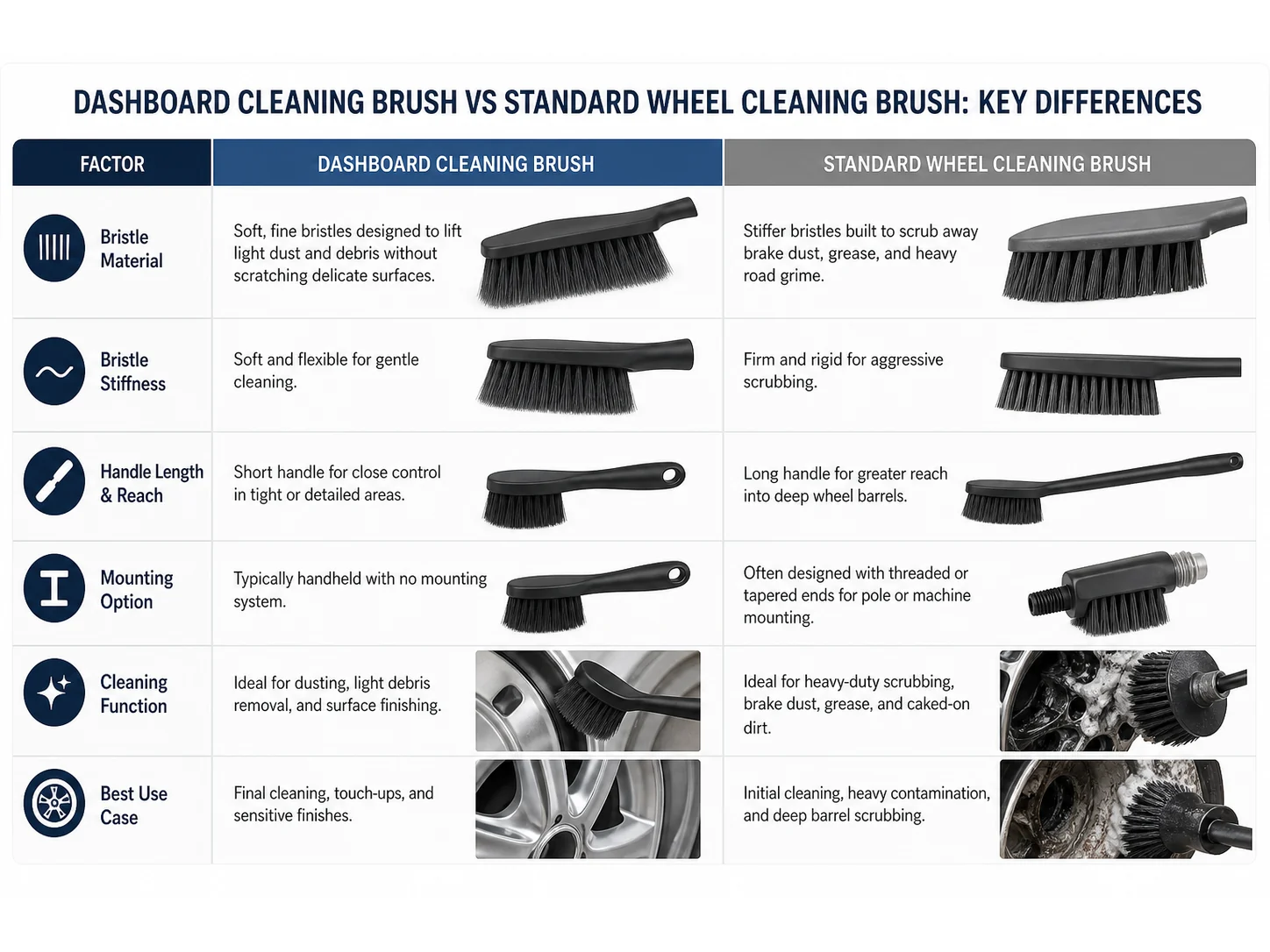
The table below compares important features for wheel barrel cleaning. Use this quick-reference to see where each brush type excels.
| Feature | Dashboard Cleaning Brush | Standard Wheel Barrel Brush | Best For |
|---|---|---|---|
| Bristle Material | Soft natural or synthetic fibers | Nylon, polypropylene, or wire (flagged or crimped) | Dash brush: delicate surfaces; Wheel brush: heavy grime |
| Stiffness | Very soft, flexible | Medium to aggressive | Dash: dust; Wheel: caked-on brake dust |
| Typical Diameter | Under 1 inch (25 mm) | 2–6 inches (50–150 mm) or more | Dash: tiny crevices; Wheel: full barrel coverage |
| Handle Length | 3–6 inches (75–150 mm) | 10–24 inches (250–600 mm) | Dash: close-up work; Wheel: deep barrel reach |
| Attachment | Usually none (handheld only) | Drill, rotary tool, or dedicated long handle | Dash: manual only; Wheel: powered option for speed |
| Surface Safety | Safe on clear coat if gentle pressure | Varies; non-abrasive nylon is safe; wire can scratch | Dash: safe on painted finishes; Wheel: must match wheel finish |
| Chemical Resistance | Often limited; natural bristles may degrade | Designed for wheel cleaners, acids, and alkaline solutions | Dash: mild cleaners; Wheel: harsh chemicals |
| Reach into Barrel | Poor for deep barrels unless brush has long handle | Excellent with extended shaft or flexible design | Dash: shallow or no-reach; Wheel: full barrel |
How to Choose the Right Brush for Your Wheel Barrel Cleaning
Avoid picking a brush just because it is low-cost or looks good in a kit. Match the brush to your specific cleaning conditions:
- Residue type: Light dust and pollen can be handled by a dashboard brush. Heavy metallic brake dust, tar, or rust stains need a stiffer wheel brush, possibly wire-assisted.
- Surface sensitivity: Painted, polished, or clear-coated wheels require non-abrasive nylon bristles. A dashboard brush may be too soft to clean effectively, while a wire brush would cause scratches.
- Equipment interface: Are you cleaning by hand or with a drill? Standard wheel brushes are available as rotary attachments for a power drill, while most dashboard brushes are hand-powered only.
- Wet or chemical exposure: If you use aggressive wheel cleaners, ensure the brush bristles and core are chemical-resistant. Many dashboard brushes use natural fibers that break down quickly.
- Hygiene expectations: Food-grade or sterile wheel cleaning may require brushes that can be autoclaved or easily sanitized. Custom nylon wheel brushes are often specified in these applications.
- Maintenance frequency: High-volume shops benefit from durable, quick-coupling wheel brushes that can be swapped fast. A dashboard brush is a detailer’s tool meant for low-cycle, precision work.
- Custom sizing: For unusual wheel designs—very deep barrels, narrow spoke gaps—a custom-designed wheel brush with a specific stem length and diameter may be necessary. Dashboard brushes rarely offer this option without a supplier drawing review.
Common Mistakes When Choosing a Wheel Barrel Cleaning Brush
- Using a dashboard brush for heavy brake dust. The soft bristles simply fold over and fail to remove bonded contaminants.
- Selecting by cost drivers alone. The lowest-cost brush may shed bristles, scratch the wheel, or fall apart in solvents.
- Ignoring chemical compatibility. Acidic wheel cleaners can eat through natural bristles and some plastics.
- Assuming one brush fits all wheels. Deep concave wheels, multi-spoke designs, and small diameters all require different reach and head sizes.
- Overlooking the core material. A wire core can rust and stain wheels if left wet; a plastic core may snap under torque.
- Using a wire brush on coated or aluminum wheels. Flagged or crimped wire is aggressive and will leave micro-scratches, dulling the finish.
- Not testing a sample first. In professional detailing or industrial settings, a sample test on a scrap wheel can prevent costly damage.
When a Dashboard Cleaning Brush Is the Wrong Choice for Wheel Barrels
A dashboard cleaning brush has clear boundaries in wheel barrel work:
- It cannot remove baked-on brake dust or iron deposits. You need mechanical agitation from a stiffer wheel brush or a clay bar.
- It cannot reach deep into a wide barrel unless paired with an extension—but most dashboard brushes lack a secure mount for one.
- It cannot be used with a power drill for high-speed cleaning, which is often necessary in commercial shops. A rotoscrub-style wheel brush cleaning kit attachment would be the right upgrade.
- If the barrel has complex geometry, a custom-designed wheel brush based on a drawing or spec sheet may be required. In these cases, a standard dashboard brush is simply the wrong tool.
- When hygiene is critical (e.g., medical equipment wheels), a dedicated, easily sterilized non-porous brush is needed, not an interior detailing item.
If you find yourself pushing too hard or making multiple passes with a dashboard brush, it’s time to switch to a purpose-built wheel barrel brush. For fleet or production environments, involve your equipment supplier early and discuss a sample or drawing review before ordering in bulk.
Final Takeaway
Choose a dashboard cleaning brush when you are dealing with light dusting, delicate painted surfaces, or extremely tight crevices where a bigger brush cannot fit. Opt for a standard wheel cleaning brush—such as a long-handle, non-abrasive nylon wheel brush—when facing regular brake dust, wet chemical cleaning, or high-volume work. Match the bristle material, stiffness, handle length, and mounting style to your wheel type and cleaning chemicals. And when in doubt, test on a small, hidden area first.
Frequently Asked Questions
Can I use a dashboard cleaning brush with a power drill?
Most dashboard brushes are not designed for drill attachment. They lack a standard hex shank and may deform or break under rotational torque. For powered cleaning, choose a drill-ready wheel brush like a rotoscrub kit or a crimped wire wheel brush.
Is a dashboard brush safe on clear-coated alloy wheels?
Yes, if the bristles are clean and you use light pressure. However, it may be too soft to remove bonded contaminants. For clear coats, a non-abrasive nylon wheel brush with flagged tips is a safer and more effective option.
What bristle material works best for wheel barrel cleaning?
For general use, flagged nylon or polypropylene bristles offer a good balance of cleaning power and surface safety. Avoid natural fibers if using harsh cleaners; they absorb moisture and break down. Wire brushes (crimped or knotted) are reserved for unpainted steel wheels or severe rust.
Do I need a long-handle wheel brush for deep barrels?
Yes. A handle length of at least 12 inches (300 mm) is recommended to reach the back of the barrel without removing the wheel. Some detailers prefer a flexible shaft or a bent stem brush for better contour following.
When should I consider a custom wheel brush design?
If your wheels have non-standard dimensions—extra-deep barrels, very narrow spoke gaps, or unusual contours—off-the-shelf brushes may miss critical areas. A custom drawing review with the brush manufacturer can yield a tailored solution that matches the exact barrel profile and mounting interface.
Can I use the same brush for wheel faces and barrels?
You can, but it is often better to separate them. Brake dust embedded in a barrel brush can transfer to the wheel face and cause micro-marring. Use a dedicated barrel brush for the inner drum and a softer face brush or dashboard brush for the spokes and rims.
How do I clean and store wheel cleaning brushes properly?
Rinse thoroughly after each use to remove chemical residue and grit. Hang dry with bristles facing down to prevent water from seeping into the core. Avoid soaking natural-bristle brushes for long periods. For nylon brushes, a periodic rinse in a mild detergent solution helps maintain bristle stiffness.
Technical References
Which nylon grade fits this job — Nylon PA, PA6 Nylon or PA66 Nylon?
| Grade | Continuous temperature (°C) | Peak temperature (°C) | Water absorption | Hardness |
|---|---|---|---|---|
| Nylon PA | 93 | 121 | 0.3–9% by PA grade and conditioning | Medium to firm; filament diameter and trim length control bending force. |
| PA6 Nylon | 80–100 | 130–160 | 1.5–3.0% | Shore D 75–85 |
| PA66 Nylon | 100–120 | 150–180 | 1.0–1.8% | Shore D 80–88 |
| PA610 Nylon | 90–110 | 130–150 | 0.5–1.0% | Shore D 72–82 |
| PA612 Nylon | 90–110 | 130–150 | 0.3–0.7% | Shore D 70–80 |
Figures as published by Brushtec / DuPont. Confirm the exact grade against the supplier datasheet before ordering.
What should replace Nylon PA for wheel barrels?
- Nylon PA — Compare Nylon PA with PP, PBT, PET. Change material when wet stiffness, temperature, chemical resistance, conductivity, particle shedding, or surface marking becomes the limiting factor.
- Abrasive Nylon — Compare Abrasive Nylon with PP, PBT, PET. Change material when wet stiffness, temperature, chemical resistance, conductivity, particle shedding, or surface marking becomes the limiting factor.