
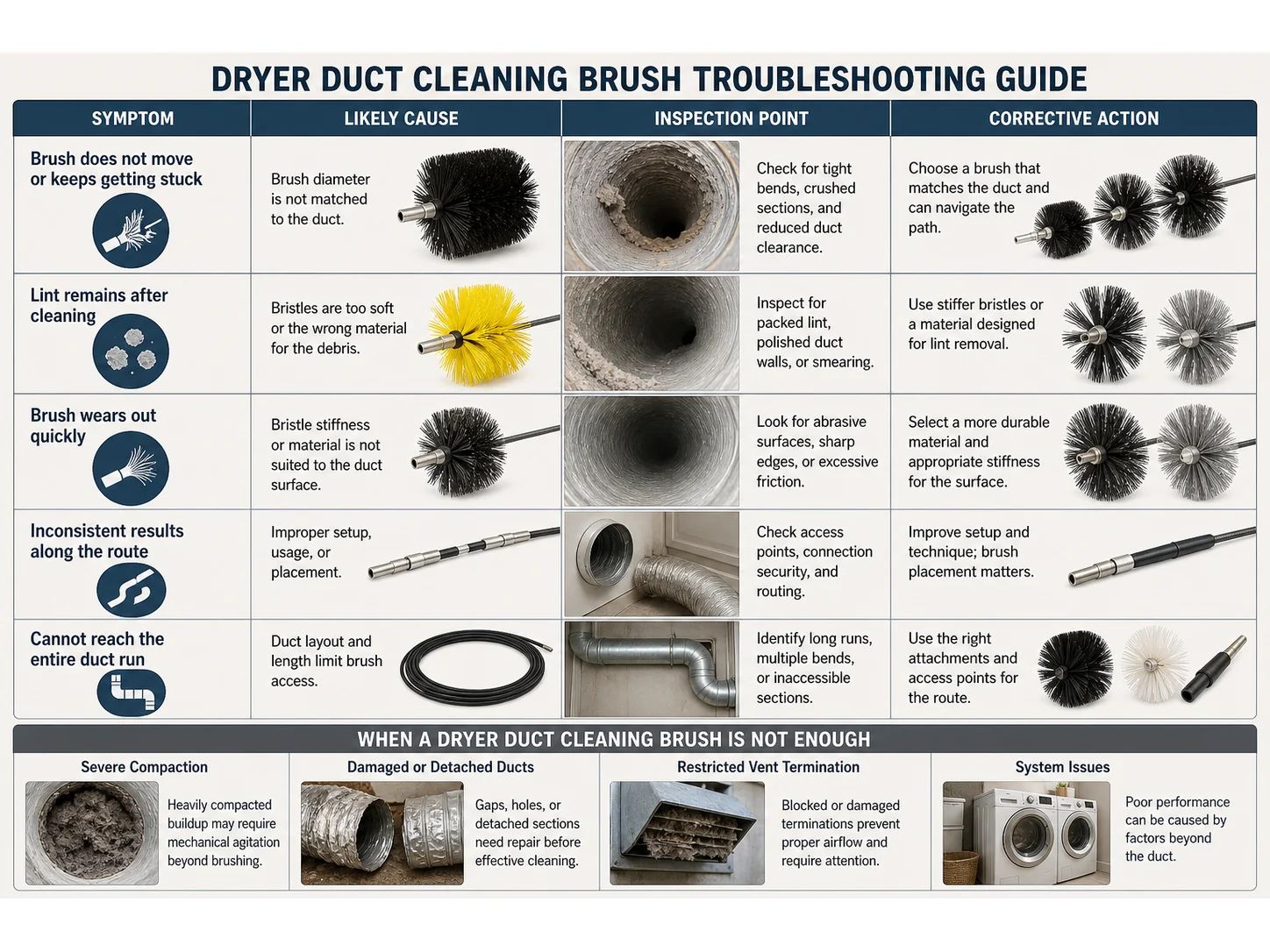
What Is a Dryer Duct Cleaning Brush?
A dryer duct cleaning brush is a cylindrical or spiral brush with bristles arranged around a central core, engineered to scrub the inner walls of a dryer exhaust duct and dislodge lint, dust, and debris. It is part of a broader preventive maintenance routine that reduces fire hazards, restores airflow, and prolongs dryer life. The brush is typically attached to a flexible rod, drill shaft, or hand crank, and is pulled or pushed through the duct run.
Common Types of Dryer Duct Cleaning Brushes
Although the core function stays the same, brushes differ by how they are driven and supported:
- Manual hand brush – A brush with a short handle or wire loop for the last few feet of the duct or short runs. Best for quick touch-ups.
- Drill–attached brush – A brush on a flexible shaft that chucks into a cordless drill. Popular for longer ducts and moderate buildup; the rotation provides fast scrubbing action.
- Rod–based brush system – Interlocking fiberglass or nylon rods with a threaded brush end. Allows the user to push the brush into deep or vertical ducts without a drill.
- Vacuum–assisted brush – A brush head connected to a vacuum hose that simultaneously scrubs and captures loosened debris, reducing mess.
Material and Design Comparison
The material, bristle stiffness, diameter, and core design determine where a brush can be safely used and what kind of residue it can remove. The table below compares the most common dryer duct cleaning brush options.
| Material | Typical Diameter | Stiffness | Handle/Core | Best For | Key Consideration |
|---|---|---|---|---|---|
| Polypropylene | 3–8 in (75–200 mm) | Medium‑soft | Threaded nylon rod, drill shaft | Flexible plastic ducts, light lint | Chemical‑resistant, gentle; may not remove thick, greasy deposits |
| Nylon | 2–6 in (50–150 mm) | Medium | Wire loop handle, threaded rod | General‑purpose, moderate buildup | Good balance of scrubbing power and flexibility; durable in dry and damp conditions |
| Stainless Steel Wire | 3–10 in (75–250 mm) | Hard | Steel rod, drill attachment | Rigid metal ducts, heavy lint and debris | Abrasive; can scratch, gouge, or puncture plastic ducts; may generate sparks if dragged against metal |
| Brass Wire | 2–8 in (50–200 mm) | Medium‑hard | Handled rod, threaded rod | Corrosion‑prone settings, metal ducts | Spark‑resistant and less aggressive than steel; suitable where steel is too risky |
| Natural Fiber (Tampico / Horsehair) | 2–6 in (50–150 mm) | Soft | Twisted wire handle, wooden rod | Sensitive surfaces, dusting light film | Absorbs moisture and oils; best for dry‑lint removal only; short service life in damp ducts |
How to Choose the Right Dryer Duct Cleaning Brush
Decision‑making moves beyond diameter alone. Match the brush to the job by checking these seven factors:
- Residue type – Dry, fluffy lint responds to soft or medium bristles. Sticky, baked‑on lint mixed with oil or fabric softener residue requires stiffer nylon or gentle wire.
- Surface sensitivity – Flexible foil or plastic ducts demand polypropylene or soft nylon brushes. Bare or painted metal ducts can tolerate brass or stainless steel if used carefully.
- Equipment interface – Confirm the brush’s connection fits your existing rods, drill chuck, or vacuum hose. A ¼-inch hex shank is common for drills, but threaded ends vary.
- Wet or chemical exposure – If the duct may contain moisture or you plan to use a cleaning solvent, choose polypropylene, nylon, or stainless steel. Natural fibers degrade quickly when wet.
- Hygiene expectations – In food processing, pharmaceutical, or lab dryer ducts, use a non‑shedding, non‑corroding material such as polypropylene or stainless steel that can be sanitized.
- Maintenance frequency – For quarterly cleaning in high‑lint environments, a durable nylon or brass brush often pays back. For annual homeowner use, polypropylene is sufficient.
- Custom size requirements – Ducts that are non‑standard diameters, square, or oval may need a custom brush. Work with a brush supplier to define the core, bristle fill, and overall diameter, and request a drawing before ordering.
Setup, Usage, and Placement Factors
Even the best brush underperforms if it cannot reach the problem area. Before selecting a brush, measure the duct run, note the number and severity of bends, and identify access points. Long runs with multiple 90° elbows may demand a more flexible core and a smaller diameter to navigate turns without binding. Outdoor terminations that are hard to reach from inside may favor a rod‑based system that can be fed from the exterior. When using a drill‑attached brush, run the drill at a moderate speed to avoid whipping the flexible shaft and damaging the duct interior.
Common Mistakes When Selecting a Dryer Duct Cleaning Brush
Specifying the wrong brush wastes time and can cause expensive damage. These are the errors maintenance crews see most often:
- Choosing by cost drivers alone – A low-cost brush with a weak core may break inside the duct, leaving a blockage harder to remove than the original lint.
- Ignoring bristle stiffness – Using a hard stainless‑steel wire brush in a plastic duct almost Help confirms punctures or tears.
- Guessing the diameter – A brush that is too small misses the duct walls; a brush that is too large jams and requires excessive force.
- Overlooking the core material – A thin, poorly crimped wire core can unwind during rotation inside a drill, turning the brush into a dangerous projectile.
- Assuming all attachment threads are the same – Metric and SAE threads, as well as quick‑connect fittings, differ between brands. Confirm compatibility before ordering.
- Skipping a sample test – For a facility with many identical dryers, testing one brush on a short, accessible duct section reveals fit and scrubbing quality before a full rollout.
When a Dryer Duct Cleaning Brush Is the Wrong Choice
A brush is not a cure‑all. If ducts are extremely long (over 25–30 feet) or have multiple tight bends, a standard brush may not reach the full length. In such cases, a high‑pressure air wand or a professional duct cleaning vacuum with rotating whip heads may be needed. If the lint buildup is heavily oil‑soaked or the duct interior shows corrosion, chemical flushing or complete duct replacement might be the usually safer solution. Likewise, if you find signs of nesting pests, a brush will not resolve the sanitation problem—contact a pest control specialist first. A brush also cannot fix crushed, disconnected, or improperly sized duct sections; those require physical repair. Finally, if the duct configuration is unknown or you are uncertain about the construction material, a borescope inspection before cleaning prevents brush‑to‑metal surprises.
Final Takeaway
The right dryer duct cleaning brush matches the duct material, lint type, and access conditions. Start by measuring the diameter and noting the duct run, then pick a brush material and stiffness that removes the residue without harming the duct. Verify attachment compatibility and, for high‑value or repeated work, run a sample first. A well‑chosen brush pays for itself in reduced fire risk, lower energy bills, and fewer service calls.
Frequently Asked Questions
What’s the difference between a dryer duct brush and a chimney brush?
A dryer duct brush is designed for smaller diameters (typically 4 inches), flexible turns, and light lint. A chimney brush is larger, much stiffer, and built to scrape creosote from masonry or metal flues. Swapping them can damage the duct or fail to clean the chimney.
How do I select the correct brush diameter for my dryer duct?
Measure the inside diameter of your duct at an accessible point. The brush should be at least as wide as the duct, and often ¼–½ inch larger, so the bristles press firmly against the walls. For very large or non‑round ducts, consult a supplier about custom sizing.
Can a drill‑attached brush damage flexible plastic ducts?
Yes, if the bristles are too stiff or the drill speed is too high. Use only polypropylene or soft nylon brushes in plastic ducts, run the drill at low speed, and avoid forcing the brush through tight bends. Inspect the duct with a borescope afterward if you are unsure.
Is a stainless steel wire brush safe for aluminum dryer ducts?
While it can be used with caution, stainless steel is much harder than aluminum and can scratch the interior or catch on joints. Brass wire or a medium‑stiffness nylon brush is usually a safer choice for aluminum ducts.
How do I clean a dryer duct cleaning brush after use?
Pull off large lint clumps by hand, then wash the brush with warm soapy water if the bristle material allows (check the manufacturer’s guidance). Rinse thoroughly and let it air‑dry completely before storing to prevent mildew or rust on the core.
What should I do if the brush does not fit my existing rods or drill?
Never force an incompatible connection. Identify the thread size and pitch (or shank diameter) on your existing equipment and order a brush with a matching coupling. Adapter sets are available, but a factory‑matched connection is more reliable.
Are there hygienic brush options for dryer ducts in food or pharmaceutical facilities?
Yes. Brushes with a stainless steel core and FDA‑compliant polypropylene bristles are available. They are less likely to shed material, withstand washdowns, and can be autoclaved in some cases. Specify your hygiene requirements when requesting a quote.
When should I call a professional instead of using a brush?
Call a professional if the duct run is unusually long, has been damaged, shows signs of nesting, or if you see moisture, mold, or corrosion. Also call a pro if you lack the access ports or tools to reach the entire duct safely. An experienced service provider can camera‑inspect the duct and use powered cleaning equipment when needed.
Technical References
- USFA — Heating Fire Safety
- USFA — Clothes Dryer Fire Safety Flyer
- EPA — Nonpoint Source: Urban Areas
- CPSC — Carbon Monoxide Information Center
Which bristle material fits this job — Nylon PA, AISI 304 Stainless Steel Wire or Brass Wire?
| Material | Continuous temperature (°C) | Peak temperature (°C) | Water absorption | Hardness |
|---|---|---|---|---|
| Nylon PA | 93 | 121 | 0.3–9% by PA grade and conditioning | Medium to firm; filament diameter and trim length control bending force. |
| AISI 304 Stainless Steel Wire | 400 | 500 | 0% | Rockwell B 70–95 depending on temper and cold work |
| Brass Wire | 150–200 | 250–300 | 0% | Rockwell B 40–90 |
| Horsehair | 60–80 | 100–120 | 8–15% | — |
Figures as published by Brushtec / DuPont; Alleima. Confirm the exact grade against the supplier datasheet before ordering.
What should replace Nylon PA when it stops working?
- Nylon PA — Compare Nylon PA with PP, PBT, PET. Change material when wet stiffness, temperature, chemical resistance, conductivity, particle shedding, or surface marking becomes the limiting factor.
- AISI 304 Stainless Steel Wire — Use AISI 316 stainless steel wire for chloride, marine, dairy, beverage, chemical washdown, or higher pitting-resistance requirements. Use carbon steel for dry aggressive cutting and brass or abrasive nylon for lower marking risk.
- Brass Wire — Compare Brass Wire with Steel wire, stainless wire, nylon. Change material when wet stiffness, temperature, chemical resistance, conductivity, particle shedding, or surface marking becomes the limiting factor.
- Horsehair — Compare Horsehair with Boar bristle, goat hair, microfiber. Change material when wet stiffness, temperature, chemical resistance, conductivity, particle shedding, or surface marking becomes the limiting factor.