
What Is a Flask Cleaning Brush?
A flask cleaning brush is a cleaning tool consisting of a stem and a bristle head configured to clean the inside walls of flasks, bottles, test tubes, and similar containers with restricted openings. The stem is typically made of twisted wire, molded plastic, or stainless steel, and it holds bristles made from nylon, polyester, animal hair, PTFE, or metal. The brush is designed to be inserted through the neck of a flask and reach all interior surfaces, providing manual or machine-driven scrubbing action.
Common Materials and Bristle Types
The performance of a flask cleaning brush is largely determined by its bristle material. Here are the most common options and where they are best used:
- Nylon – General-purpose; good flexibility, moderate chemical resistance, suitable for everyday laboratory glassware.
- Polyester – Stiffer than nylon, excellent chemical resistance, often used with organic solvents and acids.
- Goat Hair / Horsehair – Very soft, absorbent, and gentle on sensitive surfaces; ideal for delicate linings or food-grade applications.
- PTFE (Teflon) – High chemical inertness and temperature tolerance; preferred for aggressive chemicals and cleanroom environments.
- Stainless Steel Wire – Abrasive; suitable for removing heavy, burnt-on residues from metal or durable glass vessels but can scratch soft glass or coatings.
- Brass or Bronze Wire – Less aggressive than stainless steel; sometimes used for non-sparking cleaning in flammable environments.
Stem material also matters. Twisted galvanized or stainless wire provides flexibility for angled necks, while molded polypropylene or PTFE stems offer better chemical resistance and durability in aggressive cleaning agents.
Size and Diameter Options
Choosing the right size starts with two key measurements: the inside diameter of the neck and the inside diameter of the main body. The brush head diameter should be slightly larger than the body ID but still able to pass through the neck without excessive force or risk of breakage. Stem length must exceed the depth of the flask to allow full reach to the bottom. Standard sizes range from a few millimeters (for test tubes) up to several inches (for large flasks), but many applications require custom diameters and bristle lengths to clean shoulders, corners, or internal features.
Bristle Material Comparison Table
| Bristle Material | Stiffness | Chemical Resistance | Temperature Max | Typical Applications | Key Considerations |
|---|---|---|---|---|---|
| Nylon | Medium | Good (alkalis, dilute acids) | 100°C | Lab glassware, beverage bottles | Absorbs water; can soften in hot water |
| Polyester | High | Excellent (solvents, acids, alkalis) | 120°C | Chemical processing flasks, aggressive washdowns | Stiffer; may scratch very soft surfaces |
| Goat Hair / Horsehair | Low | Limited; avoid strong solvents | 80°C | Sensitive surfaces, food & beverage tanks | Not for heavy residue; sheds easily |
| PTFE | Medium-Low | Inert (nearly all chemicals) | 260°C | Corrosive chemicals, cleanrooms, high-purity | Higher cost; less aggressive scrubbing |
| Stainless Steel Wire | Very High | Good in non-acidic | 400°C+ | Heavy-duty industrial flasks, baked-on carbon | Will scratch glass; avoid in food-grade without inspection |
| Brass Wire | High | Moderate; tarnishes | 200°C | Non-sparking cleaning, soft metal residues | Leaves residues; not for sterile or reactive environments |
How to Choose the Right Flask Cleaning Brush
Your choice should be driven by the real operating conditions and cleaning requirements, not just cost drivers or a generic “medium stiffness” label. Evaluate these factors:
- Residue Type – Sticky polymers, baked-on carbon, powdery salt, or organic growth demand different levels of abrasion and chemical compatibility.
- Surface Sensitivity – Glass, borosilicate, plastic, or lined flasks react differently to abrasive bristles. Always match bristle hardness to the substrate to avoid micro-scratches or coating damage.
- Chemical Exposure – Will the brush be used with solvents, acids, or caustic cleaners? Choose bristles and stems that won’t degrade or contaminate the product.
- Temperature – Hot wash cycles or autoclave sterilization require materials that maintain shape and integrity at elevated temperatures.
- Equipment Interface – Is the brush used manually, or must it mount on a rod or machine spindle? Check stem diameter and end connection (looped, threaded, or straight).
- Hygiene & Contamination Risk – In food, pharmaceutical, or cleanroom applications, select materials that are FDA-compliant, non-shedding, and easy to sanitize. Color-coding can help prevent cross-contact.
- Maintenance Frequency – A brush that wears out quickly or traps debris will cost more in replacements and downtime. Consider cleanability and bristle retention.
- Custom Size Requirements – If standard sizes cannot reach internal ribs, side ports, or complex geometries, a custom brush with a specific head shape, crimped wire, or multi-diameter design may be necessary.
Setup, Usage, and Placement Factors
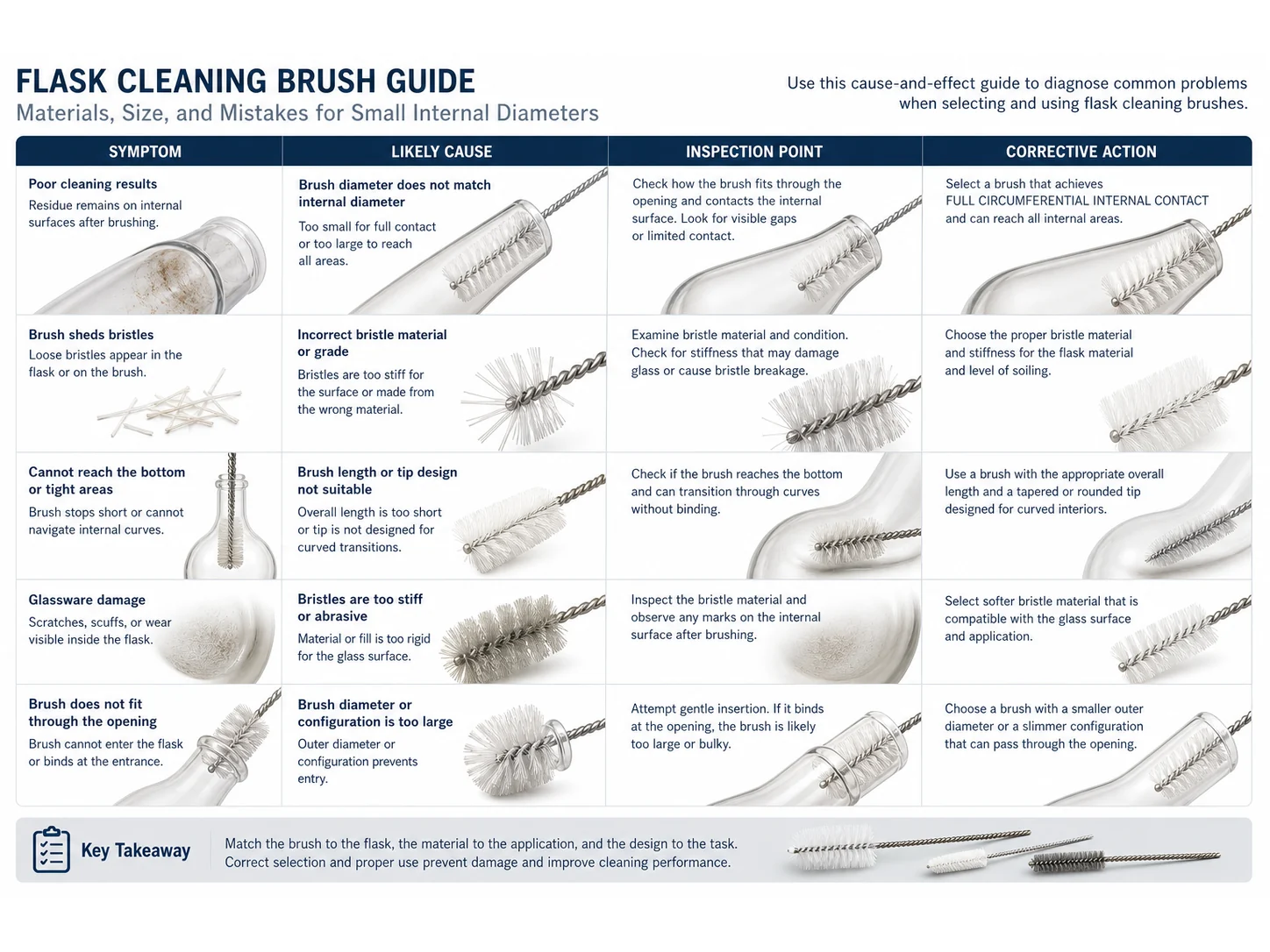
Even the best brush will fail if used incorrectly. Insert the brush gently through the neck; forcing it can chip glass or bend the stem. Rotate the brush while moving it in and out to ensure full interior coverage. After cleaning, inspect both the flask and the brush for retained particles. For repeated cycles, store brushes in a clean, dry rack—not in the flask—to prevent bristle deformation and microbial growth. In automated systems, ensure the brush is centered and secured to avoid uneven wear or vessel breakage.
Common Mistakes When Selecting a Flask Cleaning Brush
Avoid these frequent missteps that lead to poor cleaning, damaged equipment, or safety issues:
- Choosing by cost drivers alone – A low-cost brush may seem economical until it scratches an expensive reactor or leaves fibers that contaminate a batch.
- Ignoring the neck-to-body ratio – A brush that fits the neck might be too small to clean the body adequately. Always verify that bristles will reach and scrub the widest part of the flask.
- Overestimating stiffness – Too-stiff bristles can cause surface stress, especially on thin glass or plastic linings. Start with the softest material that still removes the residue.
- Underestimating chemical attack – Nylon swells and weakens in strong acids or alcohols; stainless steel corrodes in chlorinated solvents. Check compatibility charts before ordering.
- Using wire brushes on sensitive glass – Metal bristles can leave permanent scratches that become initiation points for breakage under thermal or pressure cycling.
- Forgetting about the bottom and shoulders – Many flasks have flat or curved bottoms and pronounced shoulders. A straight brush may not clean these without a curved or fan-tip design.
- Skipping a sample test – Whenever possible, buy a single sample brush first and verify fit, cleaning performance, and material compatibility in your actual process.
When a Flask Cleaning Brush Is the Wrong Choice
A flask cleaning brush excels at mechanical scrubbing inside accessible cylindrical vessels, but it has limits. If your flask has extremely complex internal geometries (e.g., baffles, narrow tubes, or deep undercuts), a brush alone may leave dead spots. For high-purity or critical cleaning applications—such as semiconductor or parenteral drug manufacturing—mechanical brushing can introduce particulate contamination; instead, ultrasonic cleaning, spray balls, or clean-in-place (CIP) systems may be required. Also, when cleaning calls for validated removal of specific contaminants, a brush alone cannot Help confirm cleanliness and must be accompanied by swab testing or rinse analysis. In such cases, consult your cleaning chemical supplier or an industrial brush manufacturer that offers custom design and drawing review to engineer a solution that addresses the entire surface.
Final Takeaway
Selecting a flask cleaning brush for small internal diameters means matching the bristle material to your residue and surface, getting the size right by measuring neck and body ID, and avoiding common specification mistakes that lead to damage or incomplete cleaning. Always test a sample, verify chemical and temperature resistance, and be ready to move to a custom design when off-the-shelf options fall short. The right brush saves vessels, reduces contamination risk, and makes cleaning faster and more consistent.
Frequently Asked Questions
What is the difference between a flask cleaning brush and a test tube brush?
While they serve similar purposes, a flask cleaning brush typically has a larger diameter head and a longer, thicker stem to accommodate the wider body and taller profile of flasks. Test tube brushes are smaller, with finer bristles and shorter stems. However, the terms are sometimes used interchangeably in smaller sizes, so look at the actual dimensions and intended application.
Can I use a stainless steel wire brush on glass flasks?
Generally not recommended for standard borosilicate glass, because stainless steel bristles can scratch the surface, creating stress concentrators that may lead to cracking. If you must remove extremely stubborn residues, consider a soft metal like brass or a nylon abrasive pad, but always test on a sacrificial piece first.
How do I measure my flask for a cleaning brush?
Measure the inner diameter of the neck opening (ID-N), the inner diameter of the main body (ID-B), and the depth from the rim to the bottom interior. The brush head should be slightly larger than ID-B to ensure wall contact, but the brush must pass through ID-N without force. For tapered necks or non-cylindrical shapes, provide a drawing with all critical dimensions to a brush supplier.
Are there food-grade flask cleaning brushes?
Yes. Look for brushes with bristles and stems made from FDA-compliant materials, such as certain grades of nylon, polypropylene, or natural horsehair. Color-coding, fully crimped construction, and metal-detectable fill materials are additional features often required in food processing to meet HACCP requirements.
What if my flask has an angled or narrow neck?
A standard straight brush may not fully clean the corners. In that case, look for a brush with a flexible twisted-wire stem that can bend, or request a custom design with an angled tip or swivel feature. Flexible stems allow the brush to follow the contour of the neck and reach hidden pockets.
How often should I replace a flask cleaning brush?
There is no fixed interval; replace the brush when you notice bent bristles, loss of stiffness, corrosion on the stem, or evidence of bristle shedding. In regulated environments, a regular inspection schedule and log should be maintained, and the brush replaced before it becomes a contamination risk.
Can I use a flask brush with strong solvents like acetone or methylene chloride?
It depends on the brush material. Polyester and PTFE bristles offer excellent resistance to most organic solvents, while nylon can swell and degrade. The stem material must also be considered; polypropylene or PTFE stems are safer choices than galvanized wire when continuous solvent exposure is expected.
What does “crimped” vs. “straight” wire stem mean for a flask brush?
A crimped wire stem has small bends or crimps that help secure the bristles more firmly, reducing the chance of bristles pulling out during use. A straight wire stem relies on the twisting of the wire alone. Crimped stems are preferred in food and pharmaceutical applications where bristle loss is a contamination risk.
Technical References
Which bristle material fits this job — Nylon PA, AISI 304 Stainless Steel Wire or Horsehair?
| Material | Continuous temperature (°C) | Peak temperature (°C) | Water absorption | Hardness |
|---|---|---|---|---|
| Nylon PA | 93 | 121 | 0.3–9% by PA grade and conditioning | Medium to firm; filament diameter and trim length control bending force. |
| AISI 304 Stainless Steel Wire | 400 | 500 | 0% | Rockwell B 70–95 depending on temper and cold work |
| Horsehair | 60–80 | 100–120 | 8–15% | — |
| Goat Hair | 50–70 | 90–110 | 12–20% | — |
Figures as published by Brushtec / DuPont; Alleima. Confirm the exact grade against the supplier datasheet before ordering.
What should replace Nylon PA for small bores?
- Nylon PA — Compare Nylon PA with PP, PBT, PET. Change material when wet stiffness, temperature, chemical resistance, conductivity, particle shedding, or surface marking becomes the limiting factor.
- AISI 304 Stainless Steel Wire — Use AISI 316 stainless steel wire for chloride, marine, dairy, beverage, chemical washdown, or higher pitting-resistance requirements. Use carbon steel for dry aggressive cutting and brass or abrasive nylon for lower marking risk.
- Horsehair — Compare Horsehair with Boar bristle, goat hair, microfiber. Change material when wet stiffness, temperature, chemical resistance, conductivity, particle shedding, or surface marking becomes the limiting factor.
- Goat Hair — Compare Goat Hair with Boar bristle, goat hair, microfiber. Change material when wet stiffness, temperature, chemical resistance, conductivity, particle shedding, or surface marking becomes the limiting factor.