
What Is a Flask Cleaning Brush?
A flask cleaning brush is a brush engineered with a flexible, twisted wire core or a shaped handle that allows the bristle section to fan out and conform to the internal contours of an Erlenmeyer, round-bottom, volumetric, or Florence flask. The bristle section is typically wider than the neck opening when expanded, providing the mechanical action needed to remove stubborn deposits from the flask shoulder and bottom. These brushes are often offered with handle extensions, interchangeable tips, or mounting options for automated cleaning systems.
Standard Cleaning Brushes in the Laboratory
Standard laboratory brushes include straight test tube brushes, cylindrical bottle brushes, and general-purpose utility brushes. Test tube brushes have a uniform diameter and are best for straight-walled glassware like test tubes, graduated cylinders, and narrow burettes. Bottle brushes may have a slightly flared tip but lack the intentional fan-out design of a true flask brush. In many labs, technicians default to a standard test tube brush for flask cleaning—a choice that can lead to incomplete scrubbing, damaged glass, or cross-contamination.
Flask Cleaning Brush vs Standard Brushes: A Practical Comparison
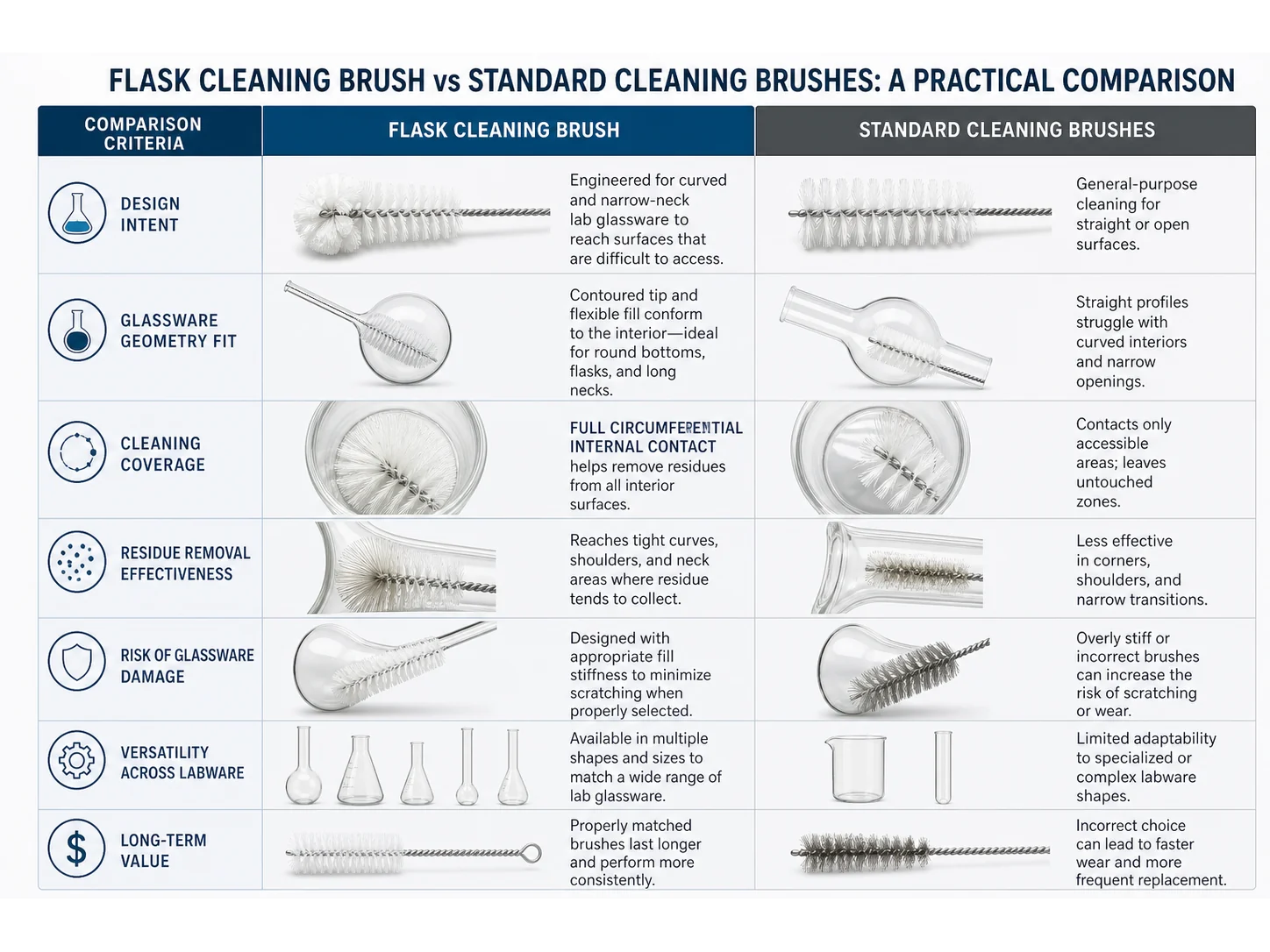
The table below compares key performance and application differences between a purpose-built flask cleaning brush and typical laboratory brushes used on glassware.
| Factor | Flask Cleaning Brush | Standard Brushes (Test Tube / Bottle / Utility) |
|---|---|---|
| Contact Geometry | Fans out to follow flask shoulder and bottom curvature | Straight or slightly flared; often misses the flask shoulder |
| Neck Fit | Compresses for insertion, then expands; fits narrow necks | May be too wide to insert or too narrow to scrub effectively |
| Material Options | Nylon, polyester, tampico, or sponge with flexible core | Similar materials but often with a rigid twisted wire stem |
| Handle / Mounting | Often uses a loop handle, drill chuck, or extended stem | Typically a simple loop or straight wire handle |
| Risk of Scratching | Reduced when correctly matched to glass surface | Can scratch with a stiff, straight core if forced |
| Residue Removal | Effective on tenacious residues (oils, baked-on media) | Better suited for light soils or pre-rinse steps |
| Throughput Compatibility | Often used with automated flask washers or rotators | Manual use primarily; some adapters for narrow tubes |
How to Choose the Right Flask Cleaning Brush
Selection depends on the interaction between residue type, glassware material, chemistry in the wash cycle, and how the brush is operated. Consider these factors:
- Residue type: Baked-on organic media require stiffer bristles or a tampico brush; fine powders or corrosion residues may need non-abrasive nylon.
- Surface sensitivity: Borosilicate glass can tolerate moderate scrubbing. Delicate volumetric flasks or coated glass may need a soft sponge tip or silicone flap design.
- Brush diameter and neck fit: Measure the narrowest neck inner diameter and select a brush that compresses to less than that diameter, then expands to fill the flask body.
- Bristle stiffness and chemical exposure: Nylon is compatible with many solvents and mild acids; polyester offers better stiffness retention in hot water; tampico is natural and soft but degrades in strong alkalis.
- Handle and core material: Stainless steel cores resist corrosion but risk scratching; plastic-coated cores or polypropylene handles are safer for delicate glass. Long handles or drill-chuck adapters suit high-throughput labs.
- Mounting options: For automated flask washers, verify compatibility with the machine’s brush spindle or adapter. Some brushes are designed for portable drill use.
- Hygiene and maintenance frequency: Brushes that hold moisture or shed bristles can cause cross-contamination. Look for designs that can be autoclaved or chemically disinfected (confirm material compatibility).
- Custom size requirements: For non-standard flasks, suppliers often provide drawings and can adjust brush diameter, bristle length, trim length, and handle shape. Request a sample or a drawing review when off-the-shelf brushes do not fit.
Common Mistakes When Selecting and Using Flask Cleaning Brushes
- Using a test tube brush on a flask: The straight shape cannot clean the flask shoulder, leaving a ring of contamination that interferes with subsequent experiments.
- Forcing an oversized brush through a narrow neck: This can snap the neck or distort the wire core, leading to glass breakage or lost bristles.
- Ignoring chemical compatibility: A brush with a natural tampico fill will rapidly fail in strong caustic wash solutions; nylon may soften in certain organic solvents. Always check manufacturer chemical resistance charts.
- Skipping the cleaning validation step: Visual inspection alone is not enough for critical applications. Run a rinse blank or a surface swab test after brushing to confirm residue removal.
- Storing the brush wet: Retained moisture promotes microbial growth and corrosion of the wire core. Hang to dry in a well-ventilated area away from chemical fumes.
- Choosing by cost drivers or generic “bottle brush” label: A low-cost standard brush may cost less but create expensive cross-contamination or glass damage over time.
When a Flask Cleaning Brush Is the Wrong Choice
A flask cleaning brush is a physical cleaning solution. It works well for visible soils, sticky residues, and routine maintenance, but it cannot replace other cleaning methods in every situation. Know these boundaries:
- Pyrogen or endotoxin removal: For injectable-grade glassware, mechanical brushing alone is insufficient. A validated depyrogenation cycle (e.g., dry heat at 250°C or chemical inactivation) must follow.
- Ultrasonic cleaning: Complex internal geometries with blind holes or sintered frits are better cleaned ultrasonically with a suitable detergent, not just a brush.
- Heavy chemical etching or re-deposited precipitates: When a flask has visible etching or mineral scale, an acid wash (e.g., dilute nitric acid) or a specialized chelant cleaner is needed before brushing, otherwise the brush will wear out quickly and may not remove the scale.
- Single-use or high-purity protocols: In some analytical labs, disposable plastic flasks or single-use culture vessels eliminate the need for any cleaning brush. If cleanroom standards require no particulate shedding, a brush may introduce fibers.
- When a supplier drawing review is necessary: For flasks with unusual shapes, a standard flask cleaning brush may still not fit well. Provide a drawing of the flask to a brush manufacturer for a custom solution, or ask for a sample to test on your actual glassware before committing to a large order.
Final Takeaway
The choice between a flask cleaning brush and a standard brush comes down to geometry. If your glassware includes curves, shoulders, or narrow necks, a purpose-built flask brush is the more reliable option for consistent cleaning and lower long-term reprocessing costs. Standard brushes remain valuable for straight-walled vessels and general bench work. Make your selection based on the specific residue, glass sensitivity, and cleaning environment—not on the brush label alone.
Frequently Asked Questions
What is the difference between a flask cleaning brush and a test tube brush?
A flask cleaning brush is designed to fan out and follow the curved inner walls of a flask. A test tube brush has a uniform diameter and is meant for straight-walled glassware like test tubes or graduated cylinders. Using a test tube brush on a flask often leaves residue in the shoulder area.
How do I measure a flask for the correct brush size?
Measure the inner diameter of the narrowest point, usually the neck. The brush, when compressed, must pass through this opening. Then, measure the largest interior diameter of the flask body to ensure the expanded brush section will make firm contact with the walls. Give both measurements when requesting a brush or a supplier drawing.
Can I use a metal wire brush for cleaning flasks?
A metal wire brush is not recommended for laboratory glassware. It will scratch borosilicate glass, creating weak points and potential sites for chemical attack or breakage. Stick with nylon, polyester, tampico, or soft sponge brushes appropriate for the chemical environment.
What bristle material is best for autoclaving a flask brush?
Many brushes with nylon bristles and a stainless steel or plastic-coated core can withstand autoclave cycles up to 121°C. Always confirm with the manufacturer because some plastics or tampico fills may degrade. If you plan to autoclave, look for a brush specifically labeled as autoclavable.
How often should I replace a flask cleaning brush?
Replace the brush when bristles become matted, bent, or start shedding. A worn brush loses cleaning efficiency and can leave fibers in the flask. In high-throughput labs, a visual inspection schedule—such as checking brushes weekly—helps catch wear before it affects cleaning validation.
Can I use a flask cleaning brush in an automated glassware washer?
Yes, many flask washers have dedicated brush spindles or adapters that accept a flask brush with a specific shank size. Check your washer manual for compatible brush dimensions and ensure the brush material can handle the wash temperature and detergent chemistry.
What is the function of a flask cleaning brush in laboratory hygiene?
The primary function is to mechanically remove residues that chemical rinsing alone may leave behind, such as dried media, oils, or precipitate rings. This reduces cross-contamination and supports reproducible scientific results.
Is there a standard drawing or specification for flask cleaning brushes?
There is no universal standard, but reputable manufacturers provide detailed drawings showing brush diameter, bristle length, trim length, handle style, and materials. If you need a custom size, you can request a drawing for your review before production.
Which bristle material fits this job — Nylon PA, AISI 304 Stainless Steel Wire or Abrasive Nylon?
| Material | Continuous temperature (°C) | Peak temperature (°C) | Water absorption | Hardness |
|---|---|---|---|---|
| Nylon PA | 93 | 121 | 0.3–9% by PA grade and conditioning | Medium to firm; filament diameter and trim length control bending force. |
| AISI 304 Stainless Steel Wire | 400 | 500 | 0% | Rockwell B 70–95 depending on temper and cold work |
| Abrasive Nylon | 120 | 150 | 0.1–1.0% | Abrasive filament; stiffness and cutting level is controlled by PA base, grit type, grit size, filament diameter and trim height. |
| Silicone | 200–250 | 280–300 | 0.1–1.0% | Shore A 20–80 |
| Polypropylene PP | 80–100 | 120–140 | ≤0.03% | Shore D 65–75 |
Figures as published by Brushtec / DuPont; Alleima; Perlon. Confirm the exact grade against the supplier datasheet before ordering.
What should replace Tube & Pipe Bore Brushes for test tube brush?
- Tube & Pipe Bore Brushes — Tube and bore brushes work by radial contact inside a confined diameter; wire wheels and cups work mainly on external edges, profiles, welds, and broad surfaces.
- Nylon PA — Compare Nylon PA with PP, PBT, PET. Change material when wet stiffness, temperature, chemical resistance, conductivity, particle shedding, or surface marking becomes the limiting factor.
- AISI 304 Stainless Steel Wire — Use AISI 316 stainless steel wire for chloride, marine, dairy, beverage, chemical washdown, or higher pitting-resistance requirements. Use carbon steel for dry aggressive cutting and brass or abrasive nylon for lower marking risk.
- Abrasive Nylon — Compare Abrasive Nylon with PP, PBT, PET. Change material when wet stiffness, temperature, chemical resistance, conductivity, particle shedding, or surface marking becomes the limiting factor.