
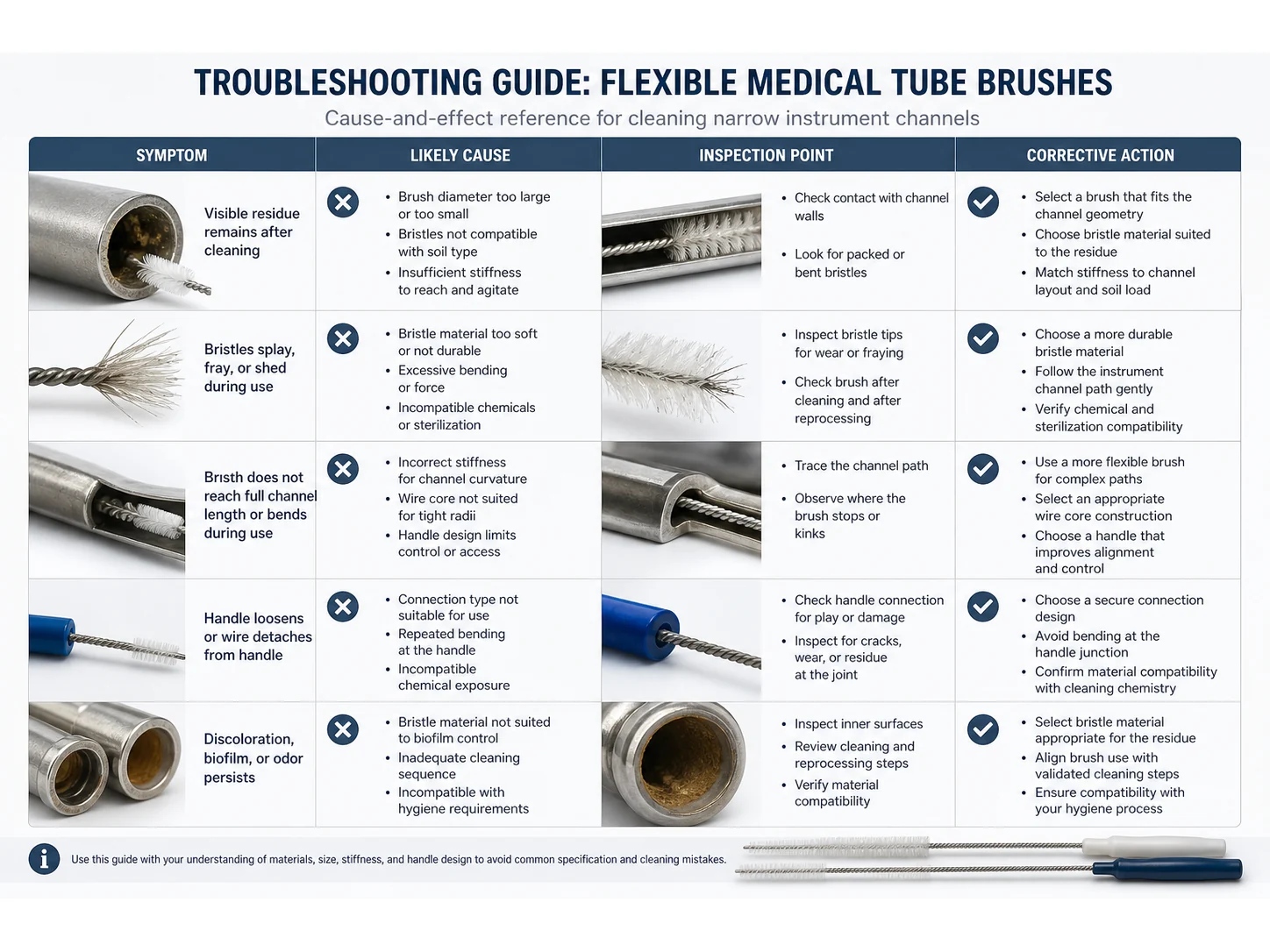
What Is a Flexible Medical Tube Brush?
A flexible medical tube brush consists of a thin, pliable core—usually twisted wire or plastic—with bristles arranged along its tip and a handle or machine mount at the opposite end. Its primary function is to mechanically scrub internal channel surfaces that cannot be reached by spray or immersion alone. The brushes are used during manual pre-cleaning, in automated cleaning stations, or in conjunction with enzymatic detergents and disinfectants. They come in a range of diameters, bristle materials, and stiffness levels to match specific instrument geometries and cleaning protocols.
Why Narrow Instrument Channels Need Special Cleaning Tools
Lumens in medical devices often have diameters of only a few millimeters or less, and their interior pathways may include bends, junctions, or dead ends. Organic residue—such as blood, mucus, or tissue—can adhere firmly inside these tight spaces. Without a properly sized and flexible tube brush, debris can remain after washing cycles, creating a protective biofilm that shields microorganisms from chemical disinfection. A brush that is too stiff may scratch delicate inner coatings, while one that is too limp may not provide effective mechanical action. The right brush must balance flexibility, abrasiveness, and material compatibility to achieve validated cleaning outcomes.
Material Options for Flexible Medical Tube Brushes
Bristle and core materials vary widely, and selection depends on the instrument surface, cleaning chemistry, and whether the brush is single-use or reusable. Common materials include:
- Nylon: Soft, non-abrasive, resistant to many cleaning agents. Suitable for delicate channels like flexible endoscope working channels or soft plastic tubing.
- Polypropylene: Stiffer than nylon, often used for moderate scrubbing action. Good chemical resistance and typically lower cost.
- Stainless steel wire bristles: Used only for robust metal channels that can tolerate aggressive abrasion, such as rigid surgical instrument cannulas. Never for soft or coated surfaces.
- PTFE (Teflon) coated wire core: Minimizes friction and prevents the core from scratching channel walls. Frequently used when the brush must pass through a long or tortuous path.
- Horsehair or natural bristles: Traditional option, very soft, and absorbent; still used in some specialized cleaning applications but less common due to hygiene and durability concerns.
Key Features to Compare: Size, Stiffness, and Handle Design
The table below compares the most important variables when evaluating flexible medical tube brushes for narrow instrument channels.
| Feature | Typical Options | Considerations |
|---|---|---|
| Brush Diameter | 1.0 mm – 10 mm and custom sizes | Must be 0.5–1 mm larger than channel ID for effective cleaning; too large may jam |
| Stiffness / Flexibility | Very flexible (thin wire core, long bristles) to stiff (thick core, short stiff bristles) | Flexibility required for curved channels; stiffness increases scrubbing force |
| Handle / Mounting | Loop handle, straight wire handle, chuck mount, quick-connect | Handheld for manual cleaning; chuck mount for drill or motor-driven cleaning |
| Core Material | Twisted stainless steel wire, twisted brass wire, plastic monofilament | Metal core adds stiffness and durability; plastic core avoids metal contact with sensitive channels |
| Bristle Configuration | All-bristle tip, combination tip (bristles + sponge), multi-size bristle rows | Sponge tips useful for absorbing fluid; multi-size bristles cover varying channel diameters |
How to Choose the Right Brush Based on Residue, Surface, and Hygiene Requirements
Start by characterizing the debris you need to remove and the channel substrate. Soft, proteinaceous soils (blood) typically require a gentle brush with high bristle density to lift material without embedding it. Hardened or mineralized deposits may need a stiffer brush, but only if the channel material can tolerate abrasion. Consider:
- Residue type: Organic vs. inorganic, soft vs. calcified. Match bristle aggressiveness accordingly.
- Surface sensitivity: Lining materials (PTFE, silicone, polyurethane) are easily scratched. Use nylon or plastic-core brushes only.
- Chemical exposure: Ensure bristle and core materials resist degradation from the detergents, enzymes, and disinfectants used in your process.
- Hygiene expectation: For critical cleaning (sterilization required post-cleaning), single-use brushes eliminate cross-contamination risk. Reusable brushes must be thoroughly cleaned and sterilized between uses.
- Maintenance frequency: In high-throughput reprocessing, durable reusable brushes with autoclavable materials may be more practical; for low volume or high-risk channels, pre-sterilized single-use brushes add safety.
- Custom size requirements: When standard diameters do not fit, manufacturers can produce custom-diameter brushes, but this often requires a drawing review and minimum order quantity. Confirm your channel tolerances precisely before requesting a custom size.
Common Mistakes When Specifying a Flexible Medical Tube Brush
- Choosing by diameter alone: A brush that fits the channel ID may still fail if the core is too stiff to pass through bends or the bristle material is incompatible with cleaning chemicals.
- Ignoring core flexibility: A wire core that is too rigid can kink or break inside the instrument, risking damage or leaving foreign material behind.
- Mismatched bristle material to cleaning agent: Using a nylon brush with strong alkaline detergents can cause bristle softening and premature failure.
- Overlooking end connections: If the brush must attach to a rotary tool or automated system, verify chuck size and whether a center wire or loop handle is needed.
- Skipping cleaning validation: Relying on visual inspection alone is insufficient. Biochemical residue testing (ATP or protein swab test) should confirm the brush’s effectiveness in your specific application.
- Using overly abrasive brushes on coated channels: Stainless steel bristles can scratch or strip thin internal coatings, creating sites for biofilm accumulation and corrosion.
When a Flexible Medical Tube Brush Is the Wrong Choice
A flexible tube brush provides mechanical action but cannot replace other critical cleaning steps. In some situations, it may be insufficient:
- Extremely narrow channels (below 1 mm): Many brushes cannot be manufactured small enough. Cleaning wires or pull-through devices may be required.
- Complex geometries with sharp turns: If a brush cannot navigate a tight bend without damaging the channel, consider flushing with high-pressure fluid or ultrasonic cleaning first.
- Biofilm-heavy instruments: Brushes alone may not fully remove mature biofilm. An enzymatic soak or automated flushing system might be needed as a pretreatment.
- Validated reprocessing: Before implementing a new brush, test its cleaning efficacy with soiled surrogate devices and appropriate cleaning indicators. If results are inconsistent, request sample brushes from a supplier for a trial evaluation.
- Machine-mounted brushes: For motorized cleaning, ensure the brush’s speed rating, torque capacity, and core construction can withstand repetitive, high-speed use without failure.
Final Takeaway
Selecting a flexible medical tube brush is a decision based on more than dimensions. Match the brush material to the channel surface and chemical environment, choose stiffness appropriate for the anatomy of the instrument, and validate that cleaning performance meets your facility’s reprocessing standards. When in doubt, work with a supplier that offers technical drawings and sample testing, so you can confirm the brush will clean effectively without causing damage. A well-chosen brush protects patients and prolongs the life of costly medical instruments.
Frequently Asked Questions
What is the difference between a flexible medical tube brush and a test tube brush?
A medical tube brush is typically longer, more flexible, and uses bristle materials compatible with chemical disinfection and sterilization. A test tube brush is generally shorter, stiffer, and designed for laboratory glassware under less stringent hygiene requirements. Medical brushes often feature specialized cores to navigate instrument lumens, while test tube brushes are simple twisted wire with stiff bristles for scrubbing open tubes.
How do I measure the correct brush diameter for a narrow medical channel?
Use a calibrated pin gauge or the manufacturer’s specification for the internal diameter (ID) of the channel. Select a brush diameter that is 0.5–1.0 mm larger than the ID to ensure adequate contact. For tapered channels, choose a brush that fits the widest point without being loose, but test that it can pass the narrowest section without excessive resistance.
Can a flexible tube brush be used with automated cleaning equipment?
Yes, many flexible tube brushes are designed with machine-mountable ends (e.g., chuck mounts) for use in automated flush-and-brush reprocessors. Verify that the brush’s rotational speed limit and core durability match the equipment’s parameters to avoid breakage.
What bristle material should I choose for cleaning delicate endoscope channels?
Soft nylon is the most common choice for flexible endoscope working channels because it effectively removes debris without scratching the inner lining. Avoid metal bristles and stiff polypropylene unless the channel is rated for such materials. Teflon-coated cores further reduce friction and wear.
How often should reusable flexible tube brushes be replaced?
Reusable brushes should be inspected before each use for bent wires, missing bristles, or corrosion. Even with proper care, brushes wear out. A general rule is to replace them when bristle stiffness decreases visibly or after a set number of reprocessing cycles recommended by the manufacturer—often every 50–100 uses depending on material and usage.
Is a stiffer brush always better for heavy debris in metal channels?
Not always. While a stiff brush provides more scrubbing force, it may also damage the channel’s interior finish or become lodged. For tough deposits, consider a moderately stiff brush combined with a presoak or enzyme treatment. Always test on a non-critical instrument first.
When specifying a brush for purchase, what technical details should I include in my inquiry?
To get accurate proposals, include: inner diameter and length of the channel, a description of any curves or junctions, the type of residue, cleaning chemicals used, whether the brush is for manual or automated use, desired handle configuration, and whether single-use or reusable is preferred. A drawing or sketch of the instrument lumen is often helpful.
Where can I find a supplier for custom-diameter medical tube brushes?
Brush manufacturers specializing in industrial or medical cleaning will often produce custom diameters after reviewing your specifications and requirements. Request a sample lot for trial evaluation before placing a full order. Many suppliers request a minimum order quantity for custom production, so plan accordingly.
Technical References
- CDC — Disinfection and Sterilization Guideline
- CDC — Core Infection Prevention and Control Practices
- FDA — Reprocessing Medical Devices in Health Care Settings
- NIST — Metric SI
Which bristle material fits this job — Nylon PA, AISI 304 Stainless Steel Wire or Brass Wire?
| Material | Continuous temperature (°C) | Peak temperature (°C) | Water absorption | Hardness |
|---|---|---|---|---|
| Nylon PA | 93 | 121 | 0.3–9% by PA grade and conditioning | Medium to firm; filament diameter and trim length control bending force. |
| AISI 304 Stainless Steel Wire | 400 | 500 | 0% | Rockwell B 70–95 depending on temper and cold work |
| Brass Wire | 150–200 | 250–300 | 0% | Rockwell B 40–90 |
| Horsehair | 60–80 | 100–120 | 8–15% | — |
| Carbon Steel Wire | 200–300 | 350–450 | 0% | Rockwell C 40–60 |
Figures as published by Brushtec / DuPont; Alleima. Confirm the exact grade against the supplier datasheet before ordering.
What should replace Tube & Pipe Bore Brushes for tube brush?
- Tube & Pipe Bore Brushes — Tube and bore brushes work by radial contact inside a confined diameter; wire wheels and cups work mainly on external edges, profiles, welds, and broad surfaces.
- Nylon PA — Compare Nylon PA with PP, PBT, PET. Change material when wet stiffness, temperature, chemical resistance, conductivity, particle shedding, or surface marking becomes the limiting factor.
- AISI 304 Stainless Steel Wire — Use AISI 316 stainless steel wire for chloride, marine, dairy, beverage, chemical washdown, or higher pitting-resistance requirements. Use carbon steel for dry aggressive cutting and brass or abrasive nylon for lower marking risk.
- Brass Wire — Compare Brass Wire with Steel wire, stainless wire, nylon. Change material when wet stiffness, temperature, chemical resistance, conductivity, particle shedding, or surface marking becomes the limiting factor.