
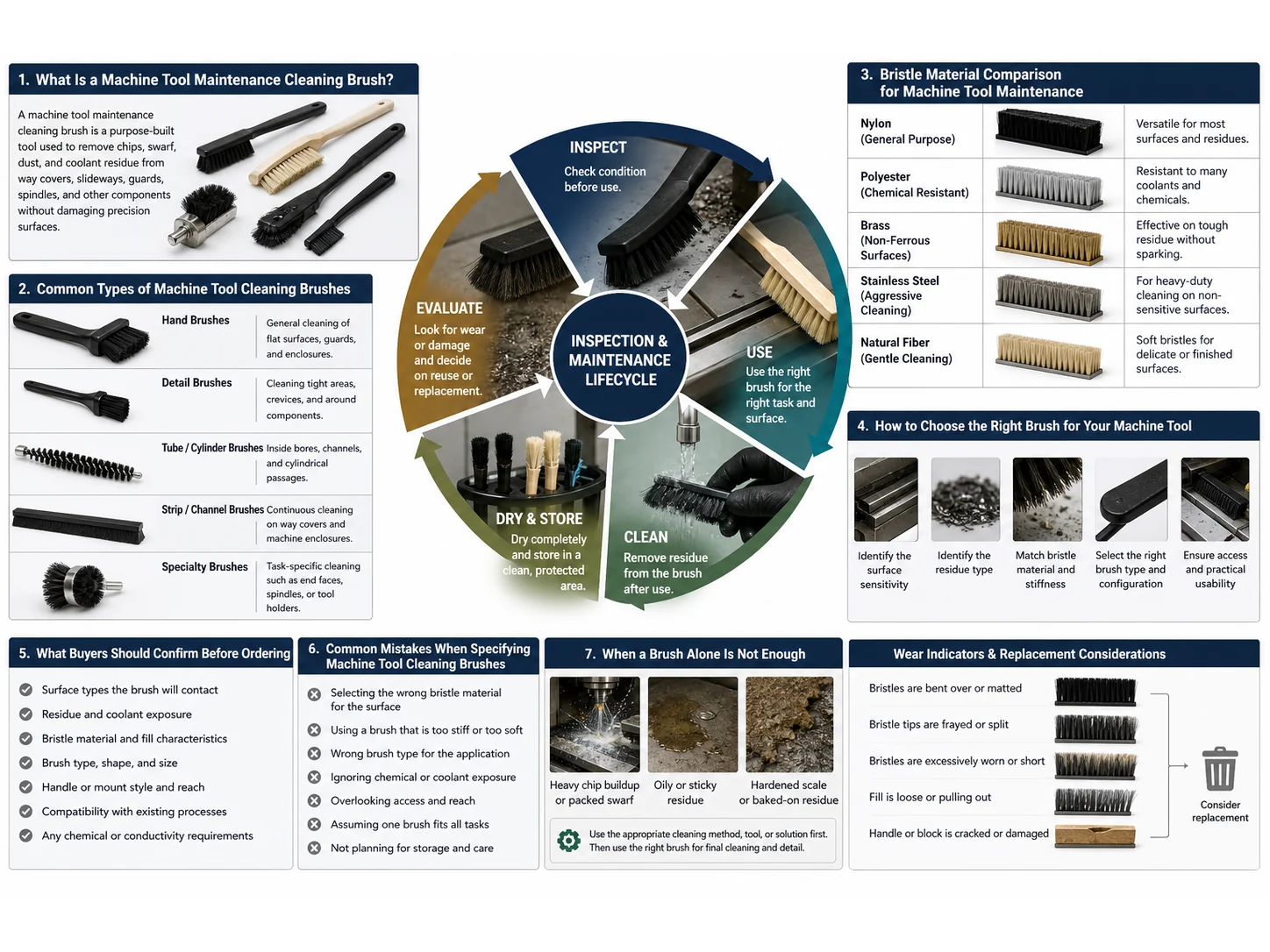
What Is a Machine Tool Maintenance Cleaning Brush?
A machine tool maintenance cleaning brush is a purpose‑designed tool that removes chips, swarf, cutting fluids, and abrasive residues from critical machine surfaces such as guideways, leadscrews, tool changers, spindles, and chip trays. Unlike general‑purpose cleaning brushes, these are engineered to work at production speeds, in wet or dry environments, and across a range of temperatures and chemical exposures while preserving surface integrity.
Common Types of Machine Tool Cleaning Brushes
Machine tool cleaning brushes are available in several basic configurations. Each style suits a specific contact geometry and cleaning method:
- Strip brushes and brush seals – mounted along edges or gaps to wipe off chips and prevent ingress onto sliding surfaces.
- Roller brushes – driven by the machine’s motion or an auxiliary motor to continuously clean conveyors, chip removal paths, or broad surfaces.
- Disc and cup brushes – used on power tools or dedicated cleaning stations to scrub localized areas such as spindle noses or tool tapers.
- Twisted‑in‑wire brushes – for cleaning internal bores, coolant passages, or small recesses where a flexible, radial reach is required.
- Tube and pipe brushes – designed to clean straight or curved internal channels without getting stuck.
- Custom profile brushes – built to follow complex surface contours, widely used in high‑volume automated cells.
Bristle Material Comparison for Machine Tool Maintenance
Bristle material determines how a brush performs on a given surface and under specific process conditions. The table below compares common choices for machine tool cleaning applications.
| Bristle Material | Surface Sensitivity | Dry / Wet Use | Temperature & Chemical Resistance | Typical Application |
|---|---|---|---|---|
| Nylon 6.6 / 6.12 (standard fill) | Medium | Both | Good in wet; moderate temperature (~80°C continuous, higher intermittent); fair resistance to common coolants | Light chip removal from cast iron or steel ways; general wiping |
| Abrasive nylon (silicon carbide or aluminum oxide impregnated) | Low – intentionally abrasive | Both, but dry preferred for maximum abrasive action | Similar temperature limits; abrasive action changes with lubricant | Deburring‑style cleaning on robust surfaces; removal of baked‑on residues |
| Polypropylene | Low – soft and gentle | Primarily wet | Low temperature (~70°C); excellent resistance to acids, alkalis, and many solvents | Soft wiper applications; chemical‑rich environments; polycarbonate guards |
| Horsehair / Tampico (natural fiber) | High – very gentle | Wet or damp | Low temperature; good wet flexibility but degrades in harsh chemicals | Delicate optical scales, precision granite surfaces, or where any scratching must be avoided |
| Brass (wire) | Low – harder than nylon but non‑sparking | Both | Good temperature range; can oxidize from certain cutting fluids | Stubborn chip removal from steel castings; conductive applications where static dissipation matters |
| Stainless steel (wire) | Very low – aggressive | Both, but dry avoids corrosion of wire | High temperature; excellent chemical resistance; food‑grade variants available | Heavy‑duty cleaning of robust machine structures; removal of built‑up coolant sludge |
How to Choose the Right Brush for Your Machine Tool
Use the following decision factors to narrow down brush options before requesting a quote or sample.
- Contact surface and sensitivity. Precision ways, linear rails, and optical scales require non‑abrasive filaments like soft nylon or natural fibers. Cast frames and chip chutes tolerate wire or abrasive nylon.
- Residue type. Long, stringy aluminum chips often snag on soft bristles – a stiff polypropylene or brass wire brush may strip them cleanly. Fine cast iron dust and coolant sludge call for dense filament packing and a material that resists loading.
- Dry or wet operation. Wet environments (flood coolant, washdown) demand filaments that do not swell, soften, or lose stiffness. Nylon absorbs moisture and can change dimension; polypropylene or wire alternatives may hold up better.
- Temperature and chemical exposure. In‑coming coolant at elevated temperatures, aggressive cleaning solutions, or proximity to hot chips narrows material choices. Refer to the table for thermal and chemical limits.
- Line speed and cycle time. Continuous brush‑to‑surface contact at high speed generates heat. Filament material, density, and trim length must be specified to avoid melting or premature wear.
- Installation space and mounting method. A brush that cannot be physically installed or replaced quickly will be neglected. Confirm whether the design allows clip‑on, press‑fit, bolt‑on, or adhesive‑backed strips, and whether maintenance access is adequate.
- Cleaning aggressiveness versus surface preservation. A more aggressive brush may clean faster but can roughen bearing surfaces over time. Always verify surface roughness requirements and, when possible, test with a prototype brush.
What Buyers Should Confirm Before Ordering
To avoid costly misunderstandings, compile the following information before approaching a brush manufacturer or distributor:
- Exact dimensions: overall length, brush face width, bristle trim length (free length), and backing profile (channel back, flat back, cylinder core, etc.).
- Mounting method: will the brush be clamped into a holder, screwed onto a shaft, glued into a groove, or mounted via a magnetic block? Include drawings or photographs of the mounting location.
- Reference to an existing sample or drawing: if replacing a machine-specific brush, provide the part number or a photograph along with measured specifications. Even a worn sample helps a supplier understand the intended cleaning result.
- Expected cleaning result: define what “clean” means – visually free of chips, residue thickness below a target, or functional test pass (e.g., no false tool‑change failure). This guides bristle density, material, and brush compliance.
- Process conditions: continuous run time versus intermittent cycling, exposure to cutting fluids, washdown chemicals, and temperature range.
Common Mistakes When Specifying Machine Tool Cleaning Brushes
- Choosing by cost or stock availability alone. A low-cost, off‑the‑shelf brush that damages a precision linear rail can cost thousands in downtime and replacement parts.
- Ignoring bristle material compatibility with coolants. Nylon brushes can swell in water‑based coolant and lose stiffness, reducing cleaning effectiveness.
- Overlooking filament density. Too sparse a fill leaves most chips behind; too dense may trap swarf and overload the drive or brush holder.
- Assuming one brush design fits all positions. The spindle nose, tool‑change gripper, and chip‑conveyor wiper require different trim lengths, backing hardness, and bristle types.
- Neglecting maintenance access. If a brush cannot be swapped in under two minutes, it will be ignored during shift changes, leading to gradual buildup and eventual machine faults.
- Skipping prototype testing. Laboratory cleaning simulations or short‑run trials with the actual contaminant reveal problems that a data sheet never will.
When a Machine Tool Maintenance Brush Is the Wrong Choice
Brushing is an effective mechanical cleaning method, but it has limits. Consider combining a machine tool cleaning brush with one or more complementary processes in these situations:
- Fine dust or airborne particulate. Use a vacuum extraction hood alongside the brush to capture sub‑micron dust that would otherwise settle onto sensitive surfaces.
- Sticky, high‑viscosity residues. A scraper blade or a pre‑spray solvent rinse can break the bond before the brush removes the remaining film.
- High‑speed continuous cleaning. An air knife positioned after the brush blows off loosened debris and coolant droplets, preventing re‑contamination downstream.
- Tight internal passages (coolant galleries, blind holes). Combine mechanical brushing with a pressurized flush or ultrasonic cleaning to dislodge packed‑in swarf.
- Clean‑in‑place (CIP) environments where disassembly is impossible. A brush may be part of an automated cycle that also includes spray jets, chemical circulation, and drain phases.
- Exacting cleanliness standards for aerospace, medical, or semiconductor applications. After brushing, a validated purification step (ultrasonic, chemical passivation, or high‑pressure water jet) may be needed to meet particle test result or surface tension specifications.
Final Takeaway
A machine tool maintenance cleaning brush is not a generic consumable – it is a precision component that protects your machine’s accuracy and reliability. Start with the surface you must protect and the residue you must remove, then select the bristle material and brush geometry that meet the operating conditions. Always verify a brush design through real‑world testing and confirm that the maintenance team can inspect and replace it quickly. When one cleaning method hits a boundary, design a system that pairs brushing with vacuum, air, or chemical assistance rather than expecting a single brush to do the whole job.
Frequently Asked Questions
Can I use the same brush for dry machining and wet coolant environments?
Probably not without design changes. Nylon bristles absorb moisture and soften in continuous wet service, reducing their mechanical scrubbing force. You may need a moisture‑resistant material like polypropylene or a stainless steel wire for wet areas, while the dry‑machining section could stay with standard nylon. Always verify with the manufacturer for your specific coolant chemistry.
What bristle material is safe for aluminum chips?
Aluminum chips tend to load and gall onto steel brushes, so stainless steel wire brushes are not always recommended. Many shops use stiff polypropylene or brass‑filled nylon for aluminum applications because the material releases the chip more readily and reduces the risk of scratching soft aluminum machine components.
How often should machine tool cleaning brushes be replaced?
There is no single interval; it depends on chip load, abrasive wear, and chemical attack. A good practice is to include brush inspection in the preventive maintenance calendar – look for flattening, bristle breakage, or permanent bending. Replace the brush when it no longer reaches the surface with the intended interference or when contamination bypasses the brush seal. Some facilities track brush life by part count or running hours and schedule proactive changes.
Is abrasive nylon safe for machine ways and linear rails?
Abrasive nylon filaments contain hard particles such as silicon carbide or aluminum oxide that can lap away precision surfaces over time. They are generally not recommended for coated ways, hardened rails, or ground mating surfaces unless the machine builder specifically approves it. For those surfaces, choose non‑abrasive nylon, polyester, or natural fibers that rely on bristle tip action rather than abrasive action.
What mounting method works best in a tight space?
In confined areas, look for brush strips with a narrow aluminum or stainless steel channel back that can be slid into a retaining slot. Magnetic‑backed strips also allow tool‑free placement on ferrous surfaces. If even those are too bulky, adhesive‑backed brush profiles exist, but they require a clean, dry, flat surface and may need periodic reapplication. Confirm the bead will not interfere with moving machine elements.
Should I test a sample brush before placing a full order?
Yes – testing with your actual contaminant, machine speed, and coolant is the most reliable way to confirm filament wear, cleaning effectiveness, and surface impact. A sample run of 50–200 parts with before‑and‑after inspection data (photos, dimensional checks, particle test results) provides objective evidence that the chosen brush meets the requirement.
How can I prevent bristles from shedding onto critical surfaces?
Bristle shedding often traces back to improper mounting, excessive interference (too deep a brush contact), or a trim length that is too long for the operating speed. Reducing interference slightly, selecting a denser filament pack, or switching to a crimped wire design (for wire brushes) can help. In cleanroom‑grade applications, consider encapsulated or fused‑end brushes that lock filaments in place. Regular inspection and replacement before severe wear sets in also minimize loose bristles.
Can a machine tool cleaning brush replace a coolant filtration system?
No. A brush removes chips and swarf from exposed surfaces; it does not filter fine particulates suspended in coolant. A properly sized filtration system – belt, drum, cartridge, or centrifuge – is still needed to maintain coolant quality and protect pumps, tools, and workpieces. The brush and filter work together: the brush keeps large chips out of the coolant return sump, and the filter handles what gets by.
Which bristle material fits this job — Nylon PA, Abrasive Nylon or AISI 304 Stainless Steel Wire?
| Material | Continuous temperature (°C) | Peak temperature (°C) | Water absorption | Hardness |
|---|---|---|---|---|
| Nylon PA | 93 | 121 | 0.3–9% by PA grade and conditioning | Medium to firm; filament diameter and trim length control bending force. |
| Abrasive Nylon | 120 | 150 | 0.1–1.0% | Abrasive filament; stiffness and cutting level is controlled by PA base, grit type, grit size, filament diameter and trim height. |
| AISI 304 Stainless Steel Wire | 400 | 500 | 0% | Rockwell B 70–95 depending on temper and cold work |
| Brass Wire | 150–200 | 250–300 | 0% | Rockwell B 40–90 |
Figures as published by Brushtec / DuPont; Perlon; Alleima. Confirm the exact grade against the supplier datasheet before ordering.
What should replace Nylon PA when it stops working?
- Nylon PA — Compare Nylon PA with PP, PBT, PET. Change material when wet stiffness, temperature, chemical resistance, conductivity, particle shedding, or surface marking becomes the limiting factor.
- Abrasive Nylon — Compare Abrasive Nylon with PP, PBT, PET. Change material when wet stiffness, temperature, chemical resistance, conductivity, particle shedding, or surface marking becomes the limiting factor.
- AISI 304 Stainless Steel Wire — Use AISI 316 stainless steel wire for chloride, marine, dairy, beverage, chemical washdown, or higher pitting-resistance requirements. Use carbon steel for dry aggressive cutting and brass or abrasive nylon for lower marking risk.
- Brass Wire — Compare Brass Wire with Steel wire, stainless wire, nylon. Change material when wet stiffness, temperature, chemical resistance, conductivity, particle shedding, or surface marking becomes the limiting factor.