
What Is an Oil Pipe Rust Removal Brush?
An oil pipe rust removal brush is a rotary tool accessory made with metal wire bristles arranged in a specific form factor (tube, cup, or wheel) to mechanically remove corrosion from pipeline components. It is driven by a power tool—typically a drill, die grinder, or angle grinder—and is selected based on the surface geometry, parent metal, and the level of rust present.
Three Main Brush Types for Oil Pipeline Work
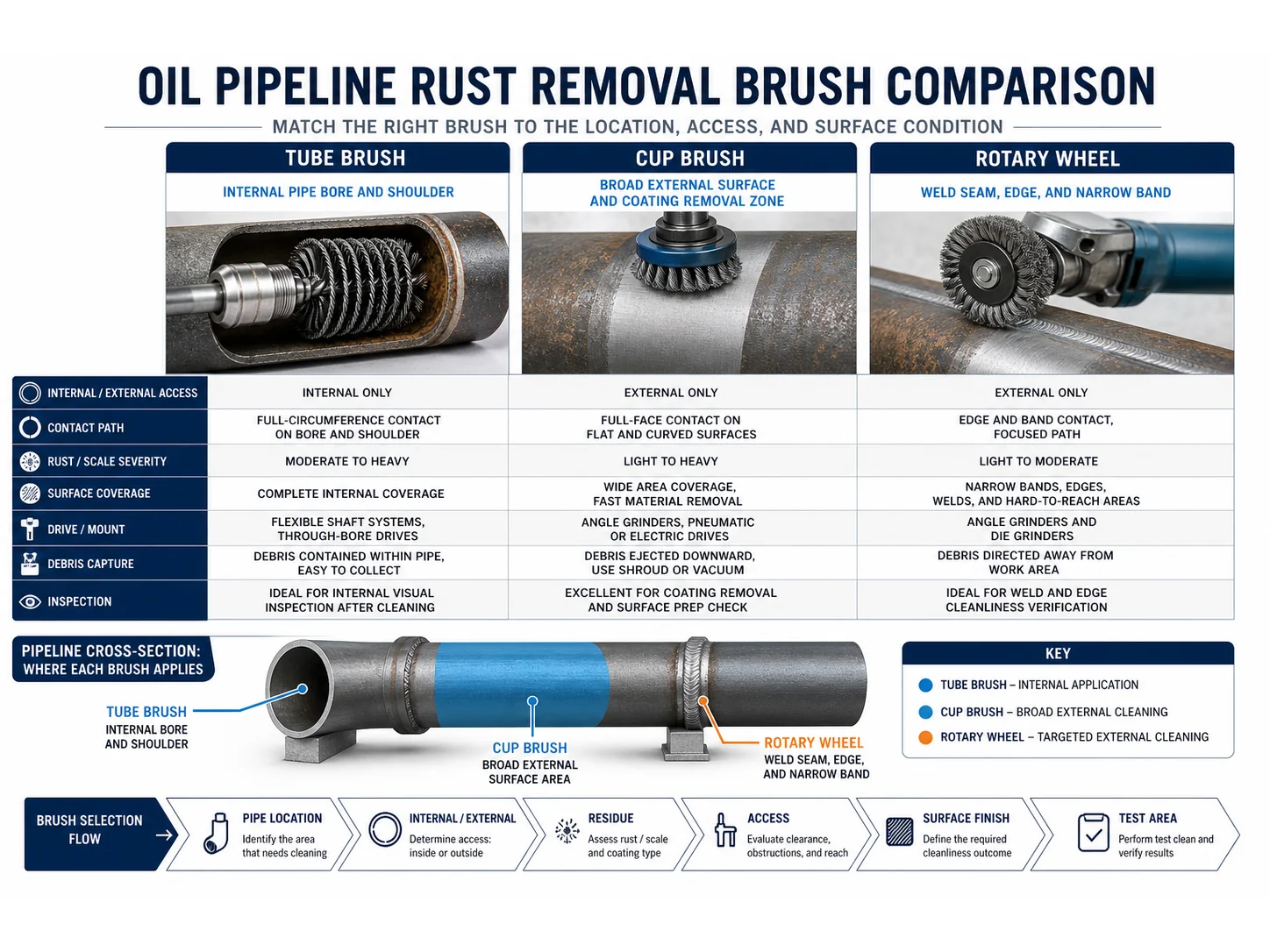
- Tube Brush (Internal): Cylindrical bristles wrapped around a stem; used to clean the inside of pipe bores, small openings, and threaded ends. Fits into a drill or air tool and is pushed through the pipe in a linear or oscillating motion.
- Cup Brush (Fittings and End Prep): Bristles radiate from a central cup. Ideal for bevel ends, flange faces, elbows, and irregular contours where a wire wheel cannot reach. Works best on angle grinders.
- Rotary / Wheel Brush (External): A flat, wheel-shaped brush that excels at large, smooth outside diameters—long runs of straight pipe, tank shells, and structural members. Run on bench grinders, handheld angle grinders, or dedicated pipe cleaning machines.
| Brush Type | Best For | Power Tool | Typical Wire Materials |
|---|---|---|---|
| Tube brush | Internal bore, threads, small holes | Drill, die grinder, air motor | Carbon steel, stainless, brass, nylon abrasive |
| Cup brush | Flange faces, fittings, inside corners | Angle grinder (4.5–7″), drill | Carbon steel (crimped/twisted), stainless, brass |
| Rotary wheel brush | Large OD pipe, flat surfaces | Angle grinder, bench grinder, pipe belt sander | Carbon steel, stainless, abrasive-impregnated nylon |
Wire Material: Carbon Steel vs Stainless vs Brass
| Wire Material | Hardness & Aggression | Corrosion Risk | Best Application | Avoid Using On |
|---|---|---|---|---|
| Carbon steel | High; fast stock removal | Leaves rustable dust; can cause after-rust rapidly if not recoated | Bare steel pipe that will be painted or coated immediately; heavy mill scale | Stainless steel or aluminum pipe; wet environments |
| Stainless steel | Moderate; good cutting but less friable | Non-rusting; safe for corrosion-resistant alloys | Stainless steel pipe, duplex, chrome-moly; any job where carbon steel contamination is forbidden | Very light cleaning where brass or nylon would suffice |
| Brass (non-sparking) | Soft; gentle on base metal | Will not spark; non-corrosive | Non-ferrous pipe, copper, brass, galvanized coatings, explosive atmospheres | Heavy rust or thick scale that requires aggressive cutting |
Speed and Feed Recommendations for Effective Rust Removal
Wire brushes work best when bristles impact the surface at the correct tip speed. As a rule, run the brush at the speed that lets the wire tips do the cutting—excessive RPM overheats bristles, causing premature failure and possibly embedding broken wires in the pipe. Use these starting guidelines for carbon steel wires (adjust downward for stainless or brass):
- Tube brushes: 1,200–2,800 RPM for power tube brushes up to 2 inches diameter; smaller hand brushes run at 500–1,200 RPM with light feed pressure.
- Cup brushes (4–5 inch): 6,000–9,000 RPM on angle grinders. Keep the brush moving; do not dwell on one spot.
- Rotary wheel brushes (6 inch): 3,500–5,000 RPM standard. Wide-face wheels can be run up to 6,000 RPM if the wire knot is properly balanced.
Feed pressure: Use the weight of the tool plus a light push. Over-pressing reduces brushing action and bends bristles permanently. Let the wire tips strike the pipe surface and recoil; that spring action peens away rust. If you see wire tips breaking off in clumps, reduce speed and feed pressure.
Common Mistakes When Using Rust Removal Brushes
- Using carbon steel wire on stainless pipe: Implants free iron that rusts later (rouge contamination). Always use a stainless or dedicated nylon abrasive brush for stainless steel.
- Running a cup brush too fast: Over-speeding fuses bristle tips and kills cutting power. Follow the manufacturer’s maximum safe RPM on the brush shank or packaging.
- Ignoring brush rotation direction: Some tube brushes are directional; running them in reverse twists the knot and reduces cleaning effectiveness.
- Reusing an oil-contaminated brush: Oil and grease on the wire body smear rust onto the surface. Replace or solvent-clean the brush first.
- Skipping a test patch on alloy pipe: Always test on a scrap or inconspicuous area to avoid surface scoring or embedding copper from brass brushes into soft alloys.
When a Chemical Rust Remover Is Preferred
Mechanical brushes are fast but can remove too much base metal, stress the pipe skin, or leave a roughened anchor profile that needs extra coating. A chemical rust remover (converter or chelating agent) is often a better choice when:
- The pipe wall thickness is thin and aggressive brushing could gouge or weaken the wall.
- Precision internal geometry (valve seats, compressor internals) cannot tolerate any dimensional change.
- Rust exists inside crevices, threaded areas, or under gaskets where a brush cannot physically reach.
- Stop-work conditions (hot work restrictions, explosive atmosphere) prohibit power brushing sparks.
- A rust converter is needed to stabilize flash rust before painting, and mechanical removal would leave active corrosion.
In many pipeline maintenance scenarios, a hybrid approach works best: use a tube or cup brush to knock off loose scale, then apply a chemical rust treatment to passivate the surface and remove the last red oxide.
Final Takeaway: Choosing the Right Brush for Your Pipeline Maintenance
Match the brush type to the surface you can access—tube brush for bores, cup brush for fittings, rotary wheel for open runs. Then match the wire material to the parent pipe metal and the end condition (will it be painted, welded, or left bare?). Start with moderate speed and light feed pressure, and always keep a stainless steel brush dedicated for stainless pipe. When in doubt, test on a scrap piece first.
Frequently Asked Questions
Can I use the same brush for carbon steel and stainless steel pipe?
No. A carbon steel brush will embed iron particles into stainless pipe and cause after-rust. Dedicate separate stainless wire brushes for stainless steel, or use a new brush each time.
How do I know when to replace a cup brush?
When the bristles shorten to less than half their original length, when the cup shows large bald spots, or when wires start snapping off in clusters. A worn brush cuts slower and can damage the angle grinder due to imbalance.
What speed should I use for a brass tube brush cleaning oil pipe threads?
Run brass wire tube brushes at 500–1,200 RPM with light pressure. Brass is softer and can “smear” onto threads at high speed; slower RPM keeps the bristles springy and effective without galling.
Is it safe to use a wire brush on a pipeline in an oil and gas facility?
Only if all hot work permits are in place and the area is gas-free. Standard carbon steel wire brushes generate sparks; in a potential flammable atmosphere use a brass or non-sparking brush and consult your site’s safety procedure.
Can I use a drill instead of an angle grinder for a cup brush?
Yes, many small cup brushes have a 1/4-inch shank that fits a drill. However, a drill’s lower RPM may be less effective, and the side load on the drill bearings can shorten tool life. For production cleaning, an angle grinder is preferred.
Do I need to use a lubricant with a power tube brush?
Not normally. Brush dry for mechanical rust removal. Adding lubricant can create a paste that clogs the bristles and hides the true surface condition. If you must use a lubricant to flush debris, choose a light, non-residue spray and thoroughly dry the bore afterward.
What’s the difference between crimped and twisted knot wire cup brushes?
Crimped wire brushes are more flexible and produce a smoother finish. Twisted knot brushes are aggressive and designed for heavy rust, scale, and weld cleaning. For oil pipe flange prep, twisted knot is common; for light surface refinement, crimped wire is better.
When should I use a chemical rust remover instead of a wire brush?
Use a chemical remover when the pipe is very thin, contains internal crevices a brush can’t reach, or when you need to prevent any spark generation. Also consider it if you want to leave a rust-inhibiting film on the surface after cleaning.
Technical References
Which bristle material fits this job — AISI 304 Stainless Steel Wire, Nylon PA or Carbon Steel Wire?
| Material | Continuous temperature (°C) | Peak temperature (°C) | Water absorption | Hardness |
|---|---|---|---|---|
| AISI 304 Stainless Steel Wire | 400 | 500 | 0% | Rockwell B 70–95 depending on temper and cold work |
| Nylon PA | 93 | 121 | 0.3–9% by PA grade and conditioning | Medium to firm; filament diameter and trim length control bending force. |
| Carbon Steel Wire | 200–300 | 350–450 | 0% | Rockwell C 40–60 |
| Brass Wire | 150–200 | 250–300 | 0% | Rockwell B 40–90 |
Figures as published by Alleima; Brushtec / DuPont. Confirm the exact grade against the supplier datasheet before ordering.
When is AISI 304 Stainless Steel Wire the wrong choice?
- AISI 304 Stainless Steel Wire — Avoid using AISI 304 as the default in marine, brine, hypochlorite, and persistent chloride environments; use AISI 316 when higher pitting and crevice-corrosion resistance is required.
- Nylon PA — The nylon family spans several grades, so heat, moisture and chemical limits should follow the selected PA resin rather than a generic nylon value.
- Carbon Steel Wire — Not for soft plastic, glass, PCB, coated solar glass or polished paint.
- Brass Wire — Avoid on stainless surfaces where copper contamination is restricted and on delicate coatings that mark under metal contact.
What should replace AISI 304 Stainless Steel Wire when it stops working?
- AISI 304 Stainless Steel Wire — Use AISI 316 stainless steel wire for chloride, marine, dairy, beverage, chemical washdown, or higher pitting-resistance requirements. Use carbon steel for dry aggressive cutting and brass or abrasive nylon for lower marking risk.
- Nylon PA — Compare Nylon PA with PP, PBT, PET. Change material when wet stiffness, temperature, chemical resistance, conductivity, particle shedding, or surface marking becomes the limiting factor.
- Carbon Steel Wire — Compare Carbon Steel Wire with Carbon steel wire, brass wire, abrasive nylon. Change material when wet stiffness, temperature, chemical resistance, conductivity, particle shedding, or surface marking becomes the limiting factor.
- Brass Wire — Compare Brass Wire with Steel wire, stainless wire, nylon. Change material when wet stiffness, temperature, chemical resistance, conductivity, particle shedding, or surface marking becomes the limiting factor.